2973
Diffusion kurtosis and intravoxel incoherent motion in predicting postpartum hemorrhage in patients at high risk for PAS disorders
Tao Lu1
1Sichuan Provincial People’s Hospital, Chengdu, China
1Sichuan Provincial People’s Hospital, Chengdu, China
Synopsis
Keywords: Placenta, Placenta
PAS is commonly associated with postpartum hemorrhage.DKI and IVIM were used to evaluate the placenta.The amount of bleeding during delivery was positively correlated with D, D*, f, and MD, but negatively correlated with MK.D and D* were significantly higher while MK was significantly lower in patients with PPH.A combination of placenta previa and D can be used to predict PPH in patients at high risk for PAS disordersINTRODUCTION
AS is commonly associated with postpartum hemorrhage (PPH) and its secondary complications including multisystem organ failure, disseminated intravascular coagulation, need for ICU admission, hysterectomy and even death. Recent functional MRI may provide information about placental function. DWI is a non-invasive MRI technique to provide microstructural and physiological information about tissues. IVIM is a bi-exponetial DWI model which aims to quantify perfusion and diffusion of the tissue. DKI is a non-Gaussian DWI model that is utilized to quantify the heterogeneity and cellularity of the tissueThe first purpose of this study was to investigate the correlation between IVIM and DKI parameters and the amount of bleeding intraoperatively. A second aim was to investigate whether IVIM and DKI parameters could be used to predict PPH in patients at high risk for PAS disorders.METHODS
During November 2018 and March 2022, a total of 109 patients were scanned with a DWI sequence and enrolled in the study. Evaluation of the DWI sequence was performed with research software (IMAgenGINE,vusion tech).All patients’whole placenta ROIs were drawn on each consecutive DWI with b=0 s/mm2 covering the whole placenta.The ADC,MD, MK, D, D*, and f values were automatically calculated, and the diffusion parameter maps were also automatically produced. A correlation analysis was used to characterize the correlation between DWI parameters and estimated blood loss during surgery.The Mann-Whitney U-test was also used to compare the difference in the DWI parameters of the whole placenta between patients with and without PPH. A multivariate logistic regression analysis with a forward stepwise procedure was used to determine the most significant risk factors in predicting PPH in patients at high risk for PAS disorders.Receiver operating characteristics (ROC) analyses were performed to evaluate the diagnostic performance of significant parameters.RESULTS
D, D*, f and MD were positively correlated with estimated blood loss (r=0.331, 0.389, 0.222 and 0.277, respectively, p<0.0001, <0.0001, =0.020 and 0.003, respectively), while MK was negatively correlated with it (r=-0.280, p=0.003) .DWI parameter comparisons showed D and D* were significantly higher (p=0.003 and 0.001, respectively) while MK was significantly lower in patients with PPH (P=0.006). Multiple logistic regression analysis showed placenta previa and D differed significantly between patients with and without PPH. The combination of the 2 risk factors showed the best overall performance, producing the highest sensitivity of 65%, specificity o f 81% and AUC of 0.795 .DISCUSSION
DKI is a non-Gaussian DWI model depicting non-Gaussian water movement with higher b values. DKI has been mainly adopted in tumors to quantify tissue heterogeneity and cellularity[1-4]. MD is the corrected diffusion coefficient for non-Gaussian bias and has a similar change to D as they are both diffusion-related coefficients. Therefore, MD is also positively correlated with estimated blood loss. In general terms, MK measures the deviation of tissue water molecules diffusion from a Gaussian distribution and can be altered by tissue complexity or cellular heterogeneity [5]. The moving blood may compromise the deviation of diffusion distribution from Gaussian form, thus resulting in the negative correlation between MK and estimated blood loss.The results demonstrated the increased diffusion motion of water molecules in the extracellular spaces and increased motion of blood water molecules in the capillary network , with decreased cellular heterogeneity in patients with PPH. In patients with higher risks of PAS disorders, preferential attachment of the blastocyst to scar tissue facilitates abnormally deep invasion of trophoblastic cells and subsequent neovascularization or dilation of the myometrial vasculature[6]. These possibly result in increased blood movement in the fetal capillaries and increased diffusion motion of extravascular water molecules within the placental villi in patients with PPH.DKI was introduced to describe water diffusion that deviates from the Gaussian law due to the complexity of the microenvironment, like cell membranes, vessels or macromolecules[7]. The application and interpretation of DKI in the placenta has not been delineated.MK has been supposed to represent the direct interaction of water molecules with the cell membrane and intracellular compounds[8]. As the motion of blood water molecules in the capillary network increased in patients with PPH, the membrane permeability also increased, resulting in decreased K value.Our study showed placenta previa and D are independent risk factors for predicting PPH. We further combined placenta previa and D together for predicting PPH in patients at high risk for PAS disorders. The sensitivity, specificity, PPV and NPV were 77.38%,69.83%, 65% and 81%, respectively, for the prediction of PPH with an AUC of 0.795. Placenta previa and D together performed better than placenta previa and D, D*, and K separately.Therefore, the combination of placenta previa and D could be used to identify patients with higher risk of PPH, the high-risk patients then can be managed with careful planning and additional blood product preparation to potentially reduce maternal mortality.CONCLUSION
IVIM and DKI parameters were correlated with estimated blood loss in patients at high risk for PAS disorders. D and D* were significantly higher and MK was significantly lower in patients with PPH. A combination of placenta previa and D can be used to predict PPH in patients at high risk for PAS disorders.Acknowledgements
No acknowledgement found.References
1 Xiao Z, Zhong Y, Tang Z, et al. Standard diffusion-weighted, diffusion kurtosis and intravoxel incoherent motion MR imaging of sinonasal malignancies: correlations with Ki-67 proliferation status. European Radiology, 2018, 28:2923–29332 Cui Y, Yang X, Du X, et al. Whole-tumour diffusion kurtosis MR imaging histogram analysis of rectal adenocarcinoma: Correlation with clinical pathologic prognostic factors. Eur Radiol 2018, 28:1485–14943 Ding Y, Tan Q, Mao W, et al. Differentiating between malignant and benign renal tumors: do IVIM and diffusion kurtosis imaging perform better than DWI? European Radiology ,2019, 29:6930–69394 Wan Q, Deng Y, Lei Q, et al. Differentiating between malignant and benign solid solitary pulmonary lesions: are intravoxel incoherent motion and diffusion kurtosis imaging superior to conventional diffusion-weighted imaging? European Radiology ,2019,29:1607–16155 Jensen JH, Helpern JA, Ramani A et al. Diffusional kurtosisimaging: the quantification of non-gaussian water diffusion bymeans of magnetic resonance imaging. Magn Reson Med , 2005,53:1432–14406 Jauniaux E and Burton GJ.Pathophysiology of Placenta Accreta Spectrum Disorders: A Review of Current Findings.Clin Obstet Gynecol. 2018 Dec;61(4):743-754. 7 Jensen JH, Helpern JA. MRI quantification of non-Gaussianwater diffusion by kurtosis analysis. NMR Biomedicine, 2010, 23:698–7108 Rosenkrantz AB, Padhani AR, Chenevert TL, et al. Body diffusion kurtosis imaging: Basic principles, applications, and considerations for clinical practice. J Magn Reson Imaging 2015;42(5):1190-1202.Figures
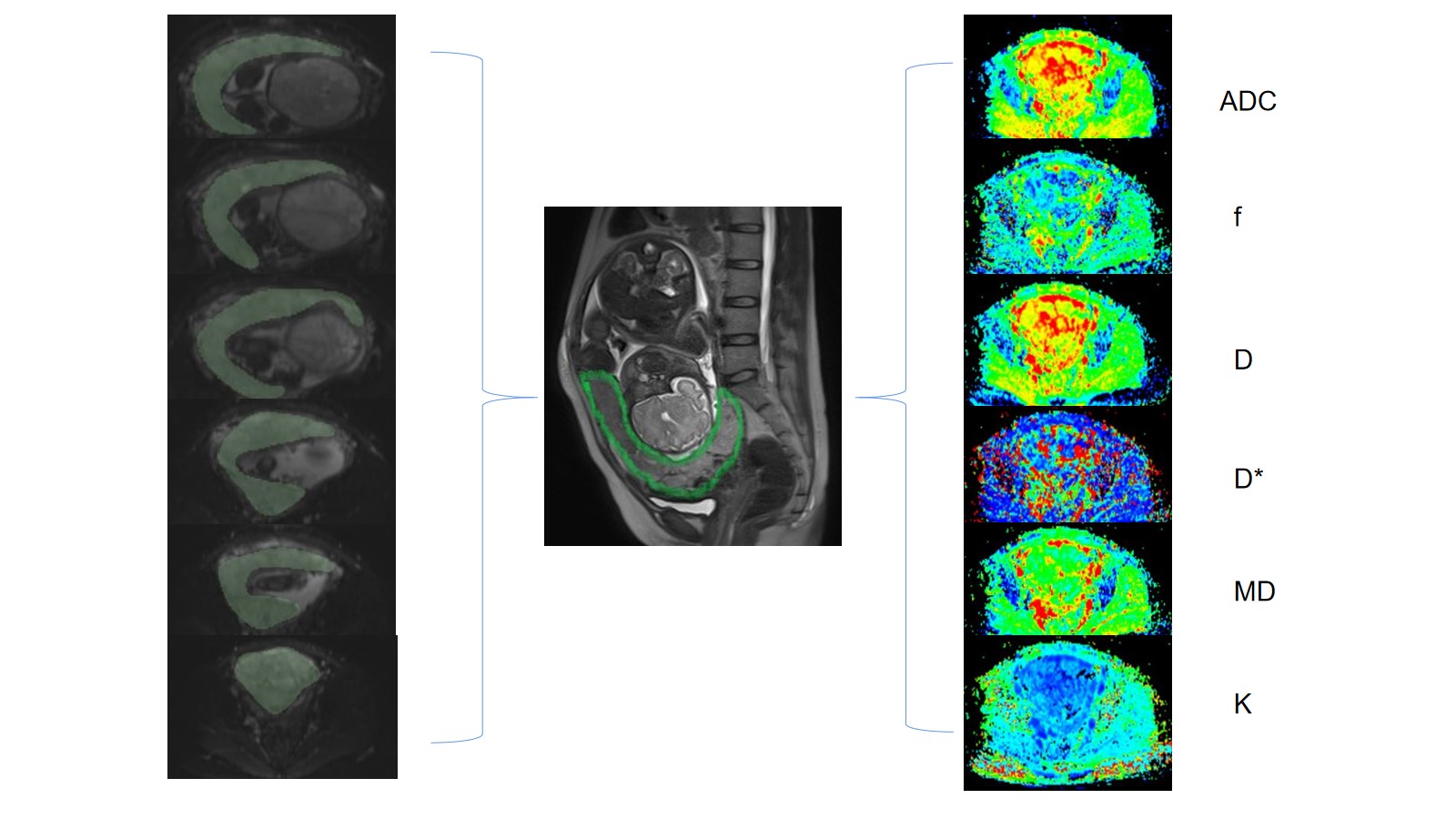
The schematic illustration of ROIs of the placenta.The ROIs were drawned covering the whole placenta and the diffusion parameter maps were automatically produced.
DOI: https://doi.org/10.58530/2023/2973