2886
Effects of SMS accelerating factor on stability of radiomics features from quantitative parametric maps of IVIM and DKI in Cervical Cancer1Department of Radiology, Hubei Cancer Hospital, Tongji Medical College, Huazhong University of Science and Technology, Wuhan, China, 2School of Biomedical Engineering, South-Central Minzu University, Wuhan, China, 3MR Scientific Marketing, Siemens Healthcare, Wuhan, China, Wuhan, China, 4MR Application Predevelopment, Siemens Healthcare GmbH, Erlangen, Germany, Erlangen, Germany, 5Department of Gynecology, Hubei Cancer Hospital, Tongji Medical College, Huazhong University of Science and Technology, Wuhan, China
Synopsis
Keywords: Radiomics, Cancer, Cervical Cancer
The aim of this study was to explore the effects of SMS on radiomics features in quantitative parametric maps based on IVIM and DKI models. Meanwhile, the effects of whole-tumor and maximal-tumor layer delineation on radiomics features were compared, whether stable features are associated with clinical staging of cervical cancer was analyzed. The results showed that SMS had the greatest effect on features extracted from D* and f map from IVIM model and the least effect on features extracted from ADC map; SMS had a greater effect on the radiomics features extracted by maximum-tumor layer delineation than by whole-tumor delineation.Main findings
Both SMS and the tumor delineation method have different effects on radiomics features based on IVIM and DKI models in cervical cancer.Introduction
Cervical cancer is one of the most common malignant tumors of the female reproductive system [1]. Accurate staging of cervical cancer has guiding significance in selection of treatment plan and evaluation of prognosis. At present, radiomics studies based on IVIM and DKI models have been used for preoperative staging and efficacy assessment of cervical cancer[2]. However, the common acquisition time of both IVIM and DKI is relatively long. The SMS technique enables simultaneous acquisition of multi-slice data to reduce acquisition time [3]. However, the effect of SMS on radiomics features extracted from IVIM and DKI maps has not yet been reported. Therefore, this study aimed to explore the effect of different SMS accelerating factors on radiomics features extracted from IVIM and DKI maps through whole-tumor and maximal tumor layer delineation.Methods
Forty patients with pathologically confirmed cervical cancer were prospectively enrolled in this study, and all patients underwent routine pelvic examination and multi-b-values DWI on a 3T MR scanner (MAGNETOM Skyra; Siemens Healthcare, Erlangen, Germany) before treatment. Routine examinations included sagittal T2WI, axial T1WI, axial T2 fat suppression and contrast-enhanced sagittal and axial T1WI. Multi-b-values DWI employs a single shot echo planar sequence, as shown in Table 1. Among them, b-values ranging from 0 to 800 s / mm2 were used for IVIM model, from 200 to 2000 s / mm2 for DKI, and only 0 and 800 s / mm2 for ADC. The parameters ADC, IVIM_ D, IVIM _ D*, IVIM_f, DKI_ MD, and DKI _MK were calculated using the research application MR Body Diffusion toolbox (Siemens Healthcare, Erlangen, Germany). Referring conventional sequences, whole-tumor and maximal tumor layer delineation was performed by radiologist 1 (with 10 years of work experience) on the b = 800 s / mm2 map in S1 sequence, and another radiologist (with 15 years of experience) confirmed. Bleeding and necrotic areas were avoided. Then, the outlined ROIs were copied into quantitative parametric maps for all sequences (S1 ~ S3). Quantitative parametric maps generated by all sequences were used to extract radiomics features with Pyradiomics software. A total of 93 features were extracted from the six categories, including firstorder, GLCM, GLRLM, GLSZM, NGTDM, and GLDM. The stability of radiomics features was evaluated by the coefficient of variation (COV) and concordance correlation coefficient (CCC) among different sequences. The grades of COV were classified as: excellent (COV ≤ 5%), good (5% < COV ≤ 10%), moderate (10% < COV ≤ 20%), poor (COV > 20%); The CCC were graded: excellent (CCC ≥ 90%), good (75% ≤ CCC < 90%), moderate (50% ≤ COV < 75%), poor (COV < 50%). Features meeting both COV ≤ 10% and CCC≥ 90% were defined as stable features.Results
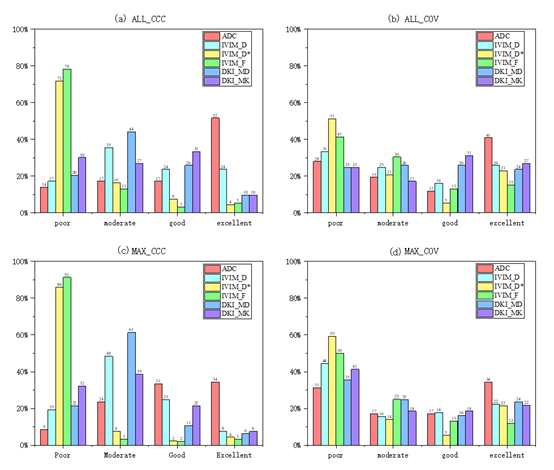
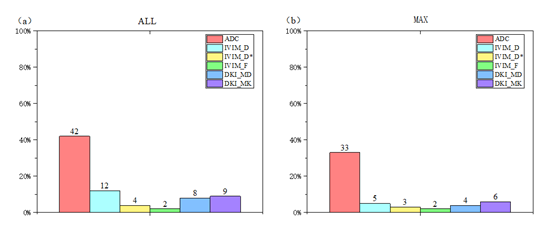
Figure 1 shows the mean proportion of COV and CCC among quantitative parametric maps of IVIM and DKI delineated from whole-tumor and maximum layers at different accelerating factors. SMS has the greatest effect on D * and f features and the least effect on ADC features based on the largest proportion of CCC and COV of poor groups and excellent groups, respectively. Meanwhile, the plexus as a whole trended that SMS had a greater impact on the radiomics features extracted from the maximum layer delineation than the whole-tumor delineation. Figure 2 shows the number and ratio of the stable features in the whole-tumor and maximum layers.Discussion
Alterations in imaging parameters not only affect the quality of the images but may also have potential effects on the intrinsic radiomics features of images. Previous study showed that the increase of the SMS accelerating factor leads to a decrease in image signal-to-noise ratio [5]. In this study, SMS showed the largest effect on D* and f-plot features. The reason may be that D* represents the slope of the fitted part of the curve at low b-values in IVIM (b<200 s/mm2), whereas SMS showed a slight signal intensity change at low b-value plots resulting in a steep change of the slope, which in turn caused a significant change in D* plots resulting in a significant effect on the features; Whereas f-map represents the fraction of the total diffusion coefficient due to microcirculation alterations in diffusion coefficient, which is highly correlated with D*, so SMS also has a large effect on f-map features. Whereas the other quantitative parameters were fitted with relatively high b-values, SMS had relatively little effect on the results of the fit, and therefore on the features. It has been reported that SMS had no effect on ADC value measurement [5], and thus more stable features were exhibited in ADC maps in this study. Meanwhile, the whole-tumor delineation in this study can provide more stable features than the maximum layer delineation, and is less susceptible to SMS, which indicates that the whole-tumor delineation can more represent the heterogeneity of tumors.Conclusion
This study shows that both SMS and the tumor delineation method have different effects on radiomics features in cervical cancer based on IVIM and DKI. This should be taken into consideration when setting-up multi-center radiomics studies.Acknowledgements
No acknowledgement found.References
[1] Bray F, Ferlay J, Soerjomataram I, et al. Global cancer statistics 2018: GLOBOCAN estimates of incidence and mortality worldwide for 36 cancers in 185 countries[J]. CA: a cancer journal for clinicians, 2018, 68(6): 394–424.
[2] Liu Z, Wang S, Dong D, et al. The Applications of Radiomics in Precision Diagnosis and Treatment of Oncology: Opportunities and Challenges[J]. Theranostics, 2019, 9(5): 1303–1322.
[3] Setsompop K, Gagoski B A, Polimeni J R, et al. Blipped-controlled aliasing in parallel imaging for simultaneous multislice echo planar imaging with reduced g-factor penalty[J]. Magnetic Resonance in Medicine, 2012, 67(5): 1210–1224.
[4] Ohlmeyer S, Laun F B, Palm T, et al. Simultaneous Multislice Echo Planar Imaging for Accelerated Diffusion-Weighted Imaging of Malignant and Benign Breast Lesions[J]. Investigative Radiology, 2019, 54(8): 524–530.
[5] Filli L, Ghafoor S, Kenkel D, et al. Simultaneous multi-slice readout-segmented echo planar imaging for accelerated diffusion-weighted imaging of the breast[J]. European Journal of Radiology, 2016, 85(1): 274–278.
Figures