2869
A Modular Parallel Radiofrequency Transmission System Platform for MRI Safety Investigations at 3 T
Benson Yang1, Fred Tam1, Maryam Arianpouya2, Cathleen Leone1, Vicki Li1, Jason Rock2, and Simon Graham1,2
1Physical Sciences, Sunnybrook Research Institute, Toronto, ON, Canada, 2Medical Biophysics, University of Toronto, Toronto, ON, Canada
1Physical Sciences, Sunnybrook Research Institute, Toronto, ON, Canada, 2Medical Biophysics, University of Toronto, Toronto, ON, Canada
Synopsis
Keywords: RF Arrays & Systems, New Devices
Parallel radiofrequency transmission (pTx) continues to show great promise in resolving MRI challenges at higher magnetic field strengths. Commercial pTx MRI systems can be very costly with limited system channel count options. This work presents the current state of an 8-channel pTx MRI system with expansion flexibility up to 32-channels that is based on software-defined radio technology.Introduction
Parallel radiofrequency (RF) transmission (pTx) has experienced rapid advancement in recent years. Major magnetic resonance imaging (MRI) manufacturers have released pTx systems and continue to invest in the technology at clinical field strengths and ultra high field strengths. At present, pTx systems of up to 64-channels have been reported in the literature1 and up to 16-channels are commercially available. An optimal one-fit-all pTx system solution capable of addressing a wide range of clinical challenges remains unclear and thus, it is important for researchers in the field to investigate various implementations. However, prototyping pTx systems can be challenging, costly and MRI vendor-specific. The present work reports on the current state of a practical modular pTx platform under development at our institution for MRI safety investigation at 3 T.Method
The pTx platform under construction follows the design principles presented in our 4-channel pTx setup2 that was integrated onto an existing 3 T MRI system (Magnetom Prisma, Siemens, Erlangen, Germany). Currently, an 8-channel system build is in-progress and is discussed in this work, which is preliminary towards an eventual 32-channel pTx system that will be also configurable for 8-, 16- and 24-channel pTx MRI. Fig. 1 displays the overall pTx system design and hardware device organization at our facility. In the magnet room, a custom 8-channel transmit-receive (TR) switch (1 of 4 switches) designed and developed in collaboration with Stark Contrast (Erlangen, Germany) splits the original MRI RF source into a dummy load and is the primary interface between the add-on pTx system and the existing MRI system. In the equipment room, two synchronized 4-channel software-defined radio (SDR) units (Crimson TNG., Per Vices, Toronto, Canada) amplified by four 2-channel RF power amplifiers (RFPA) (BT00500-AlphaSA-6751, Tomco Technologies, Stepney, Australia) are used to generate, modulate, and amplify the RF waveforms that travel through a custom penetration panel back to the TR switch for connection to a custom 8-channel coil situated on the patient table. The timing of the pTx MRI system is completely managed by the MRI system, by converting the optical unblanking signal into compatible signals for triggering the SDR and RFPA units. For safety, all digital and analog status signals on the RFPAs are monitored, and an automated safety shutdown is controlled by a field-programmable-gate-array console unit (NI-USB-7845R, National Instruments, Austin, United States) for speed and reliability. The status information of each amplifier is communicated to the user through a graphical interface and computer in the console room. The user panel allows control of the RFPAs with an override function for emergency shutdown. For add-on pTx systems such as this, cable assembly design is important for practical reasons. Here, we designed custom connection plugs using commercially available products from Harting Technologies (Espelkamp, Germany) for all our interconnections between the two systems.Results
The following figures present our 8-channel pTx MRI system in its current stage of development. Fig. 2 displays the user front panel developed for safety monitoring. Fig. 3 (a) is a layout of the system connection points that integrate the pTx and MRI systems and (b) is a photograph of an assembled TR switch. Fig. 4 is a photograph of the custom 8-channel pTx head coil.Discussion and Conclusion
This work presented the current state of an 8-channel pTx system development with a future expansion to 32-channels. The major system components are described in this work and are primarily in the prototype stages of development. Much more work remains that includes safety panel upgrades to support 8-channel monitoring and specific-absorption-rate data, pulse sequence development pertinent to imaging safety applications and MRI experiments.Acknowledgements
No acknowledgement found.References
[1] Feng et al., A 64-channel transmitter for investigating parallel transmit MRI. IEEE Trans Biomed Eng. 2012;59(8):2152-2160. doi:10.1109/TBME.2012.2196797
[2] Yang et al., A Platform for 4-Channel Parallel Transmission MRI at 3 T: Demonstration of Reduced Radiofrequency Heating in a Test Object Containing an Implanted Wire. J. Med. Biol. Eng. 2019;39:835-844. doi:10.1007/s40846-019-00478-7
Figures
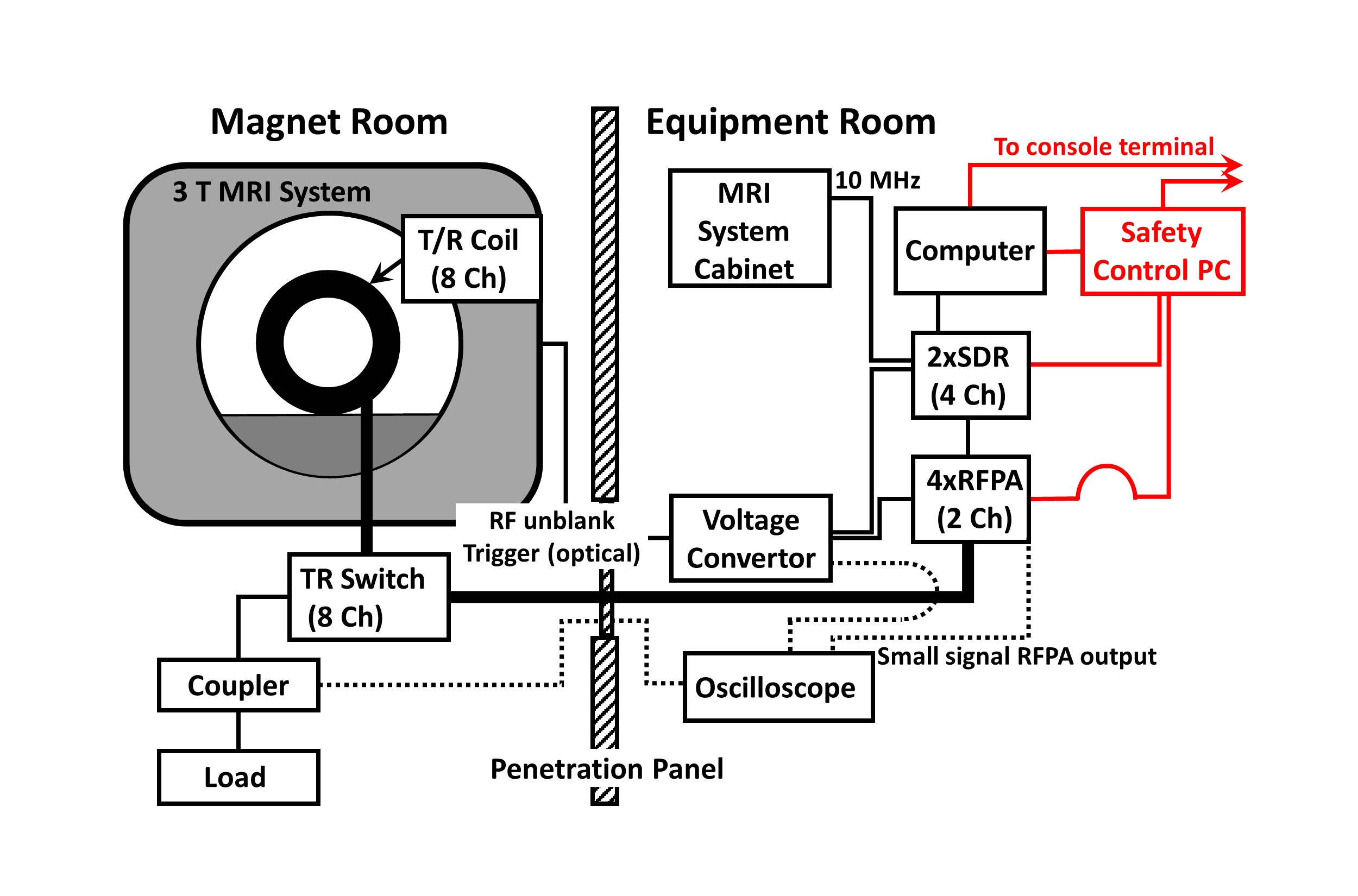
Fig. 1: The
8-channel pTx MRI system design and hardware device organization.
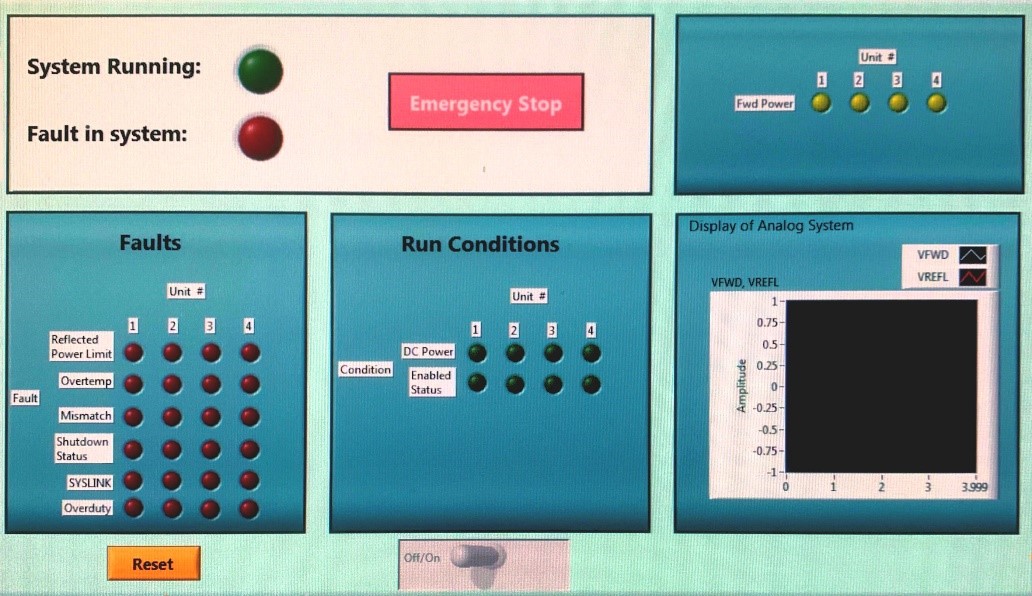
Fig. 2: The
prototype safety monitoring user front panel.
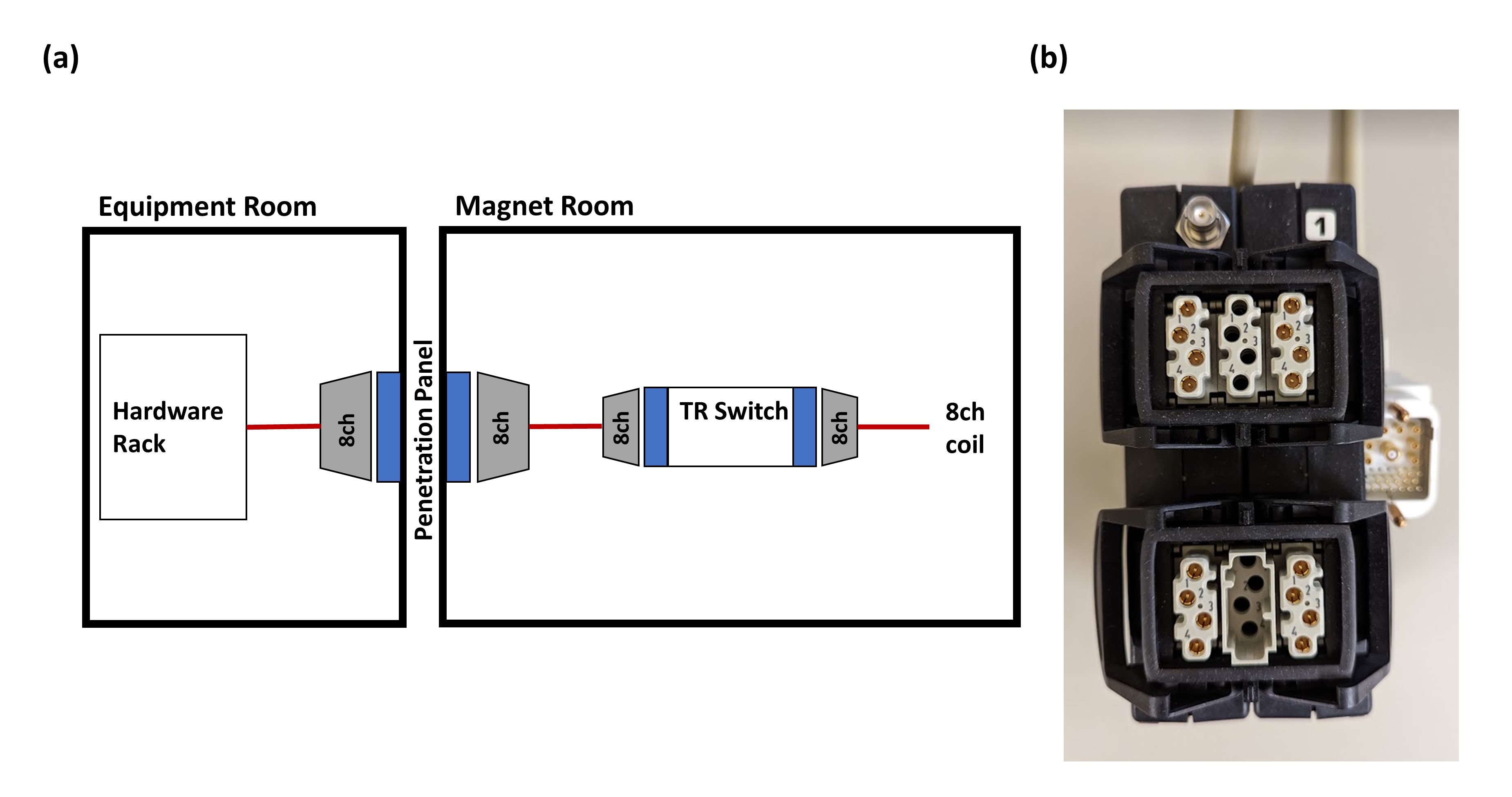
Fig. 3: (a) The
8-channel pTx MRI system cable connection layout and (b) a photograph of an assembled TR
switch.
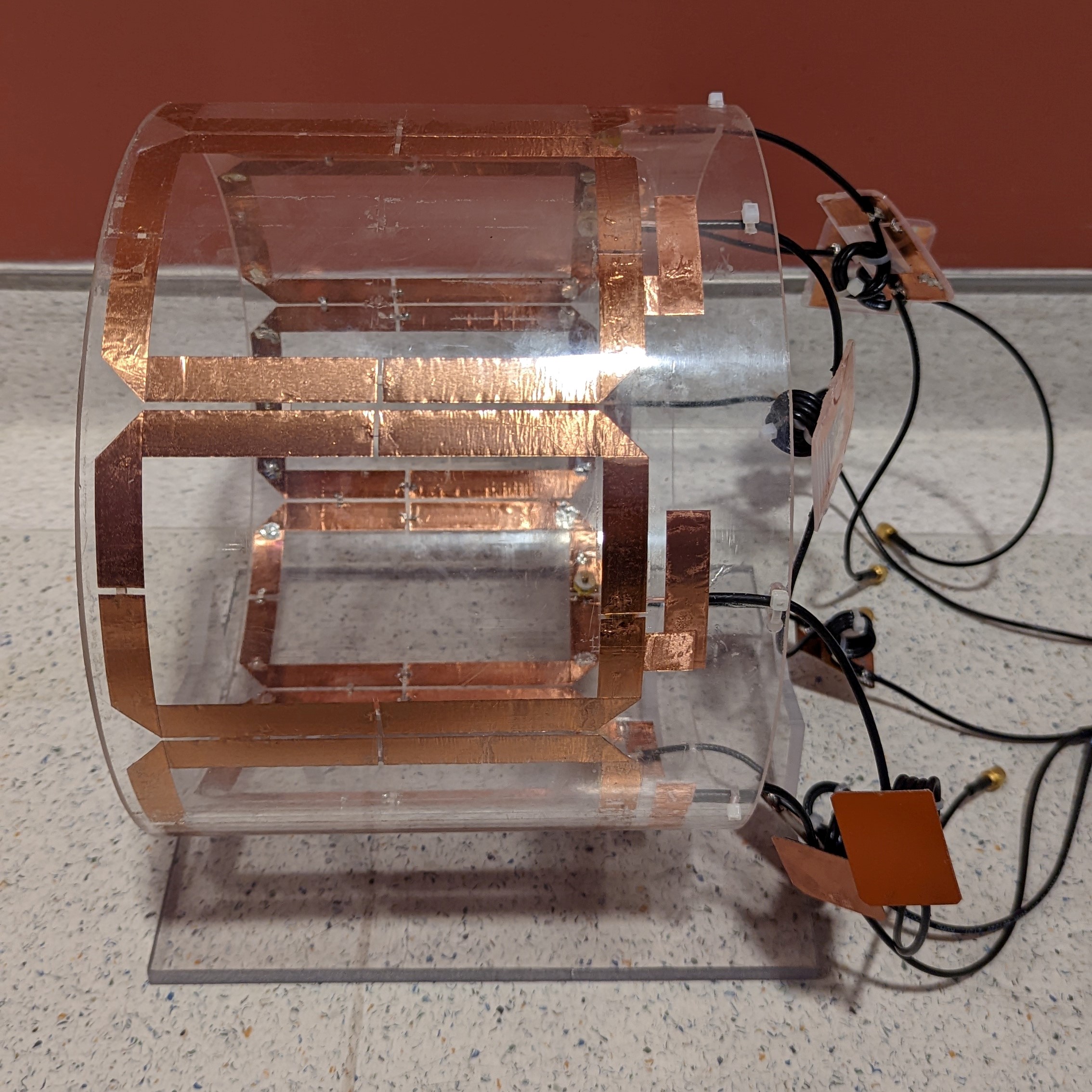
Fig. 4: The
8-channel pTx head coil.
DOI: https://doi.org/10.58530/2023/2869