2678
Multimodal neuroimaging data reveal intelligence-specific neurobiological correlates1Department of Radiology, Xiang’an Hospital of Xiamen Uneversity,School of Medicine, Xiamen University, Xiamen, China
Synopsis
Keywords: Brain Connectivity, fMRI (resting state)
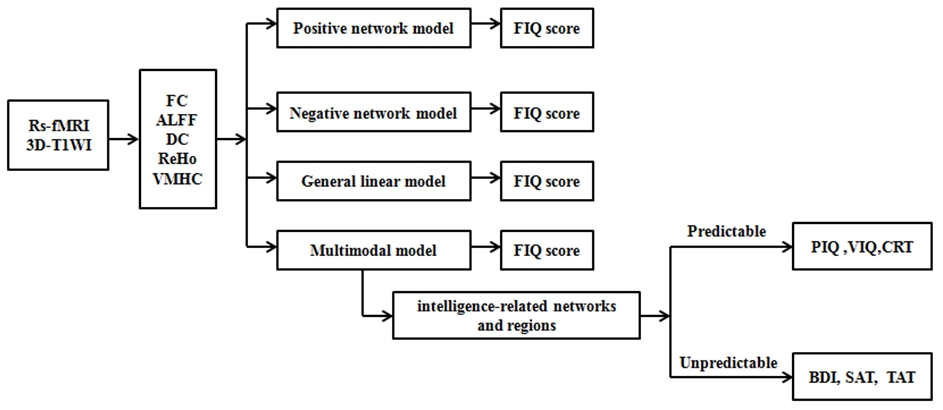
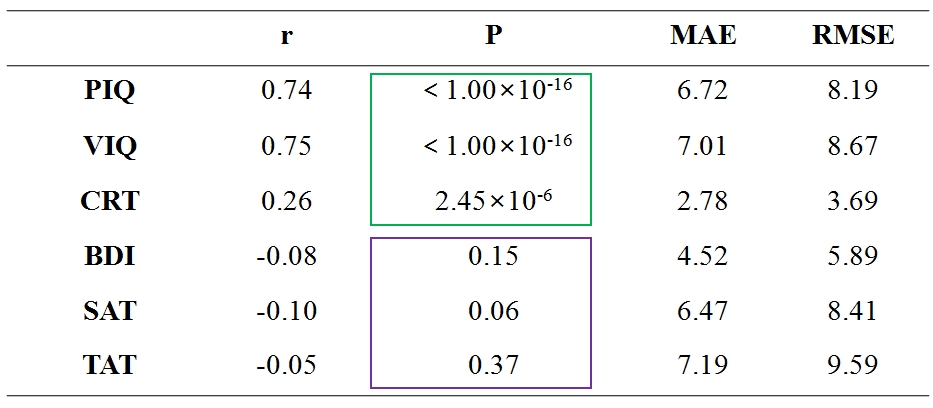
We used Brainnetome 246 atlas to construct FC matrices and extract image features from ALFF, DC, ReHo and VMHC maps.The classical CPM method using FC data and the combination model using multimodal data were constructed to predict FIQ scores. We found the combination model outperformed either classical models. Similar results were found with the Shen 268 atlas. The functional networks and regions related to intelligence mainly included intrafrontal, frontoparietal, frontotemporal and temporoparietal networks.The models constructed with the intelligence-related networks and regions could predict PIQ, VIQ, and CRT scores well, but not BDI, SAT, and TAT scores.Introduction
Intelligence has always been the focus of neuroscience and psycho scientific researchers. Intelligence tests are time consuming and require professional practitioners to perform them. The neural mechanisms of intelligence are not well understood1-3. Neuroimaging-based machine-learning techniques provide tools for the diagnosis, prediction, and pathogenesis of neuropsychiatric disorders4-6. Multimodal data can provide complementary information, potentially improve the performance of machine learning models, and more comprehensively reflect the pathological basis of diseases7,8. Connectome-based predictive modeling (CPM) is widely used because of its simplicity, low arithmetic requirements, and explanatory properties3,9,10. In this study, we aimed to investigate whether CPM based on multimodal neuroimaging data can improve the performance of intelligence prediction models, and to explore the underlying neurobiological mechanisms of intelligence.Methods
Data from two independent centers were included in this study. Dataset 1 included 159 healthy subjects, and the collected clinical data included full-scale intelligence quotient (FIQ), performance IQ (PIQ), and verbal IQ (VIQ) scores. Dataset 2 included 550 healthy subjects, and behavioral data included Combined Raven Intelligence Test (CRT), Baker Depression Inventory (BDI), State Anxiety (SAT) and Trait Anxiety (TAT) scores. All subjects' MRI data were post-processed to obtain amplitude of low-frequency fluctuations (ALFF), degree centrality (DC), regional homogeneity (ReHo) and voxel-mirrored homotopic connectivity (VMHC) maps, and Brainnetome 246 atlas was used to construct functional connectivity (FC) matrices and extract image features. Positive and negative network models and general linear model were constructed with classical CPM method using FC data, and the combination model (general linear models) was constructed using multimodal data (FC, ALFF, DC, ReHo, and VMHC) to predict FIQ scores. For models building, we use grid search method 3,11,12(λ=0.001 to 0.05 with 0.001 interval) to optimize the optimal p-threshold correlation coefficient r, mean absolute error (MAE), root mean square error (RMSE)3,13 were used to evaluate the model performance. We further validated our results with Shen 268 atlas. The intelligence-related networks and brain regions identified by FIQ were further used to build models to predict sub-domain IQ (PIQ and VIQ), other intelligence scale score (CRT), and non-intelligence scores (BDI, SAT, and TAT).Results
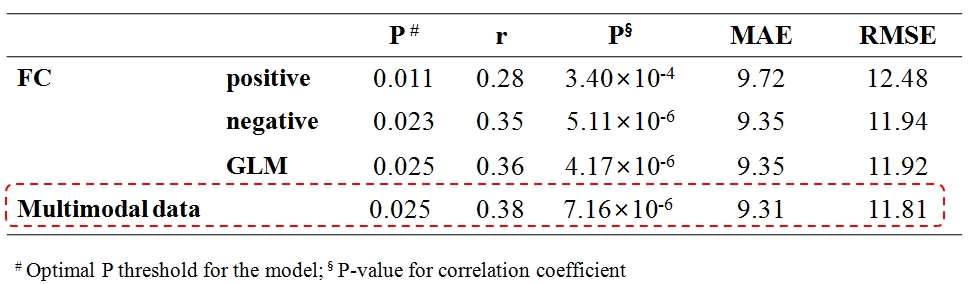
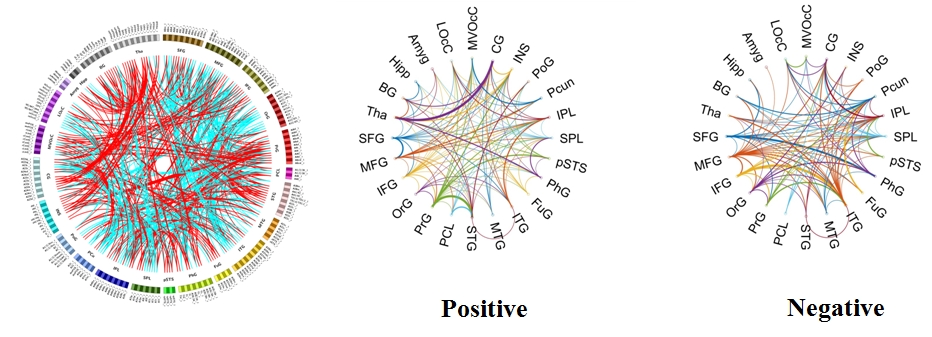
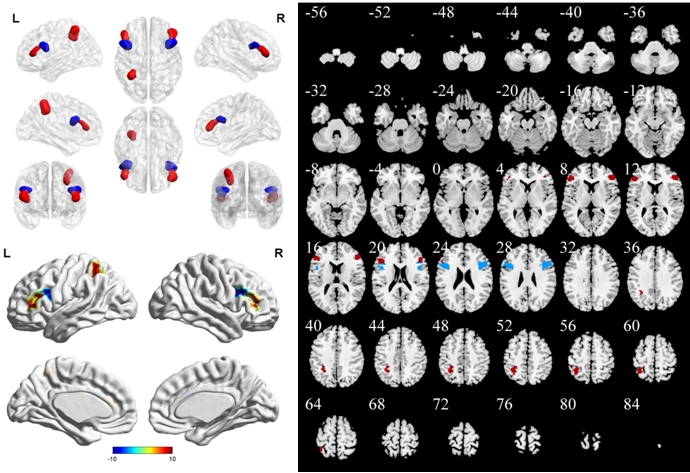
When using the Brainnetome 246 atlas, the classical FC-based models could predict FIQ score well (both P<0.001), and the combination model based on multimodal data outperformed either classical models. Similar results were found when the above analyses were repeated after controlling head motions and using the Shen 268 atlas. Based on FC data, the brain functional networks related to intelligence mainly included intrafrontal, frontoparietal, frontotemporal and temporoparietal networks, while based on ALFF, DC, ReHo and VMHC data, intelligence-related brain regions include bilateral inferior frontal gyrus and the left superior parietal lobule. Our models constructed with the intelligence-related networks and brain regions identified by FIQ could predict PIQ, VIQ, and CRT scores well (all P < 0.001), but not BDI, SAT, and TAT scores (P were 0.15, 0.06, and 0.37, respectively).Conclusion
Multimodal neuroimaging data can improve the performance of intelligence prediction model. Intelligence has specific related functional networks and brain regions, intelligence is mainly related to frontoparietal, frontotemporal and temporoparietal networks.Key words
fMRI; functional connectivity; connectome-based predictive modeling; intelligence; networkAcknowledgements
This work is supported by the Scientific Research Foundationfor Advanced Talents, Xiang’an Hospital of Xiamen University (No. PM201809170011).References
1. Kocevar G, Suprano I, Stamile C, et al. Brain structural connectivity correlates with fluid intelligence in children: A DTI graph analysis. Intelligence. 2019;72:67-75. doi:10.1016/j.intell.2018.12.003
2. Genc E, Fraenz C, Schluter C, et al. Diffusion markers of dendritic density and arborization in gray matter predict differences in intelligence. Nat Commun. May 15 2018;9(1):1905. doi:10.1038/s41467-018-04268-8
3. Jiang R, Calhoun VD, Cui Y, et al. Multimodal data revealed different neurobiological correlates of intelligence between males and females. Brain Imaging Behav. Oct 2020;14(5):1979-1993. doi:10.1007/s11682-019-00146-z
4. Kim J, Criaud M, Cho SS, et al. Abnormal intrinsic brain functional network dynamics in Parkinson's disease. Brain. Nov 1 2017;140(11):2955-2967. doi:10.1093/brain/awx233
5. Qiu S, Joshi PS, Miller MI, et al. Development and validation of an interpretable deep learning framework for Alzheimer's disease classification. Brain. Jun 1 2020;143(6):1920-1933. doi:10.1093/brain/awaa137
6. Li A, Zalesky A, Yue W, et al. A neuroimaging biomarker for striatal dysfunction in schizophrenia. Nat Med. Apr 2020;26(4):558-565. doi:10.1038/s41591-020-0793-8
7. Hong SJ, Bernhardt BC, Caldairou B, et al. Multimodal MRI profiling of focal cortical dysplasia type II. Neurology. Feb 21 2017;88(8):734-742. doi:10.1212/WNL.0000000000003632
8. Sui J, Qi S, van Erp TGM, et al. Multimodal neuromarkers in schizophrenia via cognition-guided MRI fusion. Nat Commun. Aug 2 2018;9(1):3028. doi:10.1038/s41467-018-05432-w
9. Shen X, Finn ES, Scheinost D, et al. Using connectome-based predictive modeling to predict individual behavior from brain connectivity. Nat Protoc. Mar 2017;12(3):506-518. doi:10.1038/nprot.2016.178
10. Lichenstein SD, Scheinost D, Potenza MN, Carroll KM, Yip SW. Dissociable neural substrates of opioid and cocaine use identified via connectome-based modelling. Mol Psychiatry. Aug 2021;26(8):4383-4393. doi:10.1038/s41380-019-0586-y
11. Sun H, Jiang R, Qi S, et al. Preliminary prediction of individual response to electroconvulsive therapy using whole-brain functional magnetic resonance imaging data. Neuroimage Clin. 2020;26:102080. doi:10.1016/j.nicl.2019.102080
12. Jiang R, Calhoun VD, Fan L, et al. Gender Differences in Connectome-based Predictions of Individualized Intelligence Quotient and Sub-domain Scores. Cereb Cortex. Mar 14 2020;30(3):888-900. doi:10.1093/cercor/bhz134
13. Rutherford HJV, Potenza MN, Mayes LC, Scheinost D. The Application of Connectome-Based Predictive Modeling to the Maternal Brain: Implications for Mother-Infant Bonding. Cereb Cortex. Mar 14 2020;30(3):1538-1547. doi:10.1093/cercor/bhz185
Figures