2669
Global signal regression improves model performance of connectome-based predictive modeling1Department of Radiology, Xiang’an Hospital of Xiamen Uneversity,School of Medicine, Xiamen University, Xiamen, China
Synopsis
Keywords: Brain Connectivity, fMRI (resting state), connectome-based predictive modeling
Physiologic significance of the global signal and the use (or omission) global signal regression (GSR) in fMRI data preprocessing remain controversial. Connectome-based predictive modeling(CPM) is one of the most commonly used machine-learning models. The effect of GSR on the performance of the CPM model is not well understood. We performed two preprocessing procedures for fMRI data: GSR and without GSR, and we used different brain atlases to construct CPM models to predict age, full-scale, performance and verbal IQ. We found that GSR can improve the predictive performance of CPM, at least for age, full-scale, performance and verbal IQ .Introduction
Resting-state functional MRI (rs-fMRI) is one of the most commonly used non-invasive techniques in neuroimaging1,2. The functional connectivity (FC), as one of the most commonly used rs-fMRI measurements, has been widely used in neuropsychiatric disorders2,3. Connectome-based predictive modeling (CPM) is widely used because of its simplicity, low arithmetic requirements, and explanatory properties4-6. Physiologic significance of the global signal and the use (or omission) of global signal regression (GSR) in fMRI data preprocessing remain controversial7-9. The effect of GSR on the performance of the CPM model is not well understood. In this study, we aimed to investigate whether global signal regression (GSR) can improve the model performance of CPM in predicting behavioral indicators (multi-domain IQ and age).Methods
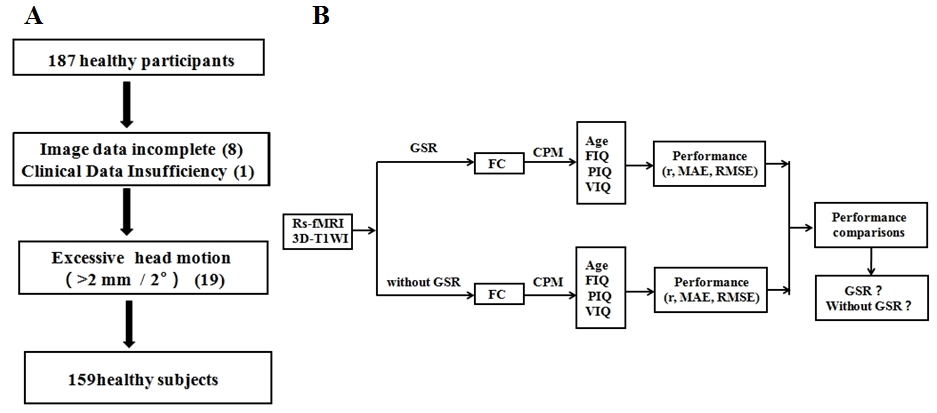
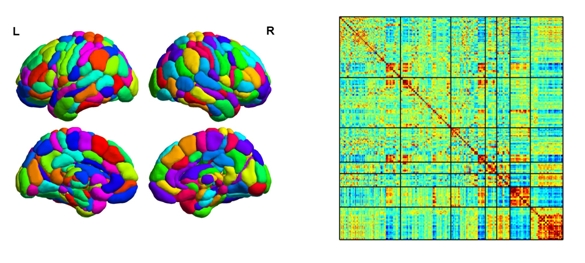
A total of 187 healthy subjects were collected, and all volunteers underwent MRI scans and clinical behavioral assessments, including full-scale intelligence quotient (FIQ), performance IQ (PIQ), verbal IQ (VIQ) and age. The DPABI software was used for fMRI data preprocessing, in which the regression covariates were treated with GSR and without GSR (GSRwithout), and different Brainnetome 246 atlas was used to segment brain regions to construct FC matrices, which were used to construct CPM model to predict age, FIQ, PIQ and VIQ. For CPM, we use grid search method 10-12(λ=0.001 to 0.05 with 0.001 interval) to optimize the optimal p-threshold, and used correlation coefficient r, mean absolute error (MAE), root mean square error (RMSE)11,13 to evaluate the model performance. We further validated our results with head motion controlling and Shen 268 atlas.Results
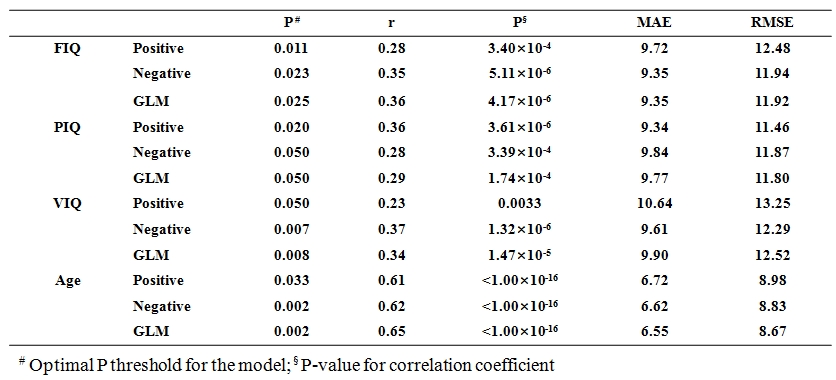
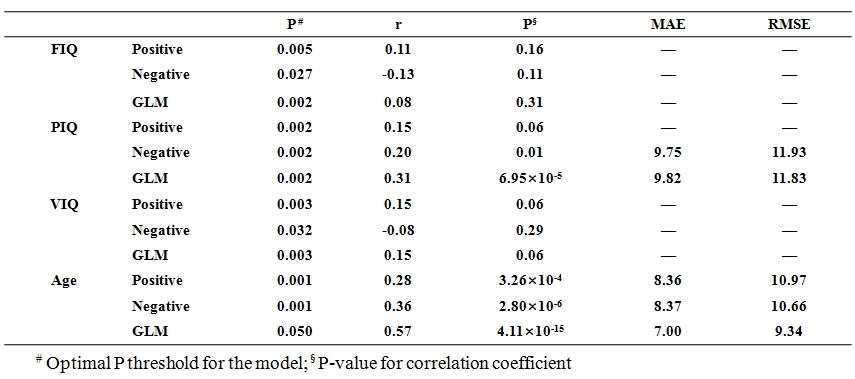
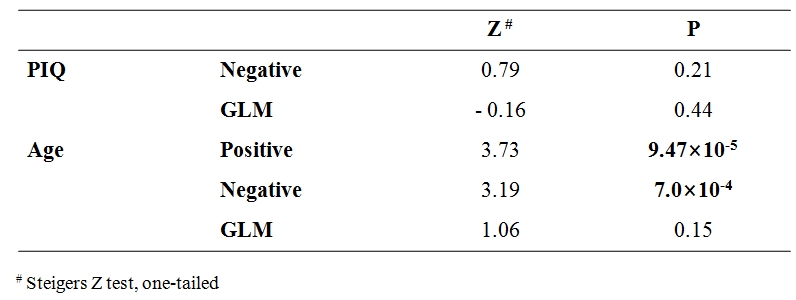
Finally, 159 volunteers were included in this study. When using GSR data, and Brainnetome 246 atlas was used to construct CPM (positive and negative network models and general linear model) to predict FIQ, PIQ, VIQ and age, we found that all models could predict the corresponding indicators well (all P < 0.05), while using GSRwithout data and the Brainnetome 246 atlas, except for the negative network model, general linear model of PIQ, and the positive, negative network models and general linear model of age (all P < 0.05), the remaining models were not significant (all P > 0.05). The GSR-based models outperformed the GSRwithout-based models. The above analysis was repeated after the subjects' head motions were controlled, and the same results were found. The above analysis was repeated using the Shen 268 atlas to verify the above results, we found similar results.Conclusion
This study applied multi-atlas, multi-model approach and multi-behavioral measurements prediction to show that GSR can improve the predictive performance of CPM, at least for FIQ, PIQ, VIQ, and age.Key words
fMRI; functional connectivity; connectome-based predictive modeling; global signal regressionAcknowledgements
This study was supported by the Scientific Research Foundationfor Advanced Talents, Xiang’an Hospital of Xiamen University(No. PM201809170011).References
1. Tu Y, Zeng F, Lan L, et al. An fMRI-based neural marker for migraine without aura. Neurology. Feb 18 2020;94(7):e741-e751. doi:10.1212/WNL.0000000000008962
2. Lichenstein SD, Scheinost D, Potenza MN, Carroll KM, Yip SW. Dissociable neural substrates of opioid and cocaine use identified via connectome-based modelling. Mol Psychiatry. Aug 2021;26(8):4383-4393. doi:10.1038/s41380-019-0586-y
3. Yin T, Sun R, He Z, et al. Subcortical-Cortical Functional Connectivity as a Potential Biomarker for Identifying Patients with Functional Dyspepsia. Cereb Cortex. Dec 10 2021;doi:10.1093/cercor/bhab419 4. Shen X, Finn ES, Scheinost D, et al. Using connectome-based predictive modeling to predict individual behavior from brain connectivity. Nat Protoc. Mar 2017;12(3):506-518. doi:10.1038/nprot.2016.178
5. Beaty RE, Kenett YN, Christensen AP, et al. Robust prediction of individual creative ability from brain functional connectivity. Proc Natl Acad Sci U S A. Jan 30 2018;115(5):1087-1092. doi:10.1073/pnas.1713532115
6. Jiang R, Calhoun VD, Zuo N, et al. Connectome-based individualized prediction of temperament trait scores. Neuroimage. Dec 2018;183:366-374. doi:10.1016/j.neuroimage.2018.08.038
7. Liu TT, Nalci A, Falahpour M. The global signal in fMRI: Nuisance or Information? Neuroimage. Apr 15 2017;150:213-229. doi:10.1016/j.neuroimage.2017.02.036
8. Murphy K, Fox MD. Towards a consensus regarding global signal regression for resting state functional connectivity MRI. Neuroimage. Jul 1 2017;154:169-173. doi:10.1016/j.neuroimage.2016.11.052
9. Li J, Kong R, Liegeois R, et al. Global signal regression strengthens association between resting-state functional connectivity and behavior. Neuroimage. Aug 1 2019;196:126-141. doi:10.1016/j.neuroimage.2019.04.016
10. Sun H, Jiang R, Qi S, et al. Preliminary prediction of individual response to electroconvulsive therapy using whole-brain functional magnetic resonance imaging data. Neuroimage Clin. 2020;26:102080. doi:10.1016/j.nicl.2019.102080
11. Jiang R, Calhoun VD, Cui Y, et al. Multimodal data revealed different neurobiological correlates of intelligence between males and females. Brain Imaging Behav. Oct 2020;14(5):1979-1993. doi:10.1007/s11682-019-00146-z
12. Jiang R, Calhoun VD, Fan L, et al. Gender Differences in Connectome-based Predictions of Individualized Intelligence Quotient and Sub-domain Scores. Cereb Cortex. Mar 14 2020;30(3):888-900. doi:10.1093/cercor/bhz134
13. Rutherford HJV, Potenza MN, Mayes LC, Scheinost D. The Application of Connectome-Based Predictive Modeling to the Maternal Brain: Implications for Mother-Infant Bonding. Cereb Cortex. Mar 14 2020;30(3):1538-1547. doi:10.1093/cercor/bhz185
Figures