2520
Disturbed cerebral white matter network topological mediate the symptom severity and cognition in children with obstructive sleep apnea1Radiology, The Second Affiliated Hospital and Yuying Children’s Hospital of Wenzhou Medical University, Wenzhou, China, 2Pediatrics, The Second Affiliated Hospital and Yuying Children’s Hospital of Wenzhou Medical University, Wenzhou, China, 3Radiology, The First Affiliated Hospital of Zhejiang University, Hangzhou, China, 4Philips Healthcare, Shanghai, China
Synopsis
Keywords: Adolescents, Brain Connectivity, obstructive sleep apnea
Obstructive sleep apnea (OSA) in children can cause deficits in cognition. The purpose of this study was to explore the underlying mechanisms of OSA-related cognitive impairment by investigating the altered topology of brain white matter networks in children with OSA. Based on graph theory and mediating effects analysis, we discovered that OSA had significantly higher global assortativity than control group, and that the nodal clustering coefficients of temporal lobes mediated the relationship between the symptom severity of OSA and the verbal comprehension index. Our findings provided a further neuroimaging evidence of impaired cognitive function in children with OSA.
Introduction
Obstructive sleep apnea (OSA) is one of the children's most serious sleep-breathing disorders, leading to attention, memory, and executive function deficits1. Exploring the pattern of OSA interference in the brain white matter network will be promising to advance our understanding of the underlying mechanisms of OSA-related cognitive disorders. This study aimed to investigate the topological organization change of white matter networks and its mediating role between symptom severity and cognition in children with OSA.Methods
Graph theory was used to examine white matter networks' global and nodal network topological properties in 46 OSA and 31 non-OSA children. All participants underwent MRI with high-resolution 3-dimensional T1-weighted images (3DT1) and diffusion tensor imaging (DTI), polysomnography monitoring (PSG), and cognitive testing. The obstructive apnea-hypopnea index (OAHI) from the PSG was utilized to characterize the severity of OSA, and hierarchical linear regression was applied to investigate the effect of OAHI on the topological properties of the cerebral white matter network. The mediating role of white matter network properties in OSA between OAHI and cognition was assessed using the bias-corrected nonparametric percentile Bootstrap method.Results
A total of 46 children with OSA (13 females, 8.9±1.4 years, OAHI > 1 event/h) and 31 controls (17 females, 8.9±1.3 years, OAHI≤1 event/h) were included in the final analysis. Children with OSA had significantly higher assortativity than the control group (t = 3.319, FDR corrected p < 0.05, Fig.1). OAHI was significantly correlated with degree centrality, nodal clustering coefficients, local nodal efficiency, and nodal shortest paths (Fig.2). For instance, there was a negative correlation between the OAHI and the degree centrality in Frontal_Mid_Orb_L (β = -0.256) and Temporal_Pole_Mid_L (β = -0.280). Meanwhile, there was a positive correlation between the OAHI and the clustering coefficients in Temporal_Pole_Sup_R (β = 0.313), and Temporal_Pole_Mid_R (β = 0.402). In cognitive testing, the verbal comprehension index (F = 0.747) and FSIQ (F = 2.303) of the WISC-IV (Chinese version) decreased with the increase of OAHI. Furthermore, mediation analysis revealed that the nodal clustering coefficients of the Temporal_Pole_Sup_R mediated the relationship between the OAHI and the verbal comprehension index (Fig.3, Table 1).Discussion
In this study, we revealed the altered white matter network properties in children (7-13 years old) newly diagnosed with OSA and the association between the severity of OSA and cognitive performance. The increase in assortativity (global metric) of the white matter network in OSA could be interpreted as an increase in useless node interconnections2-3. Apnoea and hypopnoea might cause cognitive deficits in children with OSA and functionally impair their learning efficiency, as we found that higher OAHI was associated with a lower verbal comprehension index and FSIQ of the WISC-IV (Chinese version)4-5. Besides, the nodal clustering coefficients of Temporal_Pole_Sup_R mediated the relationship between the OAHI and the verbal comprehension index, which might reflect that the damage of white matter network properties can sensitively link OSA to verbal learning ability.Conclusions
OSA impairs the development of white matter networks in the brains of children, particularly those in the frontal and temporal lobes associated with cognition. Besides, the mediating role of white matter network properties between the OAHI and the verbal comprehension index provided neuroimaging evidence of impaired cognitive function in children with OSA.Acknowledgements
No acknowledgement found.References
1. Bucks, R.S., et al., Reviewing the relationship between OSA and cognition: Where do we go from here? Respirology (Carlton, Vic.), 2017. 22(7): p. 1253-1261.
2. Lee, M.H., et al., Altered cortical structure network in children with obstructive sleep apnea. Sleep, 2022. 45(5).
3. Supekar, K., M. Musen, and V. Menon, Development of large-scale functional brain networks in children. PLoS Biol, 2009. 7(7): p. e1000157.
4.Rosenzweig, I., et al., Sleep apnoea and the brain: a complex relationship. Lancet Respir Med, 2015. 3(5): p. 404-14.
5. Stam, C.J., Modern network science of neurological disorders. Nat Rev Neurosci, 2014. 15(10): p. 683-95.
Figures
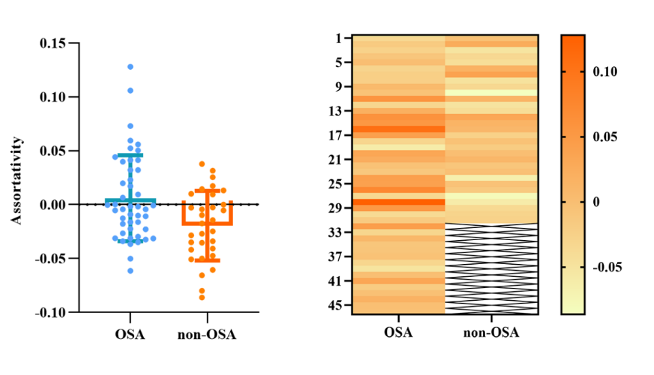
Fig. 1 Differences in white matter structural brain network metrics between children with OSA and HCs. Children with OSA had significantly higher assortativity than the control group (t = 3.319, FDR corrected p < 0.05).
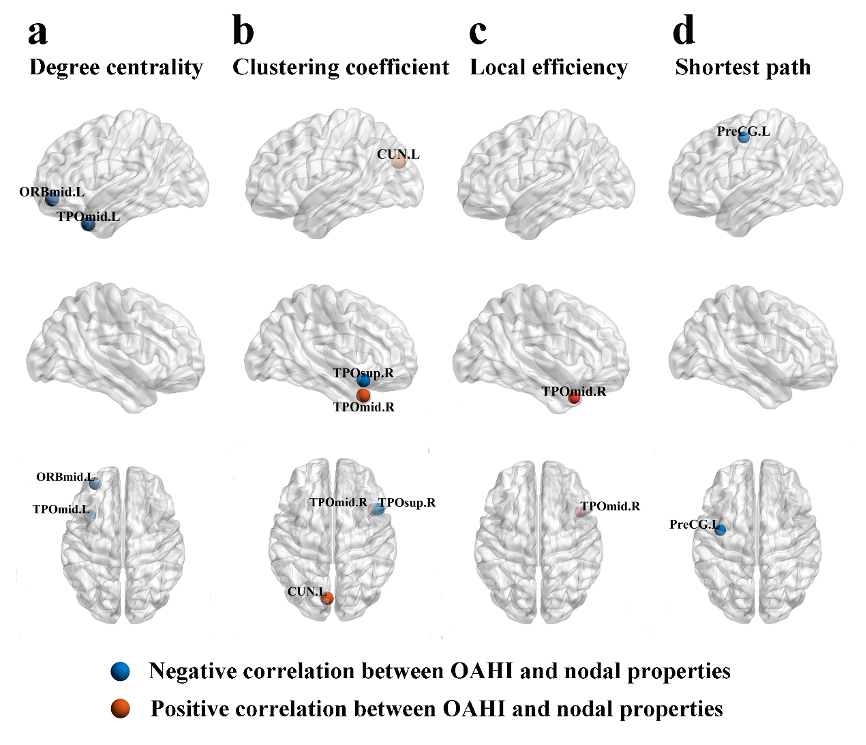
Fig. 2 Obstructive apnea hypopnea index (OAHI) was associated with regional nodal properties.
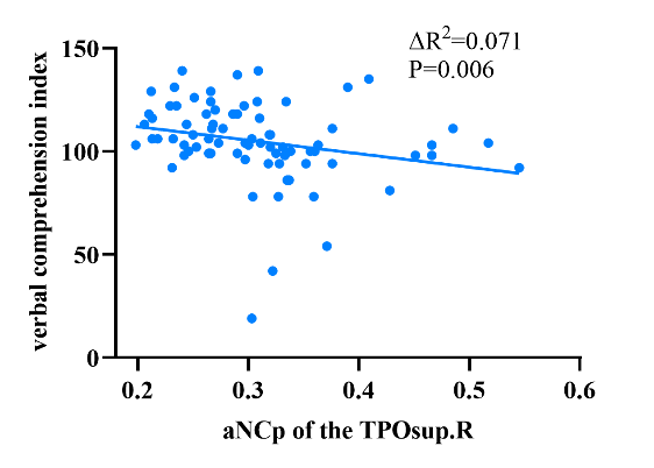
Fig. 3 Relationship between the nodal clustering coefficient of the right temporal pole of superior temporal gyrus and verbal comprehension index. Verbal comprehension scores were negatively correlated with the right temporal pole of the superior temporal gyrus. Analyses considered age, gender, and BMI. aNCp: the area under the curve (AUC) of the nodal clustering coefficient; TPOsup.R: the right temporal pole of superior temporal gyrus.
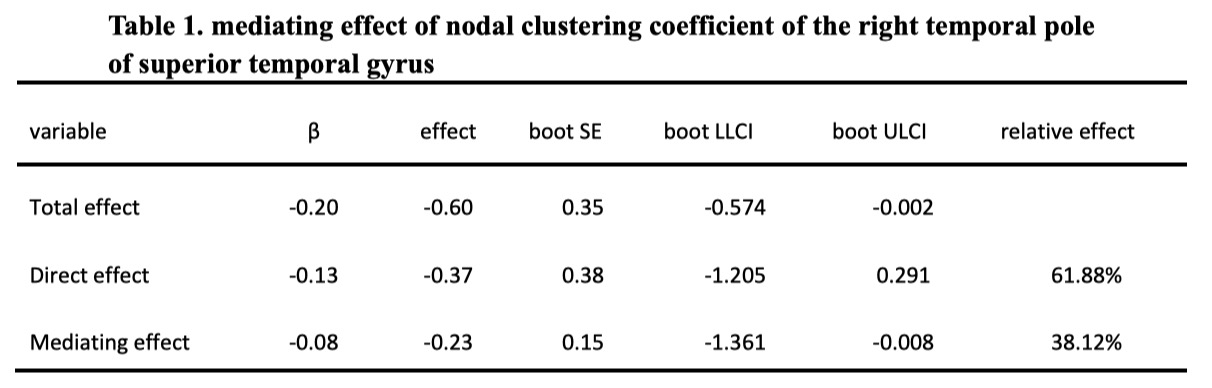
Table1 Notes: SE = standard deviation; LLCI = lower limit of the 95 % confidence interval; ULCI = upper limit of the 95% confidence interval. Boot SE, boot LLCI, and boot ULCI were all estimated using the bias-corrected percentile bootstrap method. The relative effect refers to the proportion of the total effect.