2481
4DFlow Leap-Frog and FFE-DIXON analysis for aneurysm endovascular image-guided treatment
María Paula Del Popolo1,2,3, Rodrigo Nahuel Alcalá1,2,4, Chiara Lombardo1,4, Ezequiel Petra2, Federico Julián González1,5, Olivier Balédent6, Sebastián Moguilner7, Roberto Isoardi1,4,5, Valdir Fialkowski8, and Daniel Fino1,2,5
1Fundación Escuela de Medicina Nuclear, Mendoza, Argentina, 2Fundacion Argentina para el Desarollo en Salud, Mendoza, Argentina, 3Universidad de Mendoza, Mendoza, Argentina, 4FCEN, Universidad Nacional de Cuyo, Mendoza, Argentina, 5Instituto Balseiro, Universidad Nacional de Cuyo, Bariloche, Argentina, 6University Hospital Amiens, Amiens, France, 7Harvard Medical School, Boston, MA, United States, 8Philips, Sao Paulo, Brazil
1Fundación Escuela de Medicina Nuclear, Mendoza, Argentina, 2Fundacion Argentina para el Desarollo en Salud, Mendoza, Argentina, 3Universidad de Mendoza, Mendoza, Argentina, 4FCEN, Universidad Nacional de Cuyo, Mendoza, Argentina, 5Instituto Balseiro, Universidad Nacional de Cuyo, Bariloche, Argentina, 6University Hospital Amiens, Amiens, France, 7Harvard Medical School, Boston, MA, United States, 8Philips, Sao Paulo, Brazil
Synopsis
Keywords: Blood vessels, Velocity & Flow, Neuro
4Dflow has become a widely used sequence for dynamical characterization of the vascular system. This work shows that it is feasible to implement Leapfrog to acquire results that are colse to those obtained with Finite Volume Methods with excelent results in velocity, vortex and energy, but with certain limitations when estimating the WSS. In order to diminish the acquisition time, we will implement a postprocessing tool using only a 2D Phase Contrast acquisition and implement FSI (CFD), this results will be compared with those given by the LF method.INTRODUCTION
Haemodynamic analysis considering blood as a Newtonian fluid (non microvascular tissue) in regions with small changes in flow rate, can be analyzed with Leap-Frog numerical analysis (LF). Traditional protocols for vascular pathology characterization with phase contrast techniques (PC) include a T1wGRE-3D and a ToF sequences, postprocessed with Finite Volume Methods (FVM) the velocity acquisition through three orthogonal PCs (4DFlow). The mentioned computational fluids dynamics (CFD) discretization method has as counterpart the postprocessing time’s requirements. Moreover, for a not entirely simulatable system, FVM capabilities exceed the requirements of the clinical application like execution time, meshing design and UI interaction.Regarding morphological characterisation, novel 3D sequences such as the six-echo FFEwT1-DIXON generate a T1 contrast and blood flow enhancing image that can be compared to the T1wGRE-3D and ToF set with a 40% reduction in acquisition time. Considering the cost in this sort of application and the strong computational demands of FVM, the aim of this work is to evaluate LF as an algorithm to analyze 4DFlow, guided with a morphological characterisation from FFEwT1-DIXON sequence (FFD).METHODS
Prospective study evaluated by the institutional ethics committee. An MRA protocol including T1wGRE-3D, ToF, FFD and 4DFlow sequences was acquired in 9 healthy subjects (HS) and 4 patients with intracranial aneurysms (IA) on a 1.5 Tesla Ingenia scanner, the parameters of the sequence are shown in fig1. FVM and LF were used to, independently, process the 4DFlow data, LF and FVM mesh were implemented with in-house Python routines (VTK, VMTK, YT) while OpenFoam was used for FVM mesh analysis (fig2). The results -acceleration (fig3) energy, lost kinetic energy, wall-shear stress and vortex- between both methodologies were compared with Pearson correlation coefficient (strong correlation between ± 0.50 and ± 1, moderate between ±0.30 and ±0.49). Visually, the velocity fields (fig4) and streamlines were evaluated with intra-arterial digital subtraction angiography by an endovascular therapist expert. Evaluation of morphological techniques was performed with SNR assessment of both vascular tissue segmentation and brain parenchyma. Two expert neuroradiologists segmented the brain in T1 contrasts in both the T1wGRE-3D and the FFE pulse at the FFD sequence. Similarly, vascular tissue was segmented in both the ToF sequence and the DIXON component of the FFD sequence. The segmentation was performed in 3DSlicer and the data were exported to an in-house routine made in Python using VMTK (fig 5).RESULTS
Discretisation of the velocity field had higher resolution (25%) with LF than mesh in FVM, which also had a positive impact on the assessment of the expert endovascular therapist. The energy balance had a strong correlation (r=0.73), however in the IA group, the energy balance had a moderate correlation (r=0.42). Regarding the acceleration calculation, a moderate to strong correlation was found (r=0.62). With the acceleration information and the centerline we were able of estimating the WSS. Both methods were compared by an expert endovascular therapist, the results showed that the estimation of WSS was better when using FVM, but the vortex estimation was more accurate when solving with LF.The SNR of the FFD sequence was higher for both tissue types than traditional sequences, 19% for brain parenchyma and 12% for vascular tissue.However, low-calibre vessels were visualised in more detail in the ToF sequence.
CONCLUSION
The use of T1wGRE-3D for morphological characterization and for the construction of the mesh showed to be a robust sequence, despite the number of information given by the mentioned sequence, the SNR ratio and the contrast of the sequence proved to be acceptable when time requirements arise.LF showed acceptable results, but if time is not a necesity, the CFD aproximation showed to be a better tool, especially to determine the wall shear stress
DISCUSSION
It would be interesting to implement an FSI simulation to compare the results obtained by LF. For both methods, a unique single PC readout can be implemented that reduces the acquisition time by 85% and numerical simulation techniques can be used to reproduce the haemodynamic behaviour through the motion recording that can be achieved with a dynamic morphological sequence (this can be with contrast).Acknowledgements
No acknowledgement found.References
[1] Szajer, Kevin Ho-Shon,A comparison of 4D flow MRI-derived wall shear stress with computational fluid dynamics methods for intracranial aneurysms and carotid bifurcations — A review,Magnetic Resonance Imaging,Volume 48,2018,Pages 62-69,ISSN 0730-725X,https://doi.org/10.1016/j.mri.2017.12.005.(https://www.sciencedirect.com/science/article/pii/S0730725X17302813)
Figures
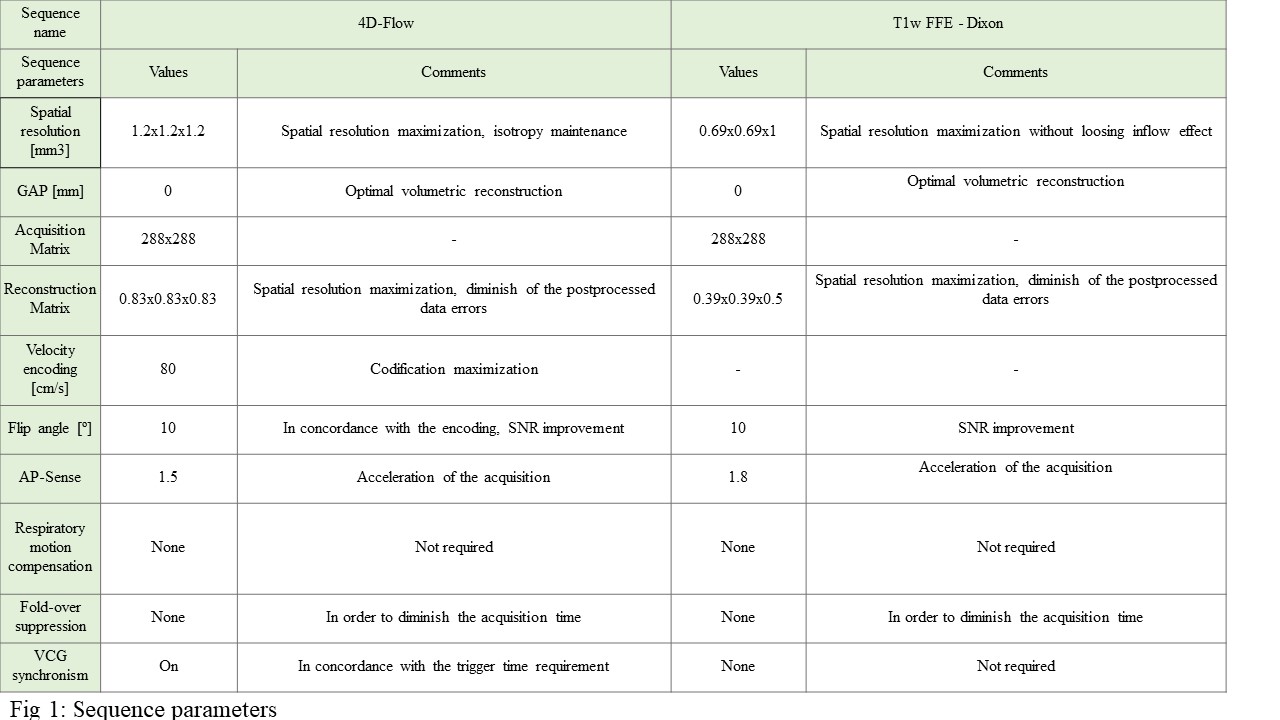
Fig. 1: Sequence parameters
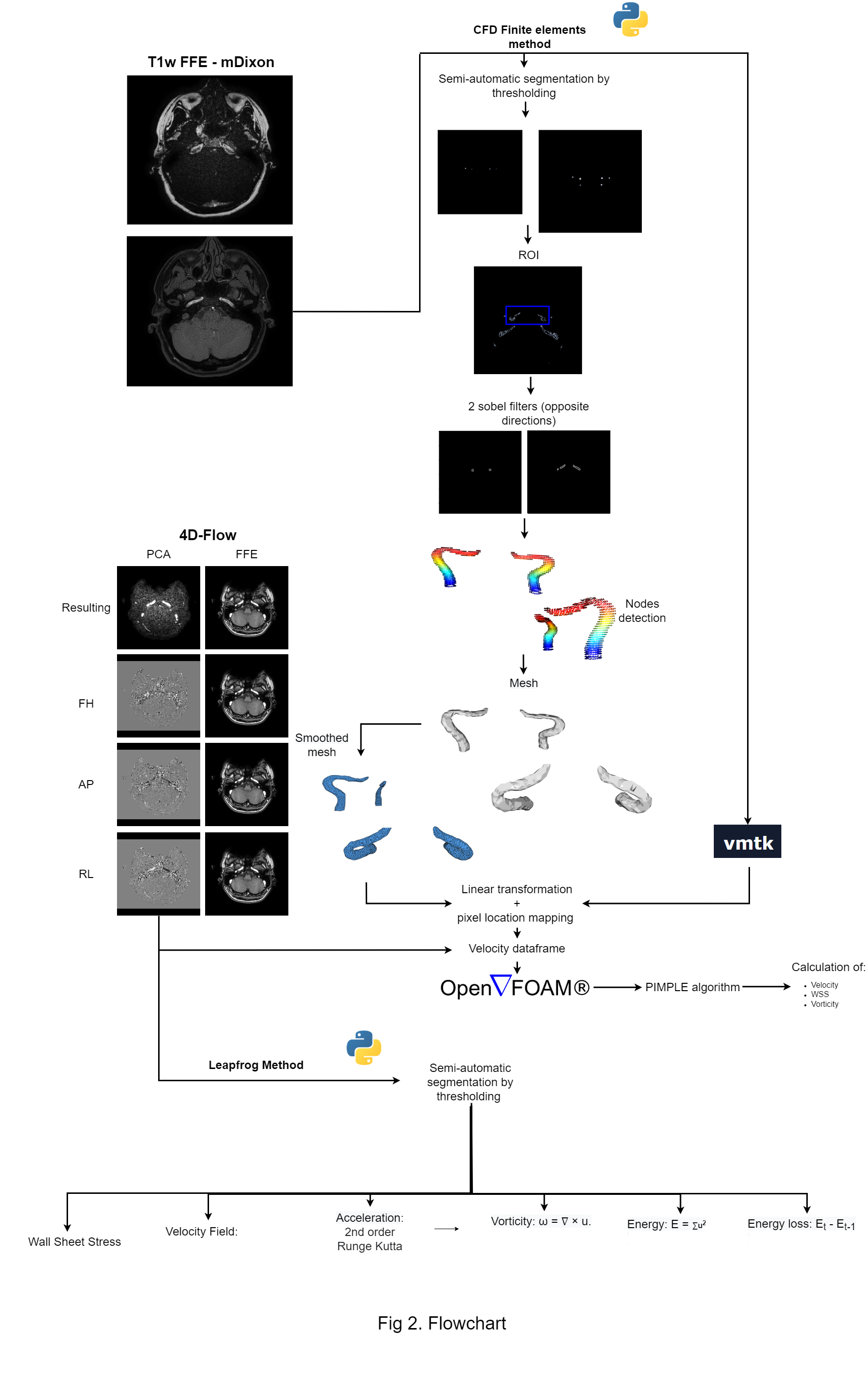
Fig. 2: Work Flow
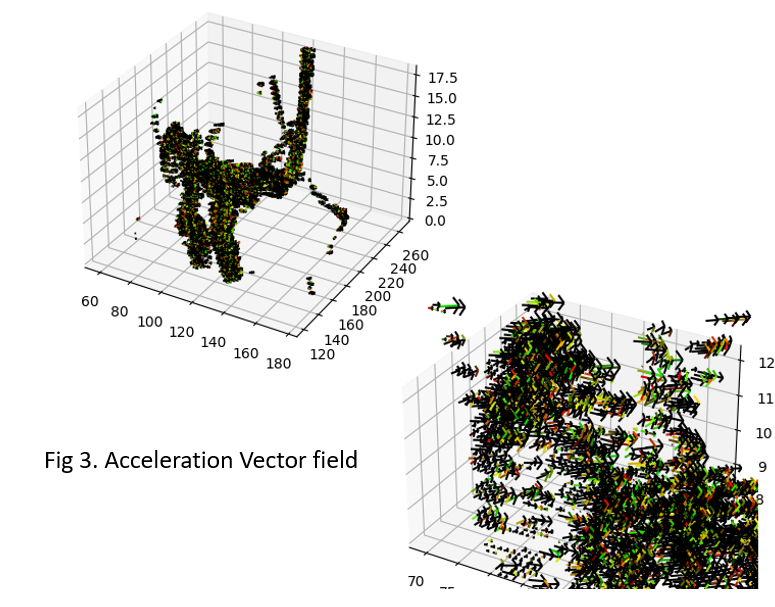
Fig. 3: LF Acceleration results
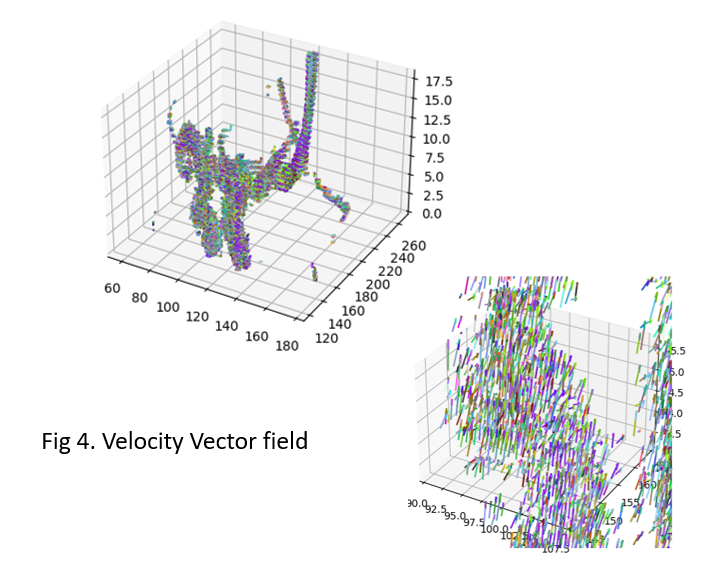
Fig. 4: LF Velocity Field
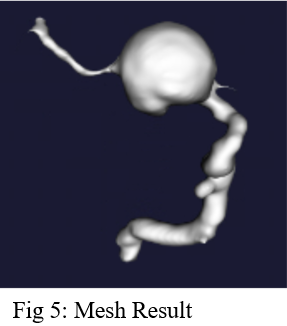
Fig 5: Mesh Result
DOI: https://doi.org/10.58530/2023/2481