2450
Cow Colostrum Regresses STAM-induced Non-alcoholic Steatohepatitis-associated Hepatocellular Carcinoma in Mice
Uma Sharma1, Sangeetha Gupta2, Ritu Tyagi1, Bhavya Dhawan2, and Ankit Shokeen2
1Department of Nuclear Magnetic Resonance, All India Institute of Medical Sciences, New Delhi, NEW DELHI, India, 2Amity Institute of Pharmacy (AIP), Amity University Uttar Pradesh, Noida Campus, Noida, India
1Department of Nuclear Magnetic Resonance, All India Institute of Medical Sciences, New Delhi, NEW DELHI, India, 2Amity Institute of Pharmacy (AIP), Amity University Uttar Pradesh, Noida Campus, Noida, India
Synopsis
Keywords: Liver, Cancer, MRI, Steatohepatitis-associated Hepatocellular Carcinoma, cow colustrum, therapy
Nutraceuticals is an emerging industry with the potential to cater the needs of many therapeutic domains, including cancer a major cause of health concerns. Despite the currently available therapeutics, complication and effective medical management of HCC, particularly at an advanced stage has several limitations. Hence, in the present study an alternative approach using an animal product cow colostrum as therapeutics for HCC is explored in STAM-induced non-alcoholic steatohepatitis-associated hepatocellular carcinoma in mice. If successful this might prove to be a very viable and effective management for NASH-associated HCC.Introduction
Liver cancer is an emerging global health concern and is expected to have an incidence of more than 1 million cases by the year 20251. Non-alcoholic fatty liver disease (NAFLD) is a major risk factor for non-alcoholic steatohepatitis (NASH)-associated hepatocellular carcinoma (HCC). It is being estimated that NAFLD develops in 70-80% of diabetic patients, which further progresses to NASH and is responsible for risk of developing into HCC by 2-3 folds 2,3. The vicious pathogenic mechanisms of HCC mainly include genomic alterations, epigenetic modifications and growth factor pathway alterations4. Sorafenib is a multi-kinase inhibitor approved for the treatment of advanced HCC. Although beneficial in patients, the adverse effects cannot be ignored including diarrhoea, hand-foot skin reaction and hypertension with cardiovascular events causing death5. Thus, there is an urge for more satisfactory treatment options through more rationale experimental and clinical studies. Colostrum, a nutraceutical the first secretion of the mammary gland produced after birth. It is rich in bioactive molecules: proteins, immunoglobulins, bactericides (lactoferrin, lysozyme and lactoperoxidase), growth factors vitamins and minerals6. The present study was designed to address the limited therapeutic strategies in Stelic animal model (STAM) which induces NASH-associated HCC. Thus, the aim of the present study was to investigate the anticancer potential of cow colostrum in STAM induced NASH-associated HCC in C57BL/6J mice. The evaluation parameters in the present study included magnetic resonance imaging (MRI), histology and biochemical analysis.Methods
All the experimental procedures were approved by the Institutional Animal Ethics Committee. Hepatic lesions in STAM mice were induced in 2-days old C57BL/6J male pups by injecting streptozotocin (STZ; Sigma, MO, USA) at a dose of 200 µg/mouse, subcutaneously. This was followed by feeding mice with high-fat diet-32% fat (HFD-32%, ICMR- National Institute of Nutrition, Department of Health Research) ad libitum being initiated from 4 weeks till 24 weeks. For the present study, animals were divided into three groups: vehicle-treated normal control (n=6), vehicle-treated STAM control (n=6) and cow colostrum (740 mg/kg, p.o.) treated STAM (n=6). The NASH-induced HCC STAM model has been reported to have an average tumour growth rate of 150% from 16-18 to 22-24 weeks of age 7-9. Thus, the animals were subjected for T2 weighted MRI at 7T (Bruker Biospin, Switzerland) animal MR scanner at two time-points: 18 weeks (detect the presence of tumour) and 24 weeks (termination of study). The 18 week MRI imaging was considered as baseline and after this all the animals were subjected for treatment with either vehicle or cow colostrum at a dose of 740 mg/kg, p.o. which was continued till 24 weeks. The animals were again subjected to MRI at the end of 24 week, the mice were then sacrificed and liver tissues were excised for histology and biochemical analysis (plasma glucose levels). Other biochemical parameters and mechanistic studies are still in progress.Results
The MRI images were analysed for detection of tumours and liver volume at both time points as 18 (baseline) and 24 weeks. Tumour nodules were absent in the vehicle-treated normal control group at both time points (Figure 2). The number of tumours detected in vehicle-treated STAM control and cow colostrum treated STAM groups at 18 weeks considered as baseline were 25±6.33 and 36±4.65. In vehicle-treated STAM group, there was a significant (P < 0.05) increase in the number of tumours 115±12.96, while in cow colostrum-treated group regression was observed with the appearance of 45±10.50 tumours as compared to baseline (Figure 2 and 3). There was no significant difference in the liver volume of the animals as analysed from MRI images among the three groups: vehicle-treated normal control, vehicle-treated STAM control and cow colostrum (740 mg/kg, p.o.) treated STAM at both time points 18 week (11.55±10.5, 14.64±1.37, 10.34±0.97 mm3) and 24 week (12.04 ± 0.29, 14.22 ± 1.26 , 9.68 ± 0.91 mm3). On the other hand, liver weight was found to be significantly increased in vehicle-treated STAM control (2.02±0.10 g) as compared to vehicle-treated normal control group (1.25±0.04 g) at 24 week. In cow colostrum (740 mg/kg, p.o.) treated STAM group due to regression in tumours insignificant increase in liver weight was observed (1.28±0.10 g) as compared to vehicle-treated normal control.Discussion
STAM is a model which simulates diabetes-associated NASH further progressing to HCC in humans which makes this model highly relevant for having clinical translational values. Colostrum is the first milk harvested following calving and is an important source of immunoglobulin’s which enhances the immune system. In addition, colostrum contains high levels of protein, fat, hormones, minerals, and vitamins as compared to whole milk. In present study, cow colostrum has been shown to have anticancer potential as evident with regression in the number of tumours and unchanged liver weight. This may be attributed to antioxidant effects of cow colostrum which is consistent with the other findings in exercise-induced oxidative stress in skeletal muscle in mice and dexamethasone-treated MC3T3-E1 osteoblastic cells 7,8. Further studies are still in progress for the current study to elucidate the mechanism of action of cow colostrum.Conclusion
Present investigation expects that cow colostrum may prove to be an effective anticancer therapy in NASH-associated HCC.Acknowledgements
The authors duly acknowledge Science and Engineering Research Board (SERB), Department of Science & Technology (DST), New Delhi, India, for providing funding in the form of Teachers Associateship for Research Excellence (TARE) Scheme to Dr. Sangeetha Gupta under the mentorship of Dr. Uma Sharma (File No. TAR/2020/000061).References
1. Llovet J, Kelley R, Villanueva A, et al. Hepatocellular carcinoma. Nat Rev Dis Primers. 2021; 7, 6. 2. Younossi Z, Anstee Q, Marietti M, et al. Global burden of NAFLD and NASH: trends, predictions, risk factors and prevention. Nat Rev Gastroenterol Hepatol. 2018;15(1):11-20. 3. Williamson R, Price J, Glancy S, et al. Prevalence of and risk factors for hepatic steatosis and nonalcoholic fatty liver disease in people with type 2 diabetes: the edinburgh type 2 diabetes study. Diabetes Care. 2011;34:1139-1144. 4. Dhanasekaran R, Bandoh S, Roberts L. Molecular pathogenesis of hepatocellular carcinoma and impact of therapeutic advances. F1000Res. 2016; 5: F1000 Faculty Rev-879. 5. Li Y, Gao Z, Qu X. The adverse effects of sorafenib in patients with advanced cancers. Basic Clin Pharmacol Toxicol. 2015;116(3):216-221. 6. Solva E, Rangel A, Murmum L, et al. Bovine colostrum: benefits of its use in human food. Food Sci. Technol Campinas. 2019;39(2):355-362. 7. Appukutty M, Radhakrishnan A, Ramasamy K, et al. Colostrum supplementation protects against exercise-induced oxidative stress in skeletal muscle in mice. BMC Res Notes. 2012;5:649. 8. Martin-Aragon S, Bermejo-Bescós P, Benedí J, et al. A Neuroprotective Bovine Colostrum Attenuates Apoptosis in Dexamethasone-Treated MC3T3-E1 Osteoblastic Cells. Int J Mol Sci. 2021;22(19):10195.Figures
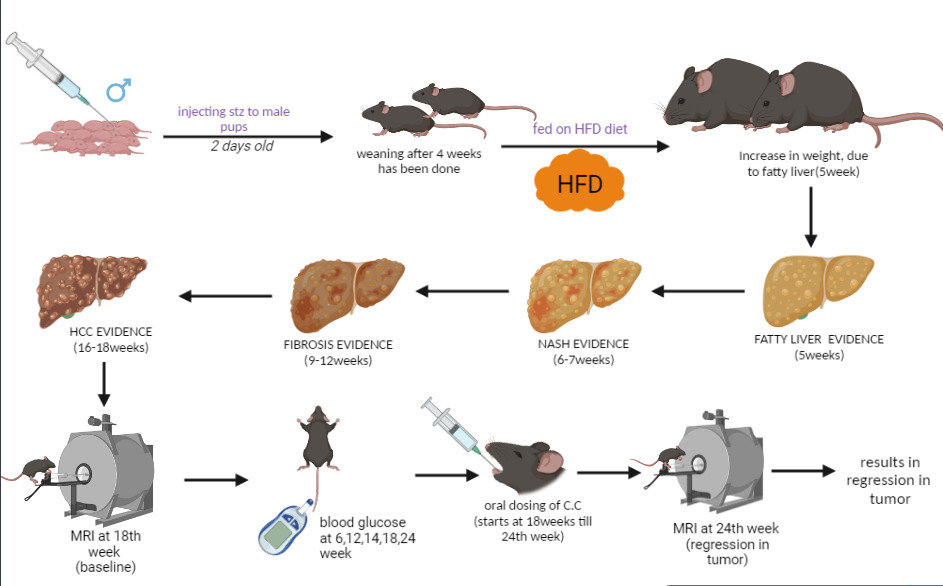
Figure 1 Schematic
representing protocol design in STAM model for the present study.
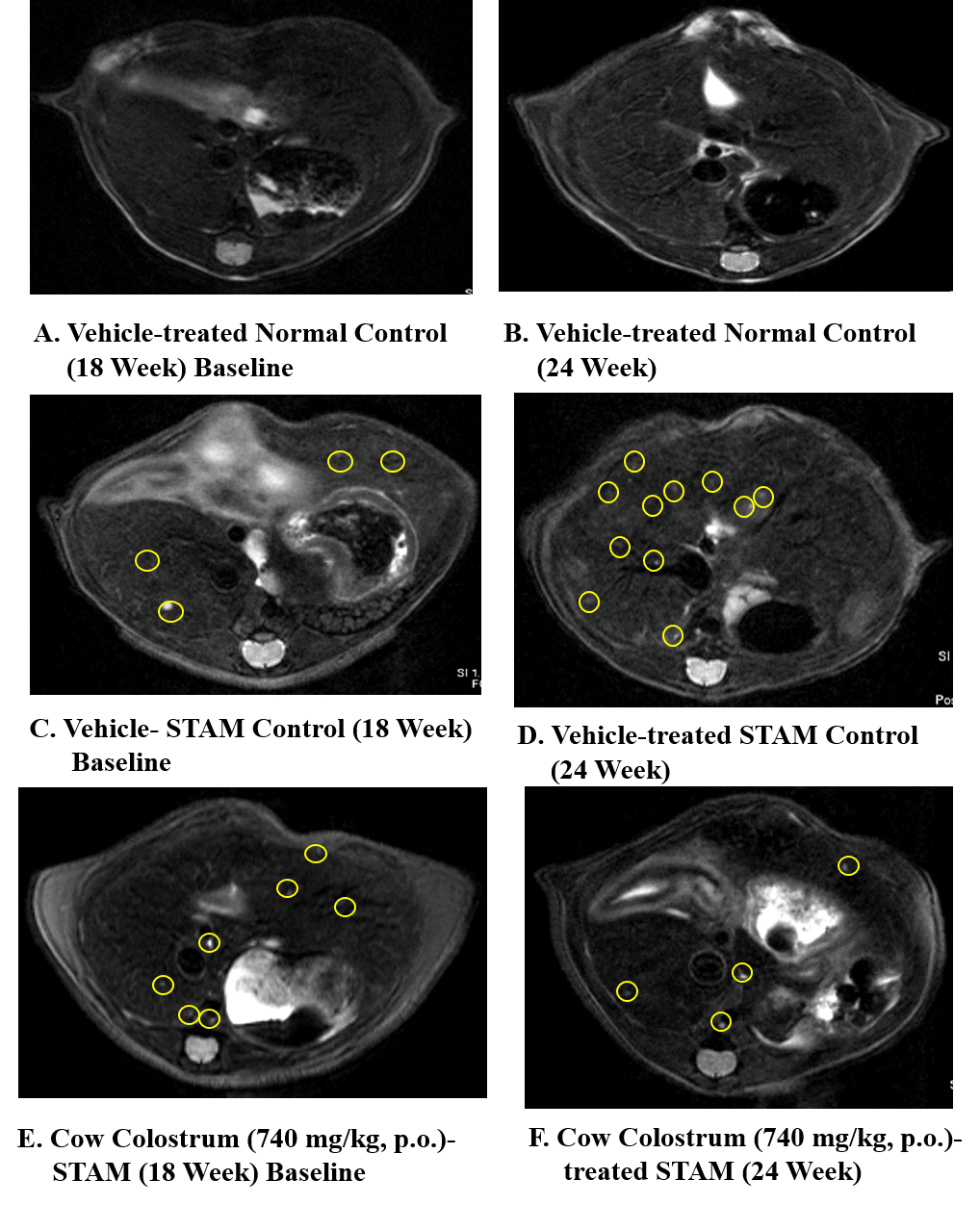
Figure 2 Representative
T2 weighted MRI images of liver of A, Vehicle-treated normal
control, B. Vehicle-treated STAM control and C. Cow colostrum (740 mg/kg, p.o.)
treated STAM at week 18 and 24. The yellow colour circle indicates presence of
nodules (C-D).
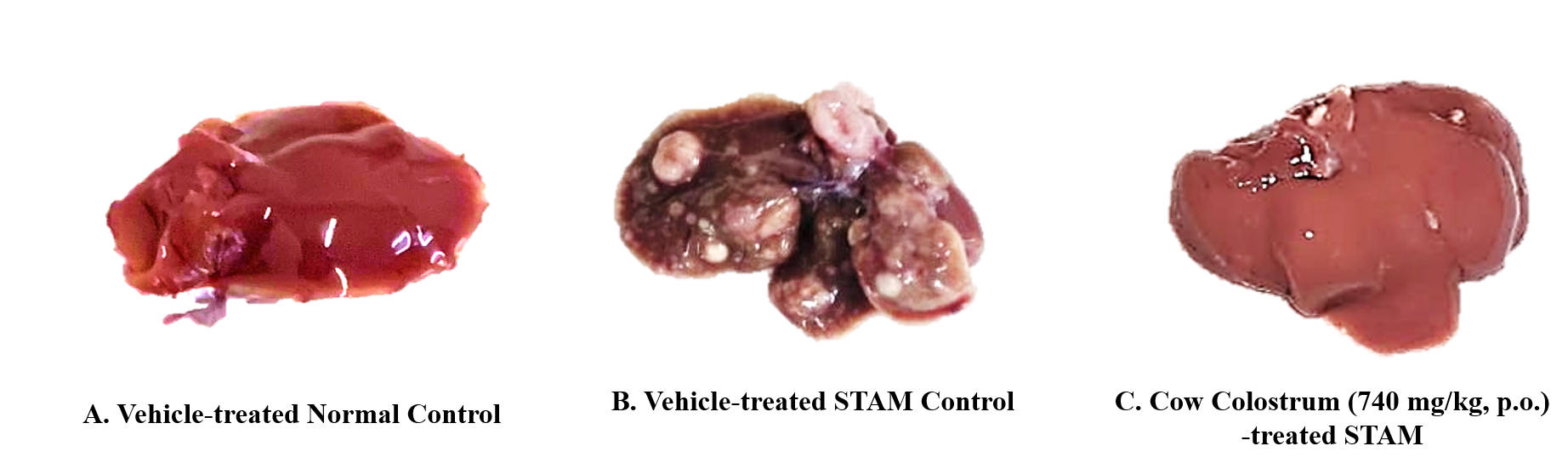
Figure 3 Macroscopic
findings regarding appearance of liver samples at 24 weeks of three groups: A.
Vehicle-treated normal control, B. Vehicle-treated STAM control and C. Cow
colostrum (740 mg/kg, p.o.) treated STAM. It appears that liver of normal
control mice were red in colour, while due to progression of NAFLD to NASH the
liver images appear to be pale in colour and NASH to HCC with the appearance of
tumour nodules.
DOI: https://doi.org/10.58530/2023/2450