2438
The value of diffusion kurtosis imaging for predicting two-year early recurrence (ER) of hepatocellular carcinoma after curative resection1The First Affiliated Hospital, Dalian Medical University, Dalian, China
Synopsis
Keywords: Liver, Cancer
Hepatocellular carcinoma (HCC) is viewed as the most frequent primary liver cancer and the third cause of cancer related death worldwide [1]. The 5-year overall survival rate is only 30–40% after surgical resection and 70% of patients have a tumor recurrence within 5 years [2]. we evaluated the discrimination power of Diffusion Kurtosis Imaging for predicting two-year early recurrence (ER) of hepatocellular carcinoma (HCC) after curative resection.Our resuts showed that DKI-based quantitative parameters might have acertain value inpredicting two-year early recurrence (ER) in HCC.Introduction
According to the latest statistics of global cancer estimates, hepatocellular carcinoma (HCC), as the most common hepatic malignancy, has ranked sixth with its incidence and third with its mortality among all cancers [3]. The 5-year overall survival rate is only 30–40% after surgical resection and 70% of patients have a tumor recurrence within 5 years [2].Therefore, it is important to predic two-year early recurrence (ER) of hepatocellular carcinoma (HCC) after curative resection. Diffusion kurtosis imaging (DKI) can better describe the real diffusion process and probe the microstructure in biological tissues and displayed fascinating biomedical potential[4]In this study, we evaluate the performance of DKI parameters in predicting two-year early recurrence (ER) of hepatocellular carcinoma (HCC) after curative resection.Materials and Methods
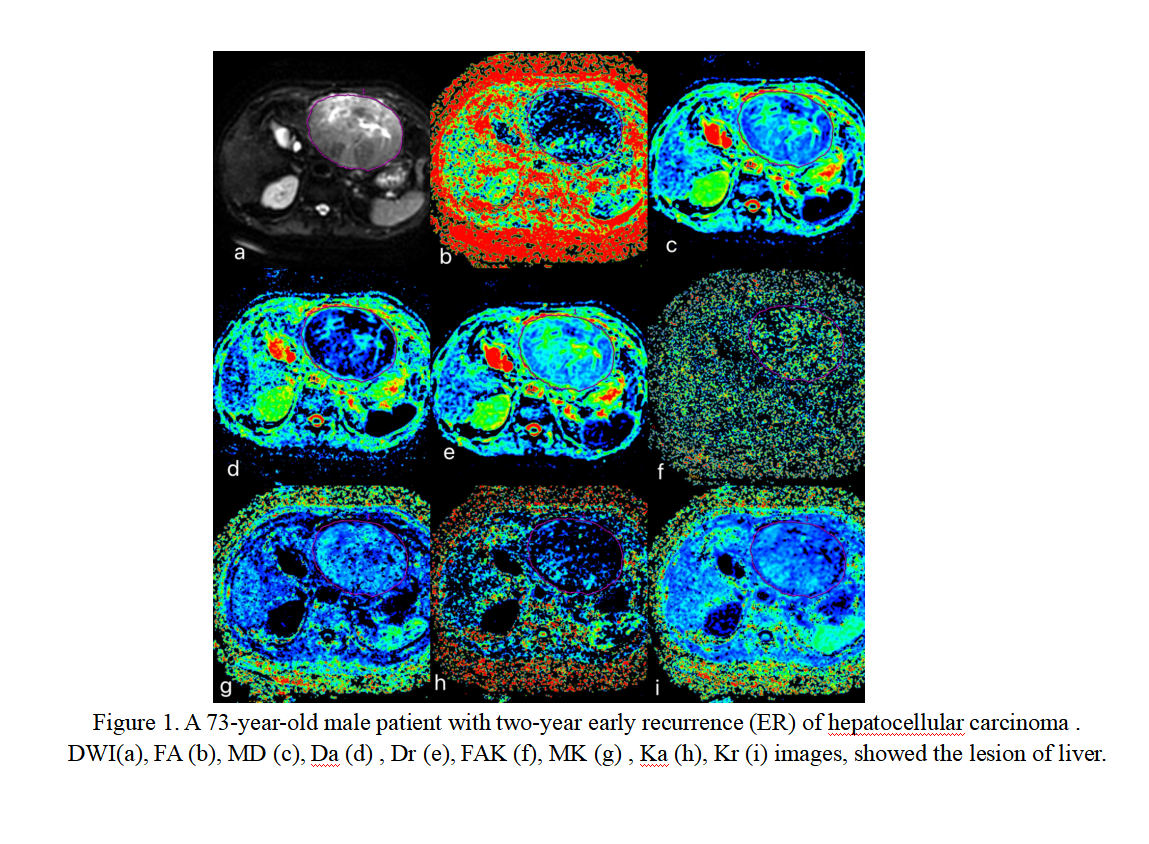
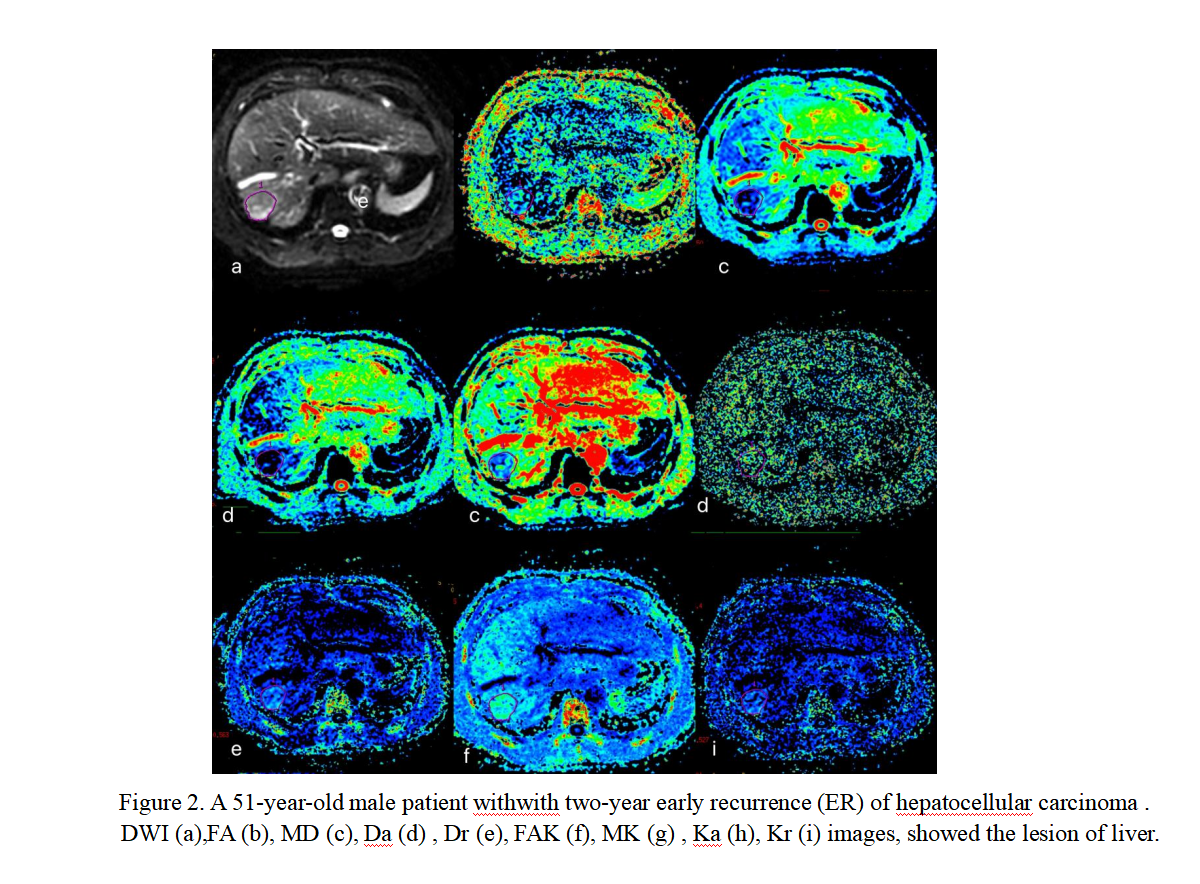
This study has been approved by the local IRB. A total of 35 cases with HCC in our hospital were retrospectively analyzed.They were divided into the early recurrence (ER) group (20 cases) and non-early recurrence (NER) group (15 cases) according to two years postoperative follow-up.Routine MRI Ax T1 FSPGR, Ax T2 FSE, DWI sequence, Dual echo sequence, DKI sequence were acquired. Quantitative DKI-derived maps, including FA, MD, Da, Dr, FAK, MK, Ka, and Kr were automatically generated from DKI sequence by using the Functool software on GE AW 4.6 workstation. Referring to the lesion information obtained on DWI images, the FA, MD, Da, Dr, FAK, MK, Ka, and Kr maps were imported into the 3DSlicer-5.0.3 andAll images were analyzed by two abdominal radiologists (with 8 and 4 years of experience in abdominal imaging) who were blinded to the histopathological results. The whole tumor was incorporated into the volume of interest (VOI) in the DWI images of b800 using 3D slicer (version 5.0.3), an open source image processing software (www.slicer. org), with DWI images as the references. ROI Based on the lesion layer The area of the tumor should be as large as possible. The parameters of different DKI maps were calculated by the in-house prototyping software developed in 3DSlicer-5.0.3. The average values of each parameter map of all tumor sections were used for further statistical analysis. All data were analyzed using SPSS Ver.27.0 (SPSS Inc., Chicago, IL, USA).The significance of the inter-group difference of continuous data were determined using the nonparametric Mann-Whitney U-test for normally or non-normally distributed data. Receiver operating characteristic (ROC) analysis was performed to evaluate diagnostic performance. A two-tailed P value less than 0.05 was considered to be statistically significant.Result
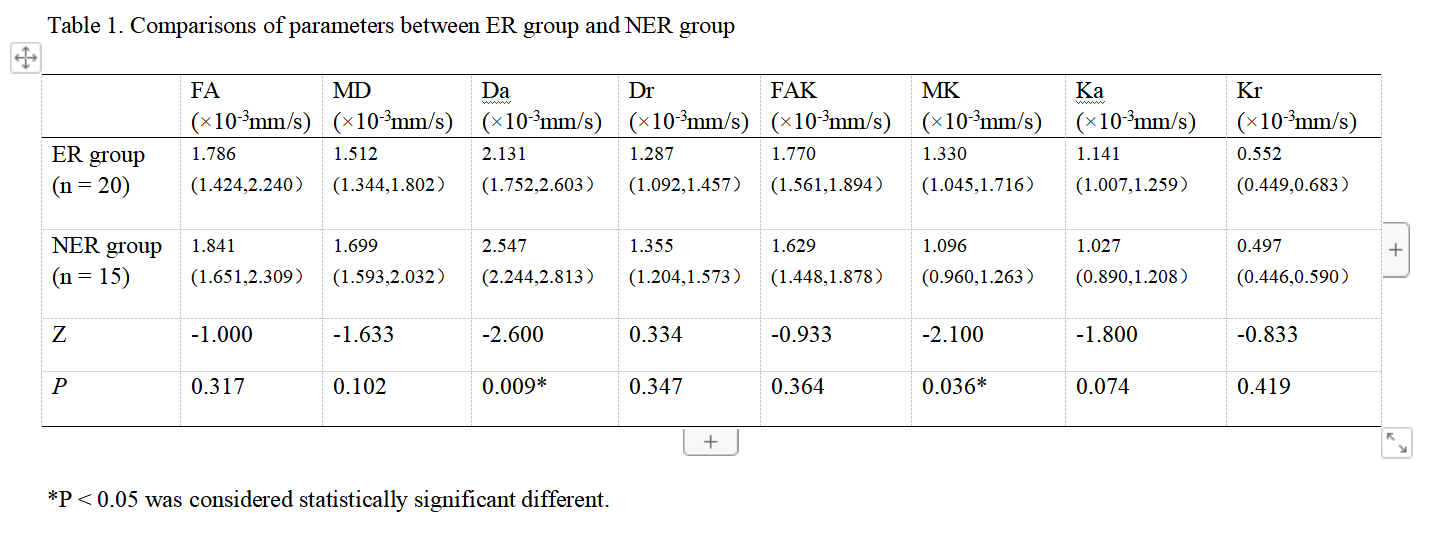
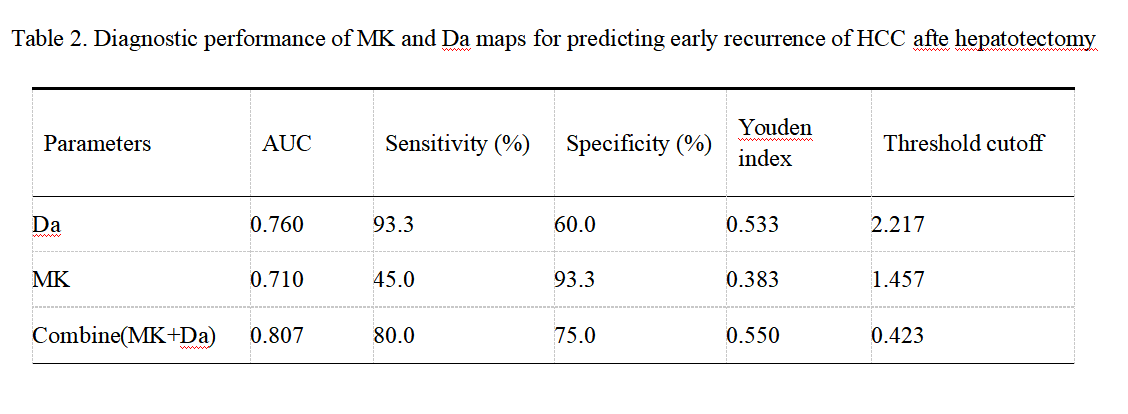
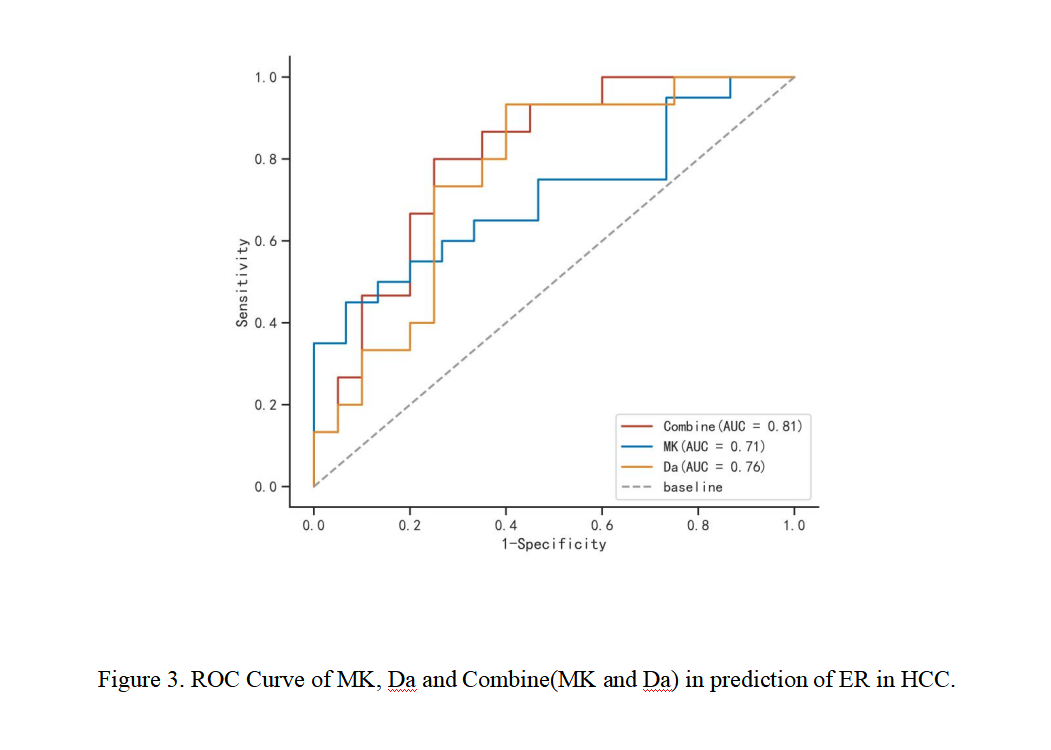
Table 1 shows the comparisons of parameters between ER group and NER group . The values of MK of NER group were significantly lower than those of the ER group (P < 0.05). The values of Da of NER group were higher than those of the ER group (P < 0.05). Table 2 shows the AUC of MK and Da for prediction of ER were 0.710, 0.760 and combination (MK+Da) were 0.807, respectively. When combination (MK+Da), the AUC was improved with a sensitivity of 80.0% and a specificity of 75.0% (cut-off value :0.423) .Discussion and Conclusion
According to the latest statistics, hepatocellular carcinoma (HCC) is the fifth most common cancer and the second most common cause of deaths in China[3]. LR and LT are currently the most important treatments. Neverless, the recurrence rates of the treatments tend to be high[5]. In this study, MK value of the ER group was higher than that of the NER group, this maybe because that the presence of tumor emboli or tumor cell clusters in the portal vein, hepatic vein, or intravascular branch of the sac may limit the interaction of water molecules closest to the cell membrane in the extracellular heterogeneous medium in ER group. Da value is lower in the ER group, which is consistent with the theory that higher kurtosis values indicate that water molecules disperse farther from the Gaussian distribution. This is consistent with the theory that larger kurtosis values indicate that the water molecule dispersion deviates from the Gaussian distribution, suggesting a more disturbed tissue structure. In conclusion, DKI parameters may be potential biomarkers for predicting MVI in HCC patients, which can provide surgeons with good prognostic information and better guide the choice of clinical surgery options.Acknowledgements
noneReferences
[1]A. Forner, M. Reig, J. Bruix, Hepatocellular carcinoma, Lancet 391 (10127) (2018) 1301–1314.
[2]S. Nakagawa, L. Wei, W.M. Song, T. Higashi, S. Ghoshal, R.S. Kim, C.B. Bian, S. Yamada, X. Sun, A. Venkatesh, N. Goossens, G. Bain, G.Y. Lauwers, A.P. Koh, M. El-Abtah,,Y. Hoshida, Molecular liver cancer prevention in cirrhosis by organ transcriptome analysis and lysophosphatidic acid pathway inhibition, Cancer Cell 30 (6) (2016) 879–890.
[3]Zhao Wei,Liu Wenguang,Liu Huaping,Yi Xiaoping,Hou Jiale,Pei Yigang,Liu Hui,Feng Deyun,Liu Liyu,Li Wenzheng. Preoperative prediction of microvascular invasion of hepatocellular carcinoma with IVIM diffusion-weighted MR imaging and Gd-EOB-DTPA-enhanced MR imaging.[J]. PloS one,2018,13(5).
[4] Tang L, Sui Y, Zhong Z, Damen FC, Li J, Shen L, et al. Non-Gaussian diffusion imaging with a fractional order calculus model to predict response of gastrointestinal stromal tumor to second-line sunitinib therapy. Magn Reson Med 2018;79(3):1399–406.
[5]Expert consensus on multidisciplinary diagnosis and treatment of precancerous lesions of hepatocellular carcinoma (2020 edition) [J]. J Clin Hepatol, 2020, 28(1): 14-20. DOI:10.3760/cma.j.issn.1007-3418. 2020.01.005.
Figures