2380
DeepRF for simulatneous multislice pulses
Jiye Kim1, Hongjun An1, Chungseok Oh1, Berkin Bilgic2,3, and Jongho Lee1
1Department of Electrical and Computer Engineering, Seoul National University, Seoul, Korea, Republic of, 2Department of Radiology, Havard Medical School, Boston, MA, United States, 3Athinoula A. Martinos Center for Biomedical Imaging, Charlestown, MA, United States
1Department of Electrical and Computer Engineering, Seoul National University, Seoul, Korea, Republic of, 2Department of Radiology, Havard Medical School, Boston, MA, United States, 3Athinoula A. Martinos Center for Biomedical Imaging, Charlestown, MA, United States
Synopsis
Keywords: Pulse Sequence Design, Machine Learning/Artificial Intelligence
DeepRF1 is a recently proposed RF pulse design method2-5 using deep reinforcement learning and optimization, generating an RF pulse defined by a reward (e.g., slice profile and energy constraint) from self-learning. Here, we proposed an improved algorithm for DeepRF that incorporates a modulation function to design an simultaneous multislice6 RF pulse. The new algorithm is tested and compared with the original multiband9 pulses, reporting reduced RF energy while preserving the characteristics of the original slice profile. Additionally, a multiPINS8 like inversion pulse is designed to demonstrate the usefulness of DeepRF for a non-constant slice selective gradient.
Introduction
Simultaneous multislice (SMS) imaging6, which acquires multiple slices simultaneously, is widely used in MR imaging to reduce the scan time. Despite this advantage, SMS RF pulses have higher RF energy deposition compared to single-slice pulses, suffering from a high specific absorption rate (SAR). A recently proposed deep reinforcement learning (DRL)-powered RF design method, DeepRF1, has successfully designed diverse types of RF pulses with reduced RF energy (ENG). DeepRF is able to design various type of pulses because the algorithm is driven only by a user-defined reward that includes slice profile specifications and RF energy. In this work, we utilize DeepRF to design a simultaneous multislice RF design pulse. To improve the performance, we propose to incorporate a modulation function in the RF generation step of DeepRF. Multiband (MB) factors 2 and 3 pulses are designed. Additionally, a multiPINS–like inversion pulse is designed to demonstrate the usefulness of DeepRF for a non-constant slice selective gradient.Methods
Conventional RF pulse designThe SMS inversion pulses are designed using multiband7 (MB factor = 2, 3) and multiPINS8 (MB factor = 3). For the multiband RF pulse with MB = 2, the parameters are as follows: pulse duration = 2.36 ms, time-bandwidth product = 1.94, slice thickness = 0.3 mm. The parameters for the multiband RF pulse with MB = 3 are as follows: pulse duration = 3.0 ms, time-bandwidth product = 1.3, and slice thickness = 0.3 mm. For the multiPINS RF pulse (MB =3), the parameters are pulse duration = 2.10 ms, time-bandwidth product = 1.3, and slice thickness = 0.3 mm.
SMS pulse design using DeepRF
DeepRF consists of two steps: The DRL step designing a large number of seed RFs and the gradient descent step optimizing top-scored seed pulses for performance improvement. For the multiband-like pulse design, we added a modulation function into the DRL step: When the DRL agent designs the magnitude and phase of an RF pulse, the RF pulse is translated to the complex domain and the pre-defined modulation function is multiplied (Fig 1a). The pre-defined modulation function is determined by the sum of sinusoidal functions whose frequencies ($$$f_{mod}$$$ ) are of which the modulation frequency of the original multiband pulse ($$$cos(f_{mod}t)$$$; $$$f_{mod}=2\pi\gamma G_{ss}z$$$ where $$$G_{ss}$$$: slice selection gradient and $$$z$$$: physical offset). To measure the effect size of modulation function, another RF pulse is also designed using the original DeepRF without a modulation function. For the multiPINS-like pulse design, DeepRF is used with the zig-zag slice-selective gradient of the multiPINS pulse instead of a uniform gradient (Fig 1b). An RF energy term and $$$L_2$$$ loss of $$$M_z$$$ between the designed RF and original SMS are used as a reward function for all pulse designs. The target inversion frequency range is -13000 Hz to 13000 Hz, excluding the frequency range out of field-of-view (don’t care region). DeepRF is implemented using PyTorch10 in Nvidia RTX 8000 GPUs (Nvidia Corp., Santa Clara, CA).
Ablation study: Optimizing original RF pulse using gradient descent
To illustrate the necessity of the DRL step of DeepRF, an ablation study is carried out. The conventional method-designed RF pulses are further optimized using gradient descent. The reward functions, which are minimized via gradient descent, are the same as those of DeepRF.
Results
For the multiband-like pulses, DeepRF with modulation function results show the ENG reduction of 4.5% and 4.4% for MB = 2 and MB = 3, respectively with comparable or slightly degraded slice profiles when compared to the multiband pulses. The RF pulses designed by DeepRF with no modulation function show slightly increased ENG and more degraded slice profiles, demonstrating the advantages of applying the modulation functions in DeepRF. On the other hand, the multiband RF pulses with optimization using gradient descent do not show substantial reductions in ENG (Figs. 2, 3).In Figure 4, the results of the multiPINS-like RF pulse design are shown. The RF ENG of DeepRF and optimized multiPINS RF pulses with gradient descent report a reduction of 11.9% and 4.2% for DeepRF and multiPINS with gradient descent, respectively when compared to the conventional multiPINS pulse, demonstrating the advantage of DeepRF. The slice profiles are similar but DeepRF shows a slightly increased stopband ripple.
Conclusion and Discussion
In this study, we modified DeepRF to design simultaneous-multislice inversion RF pulses. The results showed that designing multiband- and multiPINS-like RF pulses with reduced energy is possible using DeepRF. Adding the modulation function into the DeepRF algorithm seems to help to reduce the computational complexity of DeepRF, producing better results. However, the original DeepRF results still show similar-shaped pulses despite the fact that DeepRF had no knowledge of the multiband- or multiPINS RF pulses. In the slice profiles, DeepRF and DeepRF with modulation designed pulses had additional ripples in the don’t care region, which may be the origin of the degree of freedom in DeepRF. The slight degradation of the slice profiles was difficult to control both in DeepRF and conventional methods because they are at the boundary of the condition (e.g., maximum of TBW). DeepRF may be applied to design other types of RF pulse such as parallel transmit pulses, that have more degree of freedom for optimization.Acknowledgements
This work was supported by the National Research Foundation of Korea(NRF) grant funded by the Korea government(MSIT) (No. NRF-2022R1A4A1030579) and BK21 FOUR program of the Education and Research Program for Future ICT Pioneers, Seoul National University.References
[1] Dongmyung Shin, et al. “Deep Reinforcement Learning Designed RadioFrequency Waveform in MRI.”, Nature Machine Intelligence, 3 (2021): 985-994.[2] Vinding M.S, et al. “DeepControl: 2DRF pulses facilitating inhomogeneity and B0 off‐resonance compensation in vivo at 7 T.” Magnetic Resonance in Medicine, 85.6 (2021): 3308-3317.
[3]Vinding, Mads Sloth et al. “Ultrafast (milliseconds), multidimensional RF pulse design with deep learning.” Magnetic resonance in medicine vol. 82,2 (2019): 586-599. doi:10.1002/mrm.27740
[4] Eberhardt, Boris, et al. "B1 field map synthesis with generative deep learning used in the design of parallel-transmit RF pulses for ultra-high field MRI." Zeitschrift für Medizinische Physik (2022).
[5] Sørensen, Christoffer Bro. Applications of Deep Neural Networks in Pulse Design with Parallel Transmission for Ultra-High Field MRI. MS thesis. NTNU, 2020.
[6] Larkman, D J et al. “Use of multicoil arrays for separation of signal from multiple slices simultaneously excited.” Journal of magnetic resonance imaging, 13,2 (2001): 313-7.
[7] Souza, S P et al. “SIMA: simultaneous multislice acquisition of MR images by Hadamard-encoded excitation.” Journal of computer assisted tomography vol. 12,6 (1988): 1026-30.
[8] Eichner, Cornelius, et al. “A low power radiofrequency pulse for simultaneous multislice excitation and refocusing.” Magnetic resonance in medicine vol. 72,4 (2014): 949-58.
[9] Norris, David G et al. “Power Independent of Number of Slices (PINS) radiofrequency pulses for low-power simultaneous multislice excitation.” Magnetic resonance in medicine vol. 66,5 (2011): 1234-40.
[10] Paszke, A. et al. “PyTorch: An Imperative Style, High-Performance Deep Learning Library.” Advances in Neural Information Processing Systems, 32 (2019): 8024–8035.
Figures
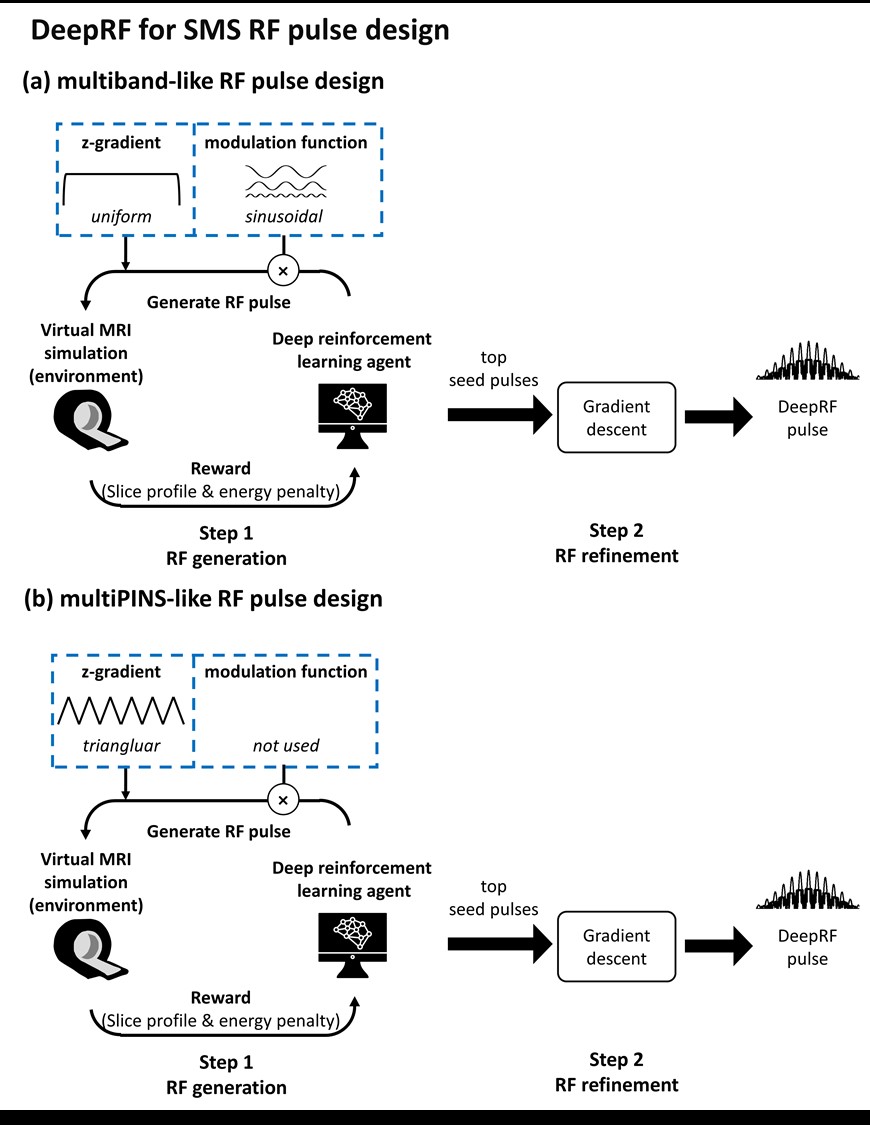
Figure 1. Overview of DeepRF for
SMS RF pulse design. (a) multiband-like RF pulse design with sinusoidal modulation
function and uniform z-gradient. (b) multiPINS-like RF pulse design with fixed
triangular z-gradient. In the first step of DeepRF, DRL agent generates RF seeds for target RF properties defined by reward
function. The RF seeds are then multiplied by pre-defined modulation
function. The pre-defined modulation function is a sinusoidal function with a
fixed frequency. Then the top 256 reward seeds are selected as the input for
optimization using gradient descent.
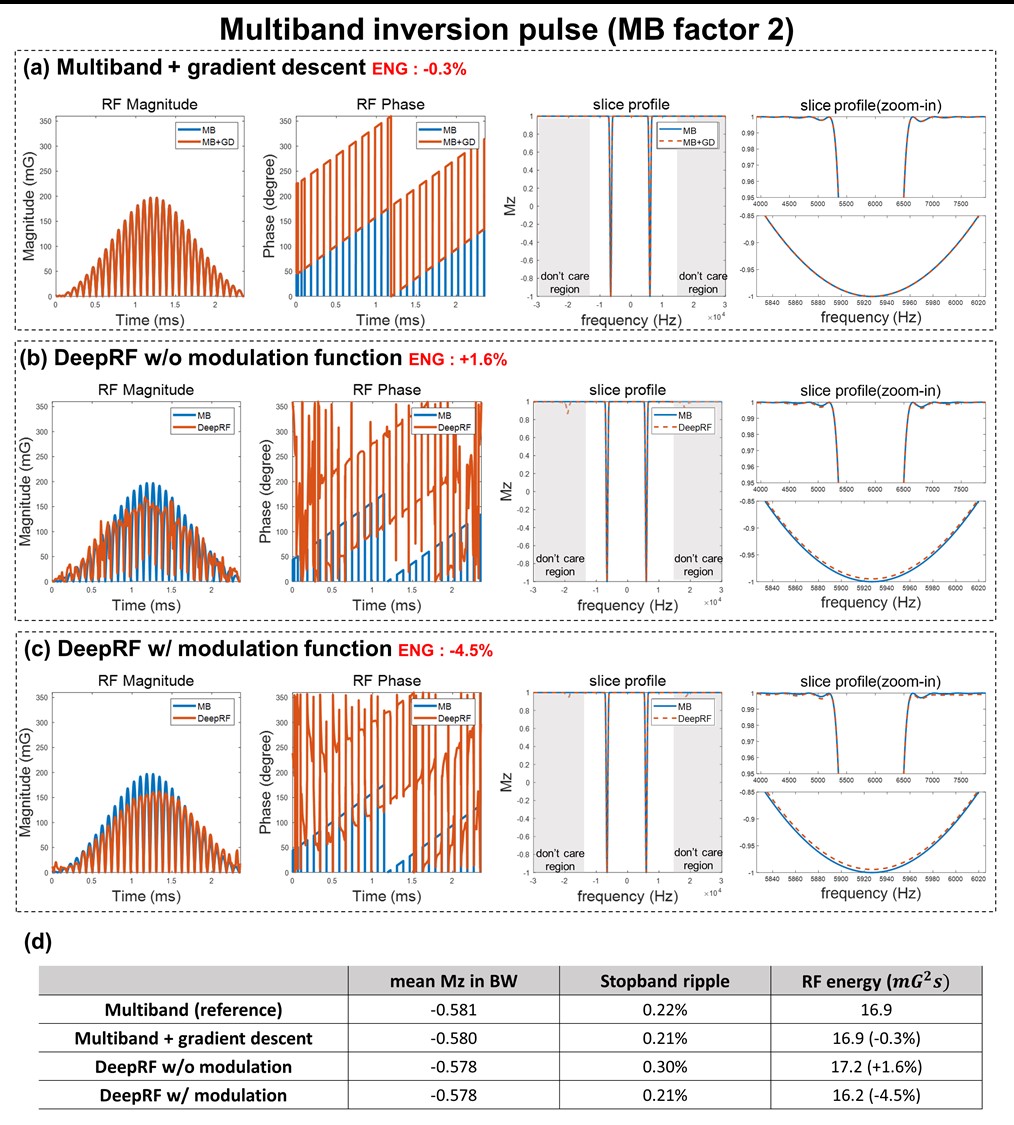
Figure 2. Comparison of the SMS (MB = 2) slice-selective inversion
pulses: multiband vs. (a) optimized multiband RF using gradient descent only
(MB+GD), (b) DeepRF without modulation function, and (c) DeepRF with modulation
function. DeepRF with modulation shows comparable slice profiles to multiband
with energy reduction of 4.5%, while original DeepRF yields degraded results.
Shaded area in slice profile is out of field-of-view. The optimized
multiband RF shows comparable slice profiles to those of multiband but shows
less energy reduction. (d) Summary of quantitative metrics.
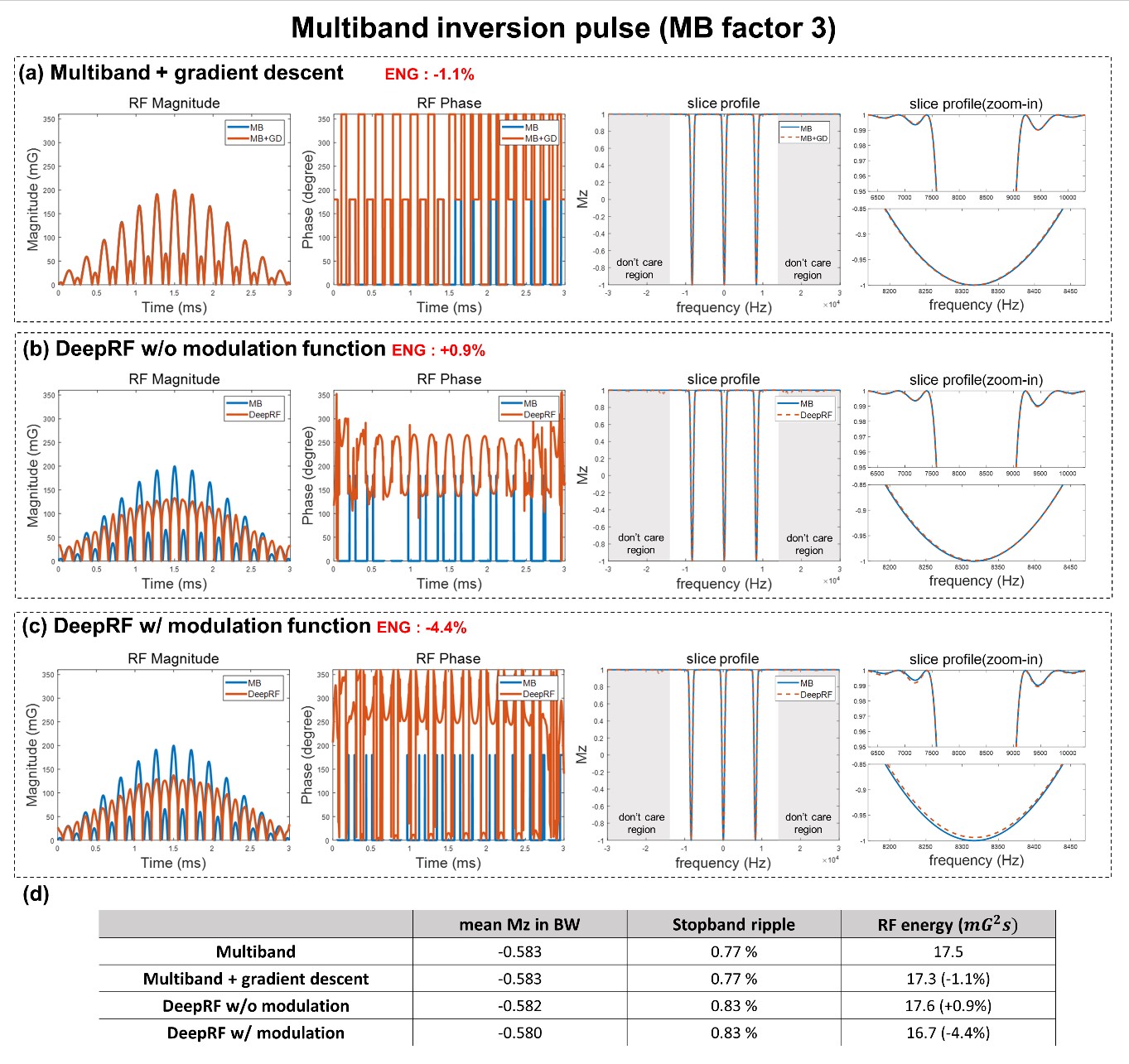
Figure
3.
Comparison of the SMS (MB = 3) slice-selective inversion pulses:
multiband vs. (a) optimized multiband RF using gradient descent only (MB+GD),
(b)
DeepRF without modulation function (c) DeepRF with modulation function DeepRF with modulation shows comparable slice profiles to
multiband with energy reduction of 4.4%, while RF of original DeepRF shows
increased RF energy (+0.9%). Shaded area in slice profile is the don’t care region
(out of FOV). Optimized multiband RF shows comparable slice profiles but shows
RF energy reduction of 1.1%. (d) Summary of quantitative metrics.
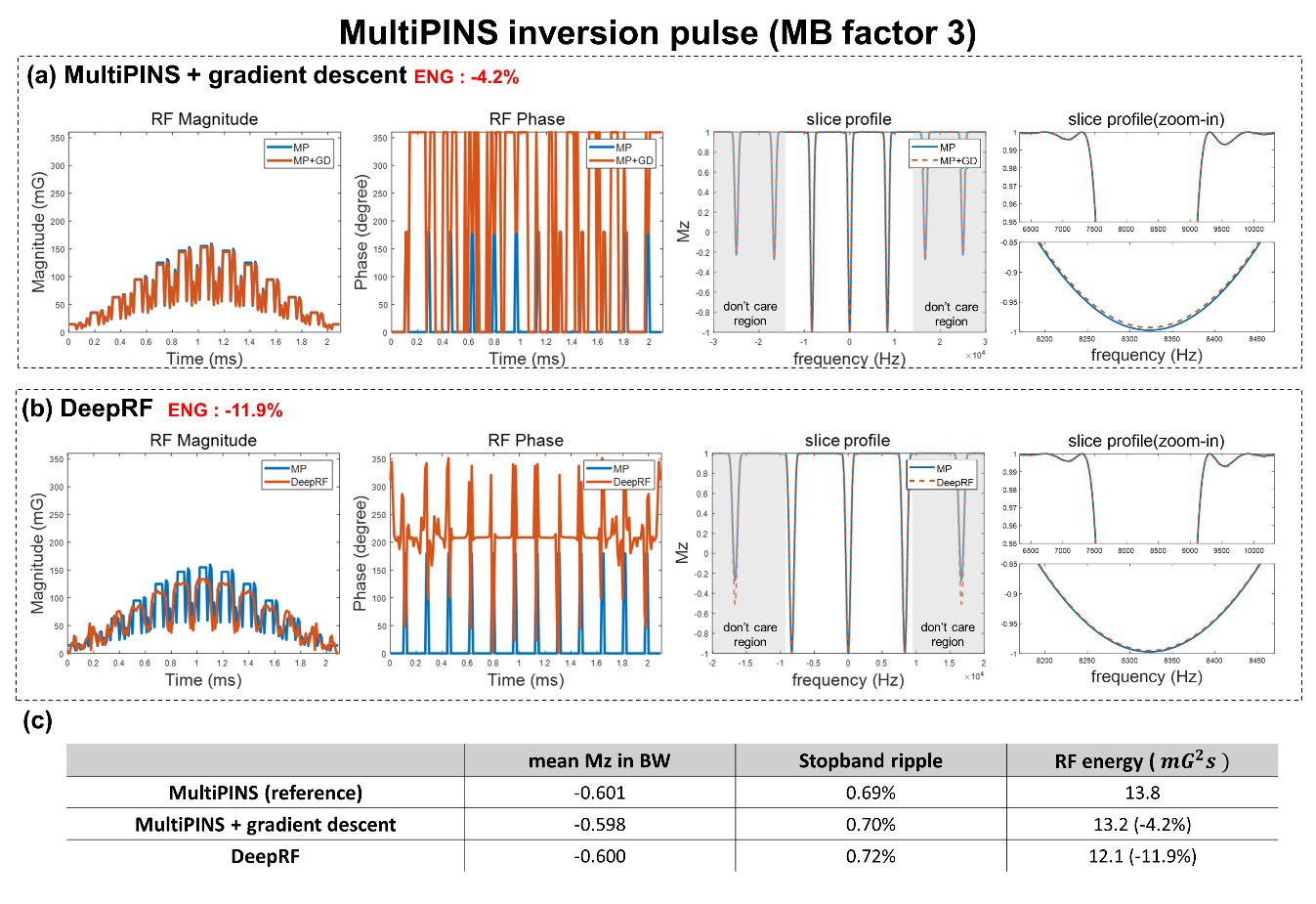
Figure 4. Comparison of the SMS (MB = 3) slice-selective inversion pulses using (a) Optimized multiPINS RF using gradient descent only vs. multiPINS, and (b) DeepRF with vs. multiPINS (MP), The RF of DeepRF shows comparable slice profiles (mean Mz in BW: -0.6, stopband ripple: 0.7%) to those of multiPINS with RF energy reduction of 11.9%, while the optimized multiPINS RF shows comparable slice profiles to those of multiPINS but shows an RF energy reduction of 4.2%. (c) Summary of quantitative metrics.
DOI: https://doi.org/10.58530/2023/2380