2379
View ordering in PROPELLER for MSK applications
Henric Rydén1, Adam van Niekerk1, Matea Borbas2, and Mikael Skorpil3
1Clinical Neuroscience, Karolinska Institutet, Stockholm, Sweden, 2Karolinska University Hospital, Stockholm, Sweden, 3Karolinska Institutet, Stockholm, Sweden
1Clinical Neuroscience, Karolinska Institutet, Stockholm, Sweden, 2Karolinska University Hospital, Stockholm, Sweden, 3Karolinska Institutet, Stockholm, Sweden
Synopsis
Keywords: Pulse Sequence Design, Data Acquisition, FSE, RARE, PROPELLER
A novel view ordering scheme for RARE (FSE/PROPELLER) imaging is proposed and compared with the vendor solution, particularly suited for MSK applications where intermediate TE is desired.Introduction
In musculoskeletal imaging PD FSE sequences are excellent for anatomy and detecting pathology in tendons, ligaments, articular cartilage and fibrocartilage. In order to optimize contrast TE is approximately 20-45 ms (1), i.e. slightly longer than in traditional PD weighting. Motion artifacts can be a problem, especially in uncooperative patients and also specifically for the cervical spine and shoulder. PROPELLER sampling can be used to mitigate the sensitivity to motion artifacts by a continuous averaging of the object (2).In order to have an intermediate TE of 20-45 ms, view ordering for conventional multishot FSE is segmented, in which a partial Fourier sampling is performed first in a linear fashion. Later shots acquire the missing lines, also linearly. This requires more than two shots to avoid superfluous echoes and is therefore not applicable to PROPELLER sequences. Instead, the vendor solution is to apply a circular shift to a linear acquisition ordering to enable arbitrary effective echo times. The amount of shift determines the center echo as exemplified in Figure 1a.
The use of a circular shift results in a sharp signal discrepancy due to T2 relaxation since the first and last echo within shots are adjacent in k-space, causing T2 blurring and ripple (3). A benefit of the circular shift method is that all other segments in k-space have a TE difference of a single echo spacing.
The proposed method LCPO (linear center, pivot outer) maintains that single echo spacing difference in the center of k-space, and spreads the remaining echoes using a pivoting pattern as shown in Figure 1b. The proposed method is a generalization of the well known linear and center-out encoding pattern for an arbitrary center echo.
This abstract investigates the impact of LCPO view ordering compared to the conventional circular shift in PD imaging with an intermediate TE for musculoskeletal imaging.
Methods
LCPO view ordering was implemented in a PROPELLER and FSE sequence using the KS Foundation framework (4). The sequence is shown Figure 2.FSE phantom scans were acquired using LCPO and circular shift with TR/TE = 3000/50 ms, ETL 16, matrix size 512x512 FOV = 240 mm.
Sagittal PD-weighted PROPELLER images of the ankle were acquired on a 3T GE Premier system with TR/TE = 3000/35 ms, ETL 16, blade dimensions 512x32, FOV 360 mm.
Results
The phantom scan (Figure 3) shows ringing in the phase encoding direction with circular shift, which is reduced in LCPO.In vivo LCPO images were sharper and more detailed compared to those acquired with circular shift ordering. There is better delineation of the thin cartilage in the talocalcaneal joint, the talocalcaneal ligament, bone trabeculae and subcutaneous tissue, as indicated in Figure 4.
Discussion
The LCPO method with center index 0 is identical to the established center-out view ordering technique. When the center index equals ETL/2, LCPO ordering is identical to linear ordering. With other center indices, LCPO serves as an extended version of center-out and linear ordering that can be used for any number of shots.The continuous development of coils and sequences have led to high resolution PD FSE musculoskeletal images. TE is intermediate to display fluid more hyperintense and be more sensitive to pathology. To further improve images LCPO was used and shown to be sharper and detailed, which is due to less T2 blurring and ringing.
Conclusion
LCPO (linear-center, pivot-outer) view ordering is especially useful for musculoskeletal PD FSE sequences, since an intermediate TE of 20-45 ms is preferred, with less blurring compared to conventional circular shift. Furthermore, it enables using PROPELLER, which cannot be sampled segmented.Acknowledgements
No acknowledgement found.References
1. Del Grande F, Guggenberger R, Fritz J. Rapid Musculoskeletal MRI in 2021: Value and Optimized Use of Widely Accessible Techniques. AJR Am. J. Roentgenol. 2021;216:704–717.
2. Pipe JG. Motion correction with PROPELLER MRI: application to head motion and free-breathing cardiac imaging. Magn. Reson. Med. 1999;42:963–969.
3. Bernstein MA, King KF, Zhou XJ. Handbook of MRI pulse sequences. Elsevier Academic Press; 2004 pp. 550–551.
4. Skare S, Avventi E, Norbeck O, Rydén H. An abstraction layer for simpler EPIC pulse programming on GE MR systems in a clinical environment. In: Proceedings of the 25th Annual Meeting of the ISMRM, Honolulu, Hawaii. ; 2017. p. 3813.
Figures
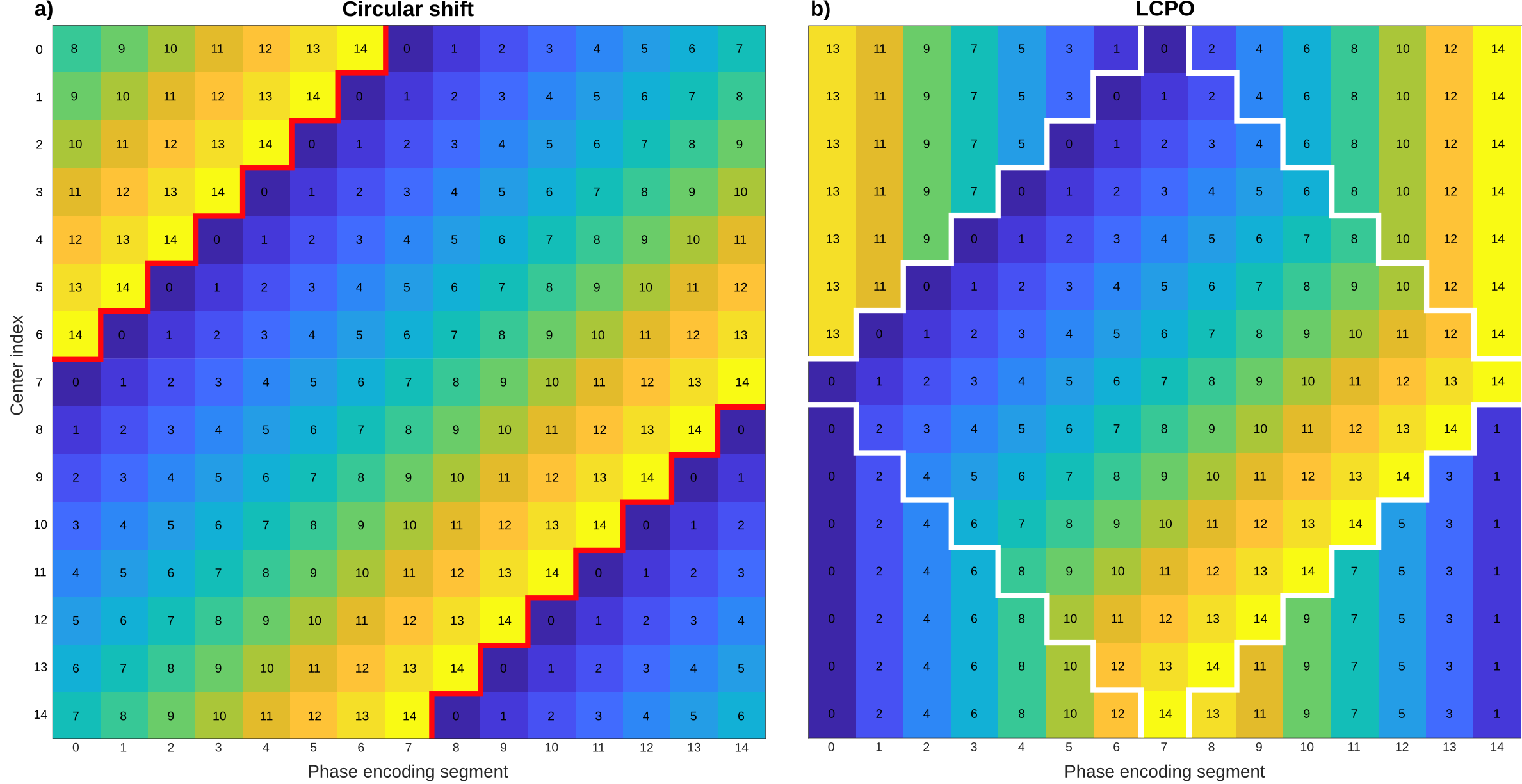
View ordering using the vendor solution of circular shifts with a scan where the echo train length is 15. Each row represents a specific center index. The large T2 discrepancy is indicated by a red border in a, and is reduced in b using the proposed LCPO ordering. Phase encodes are acquired in a linear order within the white borders in b, and in a pivoted fashion outside.
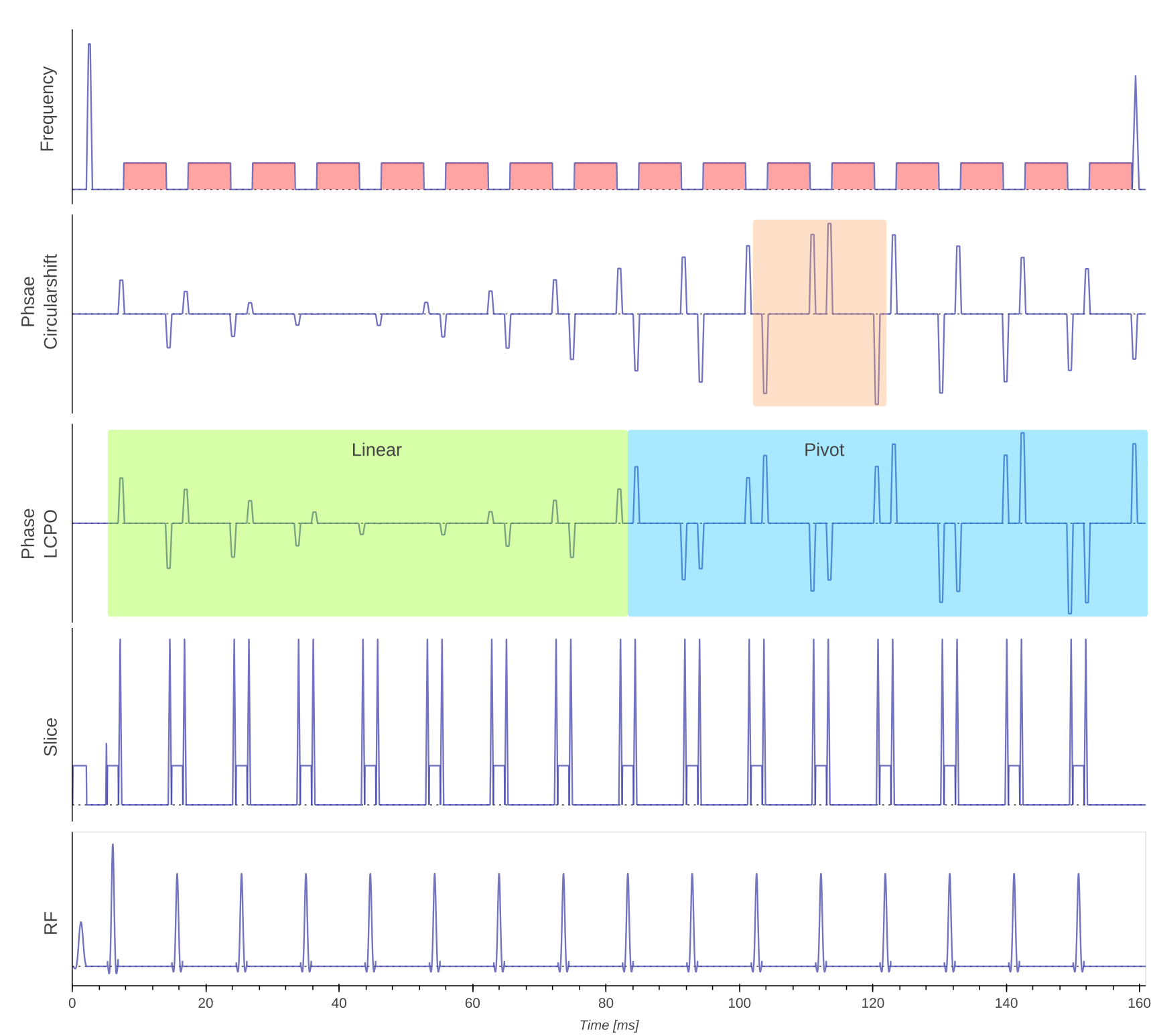
RARE pulse sequence implementation of LCPO and circular shift. The linear section of LCPO is marked green, and the pivoting in blue. The sharp signal transition in circular shift is due to the phase encodes highlighted in orange. Shaded areas during the readouts indicate sampling.
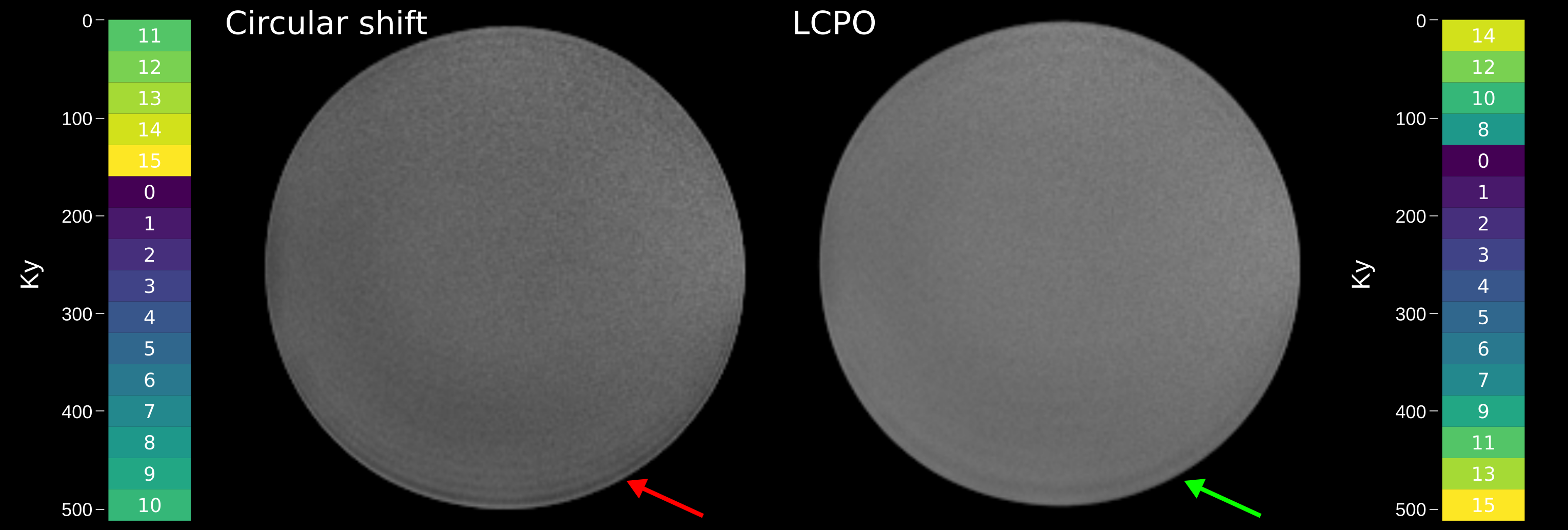
Phantom scans with a 2D FSE sequence with ETL 16, comparing the effect of view ordering using circular shifts, and LCPO. Ringing is seen near the edges of the phantom in the phase encoding direction, which is reduced in LCPO.
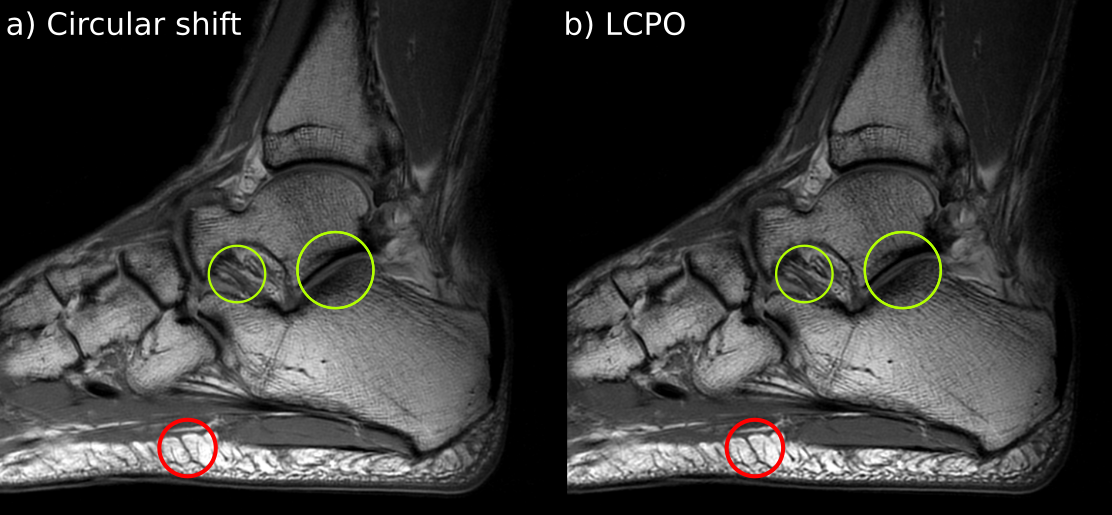
Sagittal ankle images with intermediate TE acquired with different view ordering. The proposed LCPO ordering is overall sharper.
DOI: https://doi.org/10.58530/2023/2379