2323
Deuterated Vitamin C as a new probe for the assessment of in vivo oxidative stress using deuterium metabolic imaging and 13C HP MRS
Saket Patel1, Nathaniel Kim1, Thasin Peyear1, and Kayvan R Keshari1
1Radiology, Memorial Sloan Kettering Cancer Center, Manhattan, NY, United States
1Radiology, Memorial Sloan Kettering Cancer Center, Manhattan, NY, United States
Synopsis
Keywords: Tumors, Deuterium, DMI, HP, Metabolism, Probes, Imaging agent
A chemical synthesis of C-4 deuterated ascorbic acid as a potential new deuterium metabolic imaging marker for in vivo VitC metabolism. Additionally, we have developed new HP methods for Vit C as well as its oxidized analogue, DHA, to be used as a 13C HP MRS substrates. Furthermore, deuteration increases the 13C T1 of HP DHA and improved polarization from optimized HP formulations along with enhanced 13C T1 will result in better quantification of oxidative stress in vivo. The aim is to implement both DMI and HP MRS in brain tumor models to understand the anticancer activity of VitC.Synopsis
Herein, we present, for the first time, a chemical synthesis of C-4 deuterated ascorbic acid as a potential new deuterium metabolic imaging marker for in vivo Vitamin C (VitC) metabolism. Additionally, we have developed new HP methods for Vit C as well as its oxidized analogue, dehydroascorbic acid (DHA), to be used as a hyperpolarized 13C magnetic resonance spectroscopy (13C HP MRS) substrates to access VitC/DHA metabolism in real time. Furthermore, deuteration increases the 13C T1 of HP DHA and improved polarization from optimized HP formulations along with enhanced 13C T1 will result in better quantification of oxidative stress in vivo. The aim is to implement both deuterium metabolic imaging (DMI) and HP MRS in brain tumor models to understand the anticancer activity of VitC, alone as well as VitC treatment in conjugation with radiation therapy.Introduction
Recently, VitC has been implicated as a potential therapeutic at high doses when administered IV. 1-6 The import and metabolism of VitC differs greatly among various cancer types due to differences in the tumor microenvironment as well as real time availability of Vit C when introduced. Leveraging non-invasive approaches to visualize VitC dynamics and metabolism in vivo would certainly improve the use of Vit C based cancer therapies as well as other antioxidant-based approaches. 7-8 In the recent decade, DMI and HP 13C MRS have emerged as very promising non-invasive and non-ionizing imaging modalities for examining the dynamic changes in tissue metabolism. 9 While metabolic investigation via HP MRS provides the metabolite uptake and its conversion rates to metabolic products, DMI provides metabolic insights beyond substrate uptake and at longer time scales. Although, HP 13C MRS provides far better signal to noise ratio and spatial resolution compared to DMI, HP MRS is limited by the 13C T1 and the clinical implementation resulting in very limited substrate very challenging clinical translation lack of clinically translational HP methods for metabolites other than pyruvate. To address the limitations of both methodologies, we have developed C-4 deuterated VitC for both 2H and HP 13C MRS.Methods
Isotopic deuterium labelling of VitC at C-4 position was achieved by chemical exchange under optimized reaction conditions and the percentage deuterium incorporation at C-4 was quantified using area under the curve of 13C NMR signal of C-4 VitC at 600 MHz NMR spectrometer. The hyperpolarization experiment was carried out on SpinLab polarizer (5 T; 0.8 K; GE). The frozen sample was polarized for about 1.5-2 hours and dissolved in 12 mL of D2O. Polarization and 13C T1 of each hyperpolarized substrate was measured at 1T (Magritek) by recording a 13C NMR spectra every 3s using a 5-degree flip angle. The 13C polarization and 13C T1 calculations were carried out using MATLAB software.Results
The deuterium isotopic labelling of VitC results in over 90% deuteration of ascorbic acid which is subsequently converted to deuterated DHA. In two reaction cycle of H and D exchange under alkaline conditions afforded ~ 90% deuterium incorporation. (Figure 1) The reaction provides a mixture of R and S symmetry at C-4 of VitC and the isomers were separated by fractional separation. The newly developed HP methods for DHA and VitC provides unprecedented ~35 % polarization for DHA and ~18 % for VitC compared to previously reported ~5-7% polarization for both substrates (Figure 2). 7-8Conclusions
We have shown the first synthesis and isolation of C-4 deuterated VitC and developed the optimized HP methods for several fold boost in the polarization for both DHA (~7 fold) and Vit C (~5 fold). Furthermore, the deuteration of VitC provides unique advantage for it to be employed as a DMI probe to better understand the anticancer activity and Vit C based cancer therapies. DMI together with HP MRS, have the potential to provide clinically relevant information to better understand and monitor the activity of Vit C in cancer therapy. The in vivo implementation of the developed imaging agent is currently underway.Acknowledgements
MSKCC and funding agencies.References
- Yun J, Mullarky E, Lu C, et al. Vitamin C selectively kills KRAS and BRAF mutant colorectal cancer cells by targeting GAPDH. Science. 2015, 350, 1391.
- Magrì A, Germano G, Lorenzato A, et al. High-dose vitamin C enhances cancer immunotherapy. Sci Transl Med. 2020, 12, eaay8707.
- Böttger F, Vallés-Martí A, Cahn L, Jimenez CR. High-dose intravenous vitamin C, a promising multi-targeting agent in the treatment of cancer. J Exp Clin Cancer Res. 2021, 40, 343.
- ClinicalTrials.gov Identifer: NCT01080352. Vitamin C as an Anti-cancer Drug.
- ClinicalTrials.gov Identifer: NCT00441207. Study of High-Dose Intravenous (IV) Vitamin C Treatment in Patients With Solid Tumors.
- ClinicalTrials.gov Identifer: NCT01050621. Trial of Chemotherapy Plus Intravenous Vitamin C in Patients With Advanced Cancer for Whom Chemotherapy Alone is Only Marginally Effective.
- Keshari KR, Kurhanewicz J, Bok R, Larson PE, Vigneron DB, Wilson DM. Hyperpolarized 13C dehydroascorbate as an endogenous redox sensor for in vivo metabolic imaging. Proc Natl Acad Sci U S A. 2011, 108, 18606.
- Bohndiek SE, Kettunen MI, Hu DE, et al. Hyperpolarized [1-13C]-ascorbic and dehydroascorbic acid: vitamin C as a probe for imaging redox status in vivo. J Am Chem Soc. 2011, 133, 11795.
- Kaggie JD, Khan AS, Matys T, et al. Deuterium metabolic imaging and hyperpolarized 13C-MRI of the normal human brain at clinical field strength reveals differential cerebral metabolism. Neuroimage. 2022, 257, 119284.
Figures
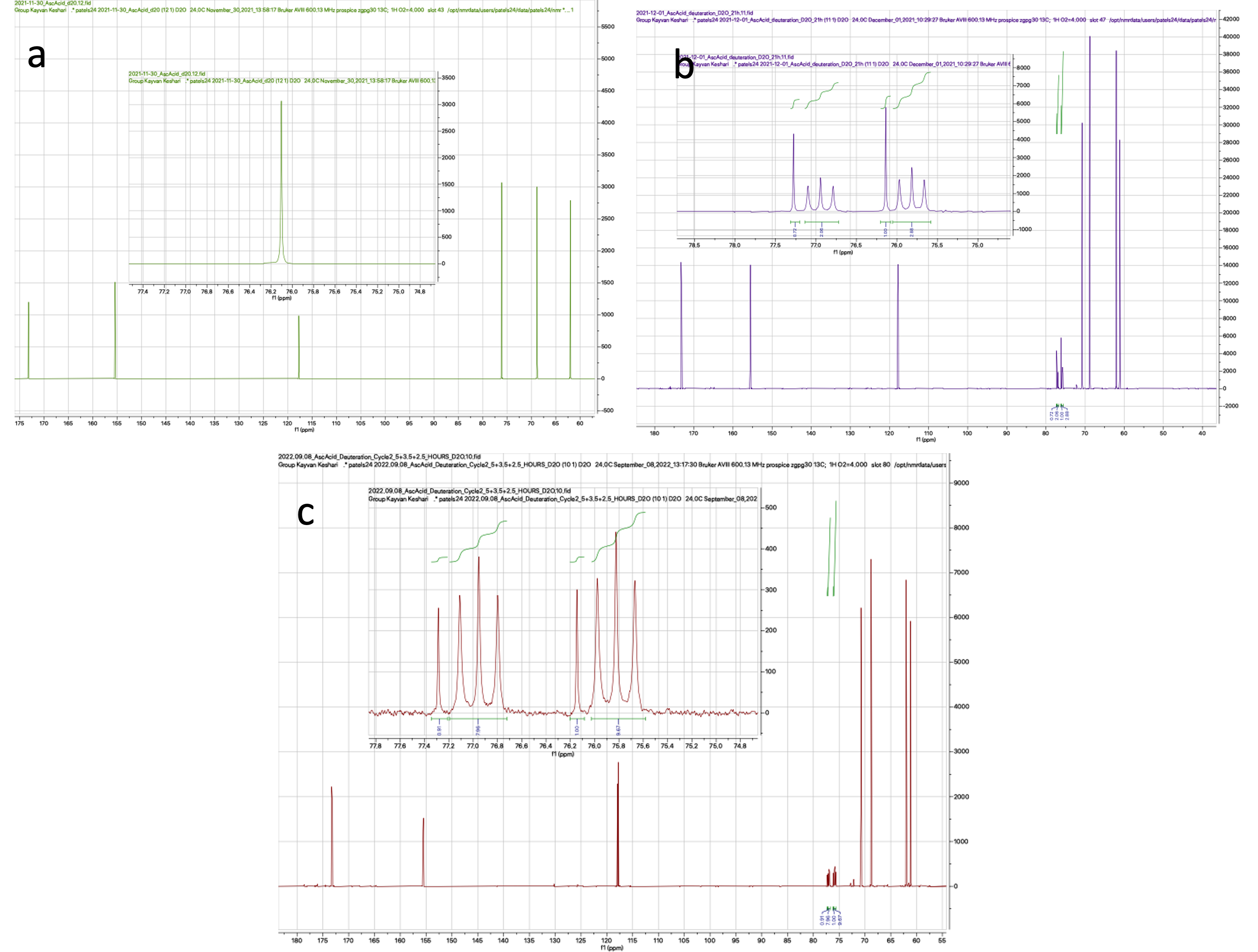
Progress of the deuteration of VitC followed by 13C NMR spectroscopy at different time points. The 13C NMR spectrum of the reaction at - a) t = 0 h; only VitC in the reaction with no deuteration. b) t = 21 h; 74 % deuteration for L-isomer after 21h of reaction. c) t = 21h +8 h. 92.3 % deuteration of L-VitC after 8 hours of reaction in second cycle. In 1c, the starting material was a product obtained from reaction time point b. The 13C NMR signal integral was used to quantify the percentage deuteration. The method for separation of both the isomers has successfully performed using fractional separation.
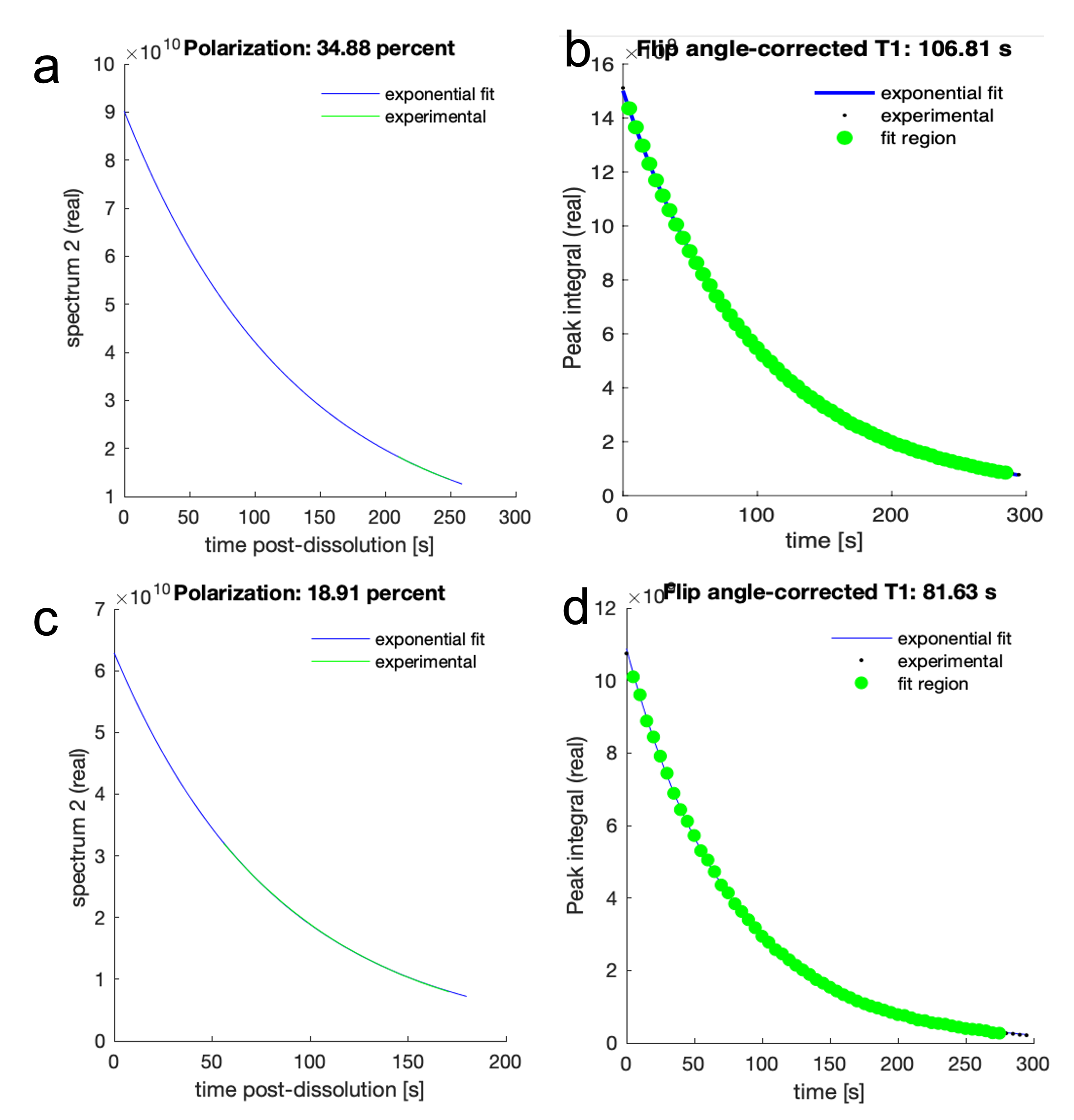
13C Hyperpolarization and 13C T1 of HP VitC and DHA, measured at 1T. a) 13C polarization of DHA; b) 13C T1 of DHA; c) 13C polarization of VitC; and d) 13C T1 of Vit C.
DOI: https://doi.org/10.58530/2023/2323