2227
Modified non-contrast enhanced spatially-selective time-resolved vessel imaging by using cylinder-shaped pre-saturation pulse train
Masahiro Takizawa1, Takashi Nishihara1, and Chikako Moriwake1
1FUJIFILM Healthcare Corporation, 2-1, Shintoyofuta, Japan
1FUJIFILM Healthcare Corporation, 2-1, Shintoyofuta, Japan
Synopsis
Keywords: Pulse Sequence Design, Lung
Cylinder-shaped pre-saturation pulse train is modified to achieve non subtract scheme for non-contrast enhanced spatially-selective and time-resolved vessel imaging. The target vessel is selected by cylinder-shaped pre-saturation, and the dynamics of blood flow in the target vessel is observed by changing the number of applied pre-saturation pulses. The developed pulse train was demonstrated to visualize dynamics of a target pulmonary vessel in the lung.Introduction
Pulmonary artery coil embolization (PACE) is often used to treat pulmonary arteriovenous malformations (PAVM). Before PACE, CT or contract enhanced (CE) time-resolved MRA is used to specify the target vessel. To label the blood flow, a few non-CE MRA method using IR or saturation pulse are developed. However, it is difficult to visualize the target vessel using conventional labelling pulses since the blood vessels have complex structure. We demonstrated non-CE selective lung imaging using a cylinder-shaped pre-saturation pulse (cylinder pulse) [1-2]. This method uses subtraction between labeled and non-labeled images to visualize the target vessel, therefore misregistration caused by patient motion becomes serious problem. In this study, we modified the sequence design to achieve non subtract scheme.Methods
Pulse sequence diagram Figure 1 shows the sequence diagram of the Cyl.-PSat pulse and the modified pulse train. To suppress residual vessel signals in the target area, a conventional saturation (Conv.-Sat) pulse, interval time between the Conv.-Sat pulse and main scan were introduced to the 3D FSE sequence. In this study, Cyl.-PSat pulse train following the Conv.-Sat pulse was used to suppress blood flow in the target vessel and the number of cylinders can be increased up to 48 to observe flow dynamics. Furthermore, Fatsat pulse was inserted between Cyl.-Psat and main scan to suppress artifacts from body wall motion.[Phantom experiment]
Experiment was conducted on a 3T whole body MRI system. A phantom with small constant flow was scanned to observe relationship between the flow distance and the Cyl.-PSat count. In this phantom, the target signal became null at the inversion time of 640 msec. So the Cyl.-PSat count were set to 4, 8, 12, 16, 20, 24, 28, and 32.
[Volunteer study]
The study was approved by the internal review board of FUJIFILM Healthcare Corp. The Cyl.-PSat was set for the pulmonary artery for the volunteer as shown in fig. 2. To visualize only inflow blood signal, the Conv.-Sat pulse was set on entire region of right lung. To set blood signal null in the target area at the point of excitation for main scan, FA of the Conv.-Sat pulse was set to 180 degrees. The interval time between the Conv.-Sat pulse and main scan was investigated using maximum number of Cyl-PSat count before experiment. And to achieve continuous suppression of inflow blood signal, the duration of Cyl.-PSat pulse was minimized (20msec). The sequence parameters were as follows; FOV 350mm, TR/TE 4000/41.4msec, slice# 144, thickness 2mm, matrix 256×140, and respiratory gating.
Results
[Phantom experiment]Figure 3 shows the result of the phantom experiment. By decreasing the Cyl.-PSat count, the water saturation length was increased, and the water gradually disappeared in the image.
[Volunteer study]
It was found that all blood flow signal were null when 850msec was used as the inversion time. As a result, the maximum number of the Cyl.-PSat with 850msec of the inversion time was 40. To visualize the flow dynamic, the Cyl.-PSat count were selected as 0 (no Cyl.-PSat), 10, 15, 20, 30, 35, and 40. Maximum intensity projection was used to show the whole flow dynamics of target vessel. The length of the visualized artery becomes longer when the Cyl.-PSat count decreases (Fig. 4).
Discussion
The phantom study and a volunteer study clearly demonstrated that the modified pulse train can visualize the flow dynamics of the spatially selected vessel. For the non-subtract scheme, it is important to adjust the interval time between the Conv.-Sat pulse and main scan to set blood signal null in the target area at the point of excitation for main scan. As for the vessel visualization, even no Cyl.-PSat case does not show veins in healthy volunteer. In the actual PAVM case, the blood flow in the target vein might be observed in the earlier phase than that in the normal vein. Therefore, it is expected that an interval time that is less than 1000 msec might be useful.Conclusion
Cylinder-shaped pre-saturation pulse train was modified to achieve non-subtracted blood flow imaging. It enabled changing the drawing length of the target vessel by changing the Cyl.-PSat count, which reflects the flow dynamics in the target vessel.Acknowledgements
No acknowledgement found.References
[1] T. Nishihara, et al. Selective MRA for Portal Venography Using Beam Saturation Pulse, 22nd ISMRM (2014), p. 1501.
[2] M. Takizawa, et al. Modified non-contrast enhanced spatially-selective and time-resolved vessel imaging by using cylinder-shaped pre-saturation pulse train in the Lung, ISMRM (2022), p. 4173.
Figures
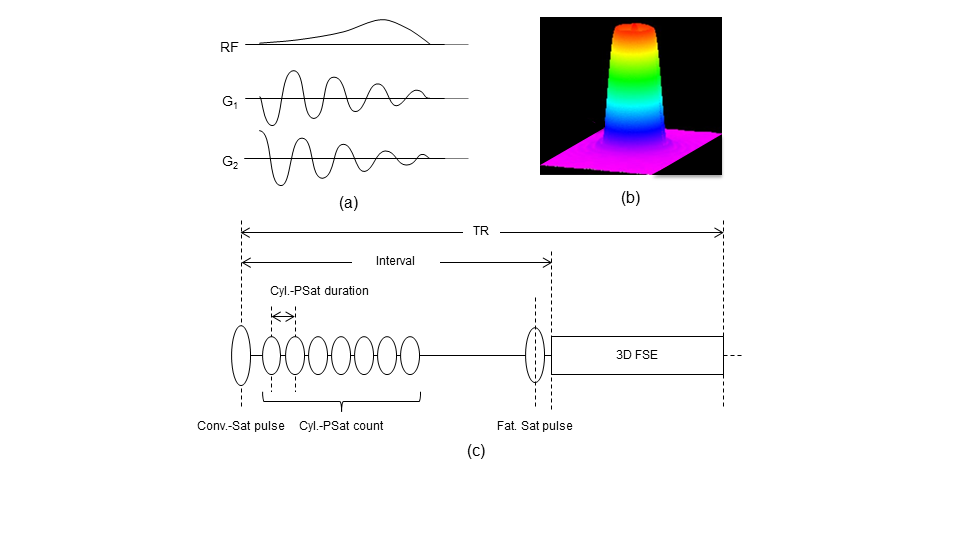
Figure
1 Pulse sequence diagram of Cyl.-PSat
pulse (a) and
excitation profile of the pulse (b). Pulse sequence diagram of 3D FSE with
developed Cyl-Psat
pulse train (c).
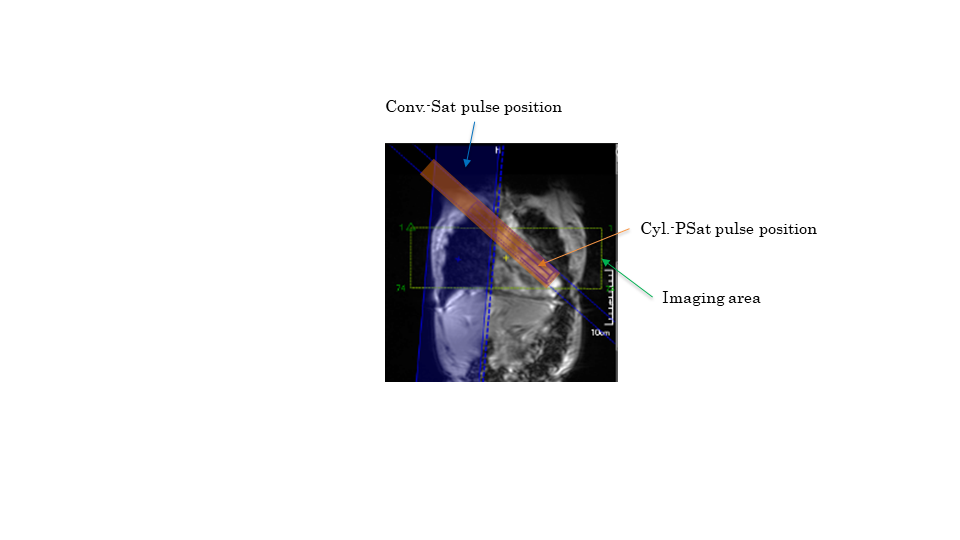
Figure 2
Each slice position of the proposed pulse train in the case of right lung
vessel imaging.
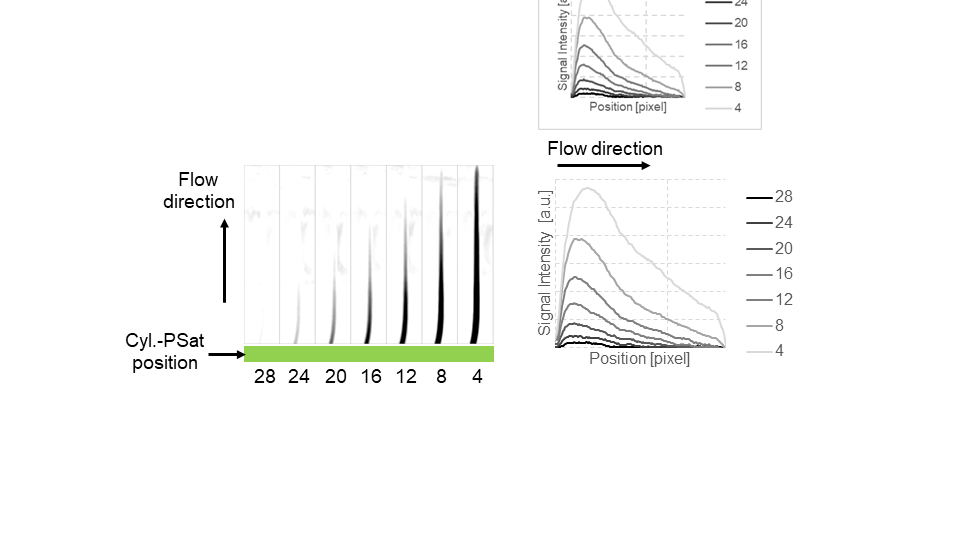
Figure 3
Suppressed inflow water signals according
to changing Cyl.-PSat count. (Gray scale reversed)
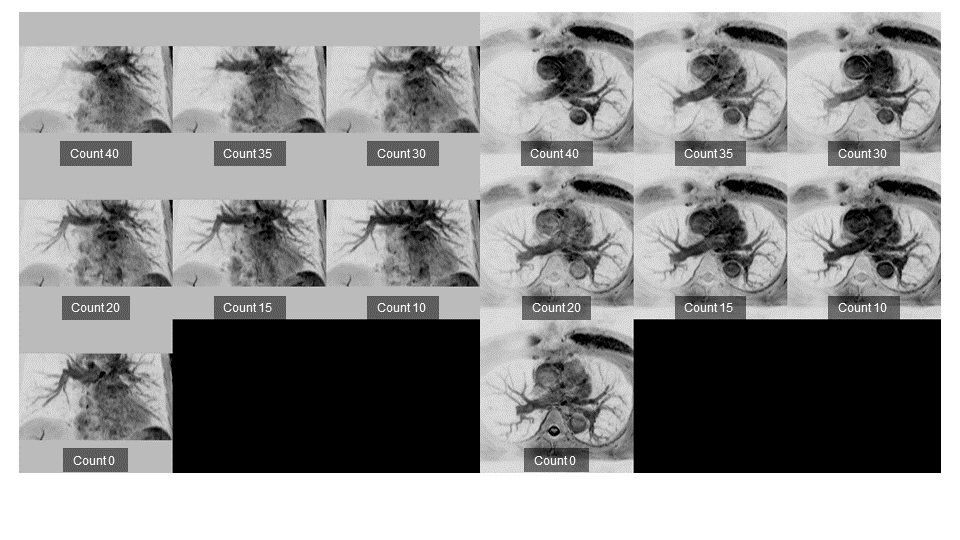
Figure 4
Result MIP image of Cyl.-PSat
count 40, 35, 30, 20, 15, 10, and 0 cases. The pulmonary artery visualization length was changed according to the Cyl.PSat count. (Gray scale reversed)
DOI: https://doi.org/10.58530/2023/2227