2224
Optimized, volumetric, isotropic-resolution T2W 2D FLAIR with high temporal and SNR efficiencies1Department of Radiology, Mayo Clinic, Rochester, MN, United States
Synopsis
Keywords: New Trajectories & Spatial Encoding Methods, New Trajectories & Spatial Encoding Methods, Spiral, FLAIR, LQ
We describe our novel T2W 2D FLAIR sequence whose temporal and SNR efficiencies are maximized by (1) an efficient IR acquisition that minimizes sequence deadtime and (2) localized quadratic encoding which eliminates SNR-inefficiencies of multi-pass 2D acquisitions. These improvements allowed our FLAIR scan to shorten the scan time while achieving higher SNR than standard SE and 2D-TSE scans of identical/equivalent scan time.Introduction
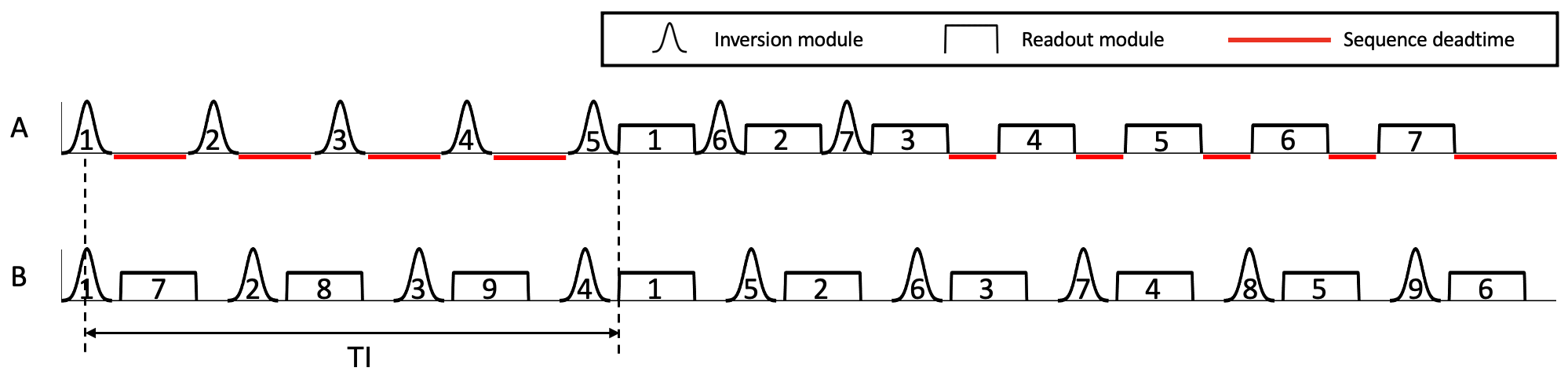
T2-weighted (T2W) fluid attenuated inversion recovery (FLAIR) scans reliably depict brain lesions often obscured in heavily T2-weighted images by bright cerebrospinal fluid (CSF) signal.1 However, the long inversion time (TI) required to null CSF degrades temporal efficiency of data sampling. ‘Interleaved’ IR acquisitions2 (Fig.1A) suffer from acquisition dead time between consecutive inversion or readout trains, as well as the dead time at the end of the TR. ‘Distributed’ IR schemes3,4 increase the temporal efficiency by continuously interleaving inversion and readout modules, but previous approaches require constraints on TI and/or TR, resulting in reduced flexibility and clinical utility. This temporal inefficiency is also compounded by SNR-inefficient multiple pass acquisitions, which acquires signal from only a subset of slices at a time. These inefficiencies lead to longer scan time and limited non-volumetric coverage of 2D FLAIR scans, which often lead to prescriptions with thick slice thickness and large slice gaps to compensate for the low SNR inefficiencies. In this work, we present a flexible T2W FLAIR sequence with high temporal and SNR efficiency. Our novel T2W FLAIR sequence consists of two innovations: (1) a temporally efficient and flexible IR acquisition technique, which continuously interleaves inversion and readout modules throughout the scan time (Fig.1B) while flexibly accommodating any user-desired TI and TR, and (2) localized quadratic (LQ) encoding5,6, which excites overlapping thick slabs and encodes them with a quadratic phase. LQ encoding results in an SNR improvement proportional to the square root of the slab thickness, by ensuring every pass acquires signals from nearly the entire imaging volume, not just from the slices acquired in the particular pass. This hybrid of 2D and 3D encoding eliminates the SNR-inefficiency associated with multi-pass acquisition, allowing contiguous volumetric coverage with improved SNR. Combined with SNR-efficient spiral spin-echo (SE) acquisitions7, together with maximally shortened scan time afforded by an efficient IR scheme, our approach results in isotropic-resolution volumetric T2W 2D FLAIR with high SNR and temporal efficiencies.Methods
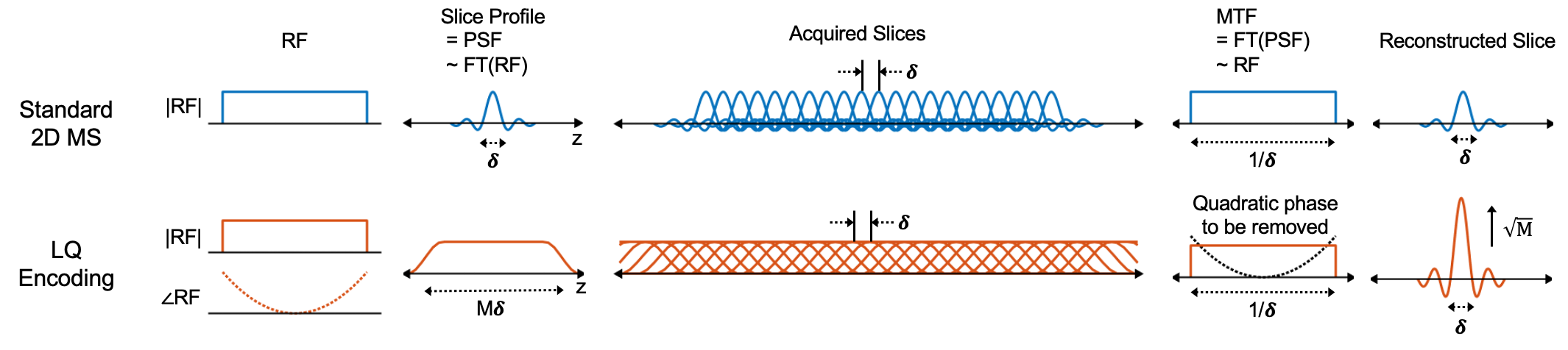
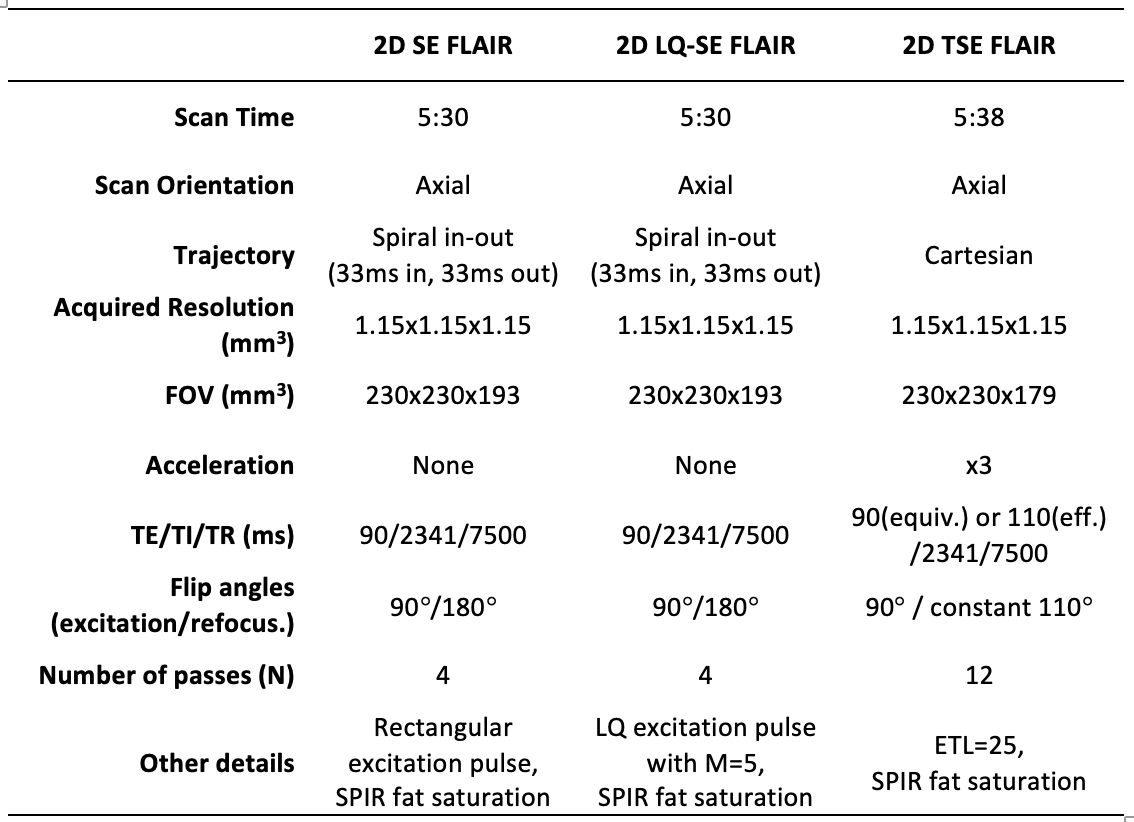
A multi-slice SE sequence was modified to enable LQ encoding by replacing the standard single-slice excitation RF pulse with a frequency-swept rectangular RF pulse. The frequency sweep makes the RF pulse resonant with spins across a slab of thickness $$$M\delta$$$ but encoded with different parts of the associated quadratic phase, where $$$\delta$$$ is the prescribed slice thickness and M is the slab-to-slice ratio determined by the extent of the frequency sweep. The LQ excitation was preceded by fat saturation and followed by a 180° refocusing RF pulse and a spiral in-out readout trajectory. This readout module (grouping) was continuously interleaved with an inversion module designed to invert a specific slice TI before the readout module’s excitation pulse. To achieve an accurate TI for every slice, the inversion module was uniformly distributed across the TR, with the readout modules placed in between, such that their excitations are placed TI after ‘inversion’ of their corresponding slices. If such placement result in an overlap between inversion and readout modules, then the number of interleaved inversion and readout modules per TR is reduced iteratively until such a placement is possible, thus satisfying both the user-prescribed TI and TR. T2W FLAIR scans were performed on a 3T scanner (Philips Ingenia) as N-pass multi-slice 2D acquisitions, using LQ-SE, SE, and TSE sequences, all with the same 5:30 scan time, 1.15mm isotropic resolution, 230x230x180mm FOV, and TI/TR=2345ms/7500ms. Slices in each pass had a center-to-center spacing of $$$N\delta$$$. For LQ-SE, where each excitation excites a slab of thickness $$$M\delta$$$, the slab thickness was limited to $$$M\delta<N\delta$$$ to avoid crosstalk, while the inversion and 180°-refocusing RF pulses were designed to invert and refocus the whole slab. The resulting LQ datasets, after all passes, contained overlapping slabs of thickness $$$M\delta$$$ centered at every slice position $$$\delta$$$ apart. After LQ reconstruction5,6, these slices were restored to a resolution $$$\delta$$$ along the slice direction (Fig.2). LQ-SE used M=3.2 for N=4. Further sequence-specific scan parameters are listed in Table 1.Results
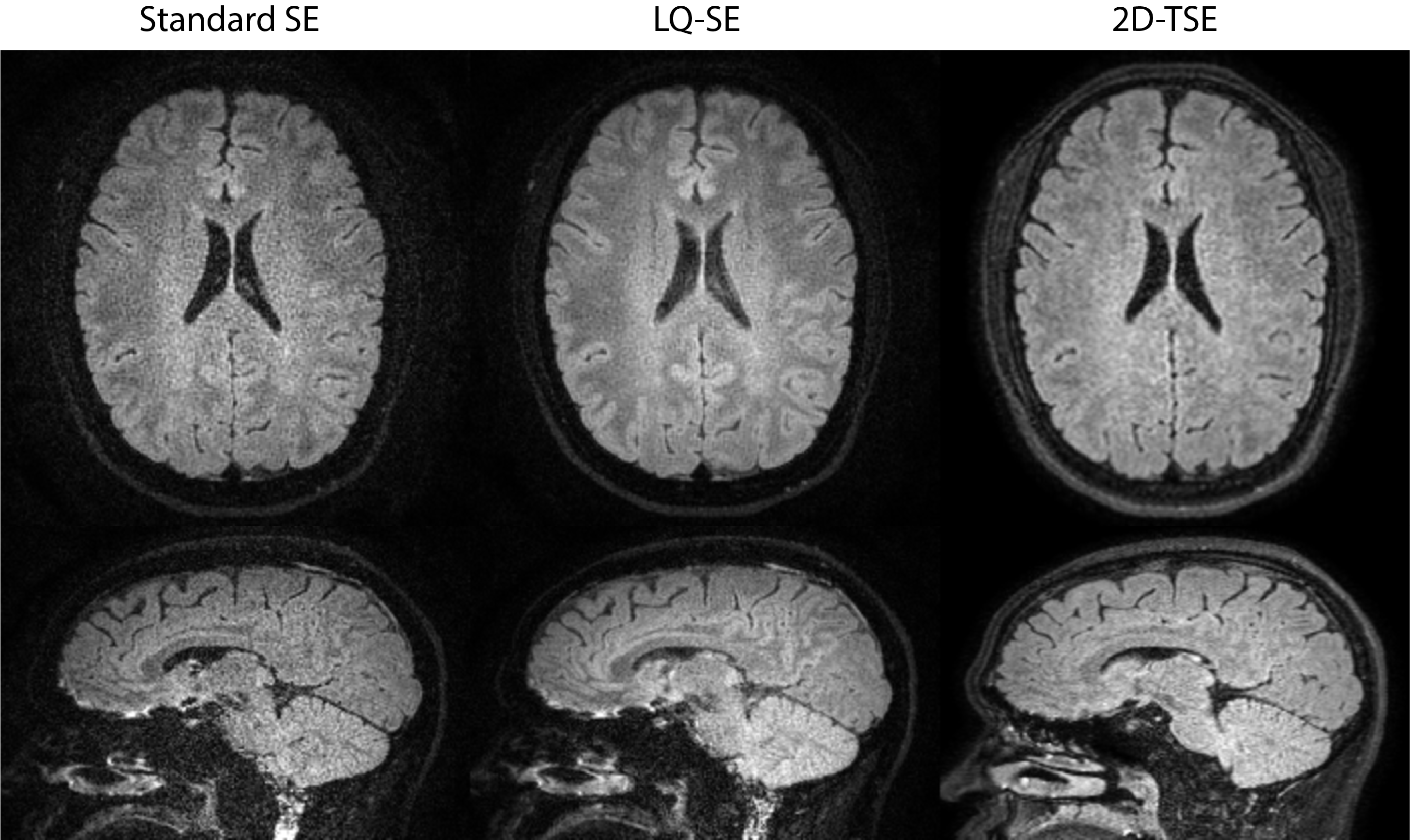
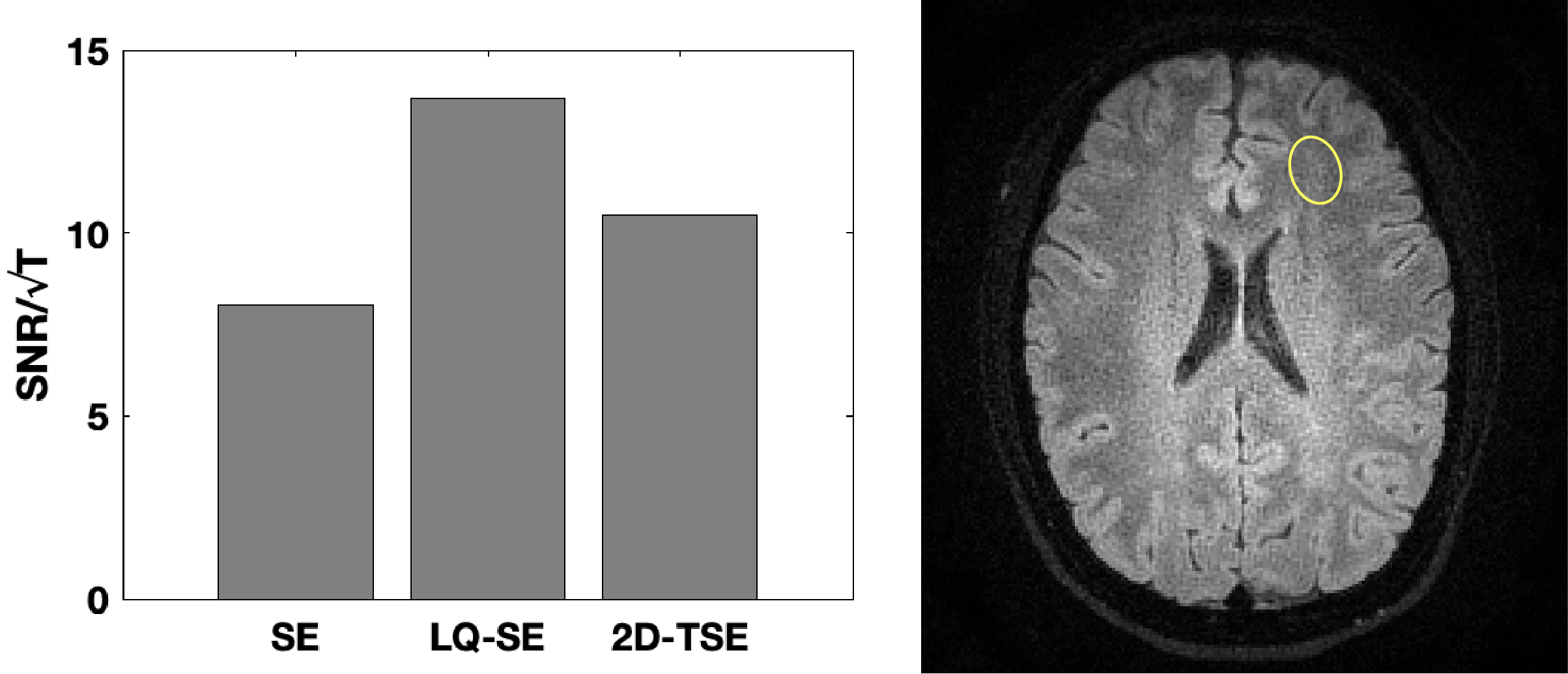
The use of SNR-efficient spiral trajectories alone enabled the T2W FLAIR SE sequence to produce a comparable SNR as 2D-TSE FLAIR (Fig.3). Addition of LQ encoding improved SNR over the SE and 2D-TSE scans, at the same scan time and identical (reconstructed) slice thickness. Quantified estimates of the SNR efficiency (Fig.4) show the LQ encoding improved the SNR by 1.71 (actual) over the SE scan (1.79 expected) and produced 1.3X-higher SNR than equivalent 2D-TSE sequence.Discussion
In LQ encoding, each slice is excited roughly M times over the N separate passes required to collect all slices. This contrasts standard multi-slice acquisitions where each slice is acquired in only one of the N passes, with an effective data collection period of $$$T/N$$$, yielding $$$SNR \propto \sqrt{T/N}$$$, where T is the total scan time. The averaging effect of LQ encoding yields a $$$\sqrt{M}$$$ SNR increase, yielding $$$SNR \propto\sqrt{TM/N}$$$, while the quadratic phase of the RF pulse responsible for extended slice thickness $$$M\delta$$$ is corrected in the reconstruction to yield slice resolution $$$\delta$$$. Thus, LQ encoding eliminates the SNR inefficiencies associated with multi-pass 2D acquisitions. Combined with temporally efficient IR acquisition and SNR-efficient spiral trajectories, our technique yielded volumetric isotropic-resolution 2D T2W FLAIR with clinically acceptable SNR.Acknowledgements
We gratefully receive research support from PhilipReferences
1. Brant-Zawadzki, M., Atkinson, D., Detrick, M., Bradley, W. G. & Scidmore, G. Fluid-Attenuated Inversion Recovery (FLAIR) for Assessment of Cerebral Infarction. Stroke 27, 1187–1191 (1996).
2. Park, H. W., Cho, M. H. & Cho, Z. H. Time-Multiplexed Multislice Inversion-Recovery Techniques for NMR Imaging. Magnetic Resonance in Medicine 2, 534–539 (1985).
3. Oh, C. H., Hilal, S. K., Mun, I. K. & Cho, Z. H. An optimized multislice acquisition sequence for the inversion-recovery MR imaging. Magn Reson Imaging 9, 903–908 (1991).
4. Listerud, J., Mitchell, J., Bagley, L. & Grossman, R. OIL FLAIR: Optimized interleaved fluid-attenuated inversion recovery in 2D fast spin echo. Magnetic Resonance in Medicine 36, 320–325 (1996).
5. Pipe, J. G. Spatial Encoding and Reconstruction in MRI with Quadratic Phase Profiles. Magnetic Resonance in Medicine 33, 24–33 (1995).
6. Pipe, J. G. Analysis of localized quadratic encoding and reconstruction. Magnetic Resonance in Medicine 36, 137–146 (1996).
7. Kim, D., Wang, D., Chao, T. & Pipe, J. G. Volumetric T2-Weighted Spin-Echo MRI with Improved SNR Using Localized Quadratic Encoding. 2022 Joint Annual Meeting ISMRM-ESMRMB. #0507.
Figures