2200
Decoding of 3T and 7T bSSFP profile asymmetries for T1, T2, and fraction quantification in two-compartment systems1Department of Diagnostic, Interventional and Pediatric Radiology (DIPR), Inselspital, Bern Universit, Bern, Switzerland, 2Department of Radiology, Lausanne University Hospital (CHUV) and University of Lausanne (UNIL), Lausanne, Switzerland, 3Department of Diagnostic, Interventional and Pediatric Radiology (DIPR), Inselspital, Bern University Hospital, University of Bern, Bern, Switzerland
Synopsis
Keywords: Data Analysis, High-Field MRI, phase-cycled bSSFP, Aceton fraction quantification
A novel Off-Resonant encoded Analytical parameter quantification using Complex Linearized Equations (ORACLE) method using phase-cycled bSSFP profiles was developed. The approach decodes complex asymmetry profiles in multi-compartment systems for simultaneous proton fraction, T1/T2 ratio, T1 and T2 quantification. The approach was validated in simulations and in an acetone-water phantom at 3T and 7T. Simulations and experiments validated the proposed method for multi-parameter quantification using phase-cycled bSSFP for two compartment singlet systems with high accuracy and precision. This provides the first step towards proton fraction quantification of more complex multiplet-systems, such as fat or myelin, exploiting complex asymmetry profiles.Introduction
Phase-cycled (PC) balanced-steady-state free-precession (bSSFP) acquisitions have traditionally been used to remove banding artifacts, but more recently for multi-parameter quantification in single-compartment systems [1-4]. Current approaches correct off-resonance effects by dismissing valuable parts of the phase-information [2,3,4], and do not utilize the phase to its full extent, hampering the extension to multi-compartment systems. Asymmetries observed in the PC-bSSFP profile have been used to quantify water and fat [5], however, to coherently describe constructive and destructive interference, multiple off-resonance sources need to be analytically disentangled. This work aims to develop an analytical framework for proton-fraction quantification of two-compartment singlet-systems with PC-bSSFP signal-profiles, while also providing banding artifact-free images. The method was validated on acetone-water mixtures at 3T and 7TMethods
PC-bSSFP Fourier-spaceFor independent $$$T_1$$$, $$$T_2$$$ and proton-fraction quantification the use of complex data is neccesary. Because the signal-evolution over the PC-dimension $$$\varphi$$$ is sensitive to off-resonance effects, inverting the signal to quantify parameters is challenging. For multi-compartment systems, the phases and magnitudes follow complicated dynamics, and their robust disentanglement remains an unsolved mathematical problem [6]. The problem can be simplified and better-conditioned by transforming the signal $$$S(\varphi)$$$ into Fourier-space [3,4]:
$$c_n=\sum_{j=0}^{N-1}S(\varphi_j)\cdot\text{e}^{\text{i}\,n\,\varphi_j}\,,\quad \varphi_j=\frac{2\pi}{N}\cdot j \;,\quad j=[0,N-1]\,,$$
where $$$N$$$ is the number of phase-cycles and $$$c_n$$$ is the $$$\text{n}^{\text{th}}$$$-mode.
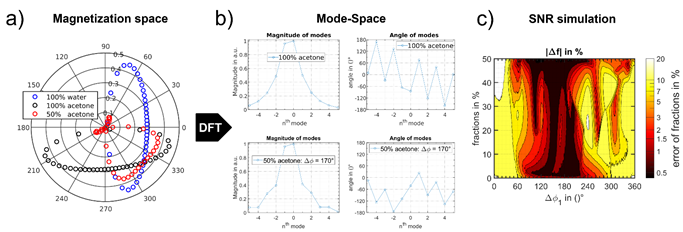
For periodic PC-bSSFP-profiles the main advantage of Fourier-transformations is the compression of almost all information in the center of the Fourier-mode-space similar to the relation between k-space and image-space (Figure 1 a,b).
Fraction estimation
In this work we used the analytical solution of $$$c_{-2}$$$, $$$c_{-1}$$$, $$$c_0$$$ and $$$c_2$$$ modes in dependence of an input-value $$$\Delta\phi_1=\gamma B_0\Delta\delta\text{TR}$$$, with $$$\gamma$$$ the gyromagnetic-ratio, $$$B_0$$$ the main magnetic-field, $$$\text{TR}$$$ the repetition-time and $$$\Delta \delta$$$ the chemical-shift difference of both substances. When using a correctly defined $$$\Delta\phi_1$$$ , the solutions predict the values of every other mode of the experimental bSSFP profile (Figure 1b). We conjecture that the minimum of the sum-of-squares of absolute-difference between predicted and experimental modes result in a good point-estimation for the proton-fraction, $$$T_1$$$ and $$$T_2$$$.
Simulations and Experiments
Simulations: To define an optimal configuration (‘bSSFP signal shape’) for fraction estimation, Monte-Carlo Bloch-equation simulations were performed for PC-bSSFP (500 variations for each value) with an SNR of 35 for $$$T_1=500\text{ms}$$$, $$$T_2=400\text{ms}$$$, $$$N=36$$$, $$$\alpha=15^\circ$$$ and $$$\text{TR}=5\text{ms}$$$ was used. Variations were performed for fractions of $$$f=[0,50]\%$$$ in 50 equidistant steps and $$$\Delta\phi_1=[0,2\pi[$$$ in 360 equidistant steps. The root-mean-square-error of $$$f$$$ was determined and plotted over initial $$$f$$$ and $$$\Delta \phi_1$$$ values.
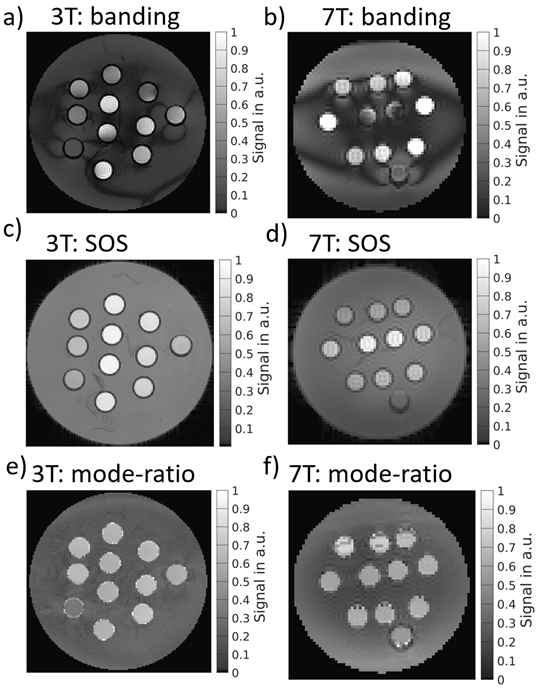
Phantom-experiments: A PC-bSSFP experiment on an acetone-water phantom with different acetone:water ratios doped with CuCl and Gd-DOTA were performed at 3T (PRISMA, Siemens Healthineers) with $$$\text{TR}=5.00\text{ms}$$$, $$$N=36$$$, $$$\alpha=35^\circ$$$, BW=625kHz and (1mm)3 resolution. At 7T (TERRA, Siemens Healthineers) with $$$\text{TR}=3.45\text{ms}$$$, $$$N=18$$$, $$$\alpha=25^\circ$$$, BW=875kHz and (2mm)3 resolution. For the 7T-experiment the 60% acetone-vial was replaced by a 58% acetone-vial without contrast-agents, due to precipitations in the mixture. Acetone reference volumes were translated by factor 0.74 for proton-fraction reference-values to consider the lower proton-density per volume ratios of acetone w.r.t. water [7]. Both fraction-estimations for the different main-field were fixed to $$$\Delta\delta=[2.45\pm0.05]\text{ppm}$$$ [7] between water and acetone as a boundary-condition with some tolerance for complex noise and $$$B_0$$$-drift. For accuracy the coefficient-of-determination ($$$R^2$$$) w.r.t. the reference was calculated, and for precision the coefficient-of-variation (COV) or the standard-deviation ($$$\sigma$$$) within one ROI. To correct for banding an exemplary $$$\big|\frac{c_1}{c_0}\big|$$$-weighting mapped to single-compartment modes of 3T and 7T was performed as well as sum-of-squares.
Results
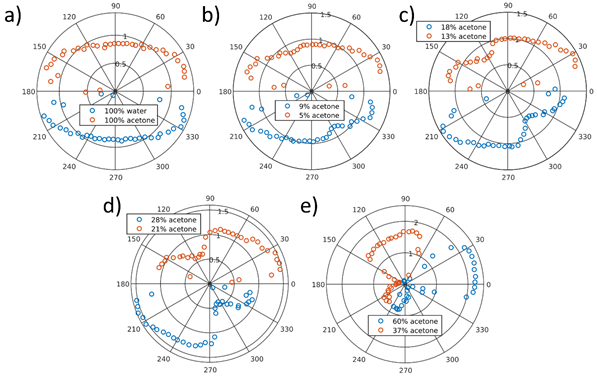
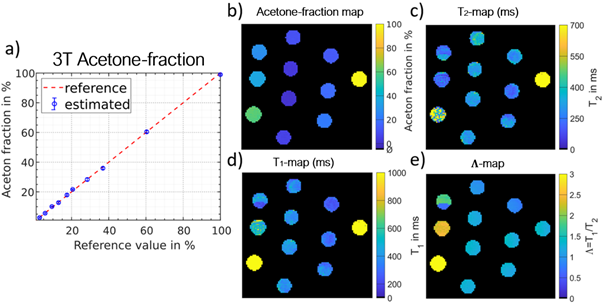
Proton-fraction quantification exhibit high accuracy ($$$R^2$$$) and precision ($$$\bar{\sigma}$$$) for 3T as well as 7T if a $$$\text{mod}(\Delta\phi_1,2\pi)\sim\pi$$$ configuration is achieved (Figure 1c). The novel fraction-quantification exhibits high robustness against noise, as low as SNR=35. For optimal configurations the fraction-estimation error is below 1.5%.At 3T asymmetry-profiles can be observed in the acetone water fraction phantom, whose asymmetry increases the closer to a 50% proton-fraction the signal corresponds (Figure 2). The estimated fractions are in high agreement with the reference values, with coefficient-of-determination $$$R^2=0.999$$$ and averaged standard-deviation $$$\bar{\sigma}=0.60\%$$$ proton-fraction (Figure 3). $$$T_1$$$-, $$$T_2$$$- and $$$\Lambda$$$-maps are in a plausible range.
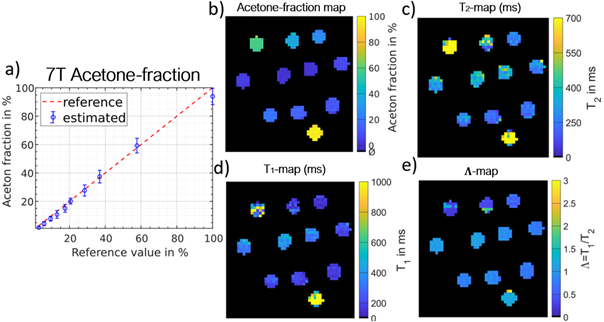
At 7T (Figure 4) all maps where masked for chemical-shift artifacts, which are more dominant at 7T. $$$T_1$$$-, $$$T_2$$$- and $$$\Lambda$$$-maps are slightly different to 3T. Fraction-maps at 7T results in $$$R^2=0.993$$$ and $$$\bar{\sigma}=2.9\%$$$ proton-fraction. Figure 5 shows bSSFP banding-artifacts compared to exemplary $$$\big|\frac{c_1}{c_0}\big|$$$-weighting mapped to single compartment modes.
Discussion
As expected, $$$T_1$$$, $$$T_2$$$ and $$$\Lambda$$$-maps are slightly different for the 3T and 7T [8]. Increased standard-deviations of proton-fraction estimation at 7T can be explained by the reduced number of phase-cycle incremented bSSFP acquisitions. Moreover, the replaced 60% acetone-vial with an 58% acetone-vial without contrast-agents shows a significant change of $$$T_2$$$-value between 3T and 7T experiment, which may indicate potential for $$$T_2$$$-quantification for two-compartment systems. Finally, mode-weighting can be used for multiple realizations of contrasts-settings, correcting for banding-artifacts for two-compartment systems.Conclusion
A novel mathematical framework was developed that describes multi-compartment systems and asymmetries in PC-bSSFP signal-profiles. ORACLE disentangles multiple off-resonance sources such as chemical-shifts, $$$B_0$$$-inhomogeneities and additional phase offsets. ORACLE quantified proton-fractions in water and acetone at 3T and 7T.Acknowledgements
We would like to thank Prof. Roland Kreis for suggesting acetone as a suitable substance for two-compartment singlet-system when mixed with water. This study was supported by the Swiss National Science Foundation (grant number PCEFP2_194296).References
[1] Elliott AM, Bernstein MA et. al. Nonlinear averaging reconstruction method for phase-cycle SSFP. Magn Reson Imaging. 2007 Apr;25(3):359-64. doi: 10.1016/j.mri.2006.09.013. Epub 2006 Nov 16. PMID: 17371725.
[2] Shcherbakova Y et. al. PLANET: An ellipse fitting approach for simultaneous T1 and T2 mapping using phase-cycled balanced steady-state free precession. Magn Reson Med. 2018 Feb;79(2):711-722. doi: 10.1002/mrm.26717. Epub 2017 May 22. PMID: 28543430; PMCID: PMC5811804.
[3] Heule R, Ganter C, Bieri O. Triple echo steady-state (TESS) relaxometry. Magn Reson Med. 2014 Jan;71(1):230-7. doi: 10.1002/mrm.24659. Epub 2013 Apr 2. PMID: 23553949.
[4] Nguyen D, Bieri O. Motion-insensitive rapid configuration relaxometry. Magn Reson Med. 2017 Aug;78(2):518-526. doi: 10.1002/mrm.26384. Epub 2016 Sep 8. PMID: 27605508.
[5] Rossi G et. al. arXiv:2005.09734 [physics.med-ph]
[6] Shcherbakova Y et. al. On the accuracy and precision of PLANET for multiparametric MRI using phase-cycled bSSFP imaging. Magn Reson Med. 2019 Mar;81(3):1534-1552. doi: 10.1002/mrm.27491. Epub 2018 Oct 10. PMID: 30303562; PMCID: PMC6585657
[7] Scott B. Reeder et. al. On the Definition of Fat-Fraction for in Vivo Fat Quantification with Magnetic Resonance Imaging, Joint Annual Meeting ISMRM, 18-24 April 2009, Hawaii, USA
[8] Bloembergen N., Purcell E. M. and Pound R. V. Relaxation Effects in Nuclear Magnetic Resonance Absorption, Phys. Rev., Vol. 73, issue 7, p. 679—712, American Physical Society,1948
Figures