2141
Fast free-breathing pediatric MRI using accelerated radial acquisition and deep learning motion-resolved reconstruction1Department of Medical Physics, Memorial Sloan Kettering Cancer Center, New York, NY, United States, 2Department of Radiology, Memorial Sloan Kettering Cancer Center, New York, NY, United States
Synopsis
Keywords: Body, Machine Learning/Artificial Intelligence
Motion remains a significant challenge in pediatric MRI. Motion-resolved 4D MRI, such as XD-GRASP, is a promising alternative to motion correction. However, long scan times and particularly reconstruction times restricted routine clinical use. This work presents a deep learning approach called MRI-movienet for 4D reconstruction of radial data, which enables acceleration of both acquisition and reconstruction for free-breathing pediatric MRI with only 1 minute scan time and less than 2 seconds reconstruction time. The deep learning approach is demonstrated for free-breathing abdominal pediatric MRI without anesthesia using XD-GRASP as a reference for comparison.INTRODUCTION
Motion remains a significant challenge in pediatric MRI1,2. In addition to involuntary bulk motion, the heart beats faster, and the diaphragm moves more rapidly, which makes the motion problem more challenging in children than adults. Motion-resolved 4D MRI, such as XD-GRASP3, represents an alternative approach to motion correction techniques and could offer higher performance. However, scan time is usually longer to be able to gather enough data for 4D reconstruction, and reconstruction time is very long due to the iterative compressed sensing algorithm. This work presents a deep learning 4D MRI reconstruction method named MRI-movienet to accelerate the acquisition and significantly reduce the reconstruction time compared to XD-GRASP. MRI-movienet operates exclusively in the image domain by exploiting space-motion-coil correlations without enforcing k-space data consistency to minimize the reconstruction time. The performance of MRI-movienet is demonstrated on free-breathing pediatric MRI acquisitions acquired without anesthesia with XD-GRASP as a reference.METHODS
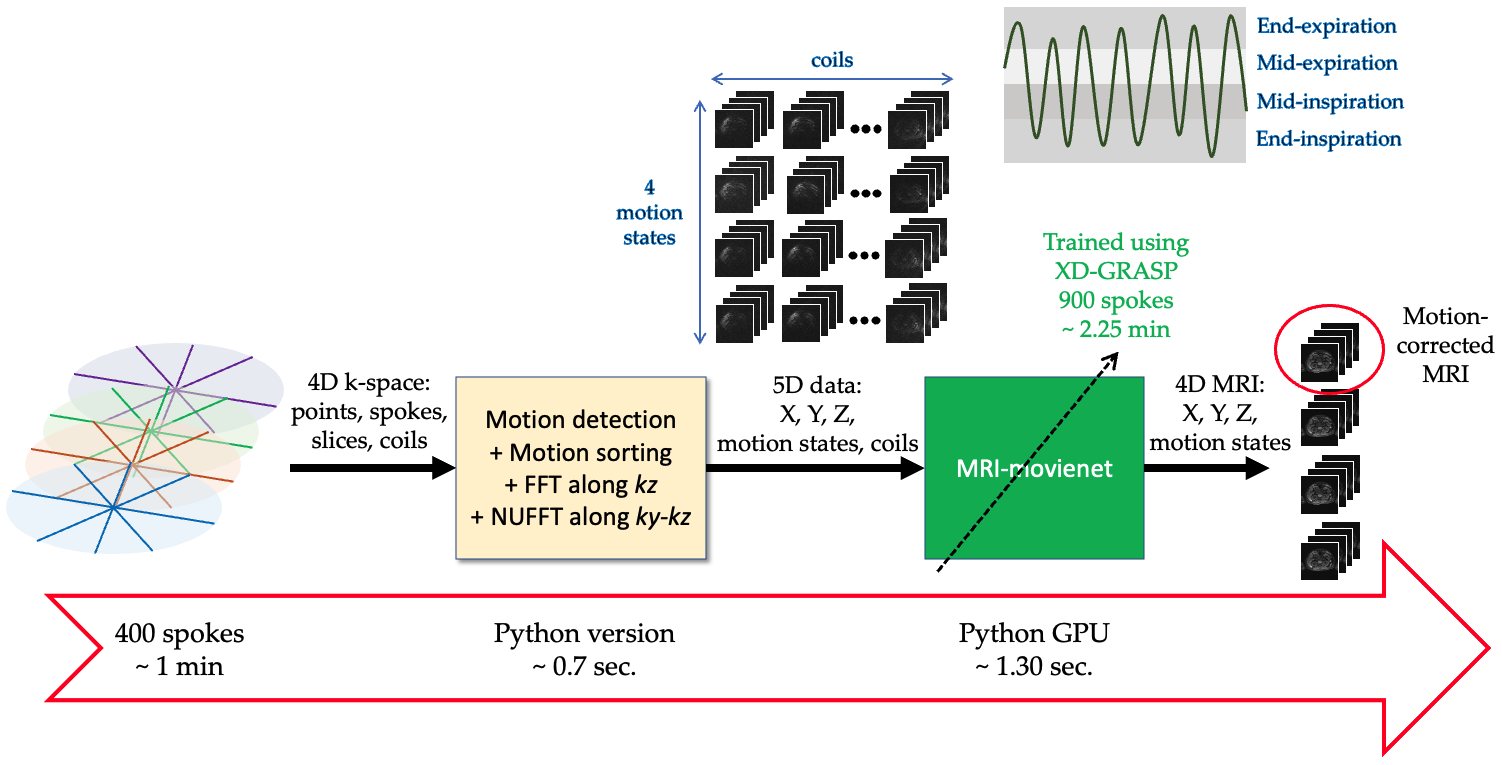
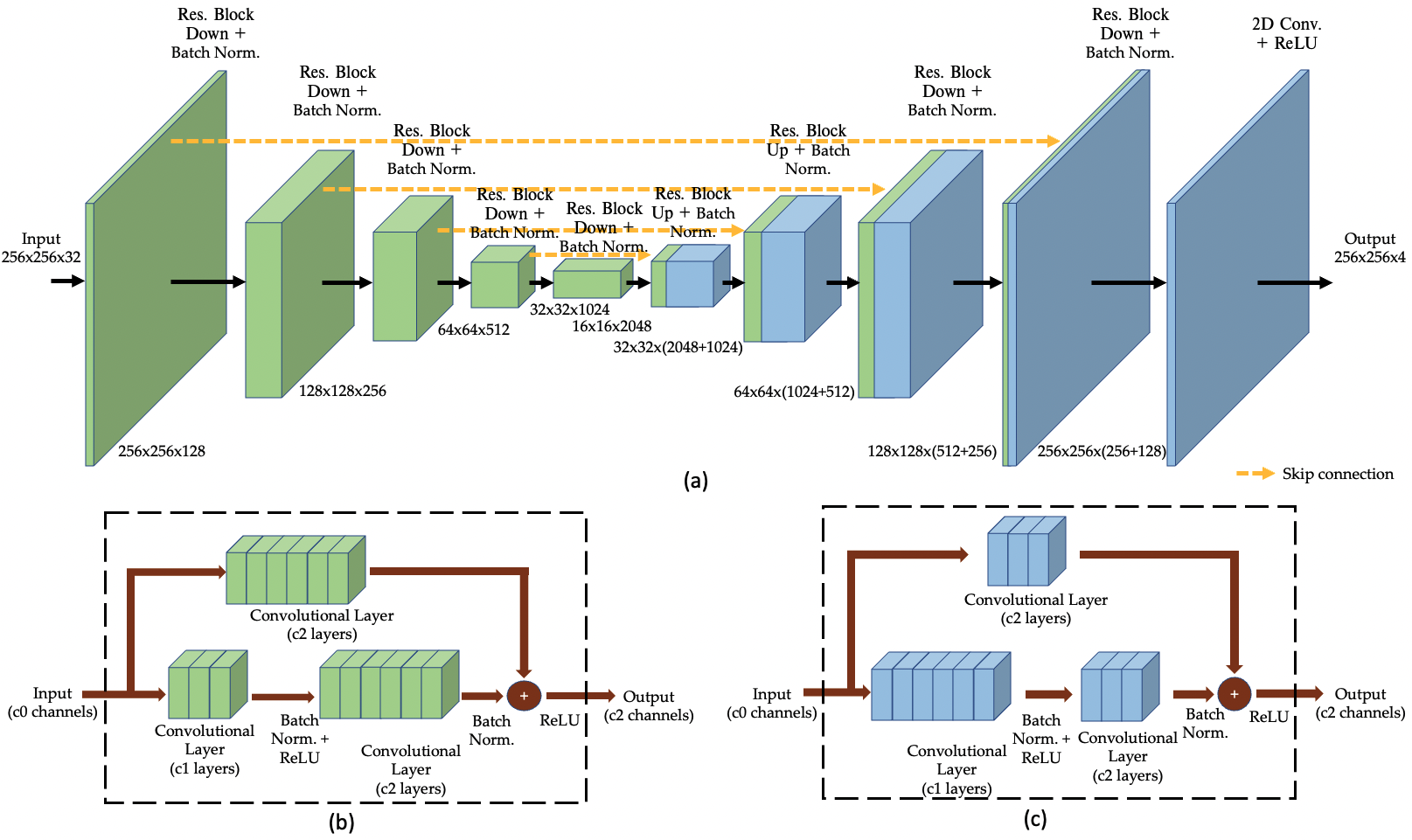
4D MRI-movienet (Figure 1): Free-breathing data acquired with 400 spokes is sorted into 4 motion states (end-expiration, mid-expiration, mid-inspiration, and end-inspiration) using the motion detection and motion sorting methodology from XD-GRASP. MRI-movienet replaces the iterative compressed sensing reconstruction in XD-GRASP. The network is trained using XD-GRASP reconstruction results with 900 spokes, which represents a 2.25-fold acceleration in scan time (900 spokes to 400 spokes). MRI-movienet uses a modified U-net architecture with residual learning blocks to exploit correlations in 5D image space (x, y, z, motion, coil) without enforcing k-space data consistency to minimize reconstruction time (Figure 2).MRI-movienet training: 14 previously acquired adult patient datasets were used to train MRI-movienet. Adult patients with cancer in the abdominal area were scanned on five different 3T scanners (4 Discovery MR750 scanners and 1 Signa Premier scanner, GE Healthcare) using a golden-angle stack-of-stars acquisition and standard body array coil. Training was performed slice-by-slice with 774 slices total (between 42 and 64 slices per dataset).
Pediatric MRI: Free-breathing T1-weighted 3D data were acquired on two pediatric patients (9 years old each patient) using a golden-angle stack-of-stars sequence on a 3T scanner (Discovery MR750, GE Healthcare) with a pediatric 24-channel body coil (Ink Space Imaging). Acquisition parameters include TR=4ms, TE=-2ms, flip angle = 12°, in-plane resolution = 1.5mm, slice thickness = 4mm, number of radial spokes = 900, and scan time = 2.25min. The first 400 spokes, corresponding to a scan time of 1min, were employed for MRI-movienet reconstruction. For comparison purposes, XD-GRASP reconstruction was performed for the first 400 spokes and for the complete dataset with 900 spokes.
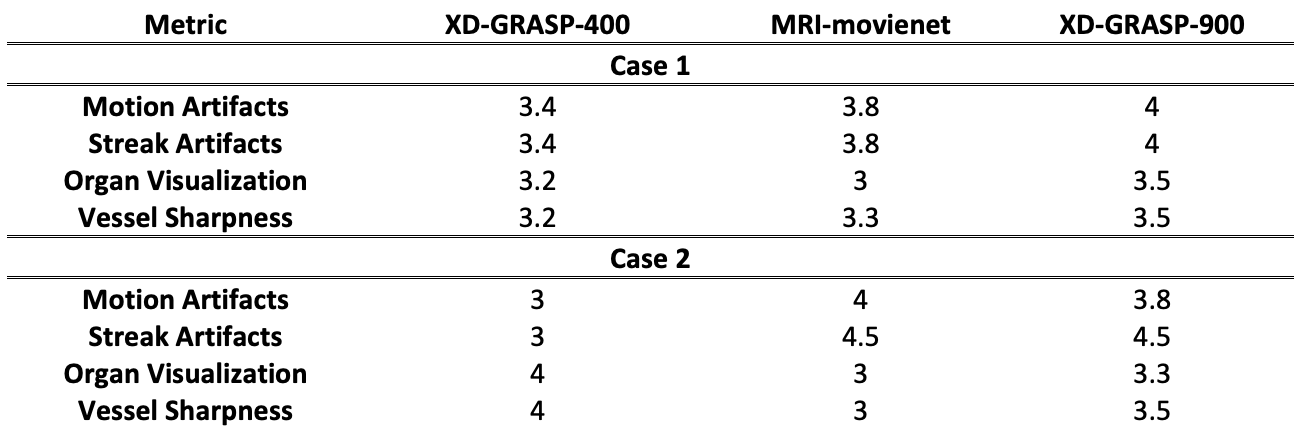
Image quality evaluation: The image corresponding to the end-expiration respiratory state was employed for comparisons. A pediatric body radiologist with 12 years of experience analyzed image quality in terms of motion artifacts, streak artifacts, organ visualization, and vessel sharpness using a 5-point rating scale. The radiologist was blinded to the images, and the different methods were presented in random order.
RESULTS
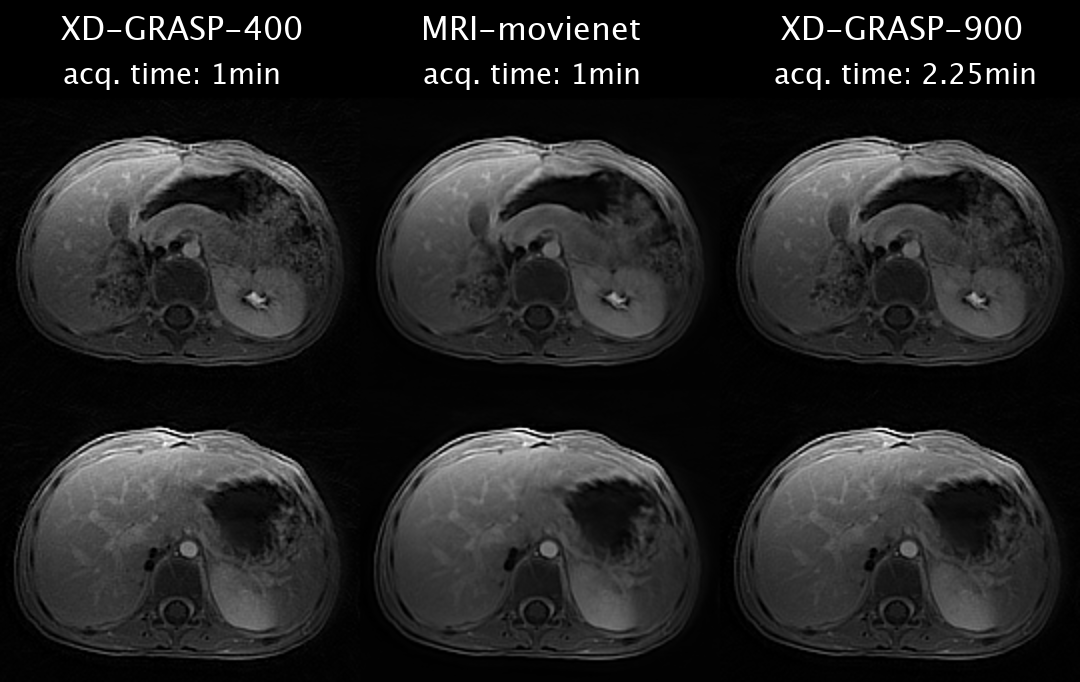
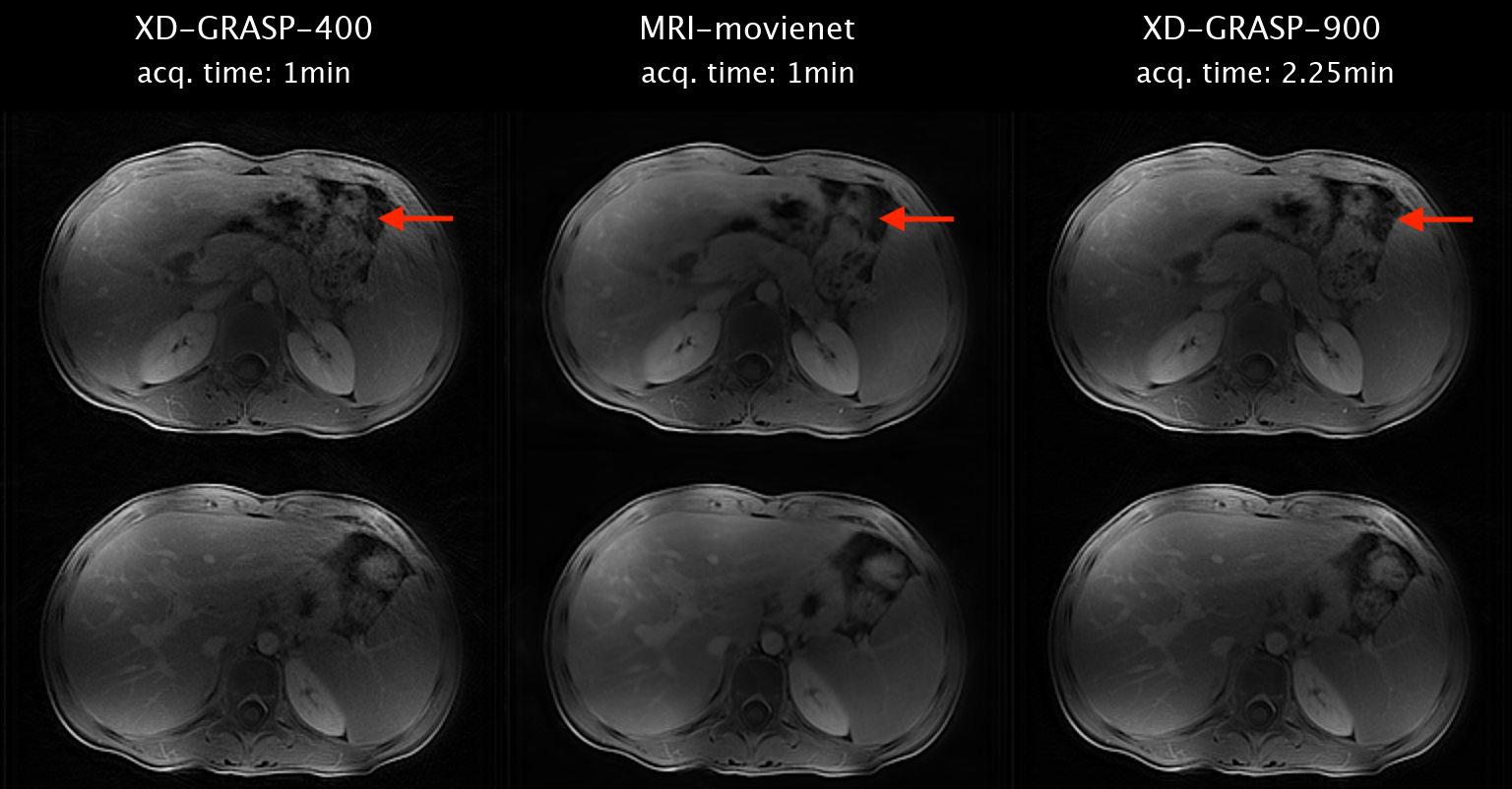
4D reconstruction time using MRI-movienet was only 1.3 seconds, which is significantly lower than XD-GRASP reconstruction time in the order of minutes. Figure 3 shows the reconstruction results for the first patient. MRI-movienet outperforms XD-GRASP for the acquisition with 400 spokes and presents similar results to XD-GRASP with 900 spokes. XD-GRASP with 400 spokes presents residual streaking artifacts that MRI-movienet removes. These results are corroborated by the qualitative image quality analysis in Figure 5, where MRI-movienet obtained higher scores in general. Figure 4 shows the reconstruction results for the second patient. In this case, image quality between MRI-movienet and XD-GRASP was similar. The qualitative analysis presented higher scores for MRI-movienet on motion artifacts and streaking artifacts but lower scores in terms of vessel sharpness.DISCUSSION
The application of deep learning image reconstruction that exploits spatial and temporal correlations without the need for k-space data consistency would enable the use of 4D MRI for free-breathing motion-compensated pediatric MRI in a clinical setting with short acquisition times of 1 minute and very short reconstruction times of only 1.5 seconds. Deep learning techniques were previously proposed for 4D reconstruction, but using k-space data consistency elongated the reconstruction process. MRI-movienet exploits spatial and motion correlation to remove the need for data consistency without introducing hallucinations. 4D MRI presents an alternative solution to the motion challenge in pediatric MRI, and MRI-movienet represents an efficient way to translate 4D MRI to clinical practice.CONCLUSION
This work demonstrated the combination of radial imaging and deep learning reconstruction for free-breathing 4D pediatric MRI with a fast acquisition of 1 minute and fast reconstruction of 1.5 seconds. The short acquisition time and motion-resolved reconstruction would enable pediatric MRI scans without the use of anesthesia, a long-desired goal.Acknowledgements
The work was supported by NIH Grant R01-CA255661.References
1. Serai, S. D., Hu, H. H., Ahmad, R., White, S., Pednekar, A., Anupindi, S. A., & Lee, E. Y. (2020). Newly developed methods for reducing motion artifacts in pediatric abdominal MRI: tips and pearls. American Journal of Roentgenology, 214(5), 1042-1053.
2. Cheng, J.Y., Zhang, T., Ruangwattanapaisarn, N., Alley, M.T., Uecker, M., Pauly, J.M., Lustig, M. and Vasanawala, S.S. (2015), Free-breathing pediatric MRI with nonrigid motion correction and acceleration. J. Magn. Reson. Imaging, 42: 407-420.
3. Feng, Li, Leon Axel, Hersh Chandarana, Kai Tobias Block, Daniel K. Sodickson, and Ricardo Otazo. "XD‐GRASP: golden‐angle radial MRI with reconstruction of extra motion‐state dimensions using compressed sensing." Magnetic resonance in medicine 75, no. 2 (2016): 775-788.
Figures