2090
Estrogen Deprivation has a Negligible Impact on Thalamic Metabolism under Central Sensitization
Dayna L. Richter1,2, Samuel Holder1,2, Harrison D Craythorne2, and Samuel Colles Grant1,2
1National High Magnetic Field Laboratory, Florida State University, Tallahassee, FL, United States, 2Chemical & Biomedical Engineering, FAMU-FSU College of Engineering, Tallahassee, FL, United States
1National High Magnetic Field Laboratory, Florida State University, Tallahassee, FL, United States, 2Chemical & Biomedical Engineering, FAMU-FSU College of Engineering, Tallahassee, FL, United States
Synopsis
Keywords: Neuroinflammation, Spectroscopy, Relaxation-enhanced spectroscopy, lactate, total creatine
Previous examinations of the nitroglycerin (NTG)-based central sensitization, a chemical model of migraine, in the Sprague-Dawley model revealed increases in thalamic lactate signal. This held across sexes, albeit at different strengths. To investigate the potential source of any sex differences, estradiol deprivation is examined using 1H relaxation-enhanced spectroscopy localized to the thalamus. While the same energetic deprivation is seen, estradiol deprivation had negligible impact on the thalamic metabolic profile under NTG. Further examinations under alternate modalities are needed.Introduction
The thalamus is a key relay for nociceptive and sensory information with direct projections to the trigeminovascular system, a neural structure heavily implicated in the onset of migraine. Previous examinations of the male Sprague-Dawley rat with respect to nitroglycerin (NTG)-induced central sensitization, a preclinical model of acute migraine, revealed increases in thalamic lactate signal. This increase implies a state of energy deprivation in the male rat thalamus prior to the onset of nociception(1). We previously have replicated this work in female Sprague-Dawley rats, as the majority of human migraineurs are women, and found similar trends, albeit to lesser magnitudes(2). To investigate the potential source of any sex differences, estradiol deprivation was examined in this report. Estradiol was targeted as, clinically, women report increased migraine frequency and severity at the beginning of their menstrual cycle, when 17β-estradiol (E2) concentrations are lowest(3). In this work 1H relaxation-enhanced spectroscopy localized to the thalamus was implemented at 21.1 T to investigate the impact of estradiol deprivation on thalamic metabolism during migraine.Methods
Animal Methods: To control estrogen levels, female Sprague-Dawley rats underwent ovariectomies 8 d prior to scanning. Rats were randomly separated into two groups: a depleted E2 group (0-μg E2, n = 4), and physiological E2 group (2-μg E2, n = 4). Groups were administered their E2 dose in a sesame oil vehicle on the fourth and eighth day post-operation to mimic the natural rat estrous cycle.MRI Methods: Prior to scanning, animals were anesthetized with 5% isoflurane in oxygen for surgery implantation of an intraperitoneal line to deliver nitroglycerin (NTG) in situ while in the magnet and after baseline scans were acquired. Post-surgery, rodents were maintained at 2-3% isoflurane in oxygen for the remainder of the scanning, then promptly sacrificed. Spectra (Figure 1) were acquired using a relaxation-enhanced, spectrally selective spin echo sequence localized to a 4x3x3-mm3 voxel via Localization by Adiabatic Selective Refocusing (LASER). The voxel was centered between thalamic lobes. With an effective TE = 54 ms and TR = 2.5 s, spectra were averaged eight times per repetition, with 32 repetitions performed.Peak selection was performed in Bruker Topspin 4.1.4. Peaks selected were those that reliably presented across animals, including glutathione (GSH), myo-inositol (MI), glycine (Gly), taurine (Tau), choline (Cho), total creatine (tCr), combination glutamate and glutamine (Glx), n-acetyl-aspartate (NAA), and lactate (Lac). Mixed model analysis with post-hoc Student’s t-tests were performed in JMP Pro 15, with p<0.05 for all significances.
Results and Discussion
The evolution of female thalamic metabolite signals similar for both E2 deprivation (0-μg E2) and stabilized physiological E2 (2-μg E2) under the influence of NTG-induced central sensitization. Of all metabolites examined, only Lac and tCr show statistical significances. Following the NTG trigger, Lac signal is significantly elevated from baseline levels out to 80 min post-injection; there is no significance between the stabilized and deprived E2 groups (Figure 2). tCr signal shows consistent significant decreases at almost all times post-injection; it is also unaffected by E2 presence/absence (Figure 3).The metabolic signals that do show statistical significance reveal a similar state of energetic deprivation induced by central sensitization as previously reported in the male and free-cycling female rat models. Lactate increases indicate the rapid recruitment of glycolysis in tandem with depletion of phosphocreatine energy storage. E2 deprivation generating no significant impacts to lactate production, which was unanticipated. It is possible that, in context of thalamic metabolism, the acute impacts of E2 deprivation versus stabilized E2 are overwhelmed by the NTG-induced central sensitization or that fluctuating E2 has minimal influence in the thalamus
Conclusion
1H RE-MRS was implemented at 21.1 T to investigate the impact of estradiol deprivation on thalamic metabolism under NTG-induced central sensitization. Contrary to what was anticipated, the impact of estradiol deprivation is negligible.Further examination of estradiol deprivation in the context of migraine by alternate modalities, such as X-nuclei or perfusion MRI, is needed.Acknowledgements
All work has been done in accordance with the Huntington Medical Research Institute and Florida State University Animal Care and Use Committees. This work was supported by the US NIH (R01-NS072497) and the US National High Magnetic Field Laboratory, which is supported by the National Science Foundation (DMR-1644779) and the State of Florida.References
1. Abad, N. et al. Metabolic assessment of a migraine model using relaxation-enhanced 1H spectroscopy at ultrahigh field. Magn. Reson. Med. 79, 1266-1275 (2018).
2. Holder, S. et al. Metabolic Impact of Spontaneous Trigeminal Allodynia in Sprague-Dawley Rats: Implications for Migraine & other Neurological Disorders. ISMRM Annual Meeting, 2021.
3. Mannix LK, Calhoun AH. Menstrual migraine. Curr Treat Options Neurol. 2004;6(6):489-498. doi:10.1007/s11940-004-0006-7
Figures
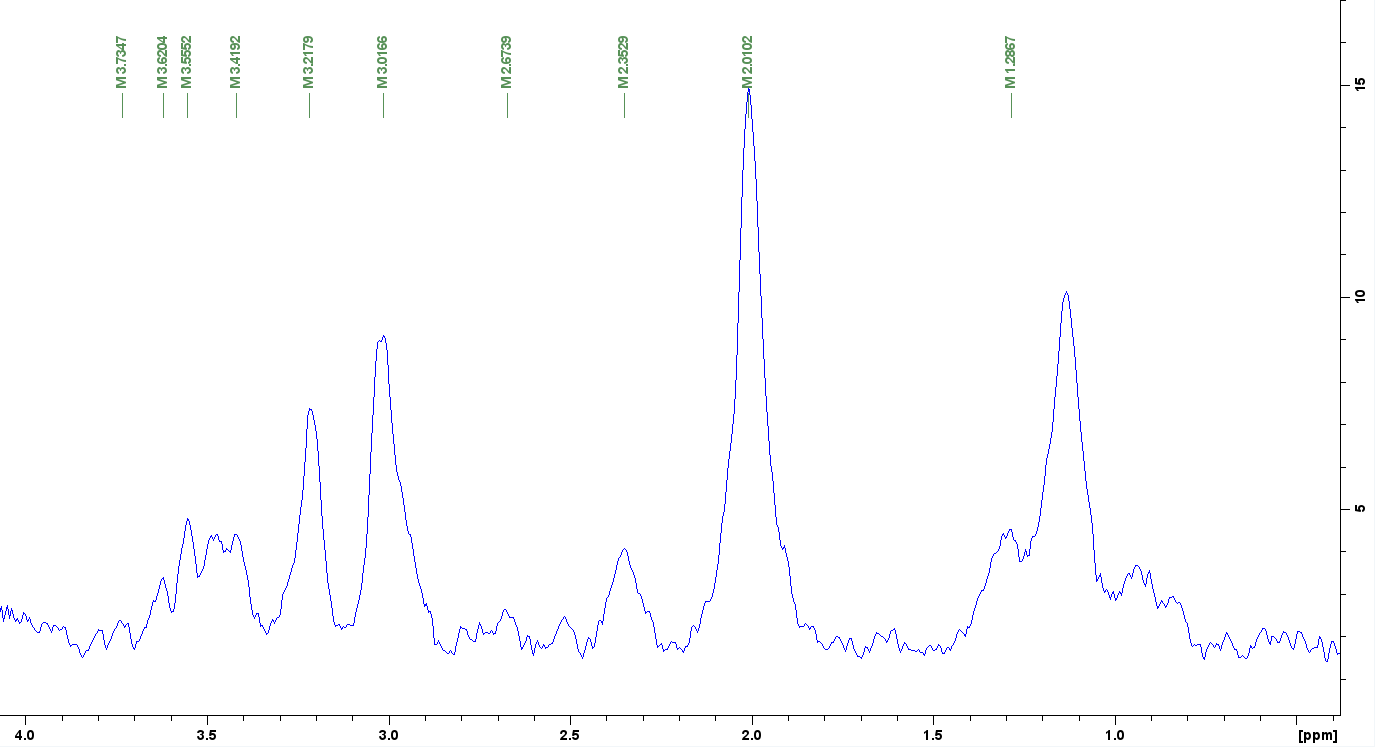
A representative 1H spectra acquired via RE-LASER with peak selection performed.
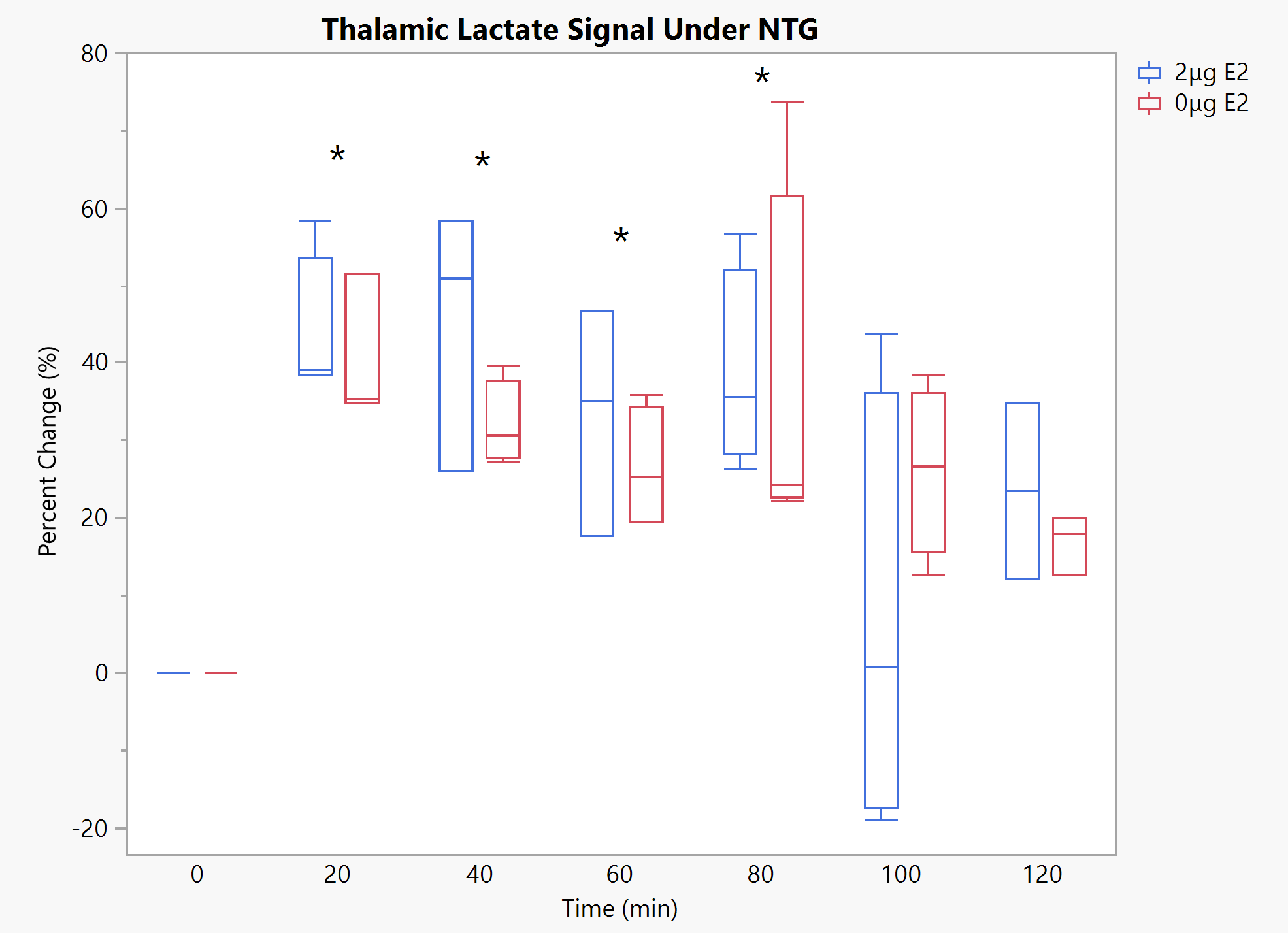
Thalamic lactate signal under 10 mg/kg NTG. * - both estradiol groups significant to baseline, no significance between groups found. p<0.05 for all significances.
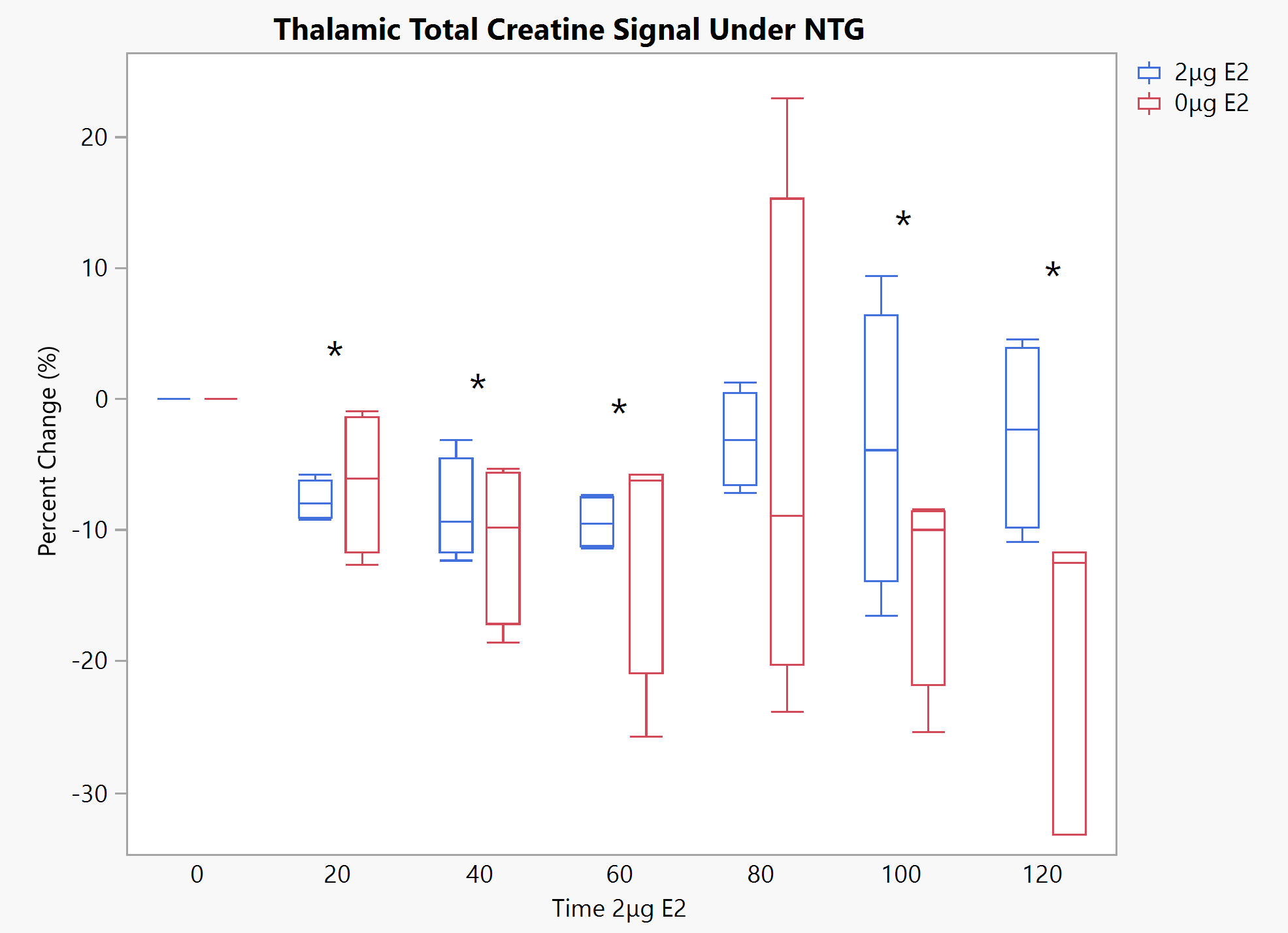
Thalamic total creatine signal under 10 mg/kg NTG. * - both estradiol groups significant to baseline, no significance between groups found. p<0.05 for all significances.
DOI: https://doi.org/10.58530/2023/2090