2023
Swin golden angle: a radial profile order for golden ratio sampling with navigator compatibility and eddy-current suppression1Center for Biomedical Imaging Research, Tsinghua University, Beijing, China, 2Institute of Science and Technology for Brain-Inspired Intelligence, Fudan University, Shanghai, China, 3School of Medical Technology, Beijing Institute of Technology, Beijing, China
Synopsis
Keywords: Data Acquisition, Cardiovascular, golden angle radial, eddy-current suppresion, profile order
Golden angle radial trajectory suffers from eddy-current when combined with trueFISP sequence. If additional navigators are required, how to keep golden ratio sampling while maintain stable steady-state is still a problem to be solved. In this work, we propose a novel radial profile order, named "swin golden angle"(swinGA), which is able to achieve golden ratio sampling, stable trueFISP signal, and navigator acquisition simultaneously. We validated the proposed profile in static phantom study and in-vivo study for free-running cardiac imaging. The results show that the proposed swinGA significantly outperforms other sampling profiles and achieves good image quality.Introduction
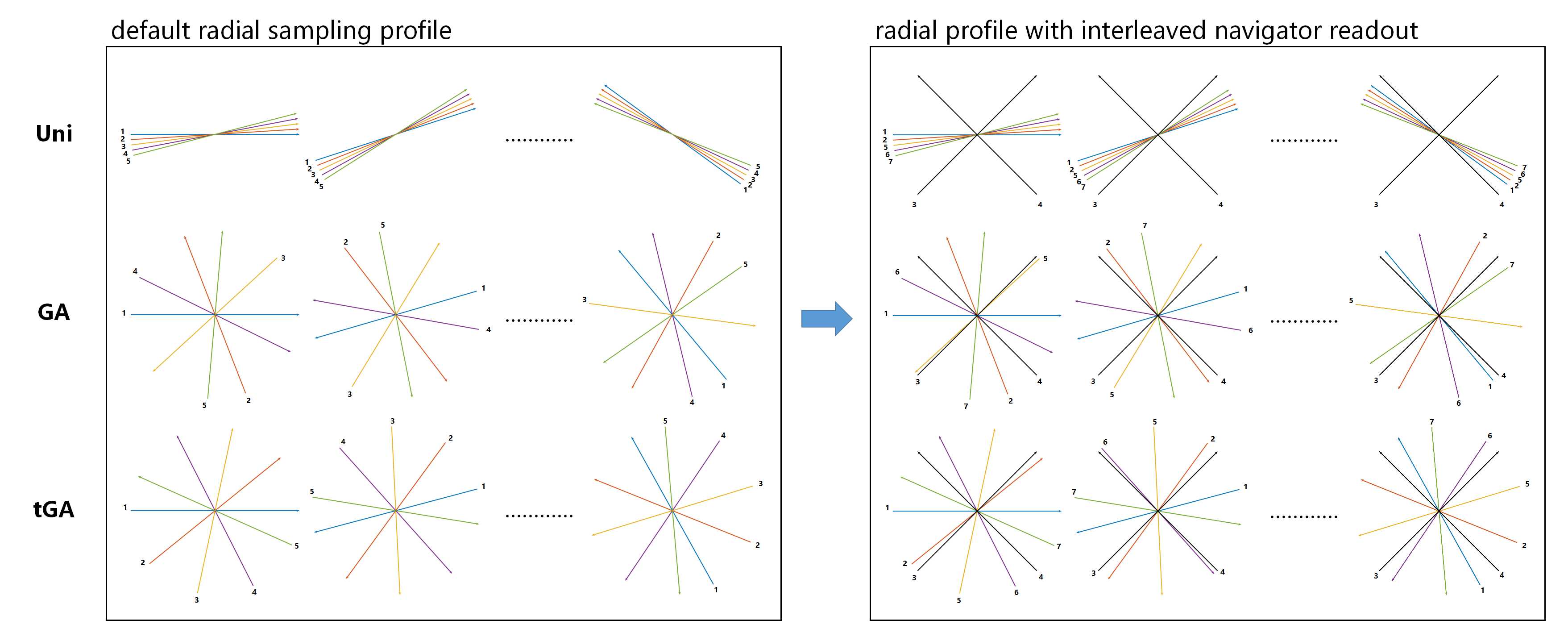
Golden angle (GA) radial trajectory[1], which uses a golden ratio angle increment in sampling the k-space lines, enables high scan efficiency and improves temporal resolution for dynamic imaging. However, directly applying GA to trueFISP sequence will induce image artifacts since the large change in gradient waveform between two readouts leads to non-smooth eddy-current effects and unstable signal[2]. GA using a tiny angle increment, which is named as tiny GA (tGA)[3], could mitigate this impaction. However, when the self-navigation acquisition is integrated, as shown in Figure 1, the trajectory will become complicated since the fixed readout direction of self-navigation will disrupt the smooth angle series.In this work, we propose a novel radial profile order, which is able to simultaneously achieve golden ratio sampling, stable signal steady-state, and navigator acquisition.
Methods
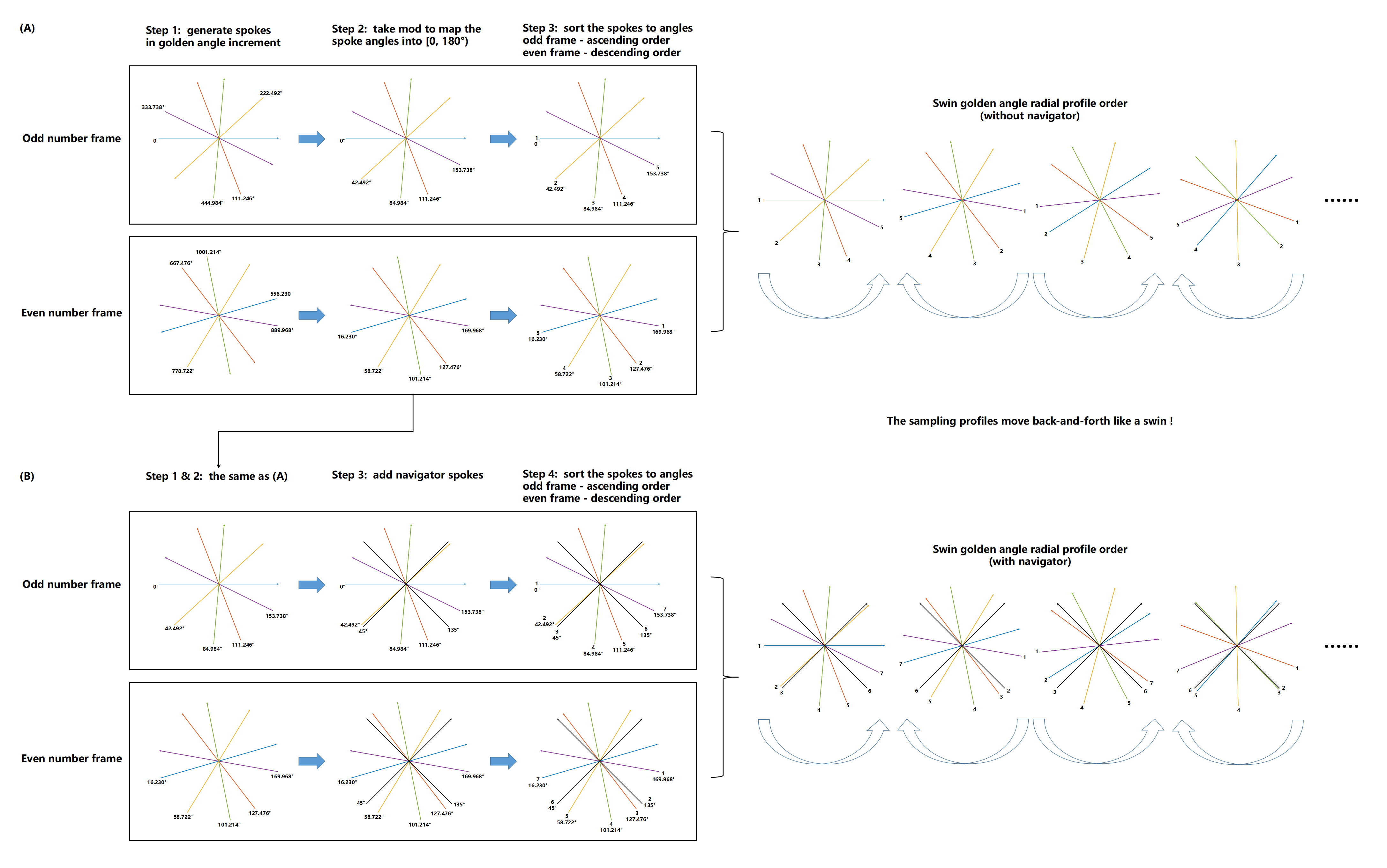
When navigator acquisition is combined with golden-angle radial trueFISP sequence, there are two major considerations. The first is that the navigator readout should be inserted into the angle series in a smooth way, in order to reduce eddy-current. The second is that the navigator should be acquired along the same direction, because the acquired data is usually not symmetric with inversed readout direction due to system imperfections(e.g., gradient delay).We design the swin golden angle(swinGA) profile to facilitate the combination of golden-angle radial trueFISP sequence and self-navigation. We first considered the trajectory without navigator as shown in Figure 2A. First, spokes of golden angle increment are generated for each frame. Second, the angles are taken modulus to 180$$$^{\circ}$$$ and mapped into range [0$$$^{\circ}$$$,180$$$^{\circ}$$$). Third, the spokes are sorted according to the modulus angles. For odd frames, spokes are sorted in ascending order. For even frames, spokes are sorted in descending order. After these three steps, the swinGA trajectory can be generated. The spokes sweep from 0$$$^{\circ}$$$ to 180$$$^{\circ}$$$ in odd frames and sweep backward in even frames, just like a swin.
Figure 2B displays how to generate swinGA trajectory with inserted navigators. The first and second steps are the same as Figure 2A. Then, the navigator spokes are inserted into the frame. Finally, all spokes (including GA and navigator) are sorted in the same way as Figure 2A.
In swinGA profile, since the navigators are inserted into GA patterns, the maximum azimuthal gap will be restricted by the fibonacci series[1], indicating the angle increment is smooth. Besides, because the spoke readout always starts from the same half-plane, the navigator quality is guaranteed.
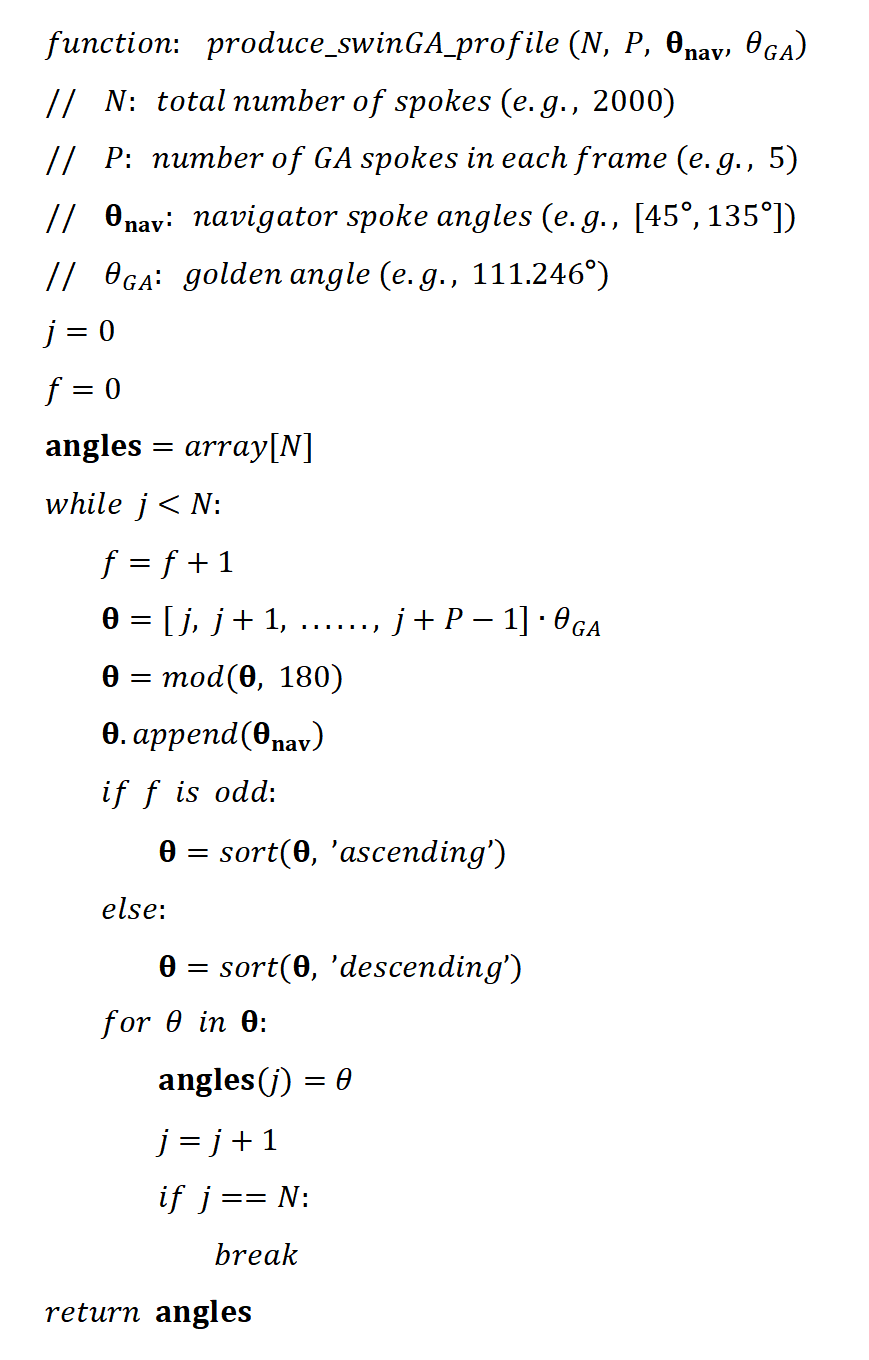
The pseudo code for swinGA is provided in Figure 3 for generating the profile angles.
Experiments
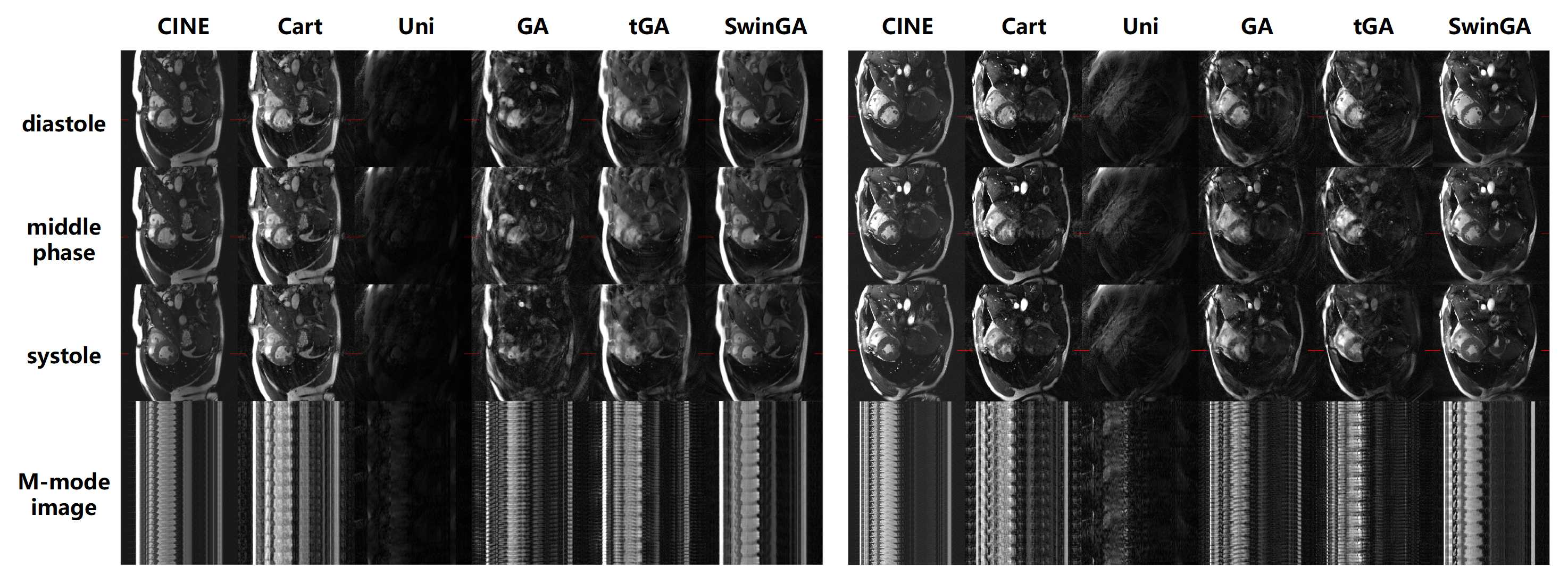
TrueFISP sequences with five trajectories, including Cartesian(Cart), uniform radial(Uni), GA, tGA and swinGA, were implemented on a 3T clinical scanner (Philips IngeniaCX R5.7.1; Best, Netherlands). The sequence parameters are kept the same for all experiments: FOV=300mmx300mmx8mm, Resolution=1mmx1mmx8mm, TR/TE/FA=4.2ms/2.1ms/45$$$^{\circ}$$$, Duration=15s. For the navigator-interleaved acuiqsition, 5 imaging spokes and 2 navigator spokes(45$$$^{\circ}$$$ and 135$$$^{\circ}$$$) are acquired in a frame, which corresponds to a temporal resolution of 29.4ms. Besides, we choose N=5 for tGA sequence. For cartesian sequence, each frame also contains 5 imaging lines(random phase encoding) and 2 navigator lines(fixed as ky=-1 and ky=0).Static Phantom Study
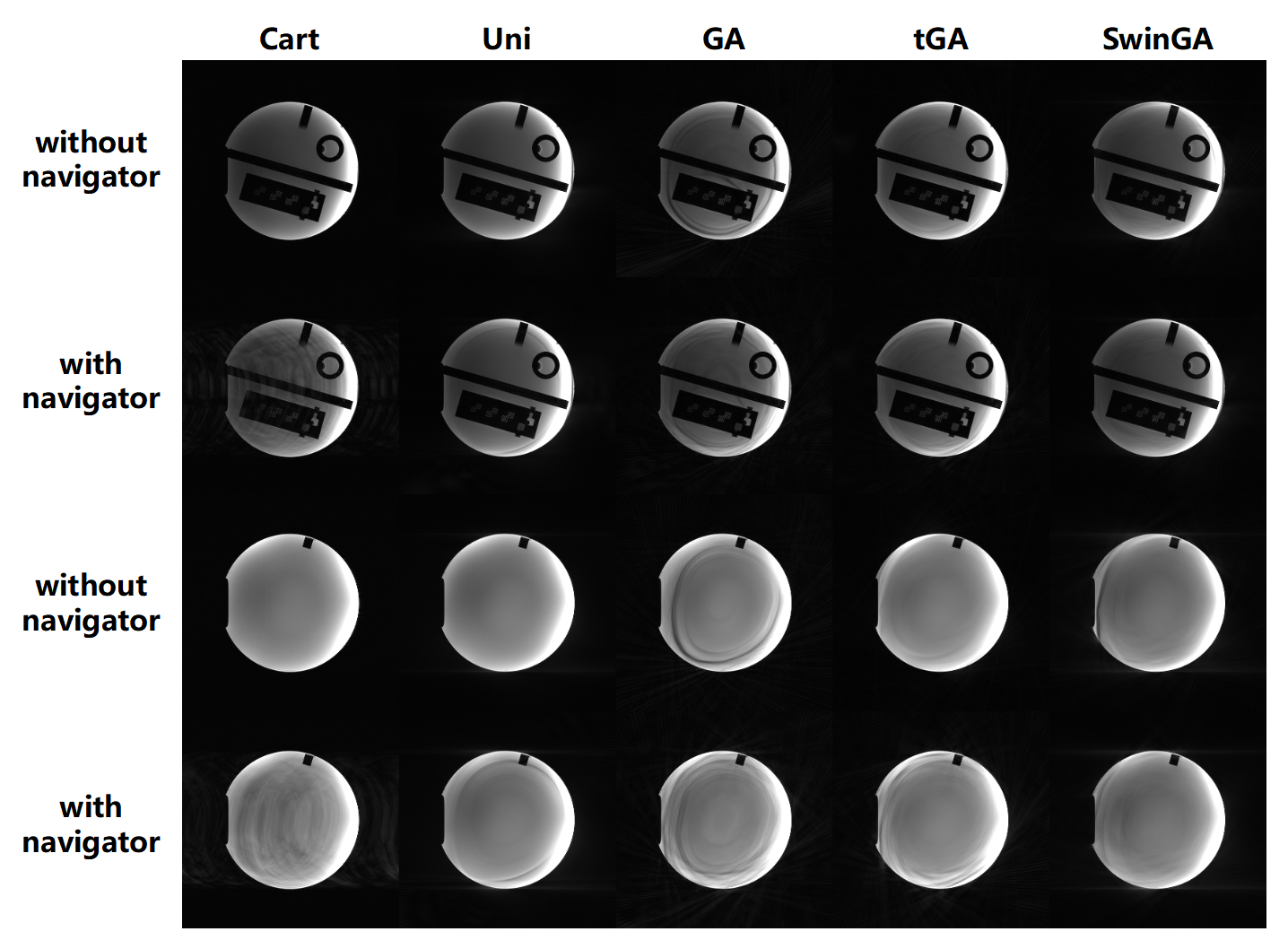
Scanning was performed on a static water phantom. After acquisition, only the imaging spokes (or phase encoding lines) were used to fill a fully-sampled k-space and reconstruct the phantom image to depict the eddy-current appearance in static objects.
Dynamic In-vivo Study
Two healthy volunteers were recruited. To exclude irrelevant factors, breath-holding is required. A PS-model based low-rank reconstruction algorithm is used for reconstructing the image for both cartesian and radial trajectory[4]. A retrospective ECG-synchronized CINE scan is additionally performed for comparison, which shares quite similar sequence parameters.
Results
The phantom study results are shown in Figure 4. It can be seen that GA always suffers from severe eddy-current artifacts. Cart, Uni, tGA keep good image quality without navigator, but display residual eddy-current artifacts when navigators are inserted. SwinGA presents the minimum artifacts with navigator acquisition.The in-vivo study results are shown in Figure 5. It can be seen that reconstruction fails for Uni, which is due to its low sampling efficiency (spokes are not evenly distributed), leading to highly ill-posed inverse problem. GA suffers from severe eddy-current artifacts. The tGA performs slightly better than GA, but the artifacts are still very obvious. Cart also suffers from eddy current, which obscures the image details at the heart region. The image produced by swinGA displays the best quality, and is highly consistent with retrospectively ECG-synchronized CINE image.
Discussion and Conclusion
In this work, we proposed "swin golden angle", which is able to simultaneously achieve golden ratio sampling, stable trueFISP signal, and robust navigator acquisition. Our validations indicated that the proposed SwinGA could effectively suppress the artifacts in cardiac imaging compared to other GA trajectories when self-navigation signals was sampled. Adding some fixed navigator readouts into GA sampling may be beneficial, because the dynamic information could be directly characterized by the navigators. Besides, since navigators do not overlap with GA spokes, all spokes can be utilized as imaging data without sacrificing the scan efficiency. SwinGA may contribute to the development of more advanced cardiac imaging techniques.Acknowledgements
No acknowledgement found.References
[1]. Winkelmann, S., Schaeffter, T., Koehler, T., Eggers, H., & Doessel, O. (2006). An optimal radial profile order based on the Golden Ratio for time-resolved MRI. IEEE transactions on medical imaging, 26(1), 68-76.
[2]. Wundrak, S., Paul, J., Ulrici, J., Hell, E., & Rasche, V. (2014). A small surrogate for the golden angle in time-resolved radial MRI based on generalized fibonacci sequences. IEEE transactions on medical imaging, 34(6), 1262-1269.
[3]. Scheffler, K., & Hennig, J. (2003). Eddy current optimized phase encoding schemes to reduce artifacts in balanced SSFP imaging.
[4]. Li, Z., Sun, A., Liu, C., Wei, H., Wang, S., Fu, M., & Li, R.
(2022). Accelerated partial separable model using dimension-reduced
optimization technique for ultra-fast cardiac MRI. arXiv preprint arXiv:2210.00493.
Figures