2004
Phase-Constrained Reconstruction for Enhancing PROPELLER SNR
Yuchou Chang1, Gulfam Ahmed Saju1, Jasina Yu1, Reza Abiri2, Tianming Liu3, and Zhiqiang Li4
1Computer and Information Science, University of Massachusetts Dartmouth, North Dartmouth, MA, United States, 2Electrical, Computer and Biomedical Engineering, University of Rhode Island, Kingston, RI, United States, 3Computer Science, University of Georgia, Athens, GA, United States, 4Neuroradiology, Barrow Neurological Institute, Phoenix, AZ, United States
1Computer and Information Science, University of Massachusetts Dartmouth, North Dartmouth, MA, United States, 2Electrical, Computer and Biomedical Engineering, University of Rhode Island, Kingston, RI, United States, 3Computer Science, University of Georgia, Athens, GA, United States, 4Neuroradiology, Barrow Neurological Institute, Phoenix, AZ, United States
Synopsis
Keywords: Motion Correction, Parallel Imaging
PROPELLER blade acquisition has been accelerated by undersampling blade k-space data. Missing data on each blade can be reconstructed by parallel MRI reconstruction methods. However, noise deteriorates the blade and the overall image quality. To enhance the signal-to-noise ratio (SNR), phase-constrained reconstruction is studied for improving the SNR of PROPELLER imaging. Phase-constrained reconstruction can improve PROPELLER imaging SNR when the acceleration of data acquisition is used. Optimal selection of the ACS lines and the outer reduction factors is expected to achieve a better SNR and accelerate the PROPELLER imaging speed simultaneously.Introduction
Periodically Rotated Overlapping ParallEL Lines with Enhanced Reconstruction (PROPELLER) 1 MRI has many clinical applications, and it is implemented on almost all clinical MR scanners of the major vendors. PROPELLER blade acquisition has been accelerated by undersampling blade k-space data. Missing data on each blade can be reconstructed by parallel MRI (pMRI) reconstruction methods. However, noise deteriorates the blade and the overall image quality. To enhance the signal-to-noise ratio (SNR), phase-constrained reconstruction is studied for improving the SNR of PROPELLER imaging.Methods
PROPELLER acquires k-space data using a group of blades as shown in Figure 1. Those blades are rotated to generate a circle field-of-view (FOV). Each blade can be acquired by a time of repetition (TR) within a turbo spin echo (TSE) sequence, and blade width is limited by echo train length (ETL). Due to the signal decay, ETL cannot be too long. It is generally between 16 to 32 for acquiring a PROPELLER blade. Therefore, the blade width cannot be large, and more narrow blades (e.g., 12 blades in Figure 1) are needed to cover the whole k-space for achieving better image quality. PROPELLER generally costs about ~60% longer time than Cartesian MRI. Blades can be acquired under the Nyquist sampling rate, and imaging speed can be accelerated. Missing data on each blade are reconstructed. As a tradeoff, SNR deteriorates due to the undersampled blades.Phase-constrained reconstruction has been used for enhancing SNR in Cartesian MRI reconstruction 2, but it has not been used for improving PROPELLER imaging. We proposed the phase-constrained nonlinear reconstruction for suppressing noise in Cartesian MRI 3. We apply the phase-constrained reconstruction for accurately recovering the missing data on the blades of PROPELLER. Specifically, each blade is acquired with undersampled data at first. Then, nonlinear reconstruction with phase-constrained prior is used for recovering the missing data on blades. Once all blades are reconstructed, we will integrate them by using coordinate generation, sampling density estimation, gridding and combining all blades, roll-off correction, data scaling, and combining all coils. SNR is observed by comparing the reconstruction results with blade reconstructions using PROPELLER GRAPPA 4.
Results
Two volunteer datasets were acquired on a Philips Ingenia 3T scanner with the 13-channel head phased-array coils. A TSE PROPELLER sequence is used for acquiring data (repetition time [TR]/echo time = 4000/109 ms; ETL = 30; matrix size = 436 x 436; slice thickness = 4 mm; 24 slices; FOV = 25 cm). Informed consent was obtained from all volunteers for all in vivo experiments in accordance with institutional review board policy. Each blade is undersampled using the outer reduction factor 2 and 10 auto-calibration signals (ACS) lines. A total of 24 blades and a subset of 8 blades are used for PROPELLER reconstruction for observing the SNR effects.As shown in Figure 2, it is seen that the phase-constrained reconstruction can improve PROPELLER SNR in comparison to the PROPELLER image which is composed of the GRAPPA-reconstructed blades. Both reconstructions used a subset of 8 blades. Phase-constrained reconstruction is close to the reference image which has fully sampled blade data. Figure 3 shows that the phase-constrained reconstruction also outperforms the GRAPPA-reconstructed blades-based PROPELLER image quality. Noise is suppressed in the phase-constrained reconstruction process. In PROPELLER, more blades acquired can improve SNR, but acquisition time is elongated, and more potential motions may bring blurring effects. Figure 4 shows that the 8-blade PROPELLER has lower SNR than that of the 24-blade PROPELLER image. Similarly, the phase-constrained reconstruction of the 8-blade PROPELLER has lower SNR than that of the phase-constrained reconstruction of the 24-blade PROPELLER image. Balancing the number of blades and the outer reduction factor on each blade can make the overall SNR optimal.
Discussion
Phase-constrained reconstruction can improve PROPELLER imaging SNR when the acceleration of data acquisition is used. We undersampled the full blade for the phase-constrained reconstruction, and the blade width is not broadened. Since blade width is generally restricted by ETL, modification of the PROPELLER sequence is needed for expanding the blade width in the future work.Conclusion
PROPELLER SNR is improved when blade acquisition is accelerated by using an undersampling strategy. Optimal selection of the ACS lines and the outer reduction factors is expected to achieve a better SNR and accelerate the PROPELLER imaging speed simultaneously.Acknowledgements
No acknowledgement found.References
1. Pipe J. Motion correction with PROPELLER MRI: application to head motion and free‐breathing cardiac imaging. Magn Reson Med. 1999;42(5):963-969.
2. Martin Blaimer, Marius Heim, Daniel Neumann, Peter M. Jakob, Stephan Kannengiesser, Felix A. Breuer. Comparison of phase-constrained parallel MRI approaches: Analogies and differences. Magn. Reson. Med. 2016; 75(3): 1086-1099.
3. Chang Y, Zhang J, Pham HA, Li Z, and Lyu J. Virtual conjugate coil for improving KerNL reconstruction. IEEE EMBC. 2022.
4. Li Z, Pipe J, Aboussouan E, Karis JP, and Huo D. A parallel imaging technique using mutual calibration for split-blade diffusion-weighted PROPELLER. Magn Reson Med. 2011;65(3):638-644.
Figures
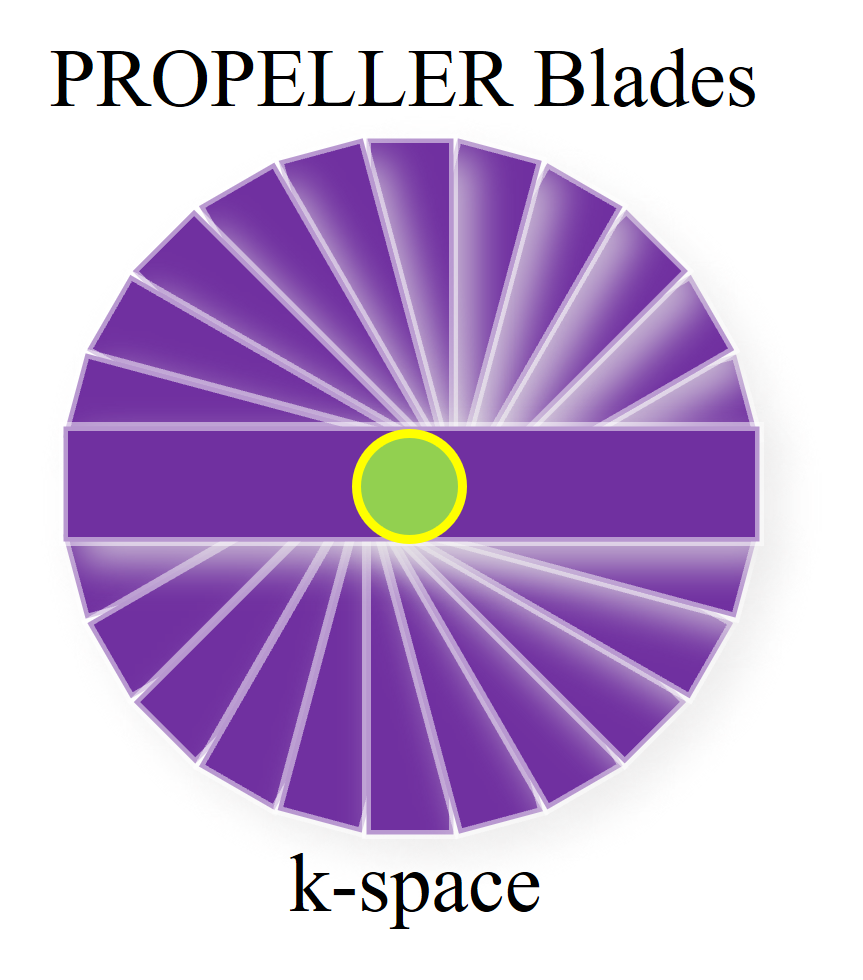
Figure 1: PROPELLER blades are used to acquire k-space data. Each blade is rotated for covering the whole k-space. The center circle overlapped by all blades is used for estimating motions.
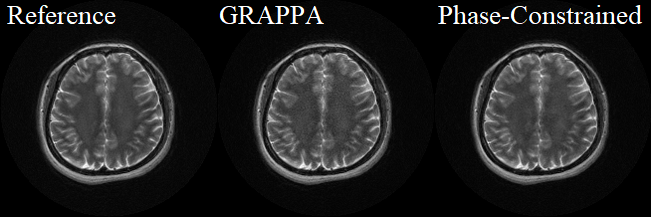
Figure 2: Axial brain image reconstruction results from subject 1. Phase-constrained reconstruction can improve the SNR of the PROPELLER image.
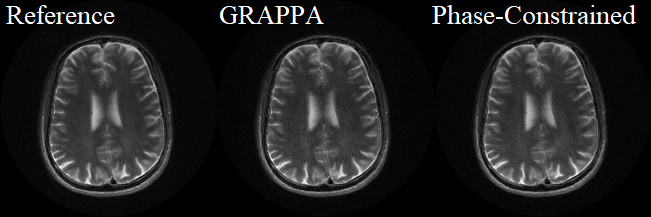
Figure 3: Axial brain image reconstruction results from subject 2. Phase-constrained reconstruction can improve the SNR of the PROPELLER image.
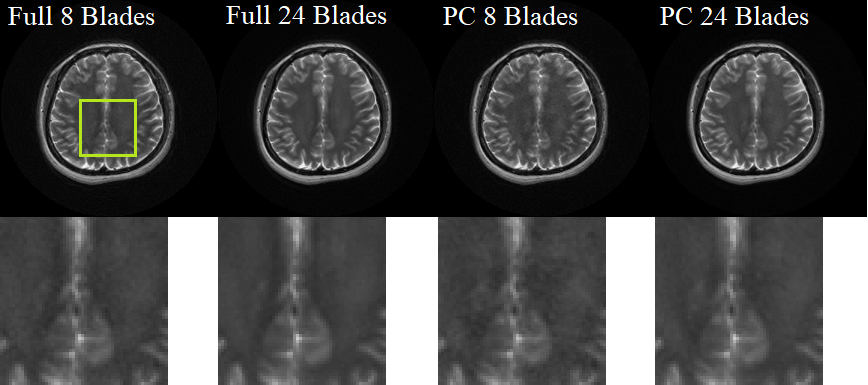
Figure 4: Comparison between 8-blade and 24-blade reconstructions. The left two columns represent reconstructions with fully sampled blades (8 and 24). The right two columns represent the phase-constrained (PC) reconstructions with undersampled blades (8 and 24). Patches are extracted for observing SNR.
DOI: https://doi.org/10.58530/2023/2004