2001
The development of Inter-/intra-volume motion correction algorithm for fMRI using a custom MRI acquisition with prospectively injected motion.1Radiology, Cleveland Clinic, Cleveland, OH, United States
Synopsis
Keywords: Motion Correction, fMRI
In this study, we propose the new inter-/intra-volume motion correction algorithm. To test the proposed method, we modify simulated Prospective Acquisition CorrEcted (SIMPACE) EPI sequence and inject both inter- and intra-volume motion during actual EPI acquisition. Using ex-vivo brain phantom, we synthesize inter-/intra volume motion corrupted MR data. We evaluate the proposed method, compared to volume motion correction method. We find that the proposed inter-/intra-volume method outperforms volume motion correction method.
Introduction
The most common methods for correction of head motion in fMRI data make the following assumption: stack of sequentially acquired 2-dimensional EPI images are considered to be a single volume acquisition and head motion is synchronized to the volume acquisition 1-7. This is the erroneous assumption that intra-volume motion is negligible. However, the head motion occurs in k-space acquisition as well as intra-volume acquisition 8. In this study, we employ simulated Prospective Acquisition CorrEcted (PACE) EPI sequence 9 and inject both inter- and intra-volume motion during EPI acquisition, referred as Simulated PACE (SIMPACE) data. We modify SLice-Oriented MOtion COrrection (SLOMOCO) method 10 and evaluate the proposed method with inter-/intra-volume motion injected SIMPACE data.Methods
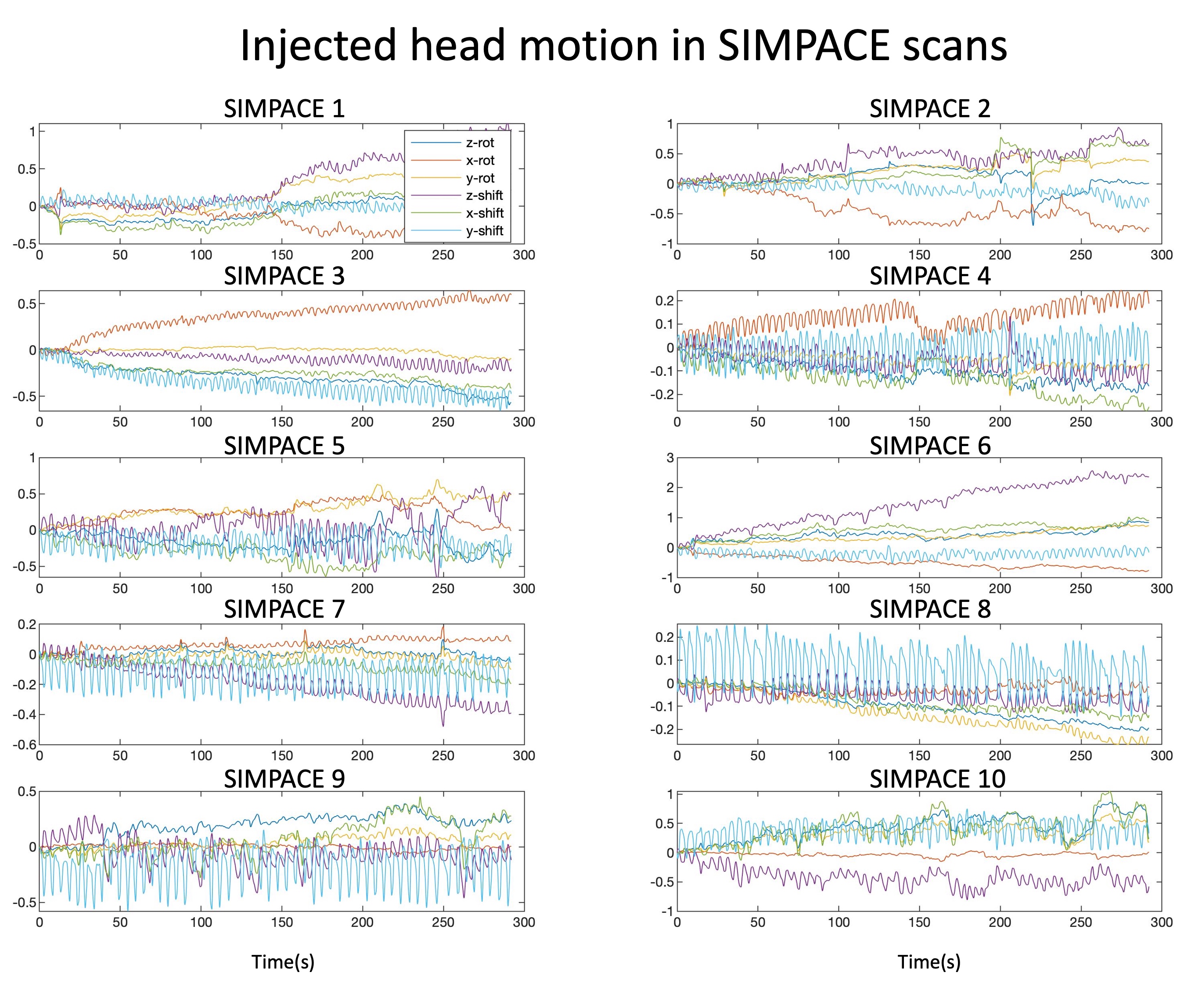
SIMPACE dataWe built the ex-vivo brain phantom 11 and scanned it with SIMPACE sequence (TR/TE=2s/28ms, voxel size = 2x2x4mm3, ascending interleaved slice acquisition, 21 slices, 150 vols) with the realistic head motion. Rigid volume motion is measured with 10 HCP YA MR data (TR/TE=0.8s/37ms, SMS=8, 72 slices, 420 vols). Then 6 volume motion parameters with 1/0.8s sampling rate are temporally interpolated to slice acquisition sampling rate of SIMPACE (=21slice/2s) and injected. Fig1 plots 6 rigid volume motion parameters of 10 subjects.
Modified SLOMOCO
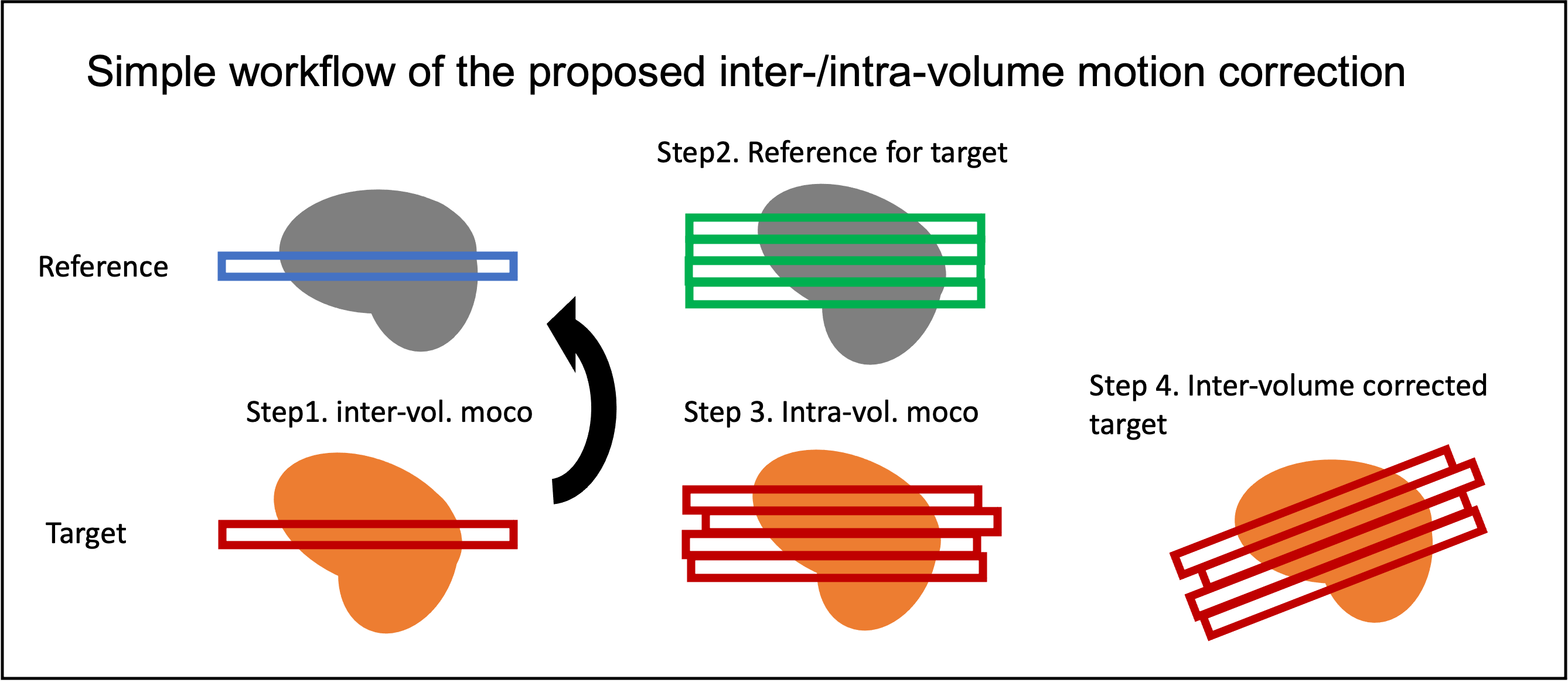
We propose new SLOMOCO method to define the individual reference slice for each target slice. Figure 2 shows its workflow. Each target volume is aligned to the reference volume (step1), and the affine transformation matrix is calculated. Using inverse transformation matrix, the reference volume is aligned to the following targe volume, providing the reference slice for each target volume (step2). In-plane motion is corrected across slices(step3), then using affine transformation matrix, in-plane motion corrected volume is aligned to the reference (step4). Out-of-plane motion is estimated in the same ways of original SLOMOCO pipeline, which is only used as regressors.
Inter-/intra-volume motion regressor
Six volume motion parameters from inter-volume motion correction (VOLMOCO) are used as regressor (vol mopa) after motion correction. Six intra-volume motion regressors from SLOMOCO are generated slice-wisely and used as the regressors (sli mopa).
Partial volume (PV) regressor
The static images are generated with the same repetition volume as the target. Then measured volume motion is injected negatively on each static image to simulate the motion corrupted data, previous suggested by the previous works 12, 13. Then, volume motion is corrected to the reference images, synthesizing the residual artifact with the motion injected and removed. We use this output as voxelwise PV regressor.
Statistical analysis
tSNR map is generated after 1) VOLMOCO, 2) VOLMOCO with 6 vol mopa regress-out, 3) VOLMOCO with 6 vol mopa and PV regress-out, 4) SLOMOCO, 4) SLOMOCO with 6 vol mopa regress-out. 5) SLOMOCO + 12 vol/sli mopa regress-out, 6) SLOMOCO + 12 vol/sli mopa + PV regress-out. Linear polynomial detrending is included in all models. Averaged tSNR values in grey matter are calculated across 10 SIMPACE data.
Results
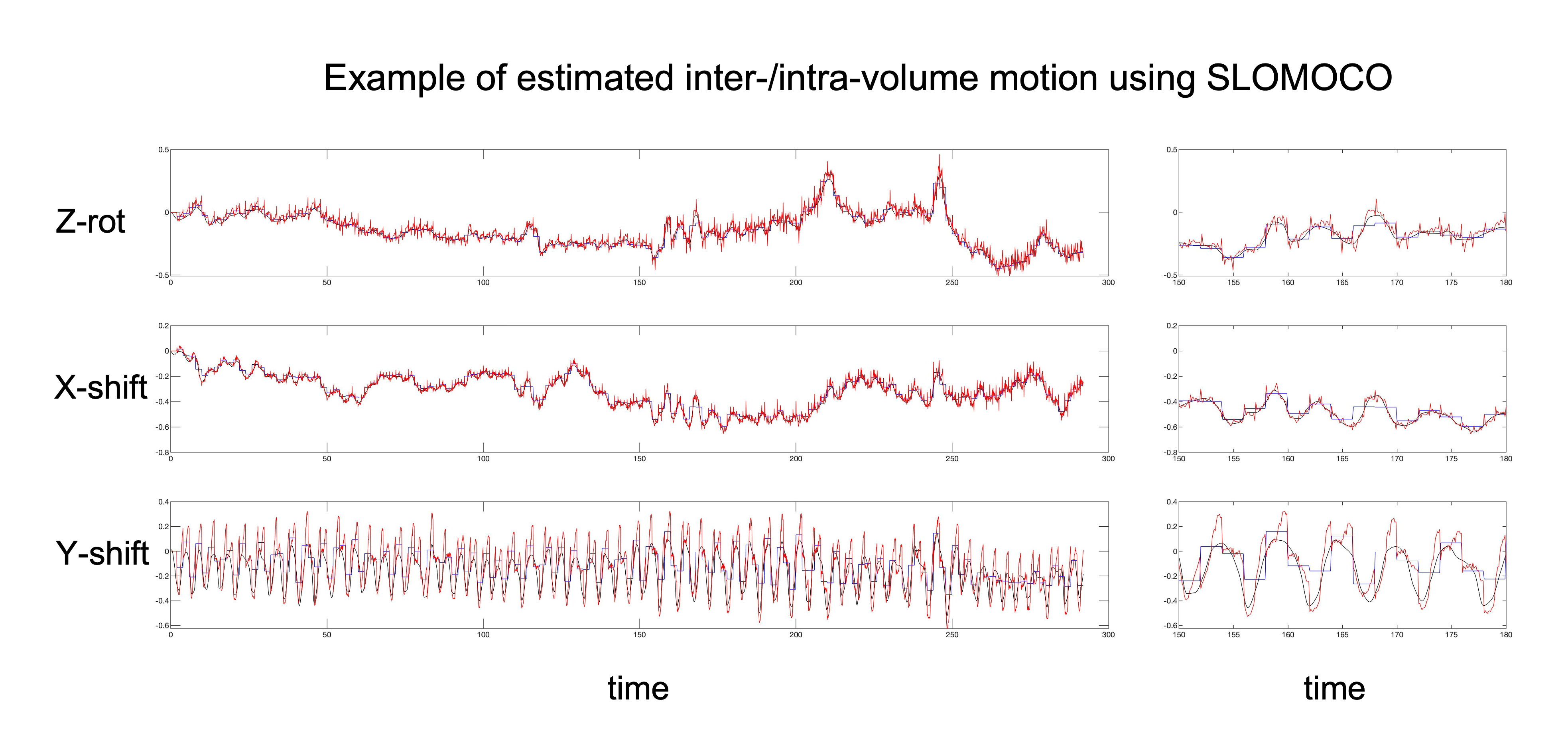
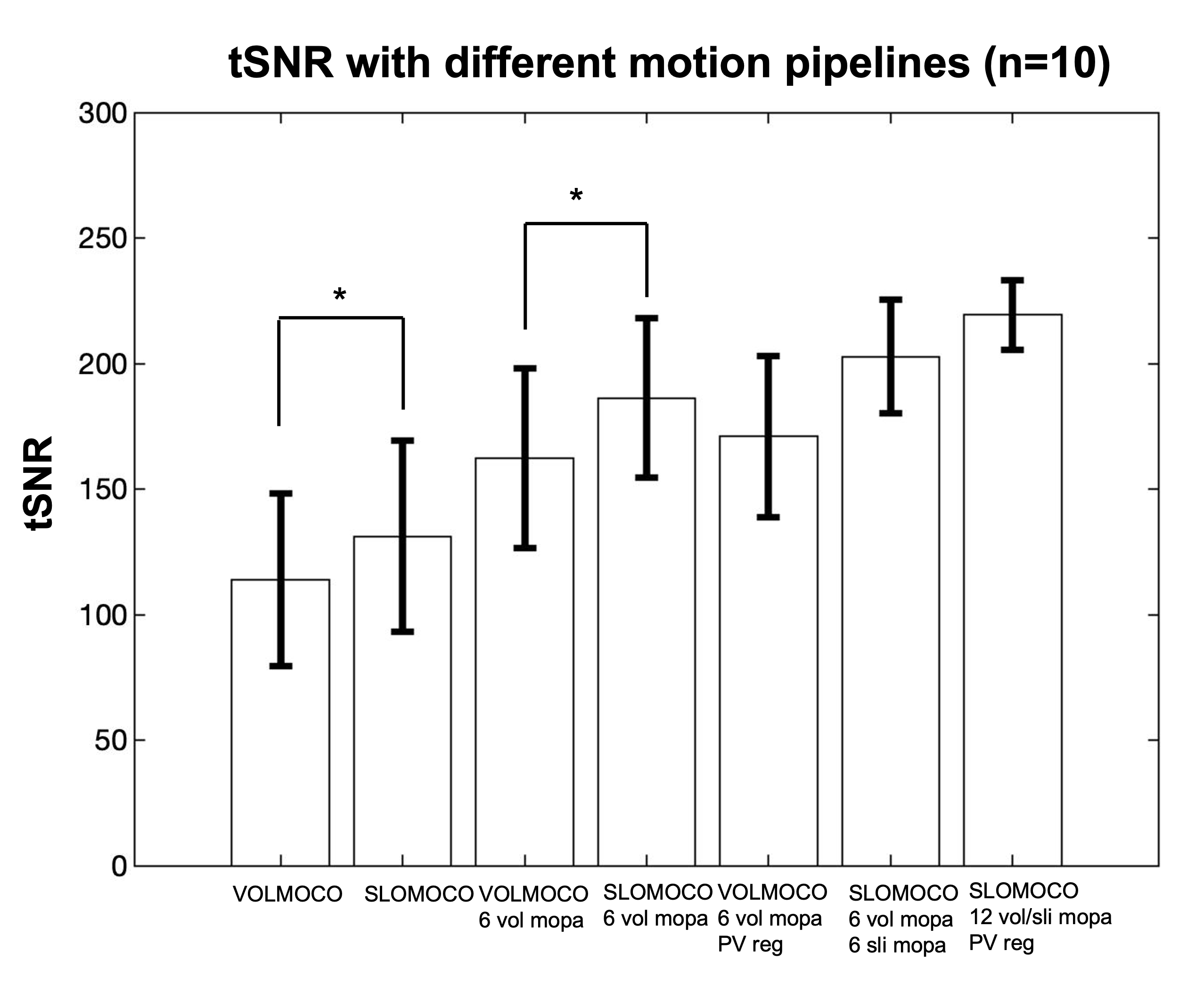
Figure3 show the example of the estimated in-plane inter-/intra-volume motion from SIMPACE 5 data using the proposed SLOMOCO. Enlarged plots show the estimated inter-/intra-volume parameters (red) follows the injected motion (black) while VOLMOCO does not estimate inter-volume motion (blue)Box plots of fig4 present that averaged tSNR of SLOMOCO is 43% higher than of VOLMOCO (114vs162). Even with the identical 6 vol mopa regressors, averaged tSNR of SLOMOCO is 42% higher than of VOLMOCO (131vs186). While additional PV regressor improves tSNR of VOLMOCO with 6 vol mopa regress-out by 5%, tSNR of VOLMOCO with 6 vol mopa and PV regressor is still less than that of SLOMOCO with 6 vol mopa (171vs186). Note that maximum tSNR and the smallest standard deviation across SIMPACE data (219±14) are observed with SLOMOCO with 12 vol/sli mopa and PV regerssors.
Discussion
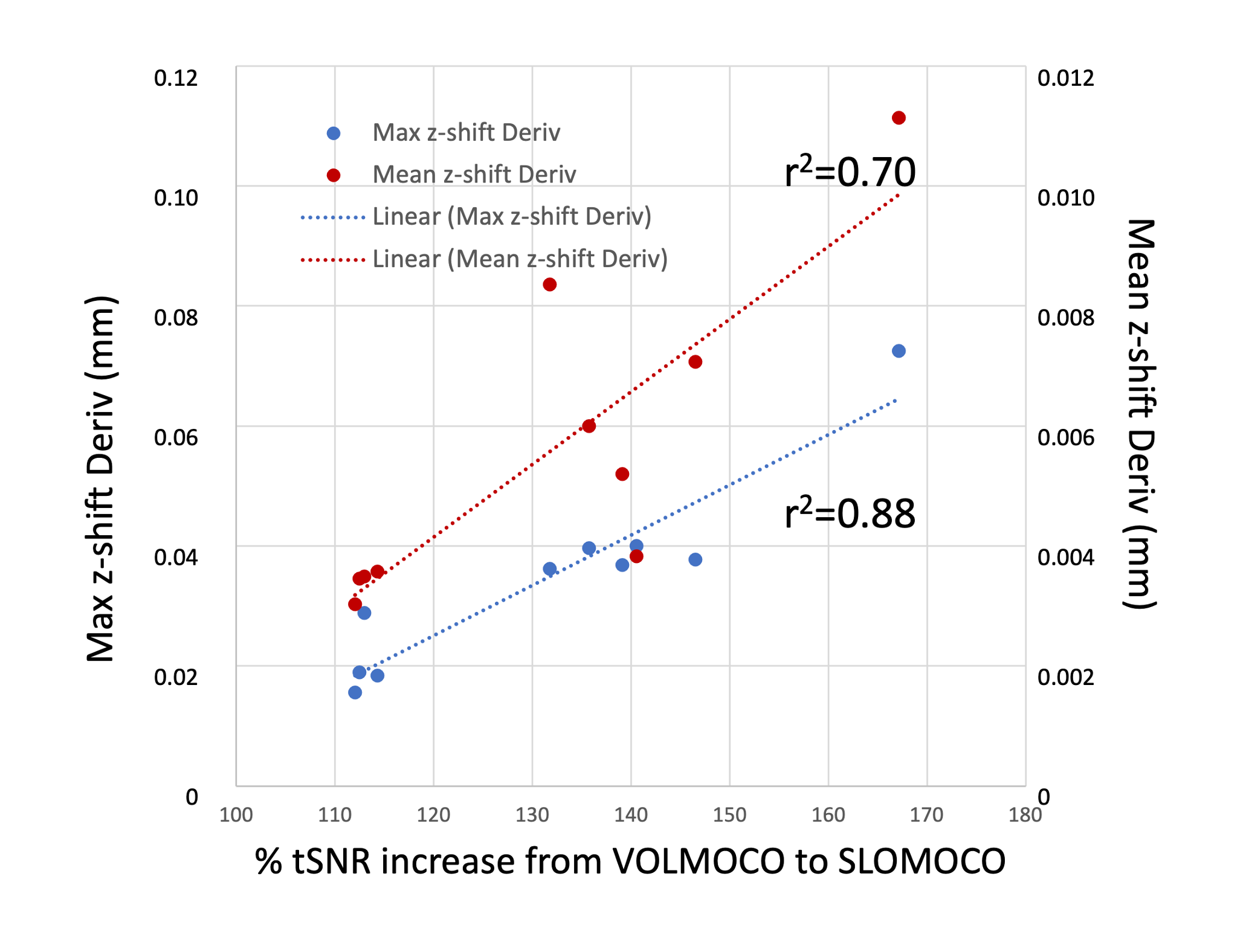
Rigid volume motion of 10 subjects is plotted as the continuous drift and the spontaneous motion pattern in Fig1 as stated in the previous studies 14. Y-shift motion (cyan color in Fig1) is fluctuated with 5 to 10s of periods, which is not only actual breathing related motion but also artificial motion in phase encoding direction due to B0 fluctuation from the breathing 15. This finding emphasizes the importance of intra-volume motion correction since the artificial motion due to the breathing is expected to be different on each slice acquisition.SLOMOCO outperforms VOLMOCO with/out the regressor models. VOLMOCO model with 6 vol mopa and PV regressors generates 171±32 of tSNR across SIMPACE data while SLOMOCO model with 12 vol/sli mopa and PV regressors has 219±13. The reduction of standard deviation in the different SIMPACE data with SLOMOCO indicates the lower tSNR cases with VOLMOCO are improved larger with SLOMOCO. Fig5 presents which SIMPACE motion pattern is improved by SLOMOCO. This exploratory investigation indicates that SIMPACE data with large change of z-directional shift has the low tSNR after VOLMOCO, which is improved by SLOMOCO dominantly. This finding agrees with the previous study to show that total displacement of z-directional motion represents the severity of motion 10.
In this study, we synthesize temporally interpolated intra-volume motion from the inter-volume motion, not presenting spontaneous intra-volume motion. In Future work, we will test the various intra-volume motion pattern using SIMPACE data.
Acknowledgements
Authors acknowledge technical support by Siemens Medical Solutions.References
1. Friston KJ, Ashburner J, Frith CD, Poline JB, Heather JD, Frackowiak RS. Spatial registration and normalization of images. Human brain mapping 1995;3:165-189.
2. Cox RW. AFNI: software for analysis and visualization of functional magnetic resonance neuroimages. Comput Biomed Res 1996;29:162-173.
3. Woods RP, Grafton ST, Holmes CJ, Cherry SR, Mazziotta JC. Automated image registration: I. General methods and intrasubject, intramodality validation. J Comput Assist Tomogr 1998;22:139-152.
4. Woods RP, Grafton ST, Watson JD, Sicotte NL, Mazziotta JC. Automated image registration: II. Intersubject validation of linear and nonlinear models. J Comput Assist Tomogr 1998;22:153-165.
5. Jenkinson M, Smith S. A global optimisation method for robust affine registration of brain images. Med Image Anal 2001;5:143-156.
6. Jenkinson M, Bannister P, Brady M, Smith S. Improved optimization for the robust and accurate linear registration and motion correction of brain images. Neuroimage 2002;17:825-841.
7. Cox RW, Jesmanowicz A. Real-time 3D image registration for functional MRI. Magn Reson Med 1999;42:1014-1018.8. Zaitsev M, Maclaren J, Herbst M. Motion artifacts in MRI: A complex problem with many partial solutions. J Magn Reson Imaging 2015;42:887-901.
9. Thesen S, Heid O, Mueller E, Schad LR. Prospective acquisition correction for head motion with image-based tracking for real-time fMRI. Magn Reson Med 2000;44:457-465.
10. Beall EB, Lowe MJ. SimPACE: generating simulated motion corrupted BOLD data with synthetic-navigated acquisition for the development and evaluation of SLOMOCO: a new, highly effective slicewise motion correction. Neuroimage 2014;101:21-34.
11. Kim S, Sakaie K, Blumcke I, Jones S, Lowe MJ. Whole-brain, ultra-high spatial resolution ex vivo MRI with off-the-shelf components. Magn Reson Imaging 2021;76:39-48.
12. Wilke M. An alternative approach towards assessing and accounting for individual motion in fMRI timeseries. Neuroimage 2012;59:2062-2072.
13. Patriat R, Reynolds RC, Birn RM. An improved model of motion-related signal changes in fMRI. Neuroimage 2017;144:74-82.
14. Power JD, Mitra A, Laumann TO, Snyder AZ, Schlaggar BL, Petersen SE. Methods to detect, characterize, and remove motion artifact in resting state fMRI. Neuroimage 2014;84:320-341.
15. Raj D, Anderson AW, Gore JC. Respiratory effects in human functional magnetic resonance imaging due to bulk susceptibility changes. Phys Med Biol 2001;46:3331-3340.
Figures