Rong Xu1, Wei Huang2, Lini Liu1, Xiaoyong zhang3, and Yingkun Guo1
1West China Second University Hospital, Chengdu, China, 2West China Second Universityy Hospital, Chengdu, China, 3Clinical Science, Philips Healthcare, Chengdu, China
Synopsis
Keywords: Cardiomyopathy, Cancer
The
stage of chemotherapy in children with ALL is a long process, and the
myocardial damage caused by chemotherapy is still unknown. The different chemotherapy
stages may have different degrees of myocardial damage. In this study, cardiac
magnetic resonance was used to evaluate myocardial strain in ALL patients at
different stages of treatment, and it was found that myocardial strain reduction was more
pronounced in the early stages of treatment, and that global strain was a risk
factor for adverse clinical outcomes.
Objective:
Myocardial
toxicity caused by cancer therapy has gradually become the main cause of
long-term poor prognosis of tumor survivors, and acute lymphoblastic leukemia(ALL)
in childhood is one of the most common cancer with long time therapy. However,
the assessment of myocardial injury is still a challenge in clinical. In this
study, we aimed to evaluate the myocardial deformation by cardiac magnetic
resonance at different stages and further to explore the prognostic value in pediatric
leukemia patients.
Materials and methods
There
were 245 children diagnosed with ALL and receiving cardiac magnetic resonance
examination in our hospital were included from January 2018 to December 2021 ,
as well as 85 normal children matching the gender and age of the patients were
enrolled. Children were grouped according to different stage of treatment (<
54 weeks, 54-125 weeks, > 125 weeks). All patients were followed up one year
after completion of MRI, with clinical adverse events defined as ICU treatment
and/or death from any cause. The left ventricle myocardial strain parameters including global
and region of radial strain (RS), circumferential strain (CS) and longitudinal
strain(LS) . the K-M analysis and univariate Cox survival analysis were used to
investigate the predictive value of CMR parameters for clinical adverse
prognosis.
Results
For
the myocardial deformation assessment, GRS and GLS in patients treated within
54 weeks were significantly lower than those in normal control group; GCS and
GLS in patients treated for more than 125 weeks were lower than those in normal
control group (all P < 0.05). GRS, GCS, and GLS were slightly lower in
patients treated for less than 54 weeks and more than 125 weeks than in
patients treated for 54 to 125 weeks. the correlation analysis showed The GRS was
significantly negatively correlated with the cumulative dose of daunorubicin in
patients treated within 54 weeks (r=-0.26,P=0.013) and over 125 weeks (r=-0.20,
P=0.044) (Figure 16). The GLS was negatively correlated with the cumulative
dose within 54 weeks of treatment (r=-0.33, P=0.001). The median follow-up time
was 1.2 years and the mean time was 1.6 years. Cox survival analysis showed
that GRS(HR=0.89; 95%CI: 0.79-0.99) and GLS(HR= 1.31; 95%CI: 1.01-1.71) was a
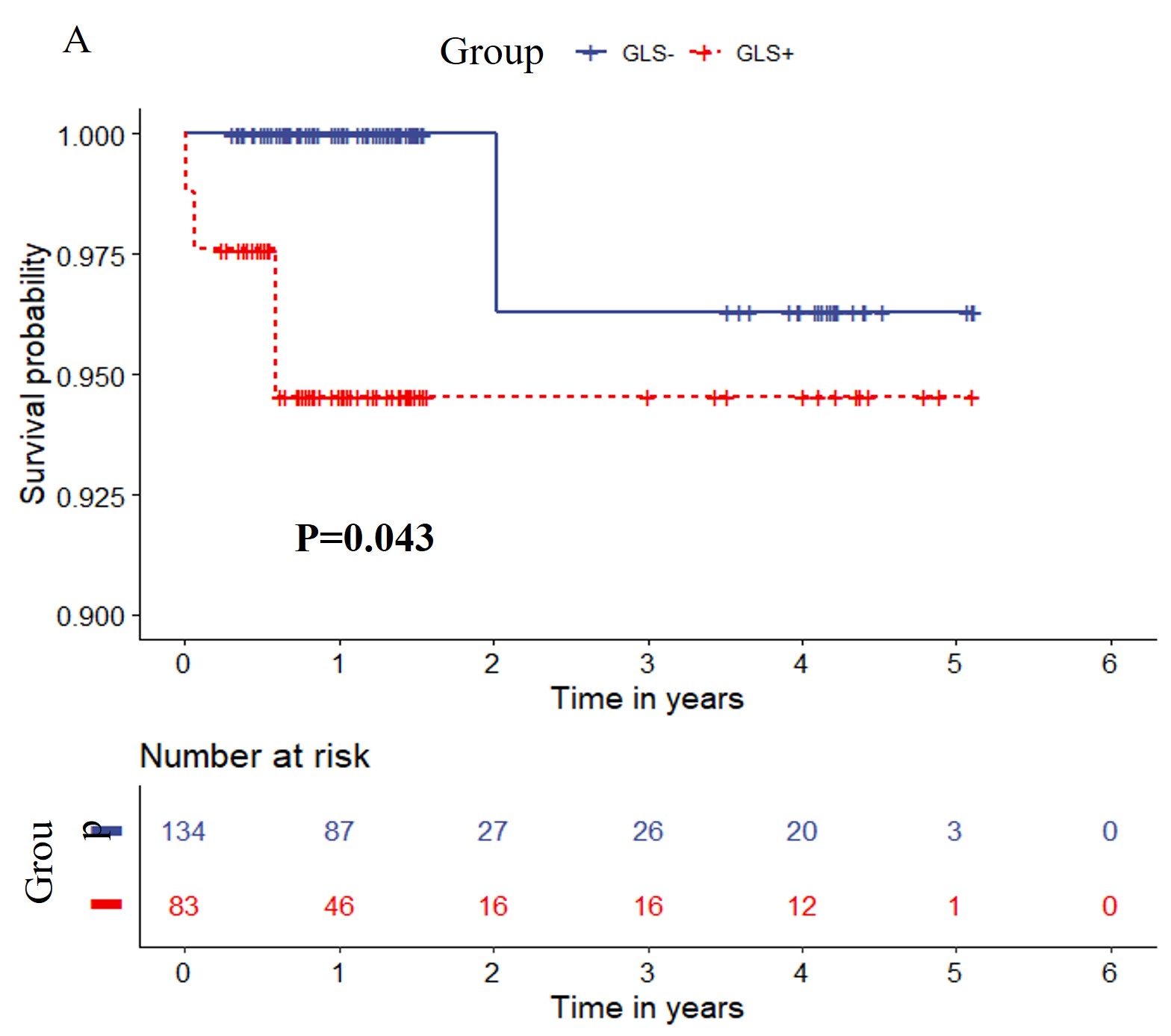
risk predictor of clinical adverse prognosis (P < 0.05). the K-M analysis of
clinical poor prognosis showed that patients with GLS <-18%
had a significantly lower survival rate than patients with ≥18% (HR:6.97,
95%CI:1.07-62.39, P= 0.043).
Conclusions
The
myocardial strain were decreased in ALL children during and after treatment,
and the decrease of myocardial strain is associated with clinical adverse
outcomes.Acknowledgements
NAReferences
[1] Steliarova-Foucher E, Colombet M, Ries LAG, et al.
International incidence of childhood cancer, 2001-10: a population-based
registry study. Lancet Oncol, 2017,18(6):719-31.
[2] Mehta
LS, Watson KE, Barac A, et al. Cardiovascular disease and breast cancer: where
these entities intersect: A scientific statement from the American heart
association. Circulation, 2018, 137(8): e30-e66.
[3]Søndergaard
MMA, Nordsmark M, Nielsen KM, Poulsen SH. Cardiovascular burden and adverse
events in patients with esophageal cancer treated with chemoradiation for
curative intent. JACC CardioOncol, 2021, 3(5):711-721.
[4]Henriksen
PA. Anthracycline cardiotoxicity: an update on mechanisms, monitoring and
prevention. Heart, 2018, 104(12): 971-77.