1942
Brain glymphatic impairment correlates with motor dysfunction after ischemic stroke1Xi'an Daxing Hospital, Xi'an, China
Synopsis
Keywords: Stroke, Diffusion/other diffusion imaging techniques
This present study used diffusion tensor image analysis along the perivascular space (DTI-ALPS) method to investigate the glymphatic activity of the corticospinal tract in subacute ischemic stroke patients with impaired motor function. We found that the subacute ischemic stroke group had a lower DTI-ALPS value on the affected side of corticospinal tract, suggesting impairment of the glymphatic system in patients with subacute ischemic stroke, which may be related to motor dysfunction.Introduction
The most common symptom related to ischemic stroke is sensorimotor dysfunction, which could recover spontaneously within three months 1. The study has pointed out that throughout the recovery process, early subacute ischemic stroke is a critical period for neuroplasticity and recovery 2. The glymphatic system is the perivascular network used for the exchange between cerebrospinal fluid and interstitial fluid in the brain. The previous research demonstrated that brain lymphatic activity is not only involved in the pathologic process of ischemic stroke but also has an influence on the recovery of ischemic stroke. The impaired brain glymphatic function is involved in the pathologic process of acute ischemic stroke 3. In this study, we used diffusion tensor image analysis along the perivascular space (DTI-ALPS) method to investigate the glymphatic activity of the corticospinal tract in subacute ischemic stroke patients with impaired motor function. We assumed that glymphatic activity was damaged after subacute ischemic stroke, and the impaired glymphatic function may be related to motor dysfunction.Methods
This cross-sectional study recruited 20 patients with ischemic stroke (mean age 59.2 years; 17 males) and 20 healthy controls (mean age 55.9 years; 11 males) with a single lesion in the left subcortical regions. All participants underwent MRI scans including diffusion spectrum imaging and T2-weighted fluid attenuated inversion recovery (FLAIR). We calculated DTI-ALPS as an MRI marker of the glymphatic system. Their demographic factors and clinical characteristics (i.e., age, sex, time since stroke onset and Fugl-Meyer assessment results) were also recorded. The DTI-ALPS between the patients with ischemic stroke and healthy controls were compared. In addition, we conducted a correlation analysis between the DTI-ALPS index and Fugl-Meyer assessment results in patients with subacute ischemic stroke. In the ischemic stroke group, the relationships of the DTI-ALPS index with Fugl-Meyer assessment scores integrity were explored using Spearman correlation analysis.Results
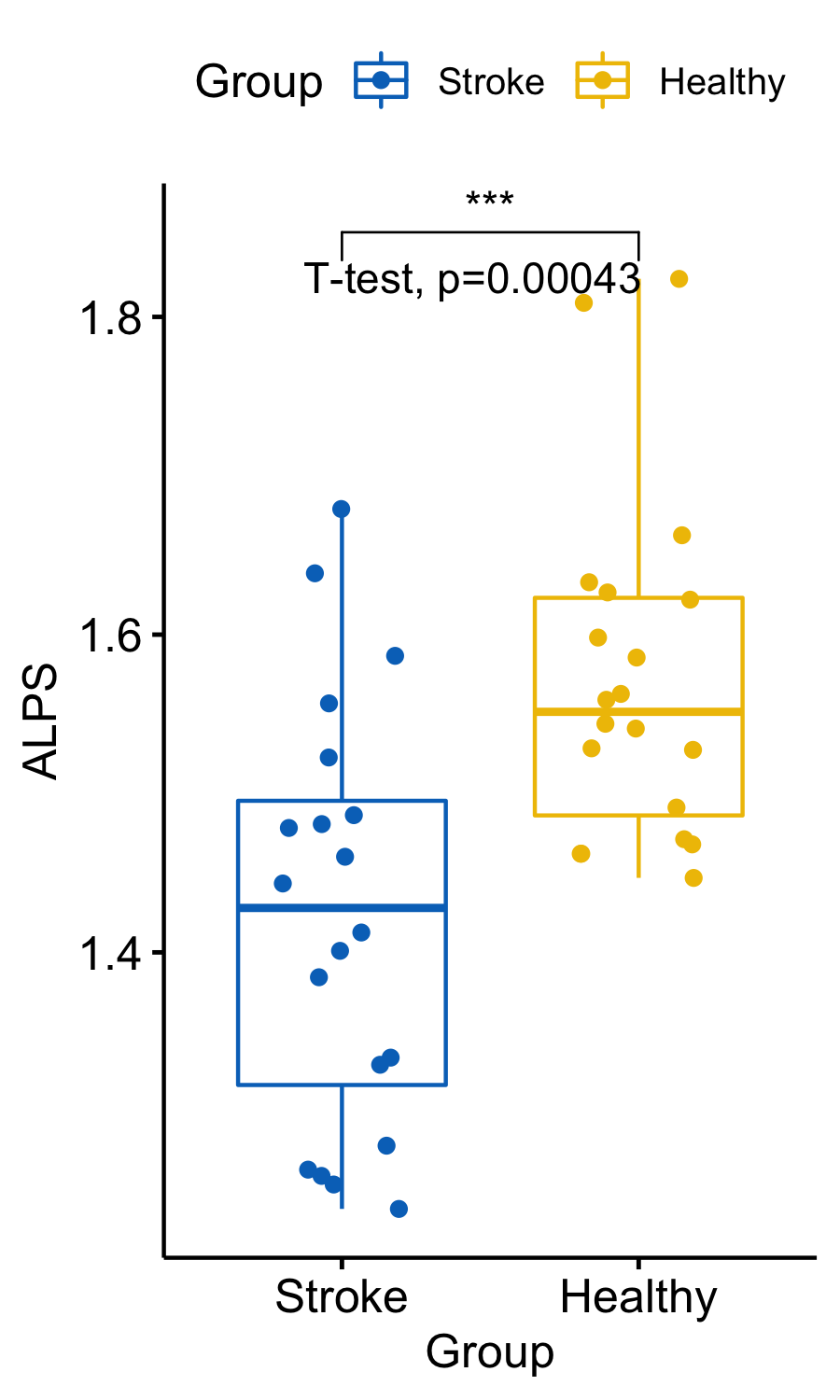
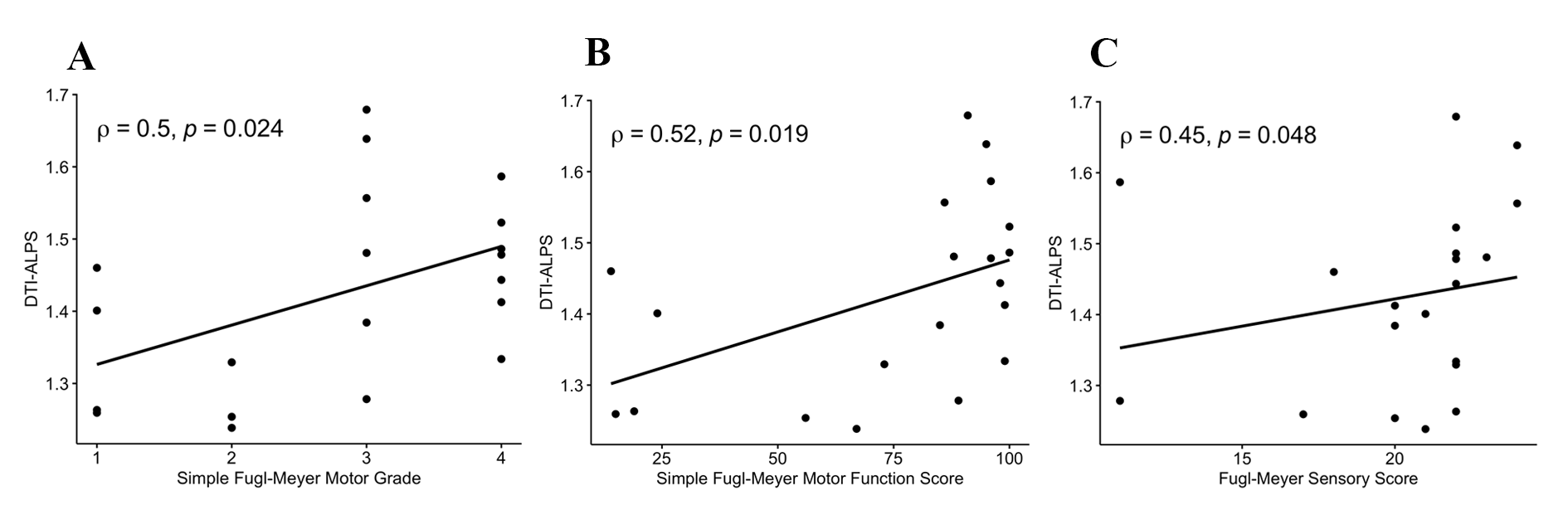
The ipsilesional DTI-ALPS index in the ischemic stroke group was significantly lower than that of the ipsilateral side in the healthy control group (t=-3.88, p<0.001). A higher ipsilesional DTI-ALPS index was associated with a better simple Fugl-Meyer motor function score (ρ=0.52, p=0.019), simple Fugl-Meyer motor grade (ρ=0.50, p=0.024), and Fugl-Meyer sensory score (ρ=0.45, p=0.048) in the ischemic stroke group.Discussion
Animal studies have provided evidence that the glymphatic system is seriously damaged and the clearance of interstitial fluid is reduced after ischemic stroke 4. In our study, the ipsilesional DTI-ALPS index was lower in the stroke group than that in healthy controls, reflecting the impaired glymphatic function in patients with ischemic stroke. We also found that a higher ipsilesional DTI-ALPS index was associated with better Fugl-Meyer scores. This finding indicated that the ischemic stroke patients had a damaged glymphatic system, which may be related to the dysfunction of ISF clearance in the glymphatic system, resulting in delaying cerebral oedema subsidence and affecting the state of motor function. However, the mechanism underlying the impairment of glymphatic function after ischemic stroke remains unknown. The possible reasons are decreased arterial pulsation, enlarged perivascular space, changes in AQP4 expression and distribution, or swollen astrocytes. More research is needed to analyze the pathophysiological changes of brain lymphatic system, so as to discover the mechanism and therapeutic target of brain oedema following stroke. Since one of the treatment principles of ischemic stroke is to remove harmful metabolites. Recent studies have found that voluntary wheel running accelerated the clearance of glymphatic function and protected mouse synaptic function 5. The research provided the association between glymphatic dysfunction and ischemic stroke, which may provide a theoretical basis for the development of new clinical therapeutics. Our finding demonstrated that there is an abnormal lymphatic function during the subacute period of ischemic stroke, which is in line with prior studies.Conclusion
In conclusion, a lower DTI-ALPS index suggests impairment of the glymphatic system in patients with subacute ischemic stroke. Significant associations are identified between the DTI-ALPS index and Fugl-Meyer scores, suggesting that the potential of DTI-ALPS as an MR biomarker for motor function from subacute ischemic stroke. These findings could extend our understanding of the pathophysiological mechanism of ischemic stroke and help to develop alternative treatment options for glymphatic activity after ischemic stroke.Acknowledgements
No acknowledgement found.References
1. van der Vliet R, Selles RW, Andrinopoulou ER, et al. Predicting Upper Limb Motor Impairment Recovery after Stroke: A Mixture Model. Annals of Neurology. 2020; 87: 383-393.
2. Bernhardt J, Hayward KS, Kwakkel G, et al. Agreed Definitions and a Shared Vision for New Standards in Stroke Recovery Research: The Stroke Recovery and Rehabilitation Roundtable Taskforce. Neurorehabilitation and neural repair. 2017; 31: 793-799.
3. Chen J, Wang L, Xu H, et al. The lymphatic drainage system of the CNS plays a role in lymphatic drainage, immunity, and neuroinflammation in stroke. Journal of Leukocyte Biology. 2021a; 110: 283-291.
4. Lv, T., Zhao, B., et al. The Glymphatic System: A Novel Therapeutic Target for Stroke Treatment. Frontiers in aging neuroscience. 2021; 13: 689098.
5. He XF, Liu DX, Zhang Q, et al. Voluntary Exercise Promotes Glymphatic Clearance of Amyloid Beta and Reduces the Activation of Astrocytes and Microglia in Aged Mice. Frontiers In Molecular Neuroscience. 2017; 10: 144.
Figures