1856
MRI-based liver iron quantification using refocused gradient-echo (bSSFP): initial results1Diagnostic and Intervnetional Radiology, Ulm University, Medical Center, Ulm, Germany, 2Section for Experimental Radiology, Ulm University, Medical Center, Ulm, Germany, 3Department of Pediatrics and Adolescent Medicine, Ulm University, Medical Center, Ulm, Germany
Synopsis
Keywords: Liver, Hematologic, Iron overload
Purpose: To evaluate the feasibility of using a balanced steady-state free precession sequence (bSSFP) to determine liver iron content (LIC).
Methods: Thirty-five consecutive patients with liver iron overload were examined with bSSFP. Signal intensity ratios between liver parenchyma and paraspinal muscles were correlated with LIC reference values obtained using Ferriscan.
Results: LIC values ranged from 24 to 756 µmol/g. The best SIR-to-LIC correlation was obtained with 3.5 ms repetition time and 17° excitation flip angle.
Conclusion: bSSFP is suitable to determine LIC. Its advantages are high SNR efficiency and the ability to acquire the entire liver in a breath hold.
Purpose
Non-invasive quantification of liver iron content (LIC) is essential for patients with increased iron absorption, hematological diseases or thalassemia. MRI methods are widely used for LIC quantification. Most studies use gradient-echo sequences, while a method employing spin-echo has been FDA certified.As far as we figured out, the refocused gradient echo sequence, also called balanced steady-state free precession (bSSFP) sequence, has not been investigated for its potential to quantify iron so far. This sequence is characterized by a high SNR efficiency, i.e., a high ratio of signal to image noise per scan time1. For this reason, the suitability of the bSSFP sequence for LIC quantification was investigated in this study.
Methods
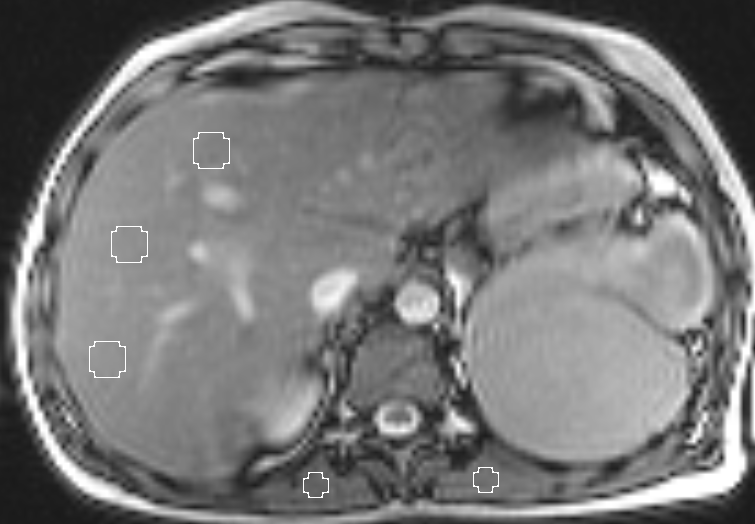
35 patients (24 male, age range 6.9 to 73 years, mean ± standard deviation 24.2 ± 14.4 years) were studied at 1.5 T (Magnetom Avanto, Siemens Healthcare GmbH, Erlangen, Germany) using a bSSFP sequence with eleven different protocols. Detailed parameters are listed in Table 1. For signal homogeneity in the imaging plane, the body resonator was used as receive coil. Immediately prior, the Ferriscan® protocol was acquired. Ferriscan® results served as reference values.The bSSFP data were analyzed by manually positioning three circular regions of interest (ROIs) in the liver parenchyma, preferably the right liver lobe, and two bilaterally in the paraspinal musculature, as shown in Fig. 1. ROI placement was performed in two different axial slices in each patient. Subsequently, the average liver signal was divided by that of the muscles to obtain the signal intensity ratio (SIR).
Statistical analysis was performed in SPSS (v. 27, 2020, IBM, Armonk, USA). Logarithms of SIR values of the different protocols were linearly correlated with the liver iron reference value. The coefficient of determination R2 served as a measure for the quality of correlations. The best ones were used to test multiple linear correlations of SIR logarithms to LIC reference.
Results
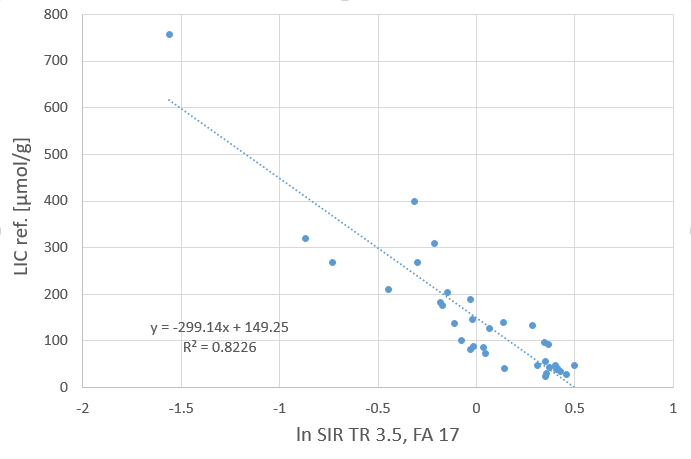
LIC reference values ranged from 24 to 756 µmol/g (MW ± stdDev 145 ± 143 µmol/g) in our patient cohort. Most LIC reference values were observed between 20 and 200 µmol/g, only a few between 200 and 400 µmol/g and only one rather high value of 756 µmol/g.The best correlation of a single protocol was obtained with a repetition time TR of 3.5 ms at a flip angle (FA) of 17° with a coefficient of determination R2 of 0.82. Fig. 2 shows a scatter plot of these data. For the other TRs, FA of 17° also yielded the best results. A multiple linear correlation of the three protocols with TRs of 3.5, 5 and 6.5 ms, each at an FA of 17°, resulted in a coefficient of determination R2 of 0.85.
Discussion
The balanced gradient echo sequence (bSSFP) has a complicated signal behavior. If the echo time TE is chosen as half of the repetition time TR, which is favorable due the necessary balance of all gradients, its signal does not depend on T2*, but, like spin-echo, on T2, offering a T2/T1 contrast2,3. As a second parameter for influencing contrast, the excitation angle is freely selectable within the maximum possible energy deposition. Short echo times are advantageous for this sequence, but require fast gradient switching and imply high energy exposure to the patients because of the fast repetition rate of excitation pulses.As the presented data show, bSSFP is in principle suitable to quantify liver iron content. Its advantages are high scan efficiency, i.e., high signal to noise ratio and short scan times. This allows imaging of the entire liver in a single breath-hold without additional acceleration techniques such as parallel imaging, which require multiple receive coils and increase image noise.
The sequence used was a standard sequence that is generally available and easily applicable in clinical routine.
The principle of the internal reference signal of the paraspinal musculature used here was already applied before by Alustiza and Gandon to GRE data4,5. The motivation to investigate the correlation of the natural logarithm of SIR values rather than SIR values themselves, was previously published work on SIR of gradient echo data6.
Limitations
The extreme susceptibility of the bSSFP sequence to magnetic field inhomogeneities is probably one reason for the scatter of the measured SIR values, since a standard sequence was used. Probably, results could be improved using proposed measures to reduce signal reduction caused by susceptibility effects7,8.
The number of patients studied was small. Furthermore, LIC reference values were not normally distributed, with a single value remarkably larger than the others. Therefore, the calibration equation obtained may be not very reliable. Further studies with larger patient numbers and distribution of LIC reference values closer to Gaussian distribution are needed to evaluate the suitability of the bSSFP sequence more thoroughly.
Despite these limitations, we were able to show that the bSSFP sequence, which is efficient and fast, but vulnerable due to susceptibility effects, is suitable for quantification of liver iron content. Sequence variants which are more robust against susceptibility artifacts could be used for optimization.
Acknowledgements
We acknowledge Karla Miller for her striking talk on bSSFP at the ISMRM 2022 meeting in London which encouraged us to re-evaluate our data.References
1. Scheffler, K. & Lehnhardt, S. Principles and applications of balanced SSFP techniques. European radiology 13, 2409-2418 (2003).
2. Bieri, O. & Scheffler, K. Fundamentals of balanced steady state free precession MRI. JMRI 38, 2-11 (2013).
3. Scheffler,
K. & Hennig, J. Is TrueFISP a gradient-echo or a spin-echo sequence? MRM 49,
395-397 (2003).
4. Alustiza, J.M., et al. MR quantification of hepatic iron concentration. Radiology 230, 479-484 (2004).
5. Gandon, Y., et al. Non-invasive assessment of hepatic iron stores by MRI. Lancet 363, 357-362 (2004).
6. Wunderlich, A.P., et al. MRI-Based Liver Iron Content Determination at 3T in Regularly Transfused Patients by Signal Intensity Ratio Using an Alternative Analysis Approach Based on R2* Theory. RoFo 188, 846-852 (2016).
7. Benkert, T., Ehses, P., Blaimer, M., Jakob, P.M. & Breuer, F.A. Fast isotropic banding-free bSSFP imaging using 3D dynamically phase-cycled radial bSSFP (3D DYPR-SSFP). Z Med Phys 26, 63-74 (2016).
8. Bıyık, E., Keskin, K., Uh Dar, S., Koç, A. & Çukur, T. Factorized sensitivity estimation for artifact suppression in phase-cycled bSSFP MRI. NMR in biomedicine 33, e4228 (2020).
Figures