1849
Heterogeneity of liver stiffness in chronic HBV infection: Influence on concordance between MRE-based fibrosis staging and biopsy staging1Department of Radiology, The Third Affiliated Hospital, Sun Yat-sen University (SYSU), Guangzhou, China, 2Department of Gastroenterology, The Third Affiliated Hospital, Sun Yat-sen University (SYSU), Guangzhou, China, 3Department of Radiology, Mayo Clinic, Rochester, MN, United States
Synopsis
Keywords: Liver, Elastography, MR elastography; Liver fibrosis; Heterogeneity
Chronic hepatitis B (CHB) viral infection can lead to liver fibrosis. Liver biopsy, the gold standard for liver fibrosis assessment, is invasive and carries risks of complications and sampling errors. MR elastography (MRE) is regarded as the most accurate noninvasive tool for evaluating liver fibrosis. In this study we characterized the spatial heterogeneity of liver stiffness depicted by MRE in patients with CHB and found heterogeneity at all pathological fibrosis stages. The severity of spatial heterogeneity affected the concordance between MRE-based and pathology-based fibrosis staging.
Introduction
Chronic hepatitis B (CHB) viral infection is one of the most common causes of liver fibrosis around the world. Monitoring the progress of liver fibrosis is essential for treatment and assessing prognosis in patients with CHB. While the inflammatory effects of CHB infections affect the whole liver, the spatial distribution fibrosis can be heterogeneous. Liver biopsy remains the gold standard for the diagnosis of liver fibrosis, but is limited by sampling error since it can evaluate only about 1/50,000th of the whole liver 1. MR elastography (MRE) is now regarded as the most accurate noninvasive test for assessing liver fibrosis. A previous study has shown that the spatial heterogeneity liver stiffness at MRE has a relationship to the degree of concordance between MRE and histopathology in staging fibrosis in nonalcoholic fatty liver disease 1. To the best of our knowledge, the influence of spatial heterogeneity of disease in CHB and its effect on concordance between MRE and biopsy has not previously been evaluated. In this study, we assessed the spatial heterogeneity of liver stiffness depicted by MRE in patients with CHB and to investigated the possible effect on concordance between MRE and pathology in staging fibrosis.Materials and Methods
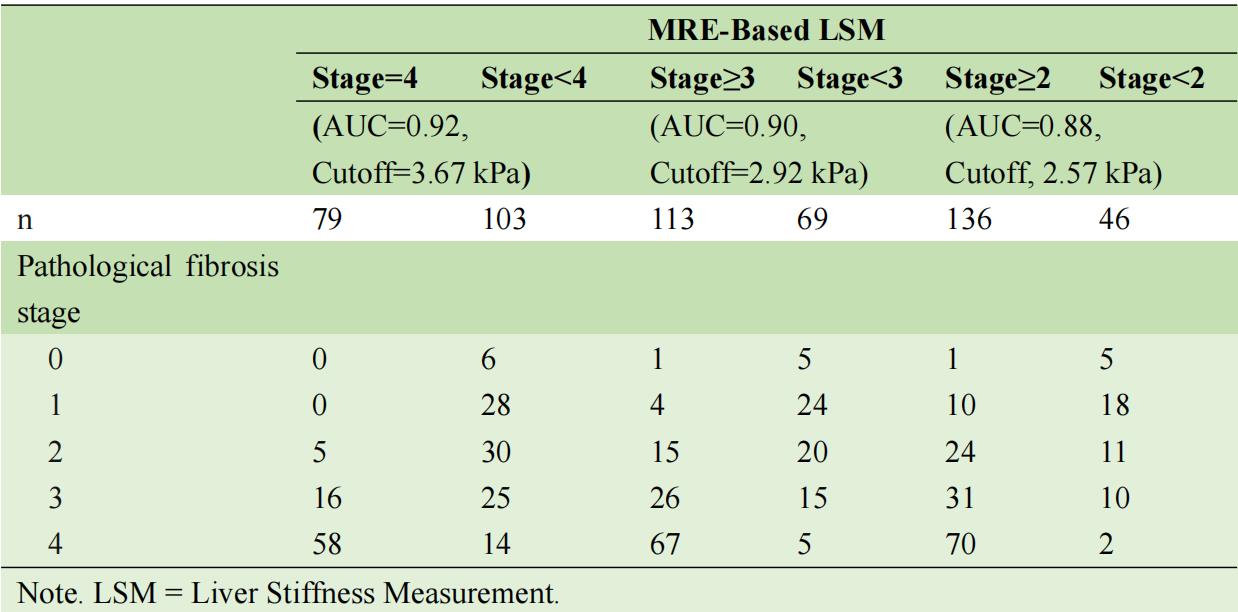
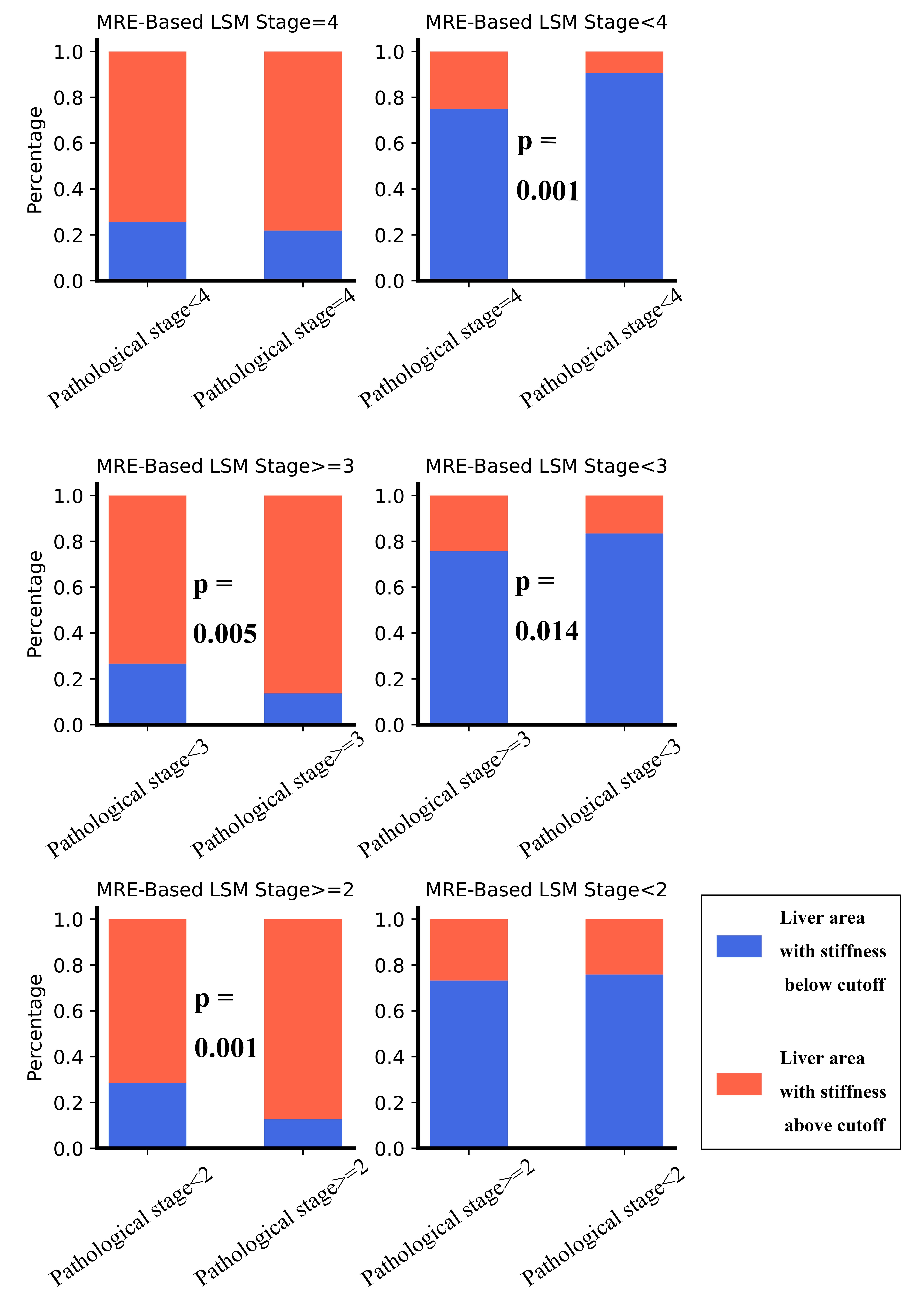
We retrospectively evaluated data from 182 patients with CHB viral infection who had pathology-proven liver fibrosis stage and underwent 2D MRE examinations at 3T scanner (Discovery MR750 GE Healthcare). MRE examinations were performed at a 60-Hz shear wave frequency, using standard, commercially available equipment. We used a SE-EPI MRE sequences, which can reduce the occurrence of technical failure compared with earlier, gradient echo-based MRE acquisition sequences 2. Liver stiffness was measured in four sections with ROI-based segmentation. The area-weighted arithmetic mean of stiffness was calculated 3, and used to assign stages of fibrosis according to stiffness thresholds of a previous study for staging fibrosis in patients with CHB as a reference 4. The concordant and discordant cases between MRE-based fibrosis staging and pathological staging were obtained (Table 1), and the association between MRE-based or pathology-based fibrosis staging and FIB-4 index were evaluated using the Spearman correlation.In order to characterize the spatial heterogeneity of liver fibrosis measured by MRE, each patients’ stiffness map (four slices) was segmented to five areas (labeled as fibrosis stage 0 to 4) by the stiffness thresholds mentioned above 4, and the percentage of each of the five areas was calculated. The heterogeneity of the liver stiffness was measured by the percentage of liver area that was below the stiffness threshold for each fibrosis group (stage ≥ 2, ≥ 3, and 4), and was compared between the discordant and concordant group using the Wilcoxon signed-rank test.
Results
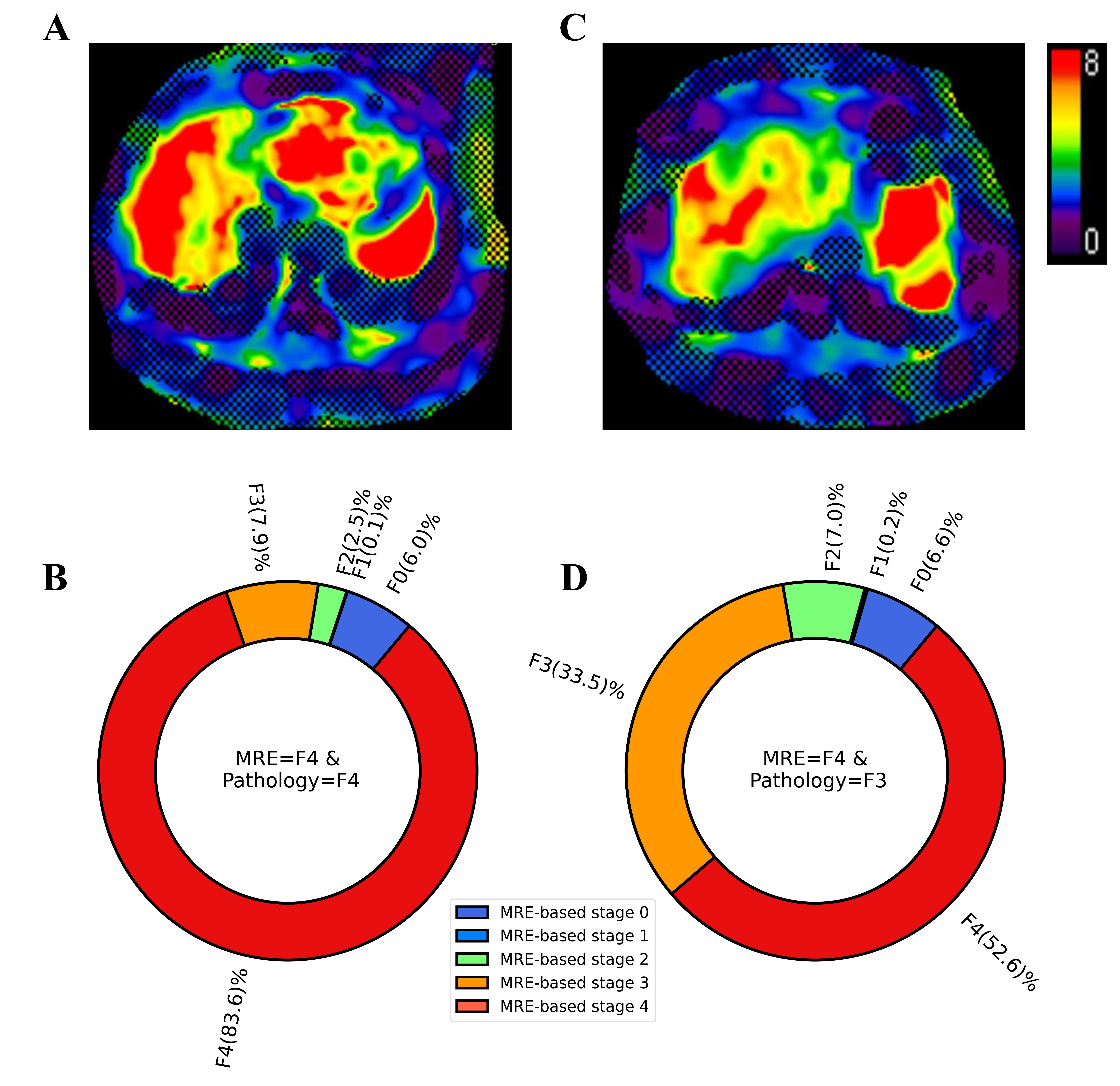
The area under the receiver operating characteristic curve (AUC) for discriminating pathological stage ≥ 2, ≥ 3, and 4 are shown in Table 1. The association between MRE-based fibrosis staging and FIB-4 index (r=0.68, p<0.001) was stronger than that between the pathology-based stage and FIB-4 index (r=0.48, p<0.001). Discordant patients with stiffness above the threshold for stage ≥ 2, ≥ 3, and 4 have a higher percentage of liver area with low stiffness compared with concordant patients (P values were 0.001 and 0.005 for stage ≥ 2 and ≥ 3) (Figure 1). Conversely, discordant patients with stiffness below the threshold for stage ≥ 2, ≥ 3, and 4 had a higher percentage of liver area with high stiffness compared with concordant patients (P values were 0.014 and 0.001 for stage ≥ 3 and 4). Figure 2 shows two representative cases who were assigned to stage 4 by MRE, but the pathological stages were 4 and 3 respectively. As shown in Figure 1, the percentage of liver areas with MRE-based stage 3 in the discordant group (33.5%) was 4 times that of concordant group (7.9%).Discussion and Conclusion
MRE demonstrated high spatial heterogeneity in patients with CHB at all pathologic fibrosis stages. The percentage of liver area with stiffness values corresponding to varying fibrosis stages affected the concordance between MRE-based and pathology-based fibrosis staging. The results suggest that reporting spatial heterogeneity in addition to mean liver stiffness may enhance the diagnostic performance of MRE in staging liver fibrosis in CHB.Acknowledgements
National Natural Science Foundation of China grant number 82202129 (CL), National Natural Science Foundation of China grant number 91959118 (JW), 82271973(JW), Key Research and Development Program of Guangdong Province 2019B020235002 (JW), Guangdong Basic and Applied Basic Research Foundation, 2021A1515010582 (JW), SKY Radiology Department International Medical Research Foundation of China Z-2014-07-2101 (JW) and Clinical Research Foundation of the 3rd Affiliated Hospital of Sun Yat-sen University YHJH201901 (JW).References
1. Kawamura N, Imajo K, Kalutkiewicz KJ, et al. Influence of liver stiffness heterogeneity on staging fibrosis in patients with nonalcoholic fatty liver disease. Hepatology (Baltimore, Md) 2022; 76(1): 186-95.
2. Li M, Yang H, Liu Y, et al. Comparison of the diagnostic performance of 2D and 3D MR elastography in staging liver fibrosis. European radiology 2021; 31(12): 9468-78.
3. Guglielmo FF, Venkatesh SK, Mitchell DG. Liver MR Elastography Technique and Image Interpretation: Pearls and Pitfalls. Radiographics : a review publication of the Radiological Society of North America, Inc 2019; 39(7): 1983-2002.
4. Chang W, Lee JM, Yoon JH, et al. Liver Fibrosis Staging with MR Elastography: Comparison of Diagnostic Performance between Patients with Chronic Hepatitis B and Those with Other Etiologic Causes. Radiology 2016; 280(1): 88-97.
Figures