1836
Highly Accelerated 3D MPRAGE using Robust SAMER Motion Mitigation1Siemens Healthcare GmbH, Erlangen, Germany, 2A. A. Martinos Center for Biomedical Imaging, Charlestown, MA, United States, 3Siemens Healthineers International AG, Lausanne, Switzerland, 4Siemens Medical Solutions, Boston, MA, United States, 5Shenzhen Magnetic Resonance Ltd.,, Shenzhen, China, 6Massachusetts General Hospital, Charlestown, MA, United States
Synopsis
Keywords: Motion Correction, Data Acquisition, Fast imaging, Compressed Sensing
Long clinical acquisitions can face the challenge of motion during the scan. One approach to address this problem is the recently introduced SAMER retrospective motion correction technique for 3D MPRAGE. As an alternative, it has been suggested to shorten the scan time by acceleration techniques, e.g., using Compressed Sensing, and thus reduce the likelihood of patient discomfort and severe motion. We here combine SAMER with Compressed Sensing for high acceleration factors (R=6).
Background
Motion during MRI scans can lead to a significant workflow burden and trigger additional patient interactions or repeated scans, ultimately leading to longer and more expensive examinations [1]. Reducing this impact is a challenging task with a multitude of different approaches [2], ranging from accelerating the acquisition to preventing and/or correcting the motion artifacts.One retrospective motion correction technique is the recently introduced SAMER technique for 3D MPRAGE that acquires a fast reference scan prior to the regular echo trains (ETs). In every ET a small number of additional samples, so-called guidance lines, are added, such that the motion parameters can be estimated retrospectively with high accuracy, followed by a motion aware reconstruction [3].
A well-known approach for shortening the scan time and thereby reducing the risk of motion artifacts is Compressed Sensing (CS) [4,5], allowing for high acceleration factors. We here show the compatibility of SAMER and Compressed Sensing and demonstrate how the combination of the two approaches can be used for 6-fold accelerated motion robust scanning.
Methods
The SAMER framework was implemented into a Compressed Sensing MPRAGE research sequence with non-uniform undersampling [6]. Following local regulations, a healthy volunteer was scanned on a 3T MRI system (MAGNETOM Vida, Siemens Healthcare, Erlangen, Germany) with a 20-channel head coil. The following acquisition protocol was used: TR=2300ms; TI=900ms; 1x1x1 mm³ isotropic resolution; matrix=256x256x208; R=6 acceleration with elliptical scanning. For benchmark of comparison, we also acquired MPRAGE data with standard clinical uniform undersampling and R=3x2 acceleration (all other protocol parameters remained unchanged).The volunteer was instructed to perform the following motion patterns in separate scans: 1) no motion; 2) deep breathing head motion; 3) two equally spaced pose changes (left and up). The patterns were acquired with both research sequences. The C++ SAMER research reconstruction pipeline was extended to include L1 Total Variation (TV) regularization in the inversion of the forward model equation. The data were then reconstructed offline with and without regularization.
Results
Fig. 1 shows the reconstructions without instructed subject motion. The acquisition with uniform undersampling led to coherent parallel imaging artifacts which the TV prior was unable to remove. The CS-sampling pattern produced noise-like aliasing yielding overall better image quality both with and without TV regularization.For two similar breathing motion pattern acquisitions (SAMER and CS-SAMER), the motion corrupted images are shown in Fig. 2, as well as motion corrected versions with and without regularization. As can be seen, the CS reordering pattern by itself improves SNR already (Fig. 2e). Additionally employing TV regularization yields high quality results (Fig. 2f) which would not have been possible without the CS reordering pattern (c.f. Fig. 2c). This finding is supported by Fig. 3 that shows the comparison for the step motion experiments, again leading to high quality motion corrected images (Fig. 3f).
Conclusions
In this work, we demonstrated compatibility of the SAMER approach with Compressed Sensing. In no-motion scans at R=6-fold acceleration, using a 20-channel head coil, we first showed superiority of CS- vs standard uniform sampling. We then demonstrated highly accelerated motion robust imaging in scans with instructed step and breathing motion.Acknowledgements
This work was supported in part by NIH research grants: 1P41EB030006-01, 5U01EB025121-03, and through research support provided by Siemens Medical Inc.
References
[1] Andre JB, Bresnahan BW, Mossa-Basha M, et al. Toward Quantifying the Prevalence, Severity, and Cost Associated With Patient Motion During Clinical MR Examinations. J Am Coll Radiol. 2015;12(7):689-695. doi:10.1016/j.jacr.2015.03.007
[2] Zaitsev M, Maclaren J, Herbst M. Motion artifacts in MRI: A complex problem with many partial solutions: Motion Artifacts and Correction. J Magn Reson Imaging. 2015;42(4):887-901. doi:10.1002/jmri.24850
[3] Polak D, Hossbach J, Splitthoff DN, et al. Motion guidance lines for robust data-consistency based retrospective motion correction in 2D and 3D MRI. Magn Reson Med. In Press. doi:10.1002/mrm.29534
[4] Donoho DL. Compressed sensing. IEEE Trans Inf Theory. 2006;52:1289–1306. 15.
[5] Candes EJ, Wakin MB. An introduction to compressive sampling. IEEE Signal Process Mag. 2008;25:21–30.
[6] Mussard, E., Hilbert, T., Forman, C., Meuli, R., Thiran, J. P., & Kober, T. (2020). Accelerated MP2RAGE imaging using Cartesian phyllotaxis readout and compressed sensing reconstruction. Magnetic Resonance in Medicine, July 2019, 1–14. https://doi.org/10.1002/mrm.28244
Figures
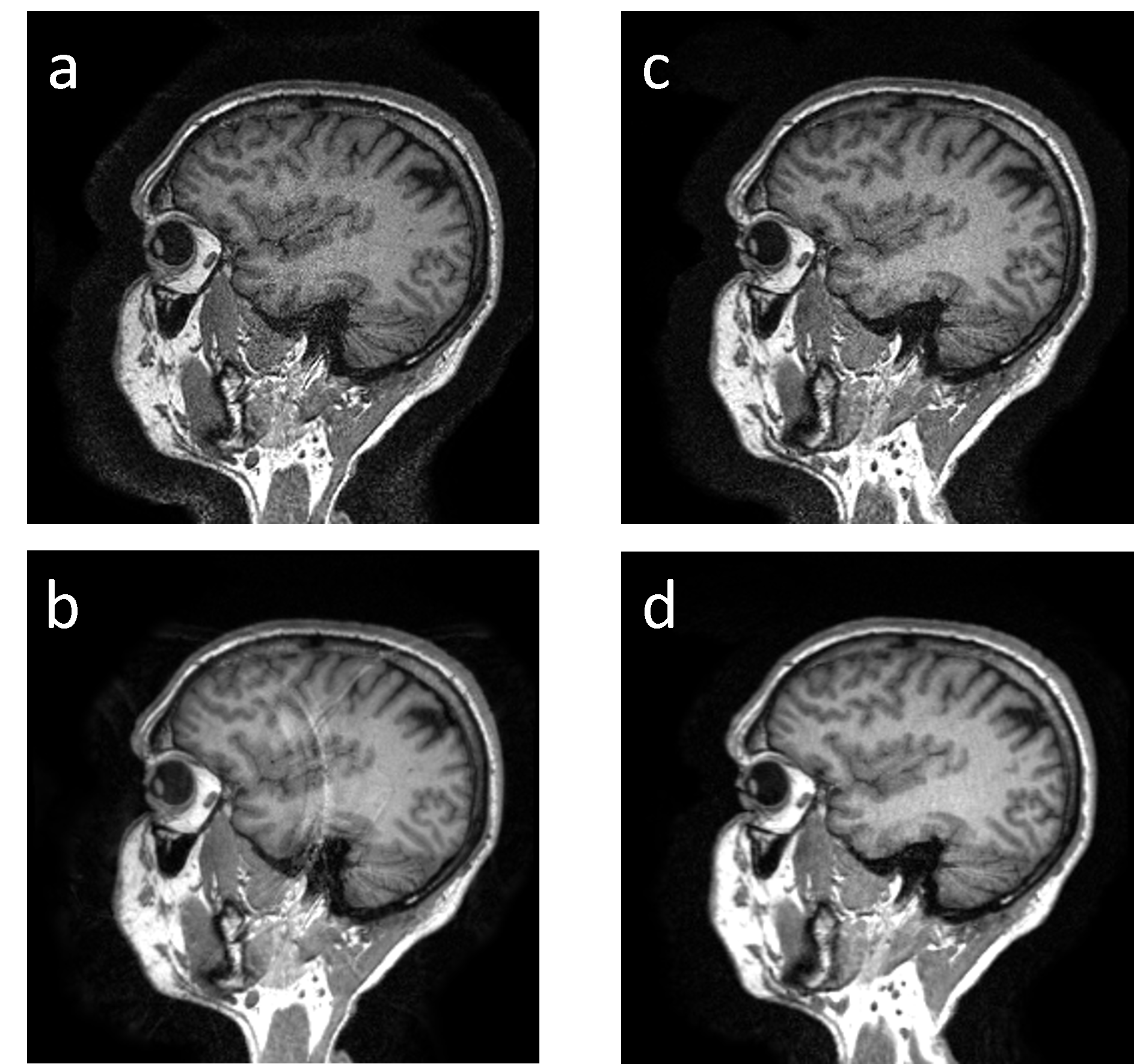
Figure 1: SAMER image quality comparison without instructed subject motion at R=6. (Left) Uniform undersampling without (a) and with (b) regularization. (Right) CS-undersampling without (c) and with (d) regularization.
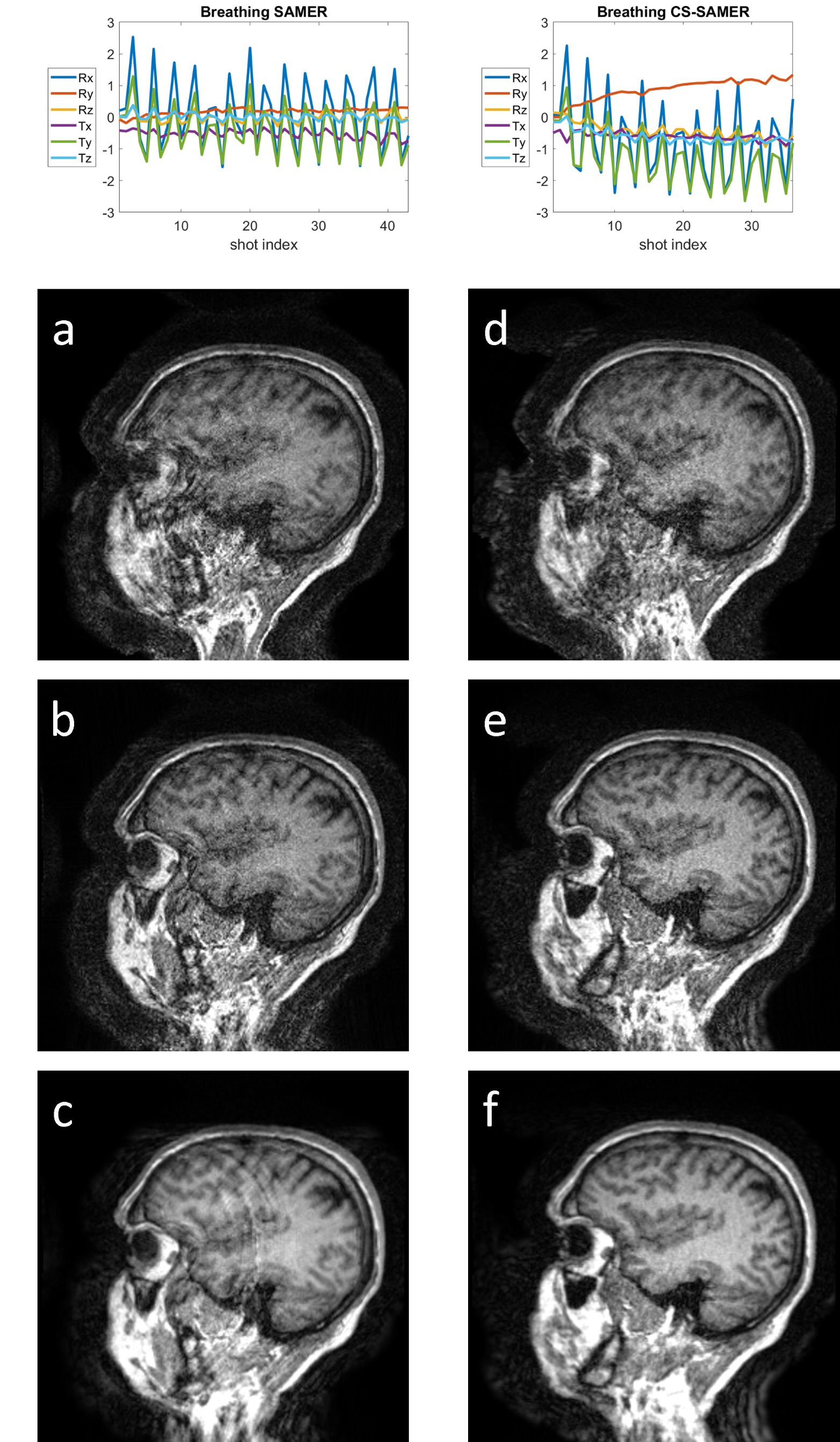
Figure 2: Image quality comparison of uniform sampling (left) and CS-undersampling (right) for acquisitions with instructed breathing motion. (a/d) no motion correction, (b/e) SAMER correction without regularization, (c/f) SAMER with L1 TV regularization. The motion plots demonstrate that both acquisitions had similar amount of motion (note that due to elliptical scanning the CS-SAMER scan is shorter and has fewer shots).
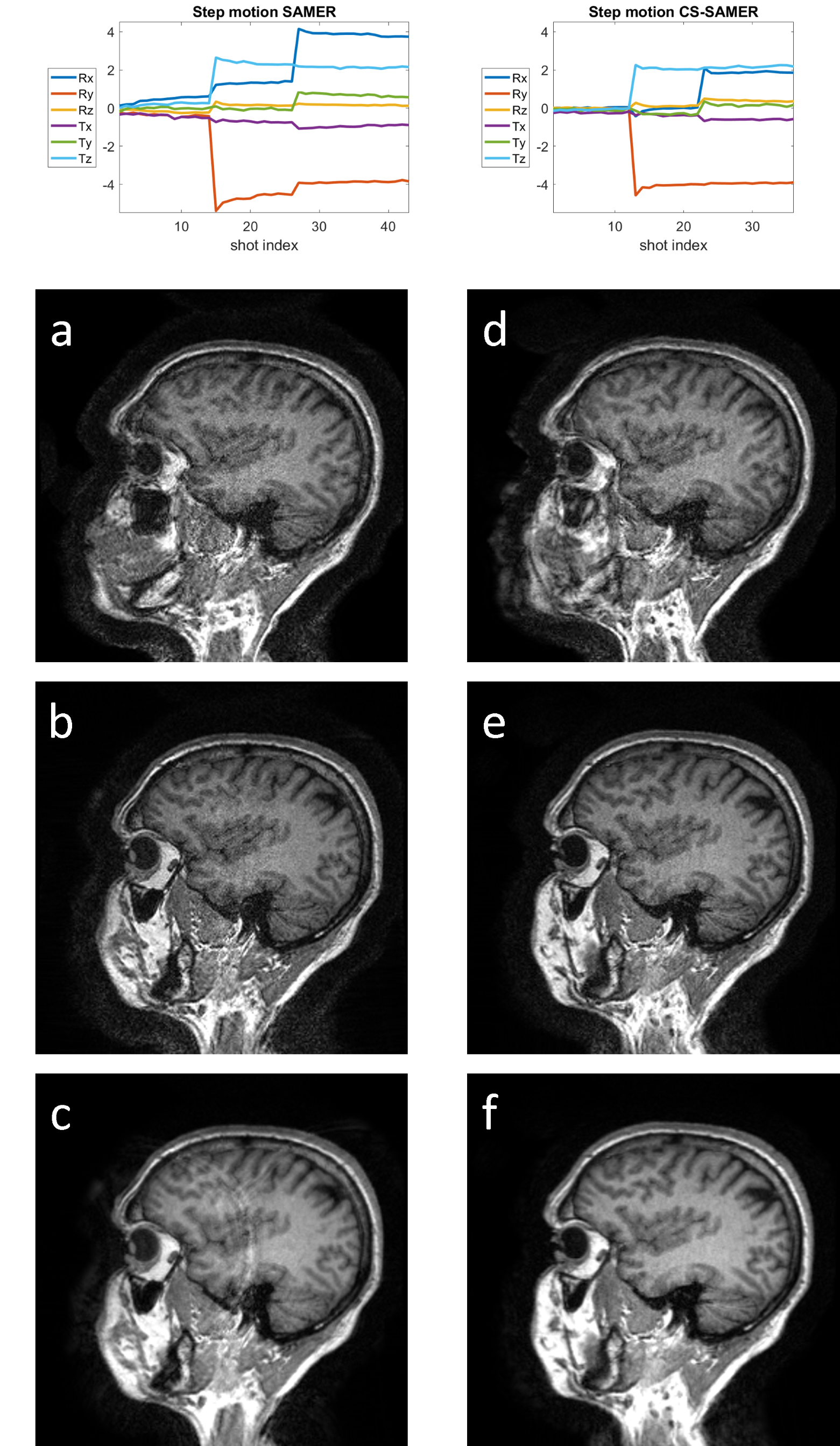
Figure 3: Image quality comparison of uniform sampling (left) and CS-undersampling (right) for acquisitions with instructed step motion. (a/d) no motion correction, (b/e) SAMER correction without regularization, (c/f) SAMER with TV regularization. The motion plots demonstrate that the two separate acquisitions had comparable motion, with slightly more rotation in the original SAMER case (again, please note that due to elliptical scanning the CS-SAMER scan is shorter and has less shots).