1806
Combined Multiparameter Quantitative MRI of PD, T1, T2 and the Diffusion Tensor with MP6-qMRI-Turbo Spin Echo with SPLICE
Ning Hua1, Andrew Ellison1, Yansong Zhao2, and Hernan Jara1
1Radiology, Boston University, Boston, MA, United States, 2Philips Healthcare, Boston, MA, United States
1Radiology, Boston University, Boston, MA, United States, 2Philips Healthcare, Boston, MA, United States
Synopsis
Keywords: Quantitative Imaging, Diffusion Tensor Imaging, qMRI, DTI
Purpose: To augment the qMRI multi-parametricity of the Triple TSE to additionally include primary diffusion tensor imaging (DTI) functionality and with seamless geometric compatibility with the nPD, T1, and T2 maps of the Triple-TSE framework. Methods: qMRI maps were generated with algorithms based on Bloch and Bloch-Torrey equations. Results: histogram analyses for the phantom and volunteer reveal well behaved qMRI data for nPD, T1, T2, MD, and FA. Conclusion: Creating a unified clinical MP-qMRI protocol for PD, T1, T2 and diffusion tensor seems within reach.Purpose
Multiparameter (MP-) qMRI frameworks consist of multi-contrast pulse sequences and Bloch theory matched algorithms for mapping multiple tissue parameters. Interest in MP-qMRI has increased in the past decade in response to the need for inter institution and cross-platform image standardization and because of the advent of fast pulse sequences which allow generating maps of the primary parameters –normalized proton density (nPD) and the relaxation times (T1 and T2)—at high spatial resolution in under 10 minutes scan time. The triple turbo spin echo (Triple-TSE) (Ref. 1) pulse sequence is advantageous for several reasons: 1) scan time efficient, 2) high resiliency to artifacts from magnetic field inhomogeneities, 3) generates directly acquired images with the typical T1- and T2- contrast weightings used clinically, 4) it is widely available across most MRI manufacturers, and 5) uses standard fast Fourier transform reconstruction. The purpose of this work was to augment the qMRI multi-parametricity of the Triple TSE to additionally include primary diffusion tensor imaging (DTI) functionality and with seamless geometric compatibility with the nPD, T1, and T2 maps of the Triple-TSE framework.Materials and Methods
Two healthy volunteers (41yo female and 37yo male) were scanned according to an institutional review board IRB approved protocol. The modular MP6-qMRI TSE pulse sequence was implemented on a 3T Ingenia Elition X whole body scanner (Philips Healthcare) by combining the Triple-TSE (Fig. 1) and DTI modules (Fig. 2) and running these sequentially with same pre-scanning settings. Both qMRI modules were implemented without fat suppression, Compressed SENSE factor of 3, and generated 80 consecutive and gapless slices. Key contrast and geometry parameters were a) Triple-TSE modules (9.5min): TRlong = 16s, TRshort = 0.5s, TE1 = 10ms, TE2 = 110ms, voxel = 0.47 x 0.47 x 2mm3 and b) DTI module (11min) with phase insensitive SPLICE (Ref. 2): TR = 25.4s, TEeff = 72ms, voxel = 0.94 x 0.94 x 2mm3. The integrated MP-qMRI relaxometry and DTI processing pipeline (IPP), which is DICOM compatible, was programmed in Python (version 3.9.13) with the Anaconda Navigator (version 2.3.2). The primary (nPD-T1-T2) qMRI maps were calculated according to the Bloch equation solution as applicable for the Triple-TSE pulse sequence. DTI maps –mean diffusivity MD and fractional anisotropy FA-- were calculated according to the Bloch-Torrey equation solution as realized in single-shell DIPY tensor reconstruction model (https://dipy.org/).Results
The qMRI maps of both volunteers were of high and comparable quality. Exemplary qMRI maps of the healthy volunteer (male 37yo) are shown in Fig. 3. In accordance with the corresponding parameter scales accompanying each map, the qMRI values of each qMRI parameter are within the accepted ranges. The accuracy of the techniques in the absence of magnetization transfer effects (Fig. 4) were further confirmed with phantom experiments using the same MP6-qMRI. Finally, histogram analyses for the phantom and volunteer reveal well behaved qMRI data for nPD, T1, T2, MD, and FA for phantom and brain (Fig. 5).Discussion and Conclusions
We have developed a modular MP6-qMRI framework for brain imaging that is fully TSE based and that generates combined data of the primary qMRI parameters (nPD, T1, T2) and diffusion tensor (DTI: MD and FA) in about 20min at high spatial resolution (voxel = 0.47 x 0.47 x 2mm3) with comprehensive anatomic coverage (80 contiguous slices). This work could have implications for creating a unified clinical MP-qMRI protocol and for the validation of DTI based tractography by combining DTI based tractography with synthetic MRI fibrography.Acknowledgements
This work used research software patches provided by Philips HealthcareReferences
1. Oshio K, Jolesz FA. Simultaneous acquisition of proton density, T1, and T2 images with triple contrast RARE sequence. Journal of computer assisted tomography 1993;17(2):333-338.
2. Schick F. SPLICE: Sub-second diffusion-sensitive MR imaging using a modified fast spin-echo acquisition mode. Magnetic Resonance in Medicine 1997;38(4):638-644. doi: https://doi.org/10.1002/mrm.1910380418
Figures
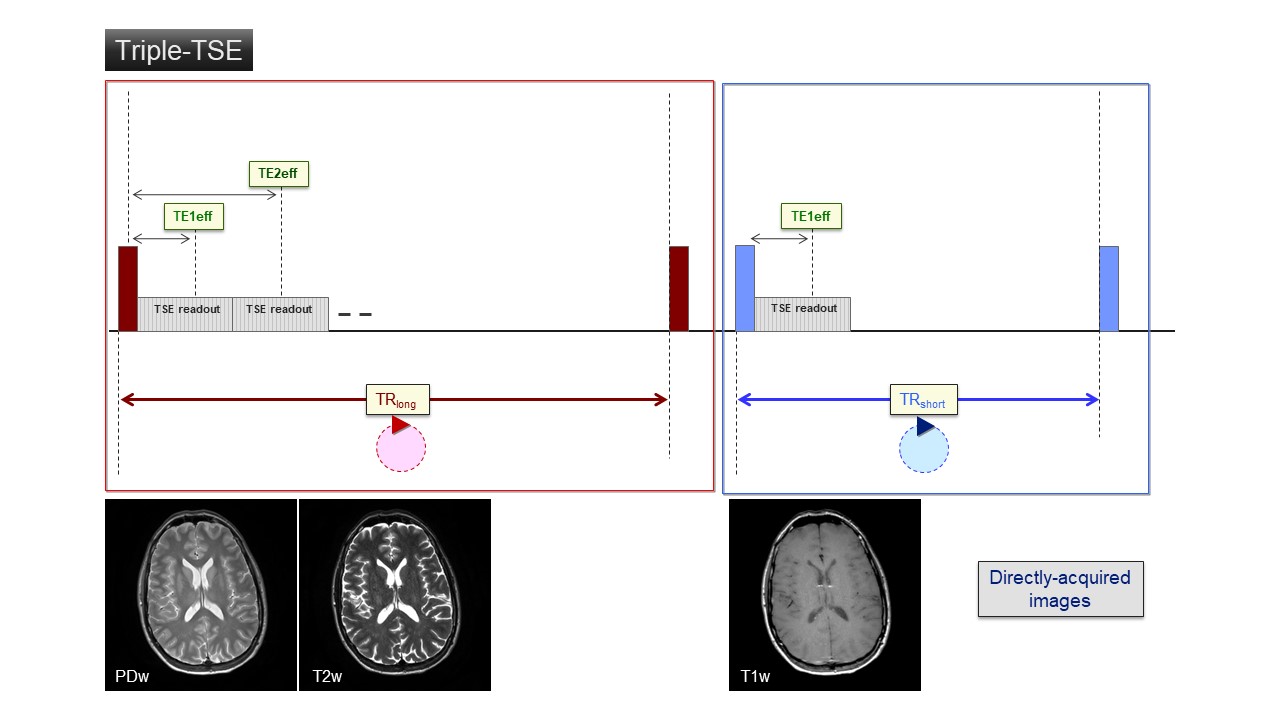
Figure 1.
Triple-TSE module
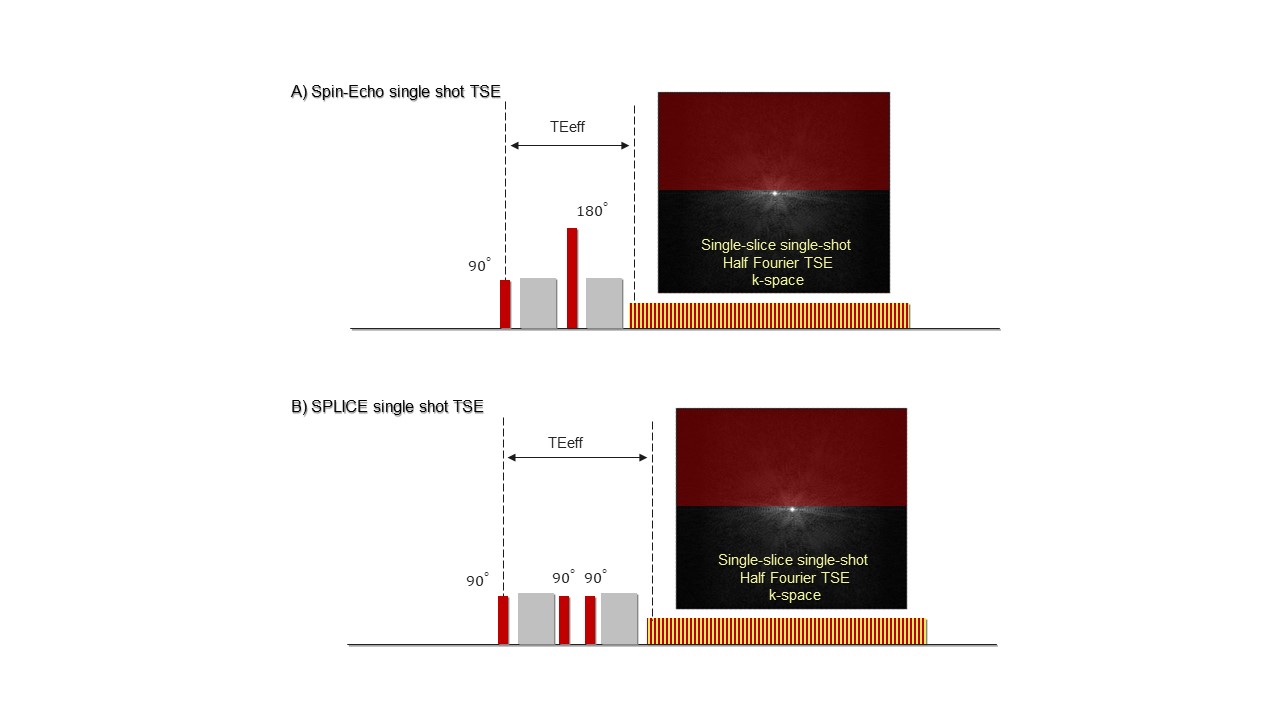
Figure 2.
DTI module with and without SPLICE
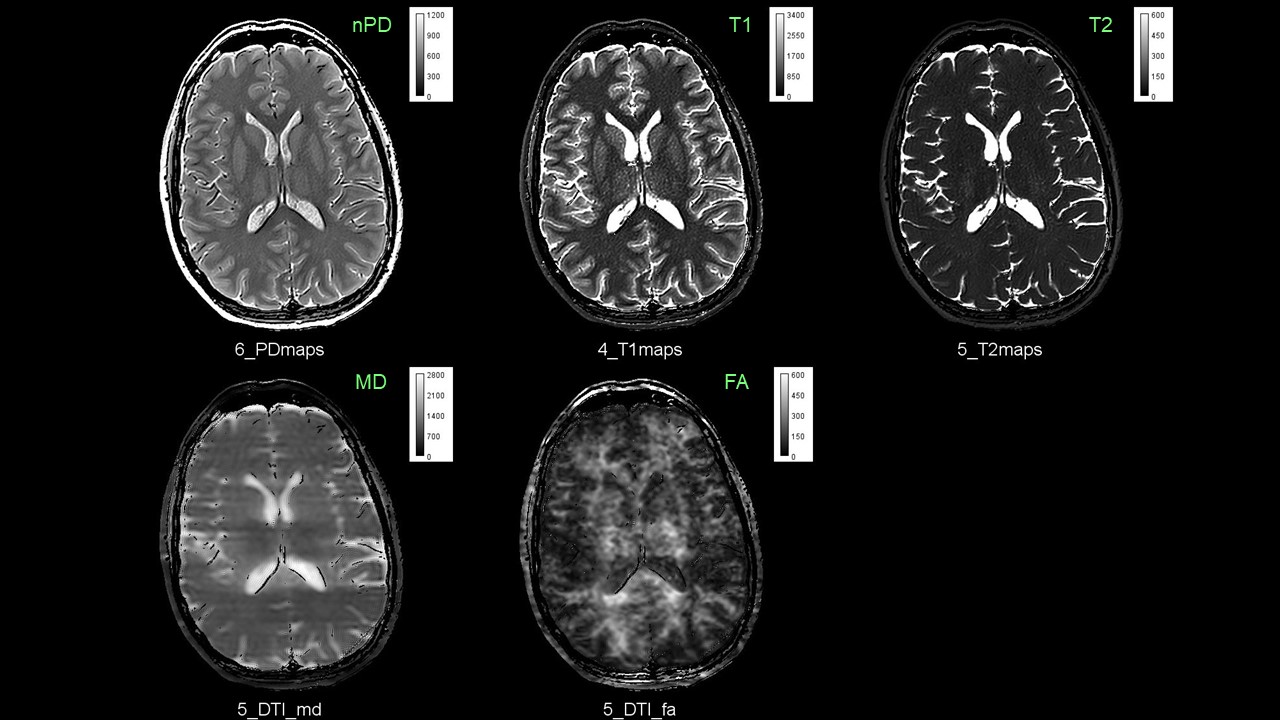
Figure 3.
Selected MP-qMRI maps of the brain
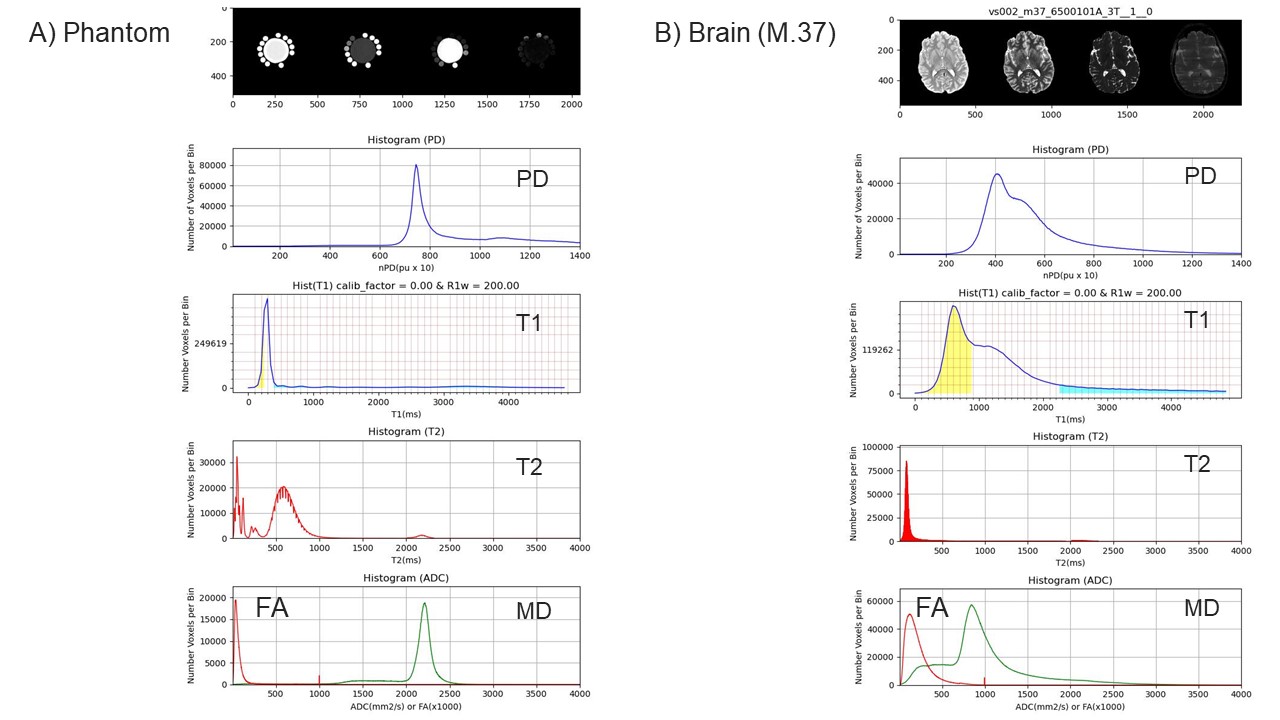
Figure 4.
MP-qMRI volumetric histograms of a phantom and brain
DOI: https://doi.org/10.58530/2023/1806