1771
Study of Frequency selective surface (FSS) to shield solenoids for low-field portable MRI1Engineering Product Developement, Singapore University of Technology and Design, Singapore, Singapore
Synopsis
Keywords: Low-Field MRI, Low-Field MRI
The lightweight frequency selective surface(FSS) using high-pass inductive mesh grids is proposed as shielding of RF solenoids at 2.84MHz for an MRI system using a Halbach array(average B0=67mT). Its effects on the coil B1-sensitivity and the shielding effectiveness are examined. A solenoid(diameter=60mm) was used as an example and the shielding of 5-25mm away was examined. The 5mm-away-FSS-shielded coil has 50.1% (in simulation) and 91.3% (in measurements) higher B1-sensitivity and comparable shielding effectiveness within a defined FoV compared to the copper-shielded coil of the same dimensions. The measured data agree with the simulated ones.
INTRODUCTION
Copper shields are commonly used to shield radiofrequency(RF) coils in a magnetic resonance imaging(MRI) scanner1. Copper shields are heavy. Meanwhile, when the distance between the copper shield and RF coil is electrically small, the magnetic field from the RF coil is reflected by the shield causing interference and may reduce B1-sensitivity. Different shielding structures are proposed in the literature. An Artificial Magnetic Shield(AMS) based on a corrugated structure was proposed for a birdcage coil in a 1.5 T MRI scanner which produces constructive interference between the fields generated by the coil and the field reflected by the shield2. However, the structure is bulky and not scalable to low frequency. Hence, it is unsuitable for space constrained portable MRI systems3,4. A deep learning-based EMI cancellation method requiring a network of strategically placed sensing coils to detect EMI signals was proposed for ultra-low field MRI scanner5. However, this approach can increase the hardware complexity of the system.In low-field MRI, the wavelength of the MRI signal is much larger than the coil dimensions. Hence the conventional copper shield could be replaced by the high pass Frequency Selective Surface(FSS)6 with inductive mesh grid which can effectively screen radio frequency signals below a few GHz. However, the shielding of RF coil in low-field portable MRI scanners using FSSs has not been explored. Hence in this work, the shielding effects of FSS using inductive mesh grids to RF solenoid coils in low-field portable MRI scanner at 2.84MHz are investigated.
METHODS
A high-pass FSS shield for a solenoid coil was designed at 2.84MHz for a low-field portable MRI system. The illustration of the FSS-shielded coil is shown in Fig.1. The FSS shield is cylindrical and coaxial with the coil. It consists of inductive mesh grids. The insert in Fig.1(a) show a unit cell which is a square with an edge length of 10mm and a cutoff frequency at 13GHz. The FSS shield has a length (Lshield) of 200mm and placed at d=5-25mm away from the coil (i.e., Dshield of 70-110mm). An RF solenoid coil with 18 number of turns, 60mm diameter, and a 4mm pitch at 2.84MHz was used in this study. The frequency corresponds to the Halbach magnet array system with an average B0 field strength of 67mT4. A cylindrical 3D field of view (FoV) with a diameter of of 37mm and a length of 40mm (denoted as $$$\varnothing$$$37mmL40mm) was considered. Simulations were conducted with a wide-band noise source centered at 2.84MHz using CST Microwave studio. For comparison, copper-shielded coils with same dimensions were simulated.For validation, the copper- and FSS-shielded coils with a proximity distance, d of 5mm and 25mm were constructed using 18AWG solid copper wire. Photos of the built coils are shown in Fig.2. The B1 sensitivity of the coils was measured on the central xy-plane(z=0) via S21-parameters by moving a pick-up loop of 8mm-diameter across the FoV. The S21-parameters were obtained using a Vector Network Analyzer(VNA) with port1 and port2 connected to the input-port of the coil and the pick-up loop, respectively.
RESULTS AND DISCUSSION
The simulated B1-field distribution on the xy-planes(z=0,10,20mm) of the copper and FSS-shielded coils with d=5-25mm are shown in Fig.3. The excitation current is 1A. The average B1-field strength (B1avg) and inhomogeneity (IH) obtained from the root mean square deviation of the field are labelled in each sub-plot. Comparing the cases of FSS-shielded coil with copper-shielded ones, the former shows a consistent B1 enhancement of 49.4-51.3%, 8.5-8.8%, 5.2-5.3%, and 3.4-3.5% across the xy-planes when d is 5,15,20,25mm, respectively. Within the defined 3D FoV, the FSS-shielded coil with d=5mm has a B1avg of 97.95 µT which is 50.1% higher than the copper-shielded counterpart. This implies that the maximum improvement in B1-sensitivity is obtained when the FSS shield is at closer proximity to the solenoid coil which can favour the constrained space in the bore of an MRI system.The noise shielding effectiveness was examined. Fig.4 shows the simulated B1-field distributions on the xy-planes(z=0,10,20mm) of the copper- and the FSS-shielded coils due to a wide-band noise source centered at 2.84MHz. Comparing the FSS-shielded coils with the copper-shielded ones, they have comparative B1 field within the defined FoV with B1avg less than 1µT. This implies that the shielding effectiveness of FSS is comparable with copper sheets.
For validation, the normalized simulated and measured B1-sensitivity maps on the central xy-plane(z=0) are shown in Fig.5. As shown, the measured results agree with the simulated ones. The 5mm-away-FSS-shielded coil shows B1-sensitivity enhancement of 91.3% within a defined FoV in the measurements when compared to copper shielded coil.
Besides the B1-field enhancement and shielding effectiveness, FSS’ with inductive mesh grids is lightweight due to the periodic discontinuities. They are lighter compared to the metallic shields of the same dimensions.
CONCLUSION
Lightweight FSS with inductive mesh grids is proposed to shield solenoids while obtaining B1-field enhancements. At 2.84MHz, the 5mm-away-FSS-shielded coil shows a B1 enhancement of 53.3% in simulation within a 3D-FoV of $$$\varnothing$$$37mmL40mm and 91.3% in measurement within a 2D-FoV of $$$\varnothing$$$37mm when compared to copper-shielded coil while having comparable shielding effectiveness. The results are promising for application of FSS to shield coils in space-constrained low-field portable-MRI systems.Acknowledgements
No acknowledgement found.References
1. M. Alecci and P. Jezzard, “Characterization and reduction of gradient-induced eddy currents in the rf shield of a tem resonator,” Magnetic Resonance in Medicine: An Official Journal of the International Society for Magnetic Resonance in Medicine, vol. 48, no. 2, pp. 404–407, 2002
2. K. Lezhennikova, R. Abdeddaim, A. Hurshkainen, A. Vignaud, M. Dubois, P. Jomin, D. Berrahou, A. Raaijmakers, N. Avdievich, I. Melchakova, et al., “Constructive near-field interference effect in a birdcage mri coil with an artificial magnetic shield,” PHYSICAL REVIEW APPLIED Phys Rev Applied, vol. 13, p. 064004, 2020.
3. Cooley, Clarissa Z., et al. "A portable scanner for magnetic resonance imaging of the brain." Nature biomedical engineering 5.3 (2021): 229-239.
4. Ren, Zhi Hua, et al. "A low-field portable magnetic resonance imaging system for head imaging." 2017 Progress in Electromagnetics Research Symposium-Fall (PIERS-FALL). IEEE, 2017.
5. Y. Liu, A. T. Leong, Y. Zhao, L. Xiao, H. K. Mak, A. C. O. Tsang, G. K. Lau, G. K. Leung, and E. X. Wu, “A low-cost and shielding-free ultra-low-field brain mri scanner,” Nature communications, vol. 12, no. 1, pp. 1–14, 2021
6. P. A. Ade, G. Pisano, C. Tucker, and S. Weaver, “A review of metal mesh filters,” Millimeter and Submillimeter Detectors and Instrumentation for Astronomy III, vol. 6275, pp. 248–262, 2006.
Figures
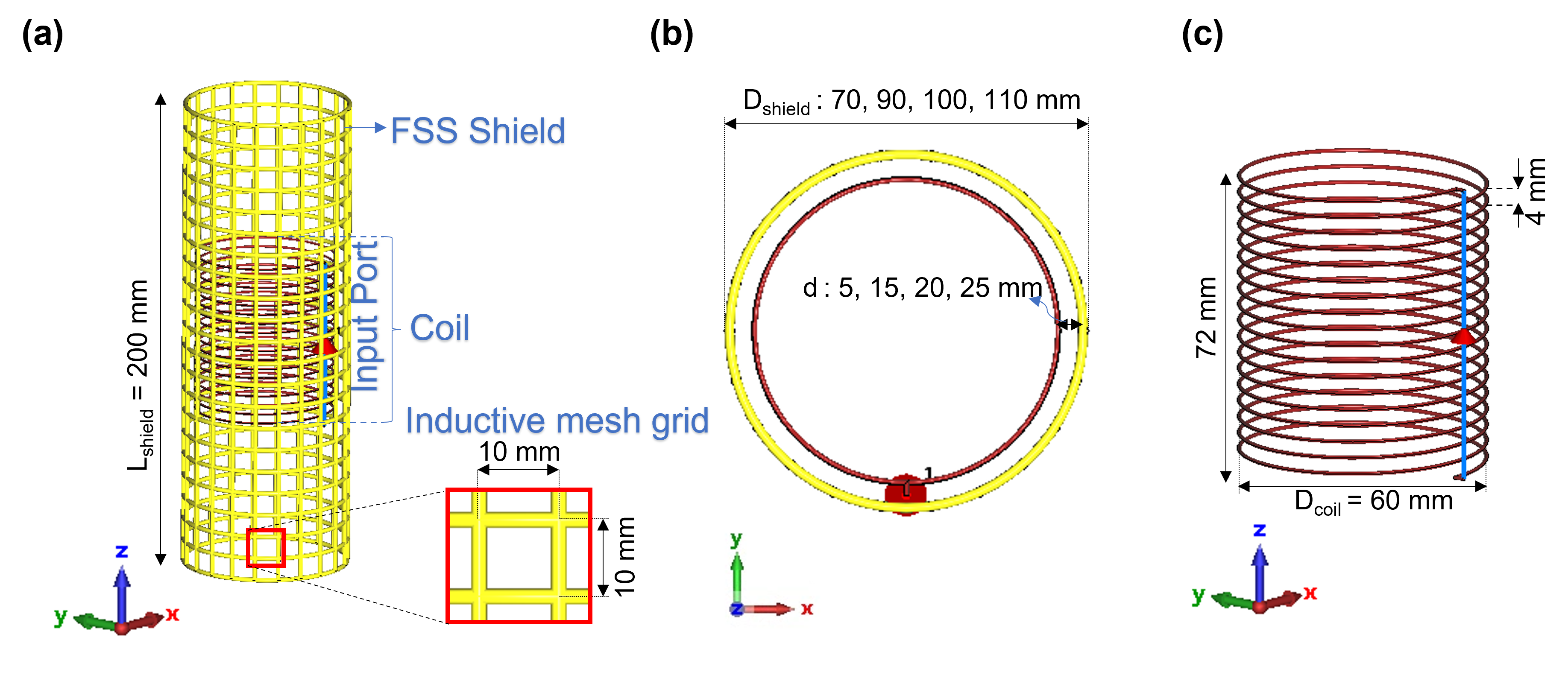
Fig 1. Illustration of the FSS shielded RF coil excited at 2.84 MHz using 1 A current source connected to input port: (a) 3D view, (b) top view, (c) solenoid coil under consideration. Four cases of shield placed at a distance, d : 5 to 25mm (Dshield : 70 to 110mm) away from the coil are considered.
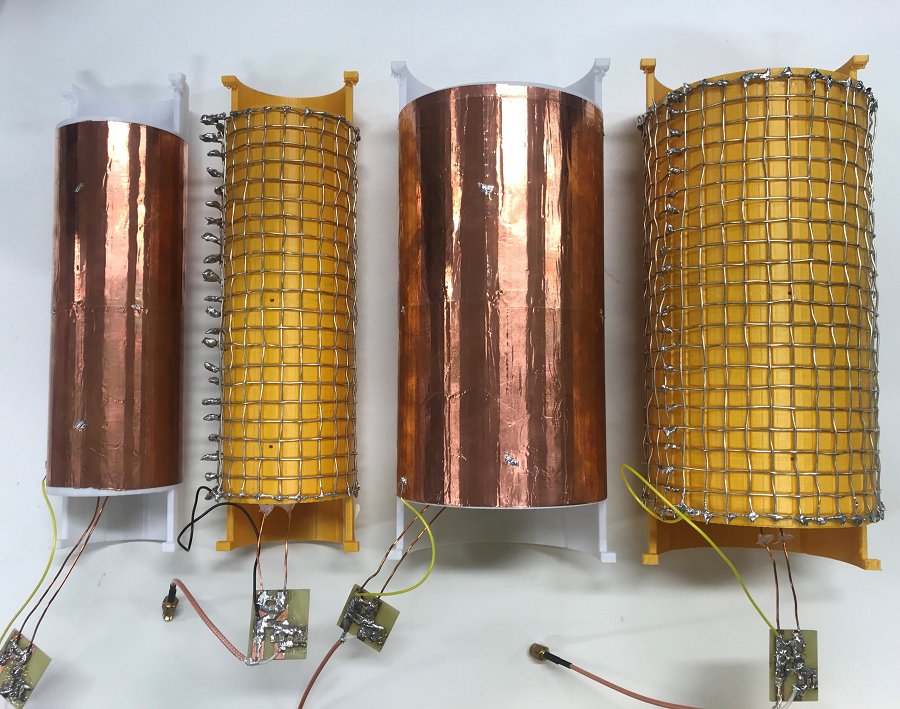
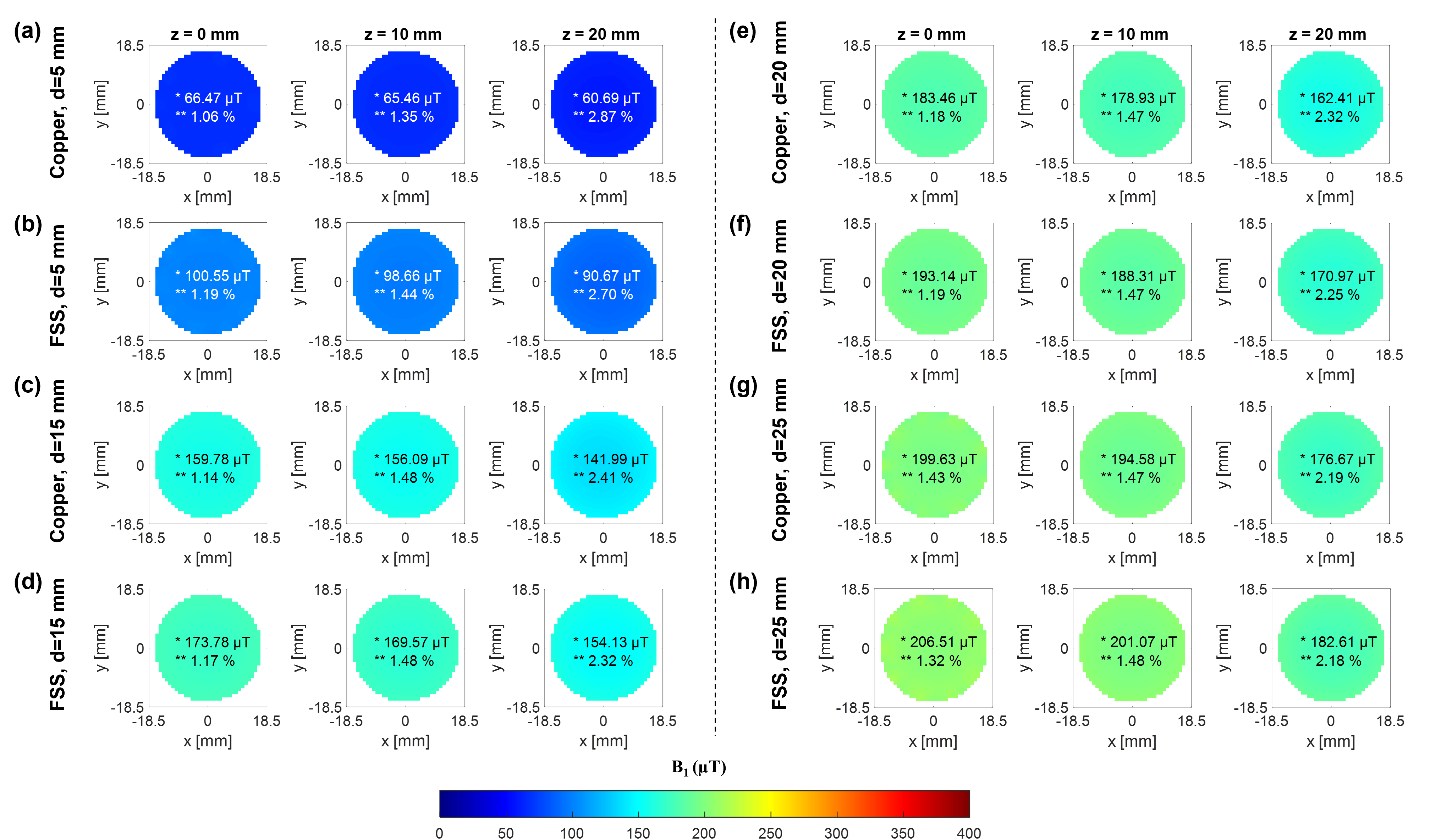
Fig 3. Simulated B1 field distribution on the xy-planes(z=0,10,20mm) when the input port is excited at 2.84MHz using 1 A current source in the copper and FSS shielded coils with a proximity distance, d of (a)-(b) 5mm, (c)-(d) 15mm, (e)-(f) 20mm, and (g)-(h) 25mm, respectively. B1avg and IH are labelled in each sub-plot, indicated by ‘*’ and “**”, respectively.
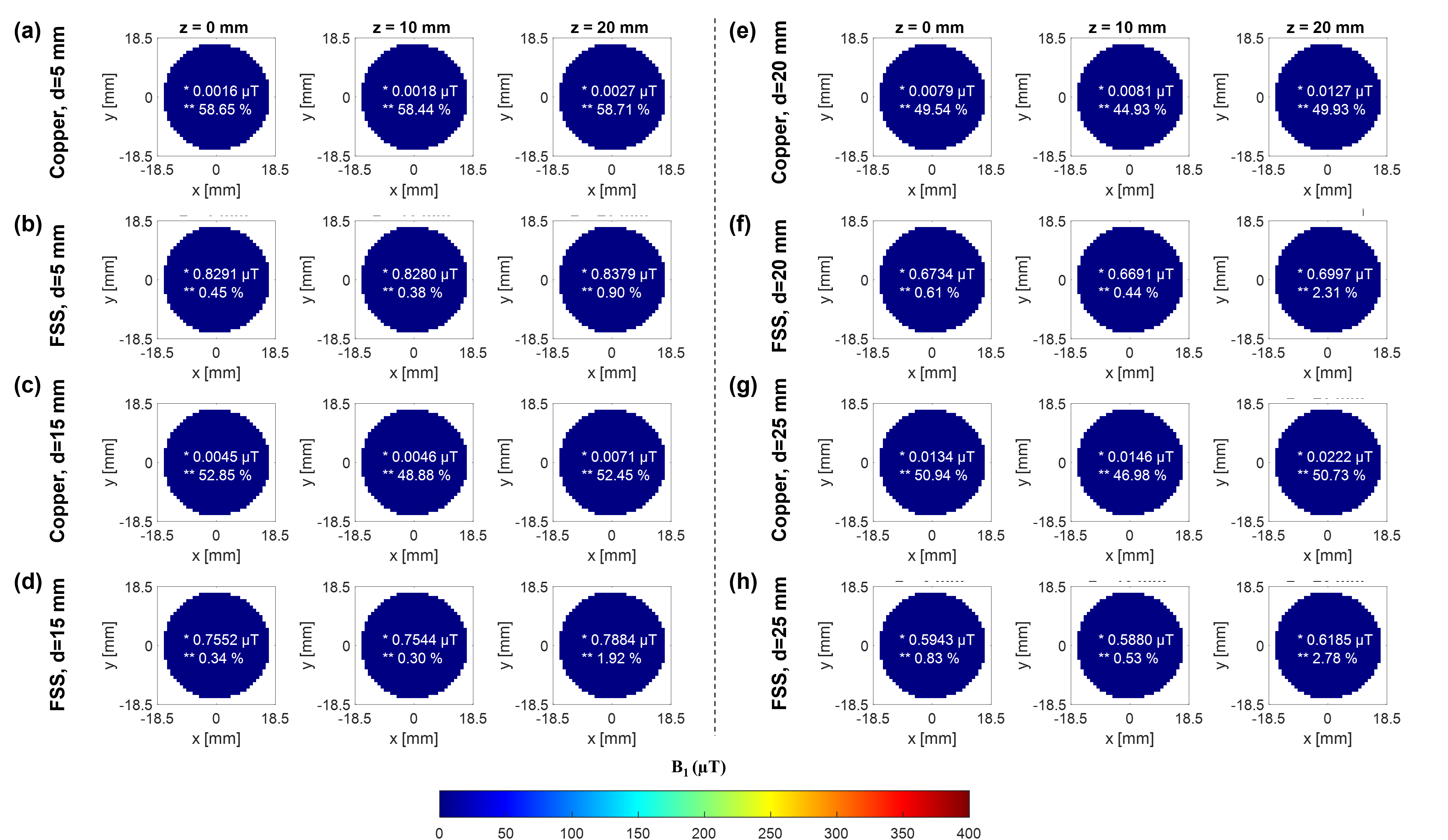
Fig 4. Simulated B1 field distribution on the xy-planes(z=0,10,20mm) due to excitation of wide-band noise source centered at 2.84MHz in the copper and FSS shielded coils with a proximity distance, d of (a)-(b) 5mm, (c)-(d) 15mm, (e)-(f) 20mm, and (g)-(h) 25mm, respectively. B1avg and IH are labelled in each sub-plot, indicated by ‘*’ and “**”, respectively.
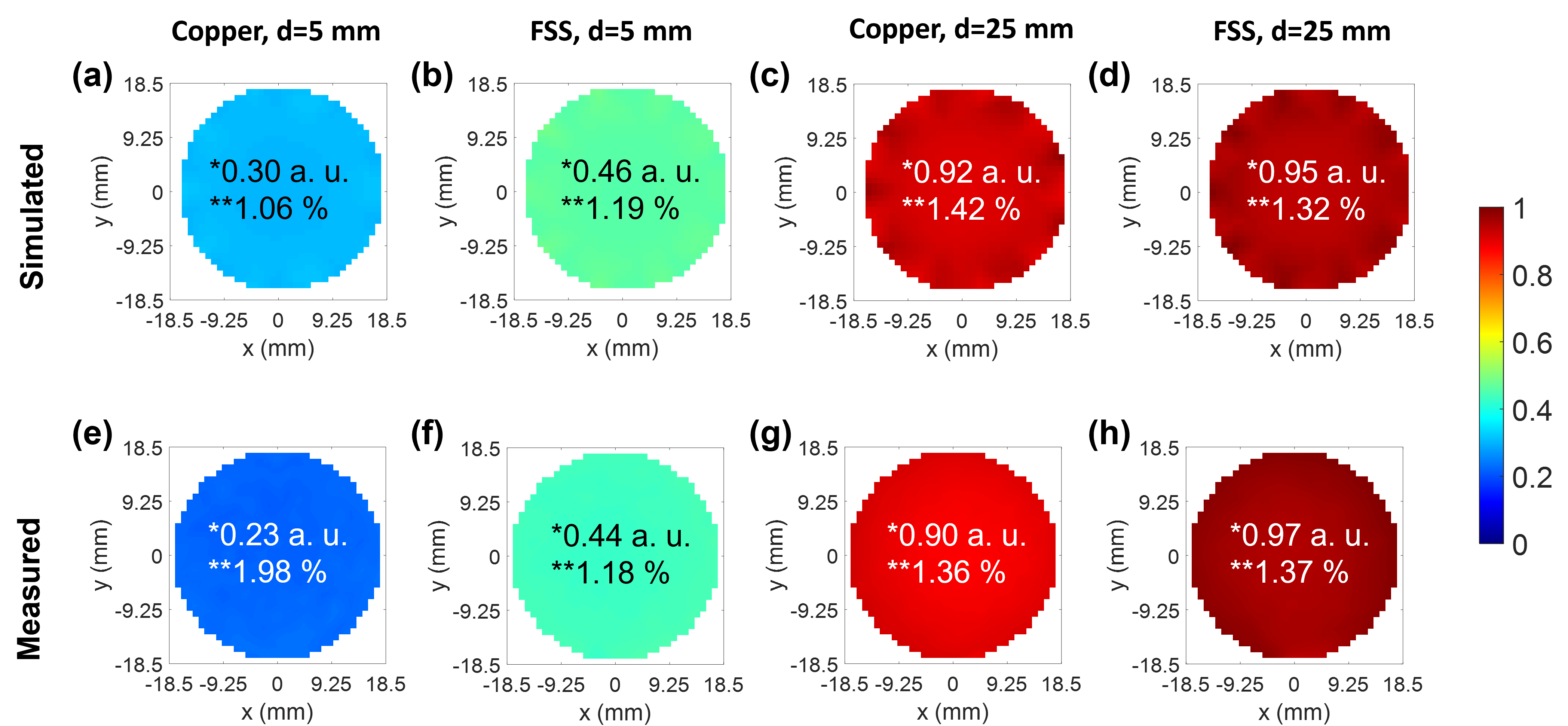
Fig 5. The normalised B1 field map on the xy-plane(z=0) obtained from (a)-(d) simulated B1 field distribution when solenoid coil is excited at 2.84 MHz using 1 A current source and (e)-(h) measured B1 sensitivity at 2.84 MHz. Column 1 & 2 represents the cases with d = 5mm and column 3 & 4 represents the cases with d = 25mm. Normalisation was done with respect to the maximum of the simulated and measured group of plots in row 1 and 2 respectively. B1avg and IH are labelled in each sub-plot, indicated by ‘*’ and “**”, respectively.