1761
Stop-Motion RF for Improving Spatial Resolution in Non-Linear Gradient-Free Low-Field MRI1Biomedical Engineering, Yale University, New Haven, CT, United States, 2Department of Radiology and Biomedical Imaging, Yale School of Medicine, New Haven, CT, United States
Synopsis
Keywords: Low-Field MRI, RF Arrays & Systems
We developed a stop-motion imaging technique in which a 3x3 radiofrequency coil that transmits Bloch-Siegert encodings is placed in a different position within the field-of-view for each MR signal acquisition. This study is performed using a non-linear gradient-free low-field MRI system. High spatial resolution is achieved through stop-motion imaging. We show that stop-motion imaging done with a total of 200 encodings (20 imaging positions and 10 encodings per position) outperformed stationary imaging performed with 200 encodings (1 imaging position and 200 encodings per position).Introduction
Transitioning to low-field creates the opportunity to redesign acquisition strategies of MRI. One possibility is to design an open MRI system that eliminates constraint of cylindrical shape of most scanners. To better target specific organs, the magnet will have an open area large enough to accommodate an average torso. Figure 1 shows a schematic of a patient lying on top of the magnet for a breast scan (though, similar geometry can be used for liver imaging, etc.). With an open design at low Bo, the standard approaches to spatial encoding (strong and volume encompassing gradient field coils) are not easily translated. To solve this problem, we propose to use Bloch-Siegert encoding, which entails applying an off-resonance radiofrequency (RF) pulse that introduces a spatially dependent phase shift to the on-resonance transverse magnetization1. The Bloch-Siegert pulses will be transmitted from a three-by-three element planar RF array (shown in Figure 2a). Different phasors (coil-windings) are created by varying the coil-element combinations of the nine RF coils2. Imaging with different phasors produces different spatial encoding information.To further increase the number of unique phasor patterns and hence the amount of spatial information, thereby improving resolution, stop-motion imaging is proposed. In stop-motion imaging, the RF coil array is moved to a different position within the field-of-view (FOV) for each image acquisition, essentially creating a different point-of-view, with the goal of increasing spatial resolution. Figure 2b shows an example of stop-motion imaging in which the RF coil array is moved to (five) different locations within the FOV; image acquisition is performed at each position. This differs from typical imaging where the RF coil array is stationary, placed in the center of the FOV for the entire image acquisition (Figure 2a). As the Bo field is inhomogeneous, the Bloch-Siegert encoding will provide unique information depending on the position of the RF coils in the FOV. Stop-motion is shown to enhance spatial resolution.
The benefit of stop-motion, changing the position of the RF coils to a different location within the field-of-view (FOV) for each imaging acquisition, is that very small movements are achievable with relatively large coil elements. For this to be done using stationary RF coils, the RF coil diameters would have to be greatly decreased which would in return decrease imaging penetration depth3. Thus, we propose to use stop-motion imaging to achieve multiple small changes in the positions of the RF coils; this will increase the amount of spatial information acquired.
Methods
The stop-motion imaging simulation was performed at twenty-five different locations within the 20cmx20cm FOV. The twenty-five locations were selected along a spiral trajectory (Figure 3). The size of the spiral trajectory was constrained by the surface area of the magnet.The encoding schemes were calculated as the weighted sum of the B1-fields from each channel of the three-by-three RF coil array. Encoding schemes were created from unique pattern combinations that arise from transmitting on all nine coils with a pulse phase of 0, 𝜋, or -𝜋. At each of the twenty-five locations, with respect to the locations within the non-linear Bo field, Bloch simulations were used to calculate the phasor generated by each encoding pattern. The MR signal generated by each encoding scheme at each location was reconstructed using the nonlinear gradient field conjugate gradient method4.
Results
Figure 4b shows the result from reconstructing a grid phantom (Figure 4a) using stationary imaging (imaging done in only the central location of the FOV). Figure 4c shows the result from reconstructing a grid phantom (Figure 4a) using stop-motion imaging performed at twenty-five locations along a spiral trajectory (Figure 3). The relationship between the number of positions for stop-motion imaging and image quality is shown in Figure 5. This relationship is captured by displaying the mean square error between the grid phantom (Figure 4a) and reconstructed images.Discussion
The results show that stop-motion imaging in positions along a spiral trajectory outperforms stationary imaging as the stop-motion result (Figure 4c) achieves a better image quality, more like the phantom grid, (Figure 4a) than the stationary result (Figure 4b).Figure 5 shows that the mean square error between the imaged phantom grid and the reconstructed images decreases as the number of imaging positions increases. Imaging in twenty locations with ten encodings per position outperformed imaging in ten locations with twenty encodings per position, and far outperformed imaging in one location with 200 encodings. Thus, for the same total number of encodings, the imaging done with a greater number of positions (and lower number of encodings per position), outperformed the imaging done with a lower number of positions (and greater number of encodings per position).
Conclusion
The stop-motion imaging outperformed stationary imaging. Thus, we have shown that stop-motion imaging improves reconstruction image quality when using a planar RF-coil array that produces Bloch-Siegert encodings in a non-linear field.Stop-motion imaging with Bloch-Siegert encoding produces high spatial resolution images without the use of strong and volume encompassing spatial encoding gradients. Therefore, the stop-motion imaging innovation improves the feasibility of open, organ-specific low-field MRI.
Acknowledgements
No acknowledgement found.References
- Kartäusch, Ralf, et al. "Spatial phase encoding exploiting the Bloch–Siegert shift effect." Magnetic Resonance Materials in Physics, Biology and Medicine 27.5 (2014): 363-371.
- Selvaganesan, K, et al. “Nonlinear projection imaging with the Bloch-Siegert shift in an inhomogeneous B0 at low-field.” ISMRM 0899 (2021).
- Haase, Axel, et al. "NMR probeheads for in vivo applications." Concepts in Magnetic resonance 12.6 (2000): 361-388.
- Selvaganesan, K., et al. “Nonlinear encoding scheme for gradient-free projection imaging in an inhomogeneous B0-magnet.” ISMRM 0504 (2022).
Figures
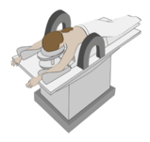
Figure 1. Schematic of a patient lying on top of the magnet for a breast scan.
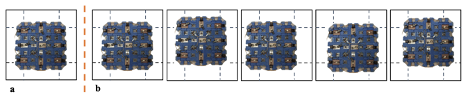
Figure 2. Three-by-three channel RF coil in FOV (FOV is at the intersection of dotted gray lines). (a): stationary imaging. RF coil is placed in only one (central) location for the entire image acquisition. (b): stop-motion imaging. RF coil is placed in five different locations and in each location image acquisition is performed.
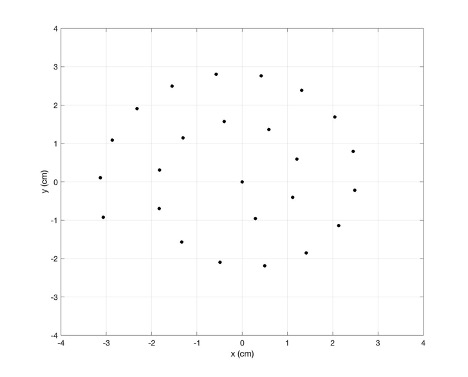
Figure 3. Twenty-five positions along a spiral trajectory. For stop-motion imaging in this study, image acquisition was performed at these twenty-five positions. Spiral size is constrained by the surface area of the MRI.
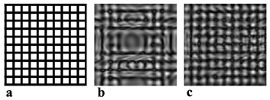
Figure 4. Example of stationary and stop-motion imaging. The same total number of encodings was used in both imaging cases.
(a): phantom grid.
(b): result of imaging phantom grid with stationary imaging.
(c): result of imaging phantom grid with
stop-motion imaging.
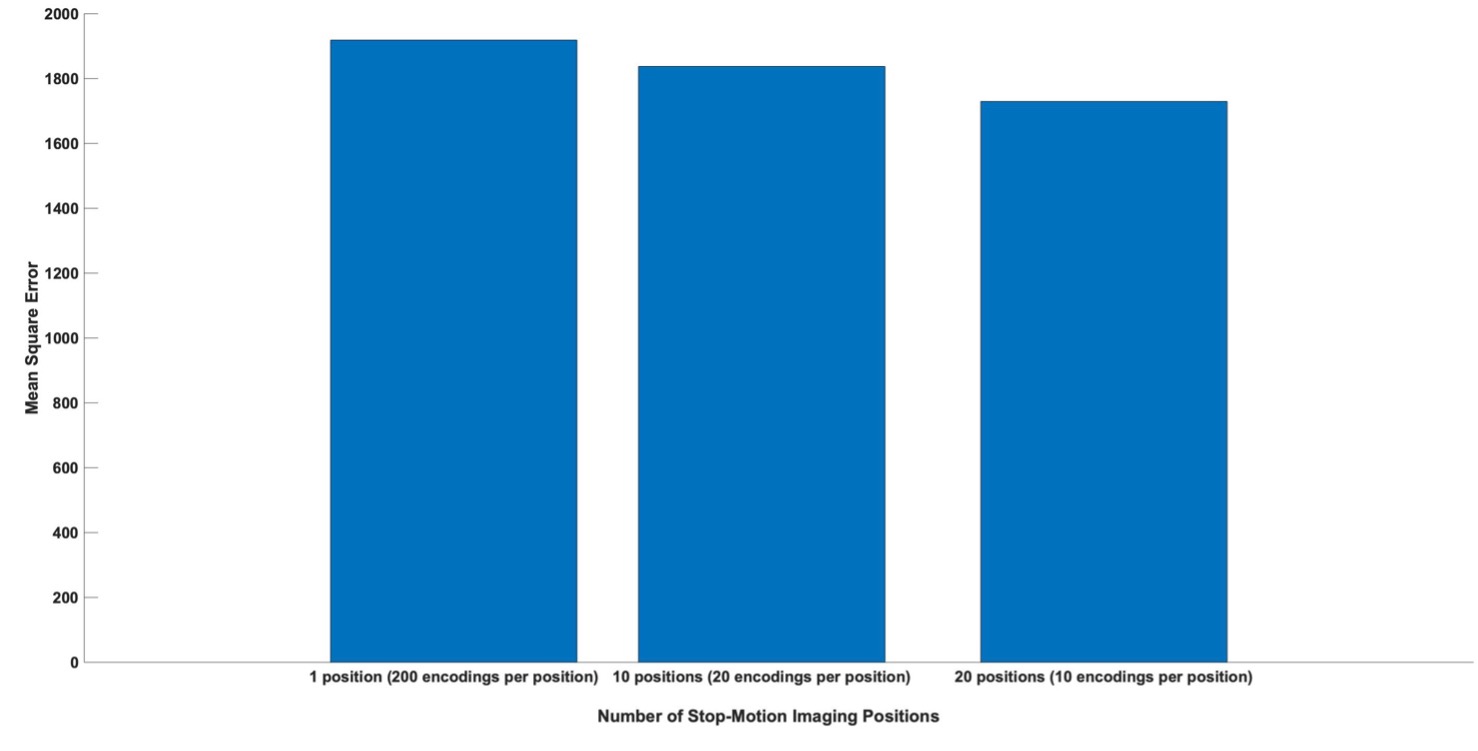
Figure 5. Mean square error between phantom grid and reconstructed images as a function of the number of stop-motion imaging positions. For the same total number of encodings (200), as the number of stop-motion imaging positions increases, the mean square error decreases.