1205
Abnormal brain function and connectivity in patients with convergence insufficiency: A resting-state functional MRI study
Yuxia Wanng1, Ye Wu2, Huaiqiang Sun3, and Fei Li1
1Huaxi MR Research Center (HMRRC), Department of Radiology, West China Hospital of Sichuan University, Chengdu 610041, Sichuan, P.R. China., Chengdu, Sichuan, China, 2Department of Ophthalmology, Laboratory of Optometry and Vision Sciences, West China Hospital of Sichuan University, Chengdu 610041, Sichuan, P.R. China., Chengdu, Sichuan, China, 3Huaxi MR Research Center (HMRRC), Department of Radiology, West China Hospital of Sichuan University, Chengdu 610041, Sichuan, P.R. China.Huaxi MR Research Center (HMRRC), Department of Radiology, West China Hospital of Sichuan University, Chengdu 610041, Sichuan, P.R. China., Chengdu, Sichuan, China
1Huaxi MR Research Center (HMRRC), Department of Radiology, West China Hospital of Sichuan University, Chengdu 610041, Sichuan, P.R. China., Chengdu, Sichuan, China, 2Department of Ophthalmology, Laboratory of Optometry and Vision Sciences, West China Hospital of Sichuan University, Chengdu 610041, Sichuan, P.R. China., Chengdu, Sichuan, China, 3Huaxi MR Research Center (HMRRC), Department of Radiology, West China Hospital of Sichuan University, Chengdu 610041, Sichuan, P.R. China.Huaxi MR Research Center (HMRRC), Department of Radiology, West China Hospital of Sichuan University, Chengdu 610041, Sichuan, P.R. China., Chengdu, Sichuan, China
Synopsis
Keywords: Nerves, Brain, Convergence insufficiency; brain function; functional connectivity; fALFF
Convergence insufficiency (CI) is the most common binocular vision disorder in optometric clinics relevant to the dysfunction of the specific neural circuit, while the neural mechanism is unknown. Using the fractional amplitude of low-frequency fluctuations fALFF and seed-to-voxel analysis, we found increased fALFF in the left cerebellum crus 1 and increased functional connectivity between the left cerebellum crus 1 and the right cerebellum crus 1 in patients with CI than healthy controls, which showed positive correlations with the severity of symptoms. These findings provide evidence of altered brain function features underlying neurobiological mechanisms of patients with CI.Background
Convergence insufficiency (CI) is the most common binocular vision disorder in optometric clinics in which the eyes have a strong tendency to drift outward with difficulty turning the eyes inward when reading or doing close work1. Patients with CI always exhibit several symptoms such as eye sore, eye hurt, double vision, blurring, and even headaches when occupying near work, especially after reading or computer work, because the two eyes do not converge adequatedly2.To maintain a good binocular single vision, the visual system uses the specific neural circuit to mediate eye movement in near work3. Previous studies reported that the incidence of CI is 42%-43% in patients with acquired brain injure4, suggesting that neural alterations are possibly associated with CI. The precise neural mechanism for this disorder, however, is still unknown. Resting-state functional magnetic resonance imaging (rs-fMRI) provides essential insights to reveal the neural mechanism of various disorders and has been used to investigate many different eye conditions, such as amblyopia and glaucoma5, 6. Thus, this study aimed to examine the underlying intrinsic brain functional abnormalities in patients with CI compared to healthy controls (HCs) using rs-fMRI.Methods
CI dysfunction was diagnosed by an optometrist using methods described in our previous study7. We recruited 34 patients with CI and 35 HCs in our study.Convergence Insufficiency Symptom Survey (CISS): Before the accommodative and binocular tests, symptoms were examined using the validated CISS 8, 9, which was translated into Chinese based on the Brislin translation model 10.Accommodative and binocular tests: All participants underwent an optometric examination by two optometrists (Y.W and L.X). The accommodative and binocular tests included the following assessments: the direction and magnitude of horizontal and vertical phoria, accommodative convergence/accommodation ratios, positive and negative fusional vergence (PFV/NFV), positive and negative relative accommodation, the near point of convergence (PAN), accommodative facility, vergence facility, and accommodative amplitude. Details about this battery of tests have been described in our previous publication 10. Brain rs-fMRI data were analyzed using the fractional amplitude of low-frequency fluctuations (fALFF) approach. Meanwhile, fALFF value was normalized to the Z-value (zfALFF) in order to reduce individual variances in overall whole-brain fALFF values. Then, a seed-to-voxel whole brain functional connectivity (FC) analysis will be applied based on the results of the voxel-based whole-brain fALFF analysis. Spearman partial correlation analyses were performed to explore the relationships between altered fALFF and FC and clinical symptom severity in all participants, with age and sex as covariates. The significant statistic threshold was set at P<0.05 with corrections for multiple comparisons.Results
Compared with HCs, patient with CI showed increased fALFF in left cerebellum crus 1 (Figure 1). The seed-based FC analysis showed that left cerebellum crus 1 showed increased FC with right cerebellum crus 1 in patients with CI than HCs (Figure 2). The fALFF and FC values were positively correlated with symptom scores measured by CISS and NPC, and negatively correlated with horizontal phoria at near (PAN) and PFV (Tables 1 and 2).Discussion
The visual system has a three-level hierarchy in controlling saccadic eye movement in which the cerebellum plays a significant role in maintaining the accuracy of saccades as the second level12, and the lesions in the cerebellar vermis lead to convergence dysfunction13. To a certain extent that fALFF indexes underlying neural activity, our results reveal that the left cerebellum activity and synchronization of metabolic mand from the neurons between bilateral cerebellum were increased in patients with CI. The CISS, NPC, PAN, and PFV measure the severity of CI. The higher CISS score and NPC values but the lower PFV and PAN values, the more severe the symptoms. Thus, the positive correlations between fALFF in the left cerebellum and FC between bilateral cerebellum and CISS scores and NPC and negative correlation with PAN and PFV may suggest that the brain needs more efforts in bilateral cerebellum to maintain good single binocular vision because of more serious exophoria in patients with CI, resulting in more severe visual symptoms.Conclusion
In conclusion, we found that patients with CI showed increased fALFF in left cerebellum and increased FC between bilateral cerebellum compared with HCs. Moreover, significant correlations between fALFF and FC values and the severity of symptoms measured by CISS, NPC, PAN, and PFV were found. These findings contribute to a better understanding of the underlying neural mechanism of CI.Acknowledgements
No acknowledgement found.References
1. Hashemi, H.; Nabovati, P.; Khabazkhoob, M.; Ostadimoghaddam, H.; Doostdar, A.; Shiralivand, E.; Yekta, A., The prevalence of convergence insufficiency in Iran: a population-based study. Clin Exp Optom 2017, 100 (6), 704-709.2. Scheiman, M.; Kulp, M. T.; Cotter, S. A.; Lawrenson, J. G.; Wang, L.; Li, T., Interventions for convergence insufficiency: a network meta-analysis. Cochrane Database Syst Rev 2020, 12, CD006768.3. Kandel, E. R.; Schwartz, J. H.; Jessell, T. M.; Siegelbaum, S. A.; Hudspeth, A. J.; Mack, S. e., Principles of Neural Science, Fifth Edition. McGraw-Hill Education: New York, NY, 2014.4. Alvarez, T. L.; Kim, E. H.; Vicci, V. R.; Dhar, S. K.; Biswal, B. B.; Barrett, A. M., Concurrent vision dysfunctions in convergence insufficiency with traumatic brain injury. Optom Vis Sci 2012, 89 (12), 1740-51.5. Chen, X.; Liao, M.; Jiang, P.; Sun, H.; Liu, L.; Gong, Q., Abnormal effective connectivity in visual cortices underlies stereopsis defects in amblyopia. Neuroimage Clin 2022, 34, 103005.6. Liu, D.; Gao, J.; You, T.; Li, S.; Cai, F.; Pei, C.; Zeng, X., Brain Functional Network Analysis of Patients with Primary Angle-Closure Glaucoma. Dis Markers 2022, 2022, 2731007.7. Wu, Y.; Zhang, Z.; Liao, M.; Li, Q.; Tang, X. L.; Liu, L., Effect of corneal refractive surgery on accommodative and binocular dysfunctions among civilian pilots in Southwest China. BMC Ophthalmol 2021, 21 (1), 95.8. Pang, Y.; Tan, Q.-Q.; Gabriel, H.; Block, S. S.; Wang, J., Application of the Convergence Insufficiency Symptom Survey in Oculomotor Dysfunction and Accommodative Insufficiency. Optom Vis Sci 2021, 98 (8), 976-982.9. Darko-Takyi, C.; Owusu-Ansah, A.; Boampong, F.; Morny, E. K.; Hammond, F.; Ocansey, S., Convergence insufficiency symptom survey (CISS) scores are predictive of severity and number of clinical signs of convergence insufficiency in young adult Africans. J Optom 2021, Jul-Sep;15(3):228-237.10. Jones, P. S.; Lee, J. W.; Phillips, L. R.; Zhang, X. W. E.; Jaceldo, K. B., An adaptation of Brislin's translation model for cross-cultural research. Nurs Res 2001, 50 (5), 300-304.11. Wu, Y.; Zhang, Z.; Liao, M.; Li, Q.; Tang, X. L.; Liu, L., Effect of corneal refractive surgery on accommodative and binocular dysfunctions among civilian pilots in Southwest China. BMC Ophthalmol 2021, Feb 19;21(1):95.12. Munoz, D. P.; Coe, B. C., Saccade, search and orient--the neural control of saccadic eye movements. Eur J Neurosci 2011, 33 (11), 1945-7.13. Sander, T.; Sprenger, A.; Neumann, G.; Machner, B.; Gottschalk, S.; Rambold, H.; Helmchen, C., Vergence deficits in patients with cerebellar lesions. Brain 2009, 132 (Pt 1), 103-15.Figures
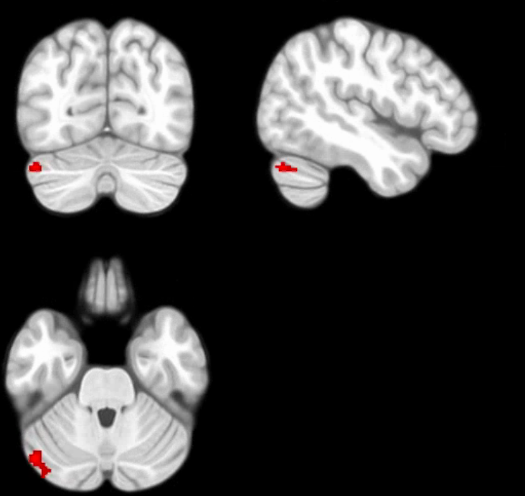
Figure 1. The present study showed increased fALFF in the left cerebellum crus 1 of CI patients than HCs. P < 0.05, p-FWE corrected.
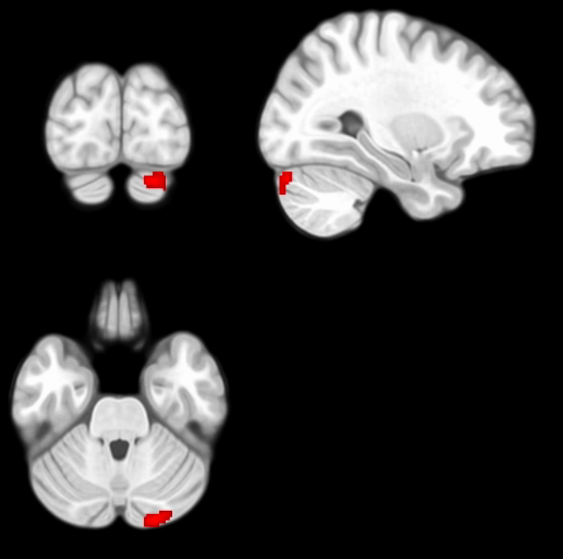
Figure 2. Seed-to-voxel analysis showed greater functional connectivity of the left cerebellum crus 1 with the right cerebellum crus 1 in CI patients than HCs. P < 0.05, p-FWE corrected.
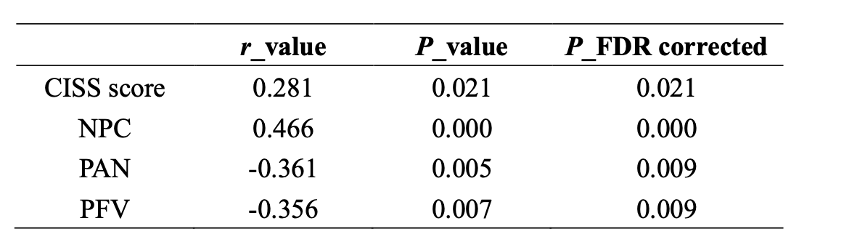
Table 1.Correlation results between fALFF in the left cerebellum crus 1 and clinical characteristics of all participants. Abbreviations: CISS, Convergence Insufficiency Symptom Survey; PAN, horizontal phoria at near; NPC, near point convergence; PFV, positive fusional vergence.
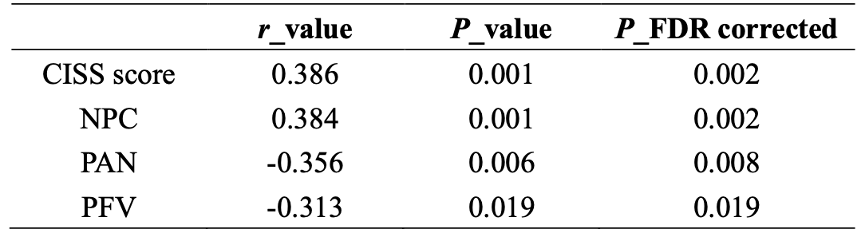
Table 2. Correlation results between functional connectivity of the left cerebellum crus 1 with the right cerebellum crus 1 and clinical characteristics of all participants. Abbreviations: CISS, Convergence Insufficiency Symptom Survey; NPC, near point convergence; PAN, horizontal phoria at near; PFV, positive fusional vergence.
DOI: https://doi.org/10.58530/2023/1205