1071
Abbreviated Three Minute 4D Flow MRI of the Portal Circulation: Prospective Evaluation in Obese Subjects1Department of Radiology, University of Wisconsin-Madison, Madison, USA, WI, United States, 2Department of Radiology and Nuclear Medicine, Universität zu Lübeck, Lübeck, Germany, 3Department of Electrical and Computer Engineering, University of Wisconsin-Madison, Madison, USA, WI, United States, 4University of Wisconsin-Madison, Madison, USA, WI, United States, 5Department of Medical Physics, University of Wisconsin-Madison, Madison, USA, WI, United States, 6Department of Medical Physics, University of Wisconsin-Madison, Madison, WI, United States, 7Department of Mechanical Engineering, University of Wisconsin-Madison, Madison, WI, United States, 8Department of Biomedical Engineering, University of Wisconsin-Madison, Madison, WI, United States, 9Department of Emergency Medicine, University of Wisconsin-Madison, Madison, WI, United States
Synopsis
Keywords: Flow, Liver
Constant, non-pulsatile flow in the portal venous system offers the possibility of time-averaged reconstruction for shortening the acquisition time. We acquired both a 10min and 3min radial 4D flow MRI (PCVIPR) in 10 subjects in a test-retest paradigm. Time-averaged 10min and 3min exams were compared to the reference standard, i.e., cardiac-phase resolved 10min exam (14 timeframes). All datasets were analyzable with quality rated as “good” for all 3min exams. Small vessels were best visualized in the time-averaged 10min data. Conservation of mass analysis and test-retest repeatability yielded excellent results for all reconstructions. Quantitative results agreed well between reconstructions.
Introduction
Abdominal 4D flow MRI offers comprehensive assessment of portal hemodynamics and holds the potential to diagnose flow-related liver pathologies non-invasively1. However, long acquisition times limit clinical utilization. Importantly, portal vein flow is near constant2 and time-averaged flow rates and patterns are of primary interest. Therefore, k-space-based temporal averaging has been proposed by Landgraf et al.3 to reduce acquisition time. In that work retrospective undersampling of radial 4D flow acquisitions achieved an exam time reduction of up to 70-80%.The purpose of this work was to develop and prospectively validate an abbreviated radial 4D flow MRI protocol to characterize the hemodynamics of blood in the portal vein. This was to be achieved through k-space-based temporal averaging, exploiting the known steady flow conditions in the portal vein.
qehtqerh
Methods
Cohort:10 obese participants, reflecting a challenging population with an increased prevalence of liver pathology (34-60years, BMI>35), were recruited prospectively after IRB approval and informed consent. Participants fasted for 5 hours before the exam to ensure stable portal hemodynamics. They received 3mg/kg intravenous ferumoxytol (Feraheme, AMAG Pharmaceuticals) per ISMRM guidelines4 (off-label use) ensuring a high signal-to-noise ratio during the study.5
MRI:
The imaging protocol consisted of two 4D flow acquisitions using a 5-point velocity-encoded 3D radially undersampled trajectory (PCVIPR6) with inner volume excitation7 covering the upper abdomen. The number of radial projections was adjusted for acquisition times of 10min (n=16,000) and 3min (n=5,500). Acquisition parameters included: imaging volume=48x48x24cm3; acquired resolution=1.25mm isotropic; TE/TR=2.2/7.6ms; flip=14˚; VENC=60cm/s. Offline postprocessing included time-averaged reconstruction for both acquisitions (10min-AVG, 3min-AVG) and cardiac time-resolved reconstruction (14 timeframes, 10min-TR) for the 10min acquisition. CG-SENSE reconstruction8,9 included retrospective respiratory gating, corrections for Maxwell terms, and gradient non-linearity. Both 3min and 10min exams were repeated after repositioning resulting in 6 datasets per subject.
Analysis:
Data were analyzed with GTFlow (v4.8, Gyrotools, Switzerland). A radiologist with 12 years of experience with 4d flow MRI rated the analyzability on a Likert scale (1=excellent, 2=good, 3=marginal, 4=not analyzable) and recorded the visibility of small vessels in the complex difference (CD) images.
Nine contours were manually placed in the 10min-AVG phase contrast (PC) angiogram for both 10min reconstructions (Figure 1a). They were copied and adjusted to the 3min exam to reduce placement variability. Flow, average velocity, voxel-based maximum velocity, and vessel area were measured. Particle tracing was used and the percentage of particles emitted from contour PV1 and arriving at contour PV3 was recorded as a measure of quality.
Analysis included (1) conservation of mass (COM)-analysis, (2) test-retest repeatability, and (3) comparison of quantitative results. COM-analysis determined the bias between inflow and outflow at the splenomesenteric confluence (SMV+SV ≈ PV1) and the portal bifurcation (PV3 ≈ RPV+LPV, Figure 1a). Relative error (RE) was calculated as RE=(inflow-outflow)/mean(inflow, outflow). Quantitative results were compared by Bland-Altman, linear regression analysis, and Pearson’s correlation. Values are reported as mean±standard deviation.
Results
Data qualityAll datasets were analyzable with most being rated as “good” (Figure 1, Figure 2a). Small vessels were best visible in 10min-AVG (Figure 2b). COM-analysis yielded good results for all reconstructions (RE=-1±11%; slope=0.08-0.98; intercept=0.78-2.20; correlation coefficient r=0.934-0.968), (Figure 3). Particle arrival from PV1 to PV3 was similar between reconstructions (10min-TR: 73±12%, 10min-AVG: 76±8%; 3min-AVG: 72±10%).
Repeatability
For all reconstructions, test-retest repeatability was excellent for area and flow (r=0.92-0.98) and good for average and maximum velocity (r=0.80-0.93), (Figure 4). For area and flow, limits of agreement were slightly broader for the 3min exam compared to 10min with no relevant difference for average velocity. Maximum velocity results varied less for the time-averaged reconstructions compared to time-resolved.
Quantitative results
Time-averaging of the 10min acquisition did not alter flow and average velocity (Figure 5a). Maximum velocity was lower in the time-averaged reconstruction. Shortening the acquisition time yielded similar results to the 10min exam with excellent correlation and narrow limits of agreement (Figure 5b,c).
Discussion
In this work, we validated a prospectively abbreviated time-averaged 4D flow MRI protocol that successfully characterized the hemodynamics of the portal circulation. We demonstrated equivalent quantitative results for flow and average velocity compared time-resolved reconstructions.Our findings have important implications for the routine use of 4D flow MRI in the liver. With a 3min sequence, the routine acquisition of 4D flow MRI in patients with known liver disease should be possible. For example, there would be minimal impact on the addition of a 3-minute 4D flow exam to an HCC screening protocol10 after the portal venous phase, prior to delayed 5-7min phase T1w imaging, leading to no increase in the overall exam length. This would be particularly interesting in patients with portal hypertension as 4d flow MRI has the potential to identify gastroesophageal varices at-risk for bleeding non-invasively11 in contrast to the invasive esophagogastroduodenoscopy that is the current clinical standard12.
We only tested time-averaged reconstruction for contrast-enhanced radial 4D flow MRI. Future work should investigate whether the results are transferable to Cartesian and non-contrast-enhanced acquisitions. k-space-based averaging could be combined with other acceleration techniques proposed for 4D flow MRI13-16.
Conclusion
Abbreviated time-averaged acquisition of 4D flow MRI that exploits the constant flow in the portal circulation facilitates exam time reduction from 10min to 3min while maintaining data quality and quantitative flow results.Acknowledgements
The authors wish to acknowledge the NIH (R01 DK125783) for supporting this study, as well as GE Healthcare which provides research support to the University of Wisconsin. Dr. Oechtering receives funding from the German Research Foundation (OE 746/1-1). Dr. Reeder is a Fred Lee Sr. Endowed Chair of Radiology.
References
- Oechtering TH, Roberts GS, Panagiotopoulos N, Wieben O, Reeder SB, Roldan-Alzate A. Clinical Applications of 4D Flow MRI in the Portal Venous System. Magn Reson Med Sci 2022.
- McNaughton DA, Abu-Yousef MM. Doppler US of the liver made simple. Radiographics 2011;31:161-88.
- Landgraf BR, Johnson KM, Roldan-Alzate A, Francois CJ, Wieben O, Reeder SB. Effect of temporal resolution on 4D flow MRI in the portal circulation. J Magn Reson Imaging 2014;39:819-26.
- Vasanawala SS, Nguyen KL, Hope MD, et al. Safety and technique of ferumoxytol administration for MRI. Magn Reson Med 2016;75:2107-11.
- Bashir MR, Bhatti L, Marin D, Nelson RC. Emerging applications for ferumoxytol as a contrast agent in MRI. J Magn Reson Imaging 2015;41:884-98.
- Johnson KM, Lum DP, Turski PA, Block WF, Mistretta CA, Wieben O. Improved 3D phase contrast MRI with off-resonance corrected dual echo VIPR. Magn Reson Med 2008;60:1329-36.
- Oechtering TH, Shamim AMKM, Spahic A, et al. Fat mitigation strategies to improve image quality of radial 4D flow MRI in obese subjects. 31st Annual Meeting of the ISMRM. London, UK 2022.
- Qu P, Zhong K, Zhang B, Wang J, Shen GX. Convergence behavior of iterative SENSE reconstruction with non-Cartesian trajectories. Magn Reson Med 2005;54:1040-5.
- Spahic A, Oechtering TH, Roberts GS, et al. Abdominal 4D Flow MRI in Obese Patients – A Pilot Study. 33rd Annual International Conference of the Society of Magnetic Resonance Angiography (SMRA). virtual, 2021, Abstract ID #64.
- Marrero JA, Kulik LM, Sirlin CB, et al. Diagnosis, Staging, and Management of Hepatocellular Carcinoma: 2018 Practice Guidance by the American Association for the Study of Liver Diseases. Hepatology 2018;68:723-50.
- Motosugi U, Roldan-Alzate A, Bannas P, et al. Four-dimensional Flow MRI as a Marker for Risk Stratification of Gastroesophageal Varices in Patients with Liver Cirrhosis. Radiology 2019;290:101-7.
- Garcia-Tsao G, Abraldes JG, Berzigotti A, Bosch J. Portal hypertensive bleeding in cirrhosis: Risk stratification, diagnosis, and management: 2016 practice guidance by the American Association for the study of liver diseases. Hepatology 2017;65:310-35.
- Kim D, Jen ML, Eisenmenger LB, Johnson KM. Accelerated 4D-flow MRI with 3-point encoding enabled by machine learning. Magn Reson Med 2022.
- Richter JAJ, Wech T, Weng AM, et al. Accelerated aortic 4D flow MRI with wave-CAIPI. Magn Reson Med 2021;85:2595-607.
- Garreau M, Puiseux T, Toupin S, et al. Accelerated sequences of 4D flow MRI using GRAPPA and compressed sensing: A comparison against conventional MRI and computational fluid dynamics. Magn Reson Med 2022;88:2432-46.
- Aristova M, Pang J, Ma Y, et al. Accelerated dual-venc 4D flow MRI with variable high-venc spatial resolution for neurovascular applications. Magn Reson Med 2022;88:1643-58.
- Roldan-Alzate A, Campo CA, Mao L, Said A, Wieben O, Reeder SB. Characterization of mesenteric and portal hemodynamics using 4D flow MRI: the effects of meals and diurnal variation. Abdom Radiol (NY) 2022.
Figures
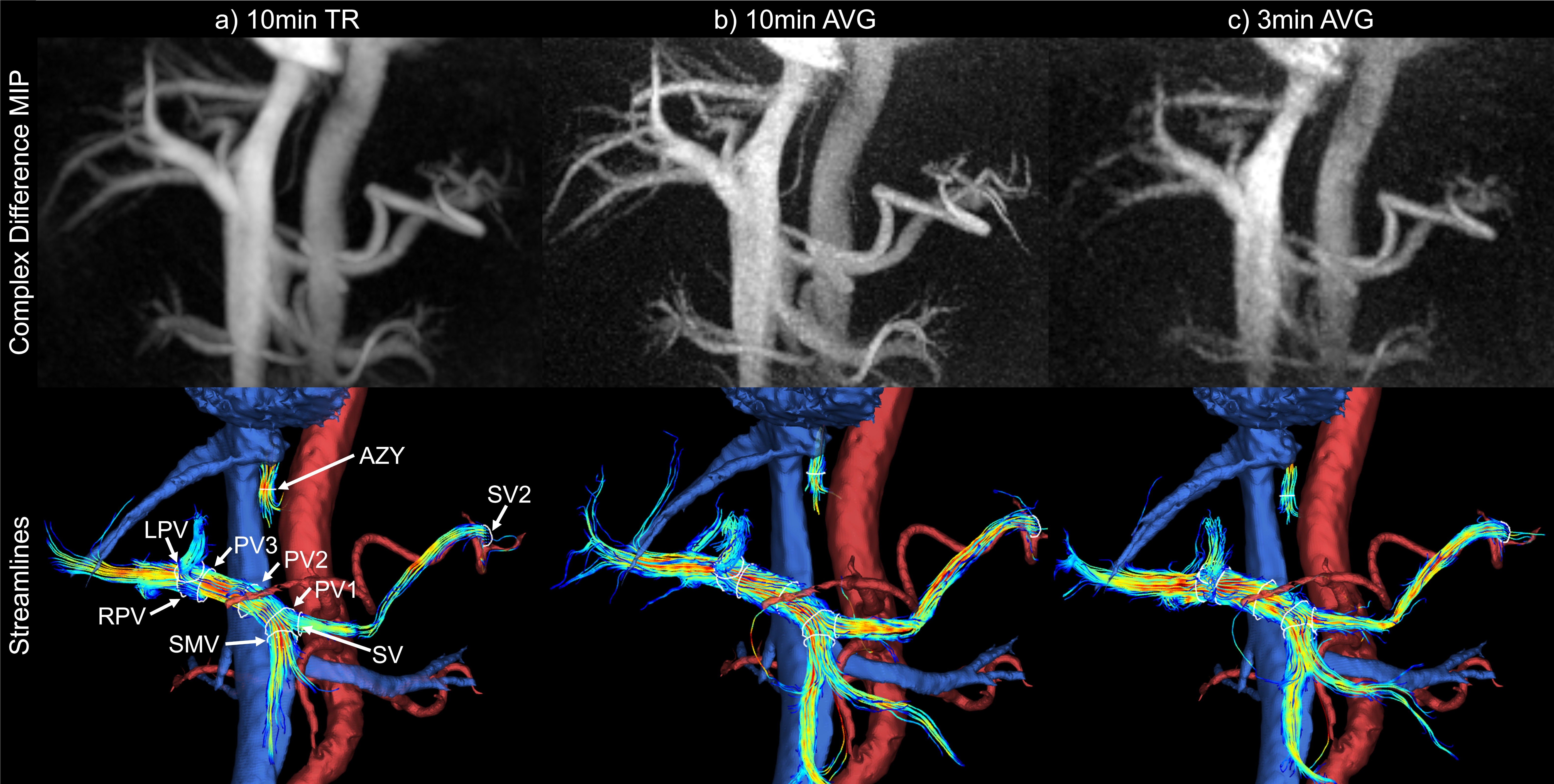
Figure 1: Analyzability of small vessels in the complex difference MIP (upper row) and streamline length (lower row) was best in the (b) 10min time-averaged reconstruction as seen in this participant (female, 59 years, 113kg, 158cm, BMI 45.7). (a) Time-resolved reconstruction of the 10min exam allowed better visualization of small vessels but showed worse streamline visualization than the (c) 3min time-averaged exam. superior mesenteric vein (SMV), splenic vein (SV), portal vein (PV1-PV3), left and right portal vein (LPV, RPV), azygos vein (AZY).
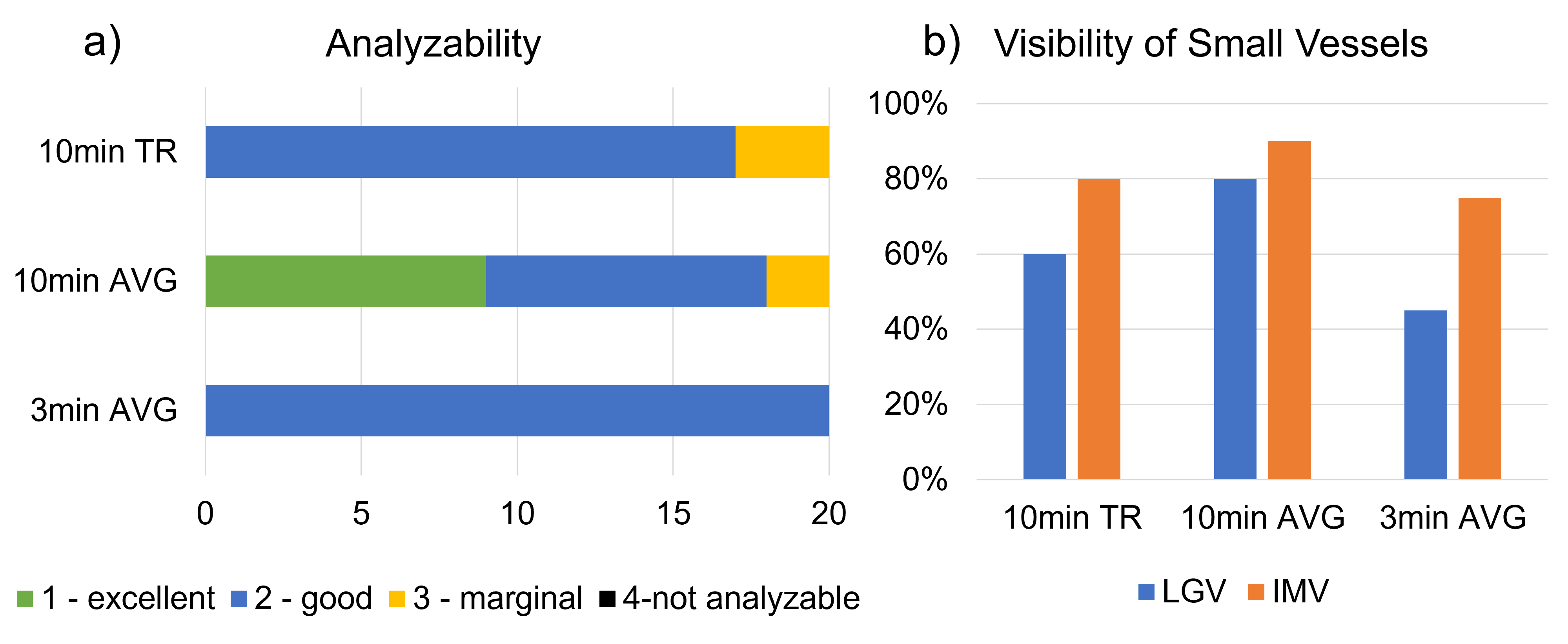
Figure 2: a) All acquisitions and reconstructions were analyzable. Excellent analyzability was achieved in n=9/20 10min-AVG datasets. 3/20 10min exams were marginally analyzable due to motion artifacts which are more likely in longer exams. b) Time-averaged 10min exams (10min AVG) offered best visibility of small vessels, i.e., left gastric vein (LGV), and inferior mesenteric vein (IMV), in the complex difference angiograms.
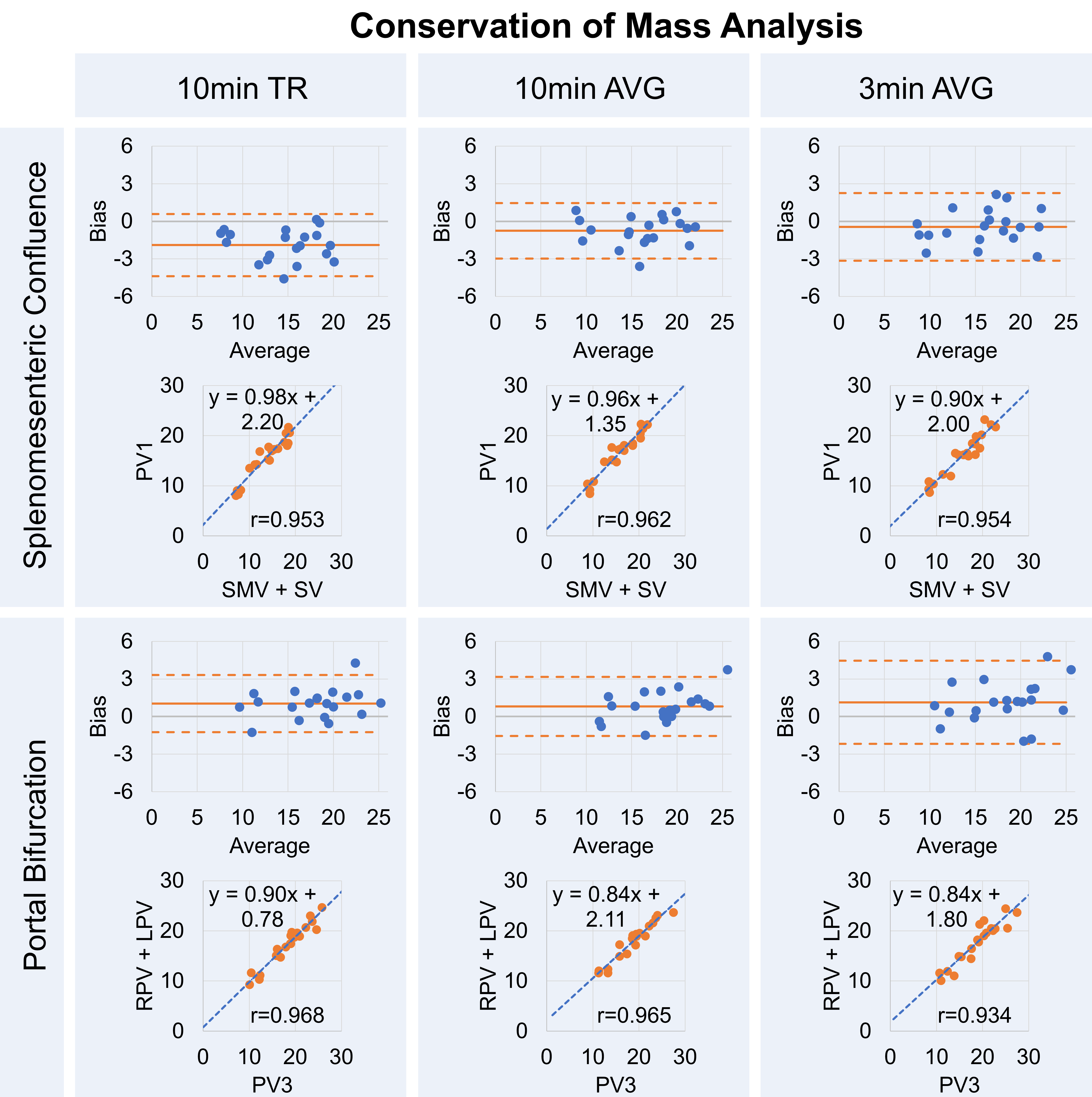
Figure 3: Conservation of mass analysis yielded excellent agreement of flow rates (ml/s) between inflow and outflow at the splenomesenteric confluence and the portal bifurcation for all reconstructions as visualized by Bland-Altman plots, regression analyses, and Pearson’s correlation coefficient r.
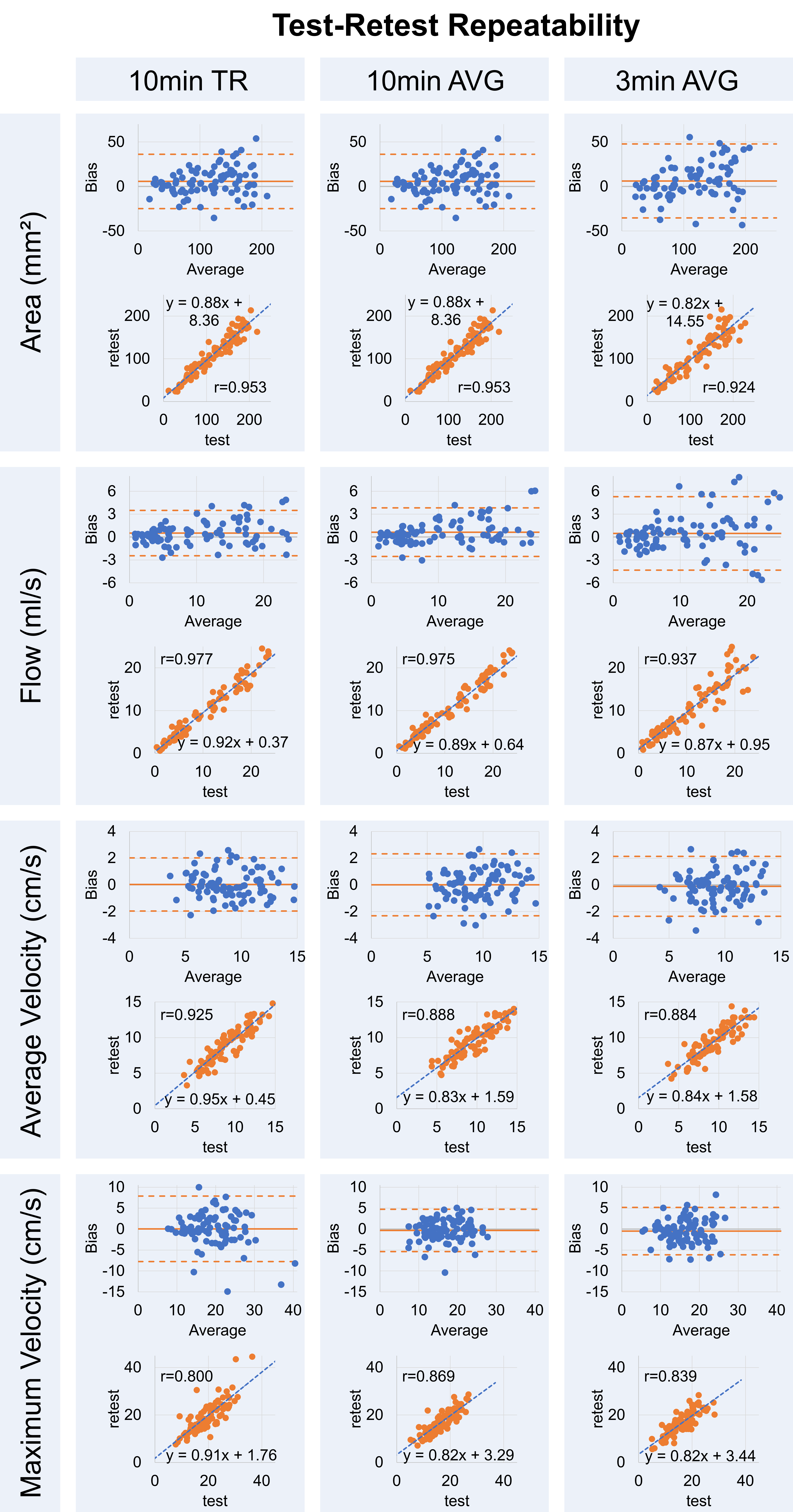
Figure 4: Bland-Altman plots and regression analyses showed that test-retest repeatability was excellent for area and flow, and good for average and maximum velocity. Mean bias was comparably low between all reconstructions. Limits of agreement were slightly broader for 3min-AVG for area and net flow as well as for 10min-TR for maximum velocity. Area and flow were consistently lower for all retest acquisitions, possibly related to prolonged fasting17.
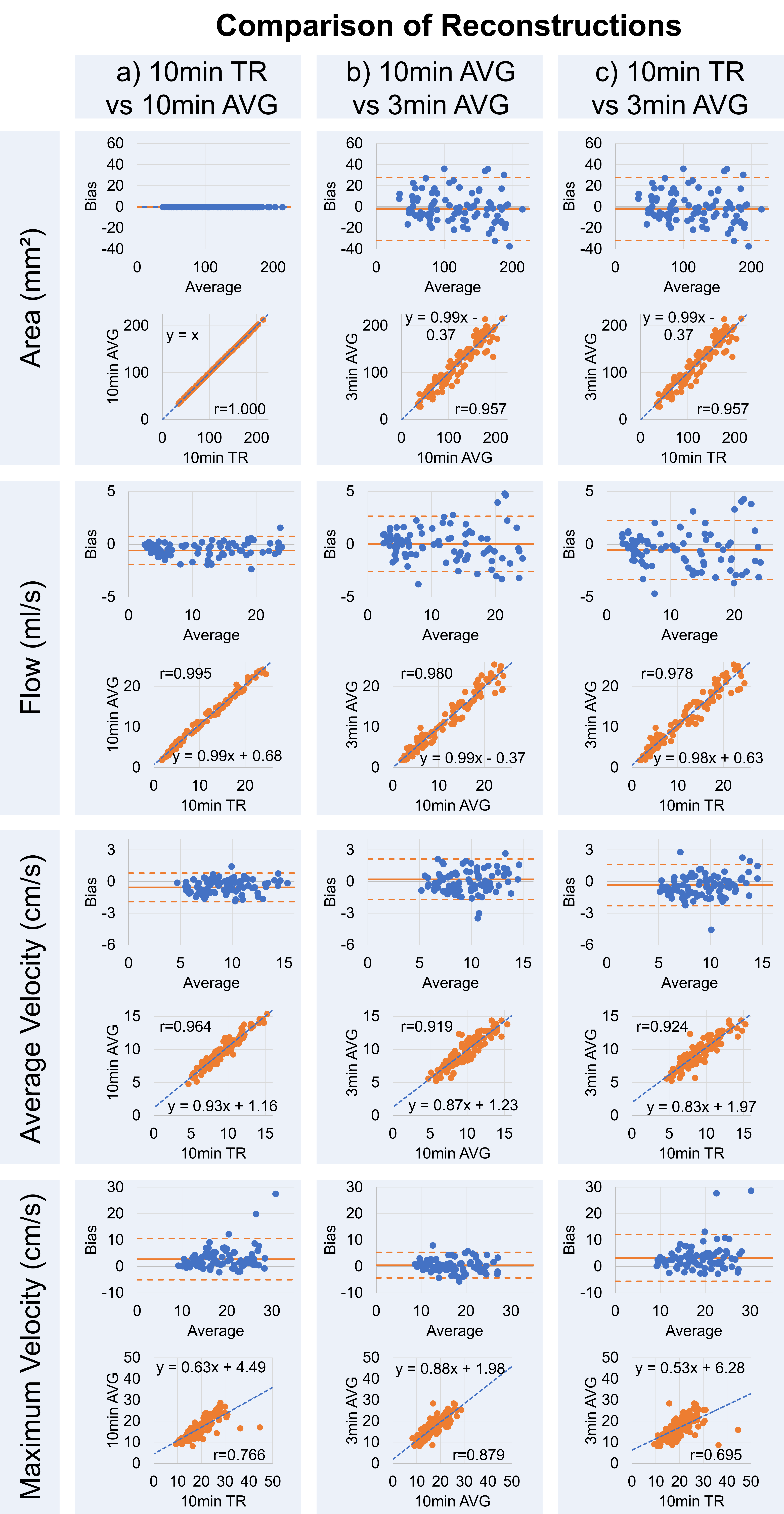
Figure 5: a) Bland-Altman plots and regression analyses indicate excellent agreement between the time-averaged (AVG) and time-resolved (TR) reconstruction of the 10min exam for area, flow, and average velocity. Only voxel-based maximum velocity was significantly lower in the time-averaged reconstruction. b+c) Reduction of acquisition time from 10min to 3min was possible while maintaining quantitative results.