1025
Multivariate Patterns of Brain Functional Connectome Underlying COVID-related Negative Affect Symptoms1Department of Radiology, West China Hospital of Sichuan University, Chengdu, China, 2Department of Psychiatry and Behavioral Neuroscience, University of Cincinnati, CINCINNATI, OH, United States
Synopsis
Keywords: Brain Connectivity, COVID-19
In the investigation of mental health issues following the unprecedented COVID-19 pandemic, we used the pre-COVID neuroimaging data to predict the severity of negative affect during the pandemic in a general population. Notably, covariation patterns of mode stress and mode anxiety were identified, and the brain DAN network plays a critical role in both modes. Based on individualized patterns, we may identify individuals who confer high vulnerability to pandemic-induced stress or anxiety symptoms. Our findings may facilitate the understanding of neural correlates underlying pandemic-induced negative affect, and the susceptibility neuromarkers may serve as targets for early prevention and psychological intervention.Introduction
The coronavirus disease 2019 (COVID-19) pandemic has generated a chronically constant state of tension with a surge of public mental health crises [1, 2]. Given the pervasive life events of uncertainty during the pandemic, individuals may be increasingly vulnerable to pandemic-induced negative affect (e.g., anxiety and stress) [3, 4]. The severity of negative affect for general individuals may vary due to different external conditions and personal factors [5]. Prior studies employed brain features to predict the univariates of negative affect. Factor analysis was frequently used to capture the overall essence of negative affect in the field of psychology, but the source of its heterogeneity is only derived from the covariance of clinical symptoms rather than accounting for brain features and clinical measures together [6]. Therefore, data-driven multivariate analysis with a combination of both brain and clinical features is the key to identifying the neural mechanism of negative affect. Aberrant brain patterns captured by canonical correlation analysis (CCA) could reveal neuropsychological substrates of different psychological traits from multi-dimensional aspects and may show potential in the clinical assessment of psychiatric disorders [7].Material and Methods
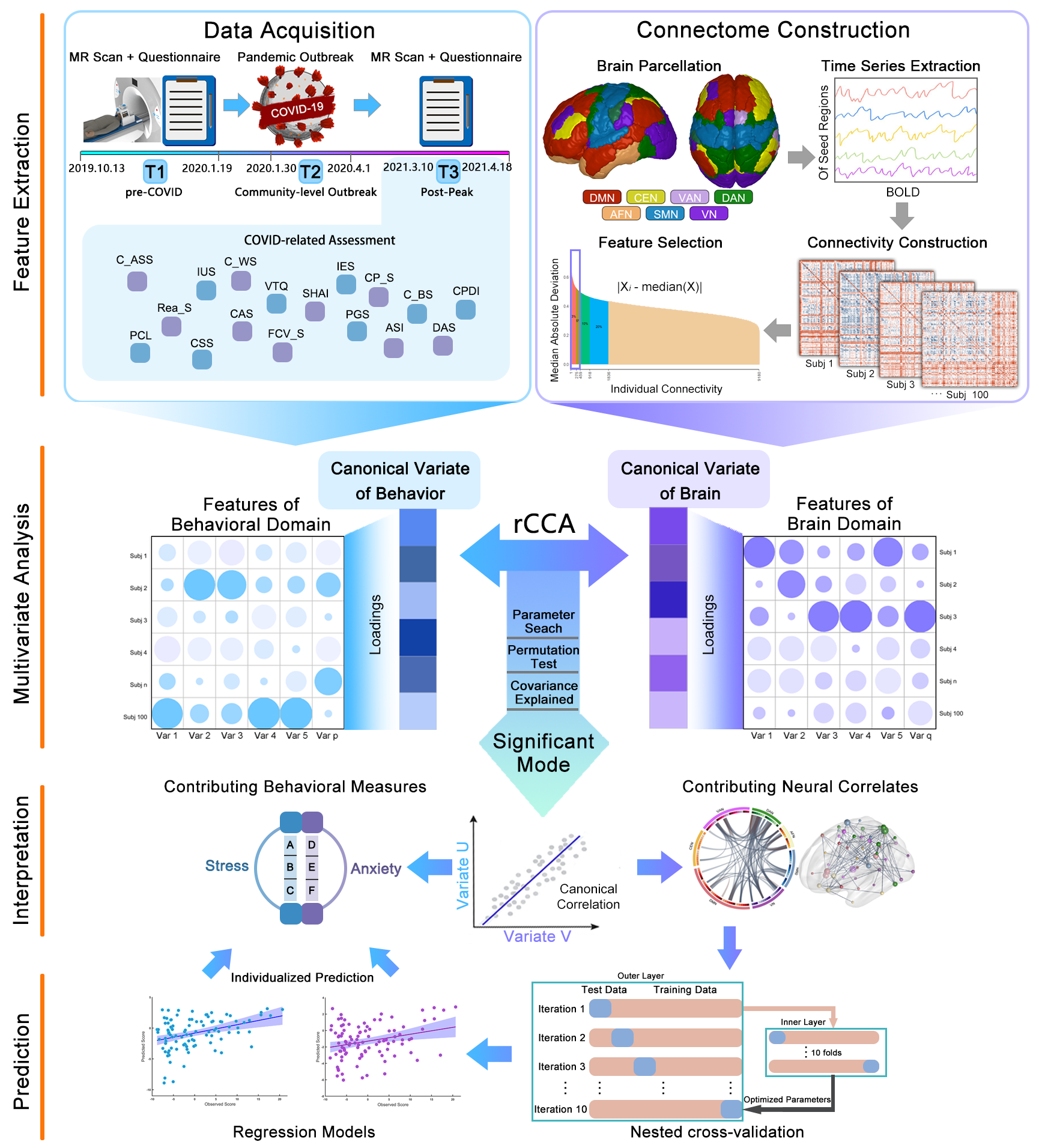
We recruited 100 participants who had no known history of psychiatric or neurological disease to complete multimodal neuroimaging scanning from October 13, 2019 to January 19, 2020. All subjects were recontacted for follow-up psychological evaluations including COVID-related questionnaires from March 10 to April 18, 2021 during the pandemic. Psychological traits were assessed with 17 self-reported questionnaires, mainly including items on COVID-19-related negative affect symptoms (e.g., depression, anxiety, and stress). The total scores on corresponding items of these scales were calculated. We constructed a brain connectome of functional connectivity based on 136-area parcellation. Regularized CCA method was used to build up maximal correlations between linear combinations of both psychological and brain connectome data and to compute pairs of canonical variates [6]. We reported covariation modes that were statistically significant at FDR correction (q < .05) and explain more than 5% of the covariance [7]. To determine features that stably contributed to each covariation mode, we computed canonical loadings between each canonical variate and its original variables [7, 8]. We established a machine learning pipeline to predict the scores of psychological traits based on identified brain features [9].Results
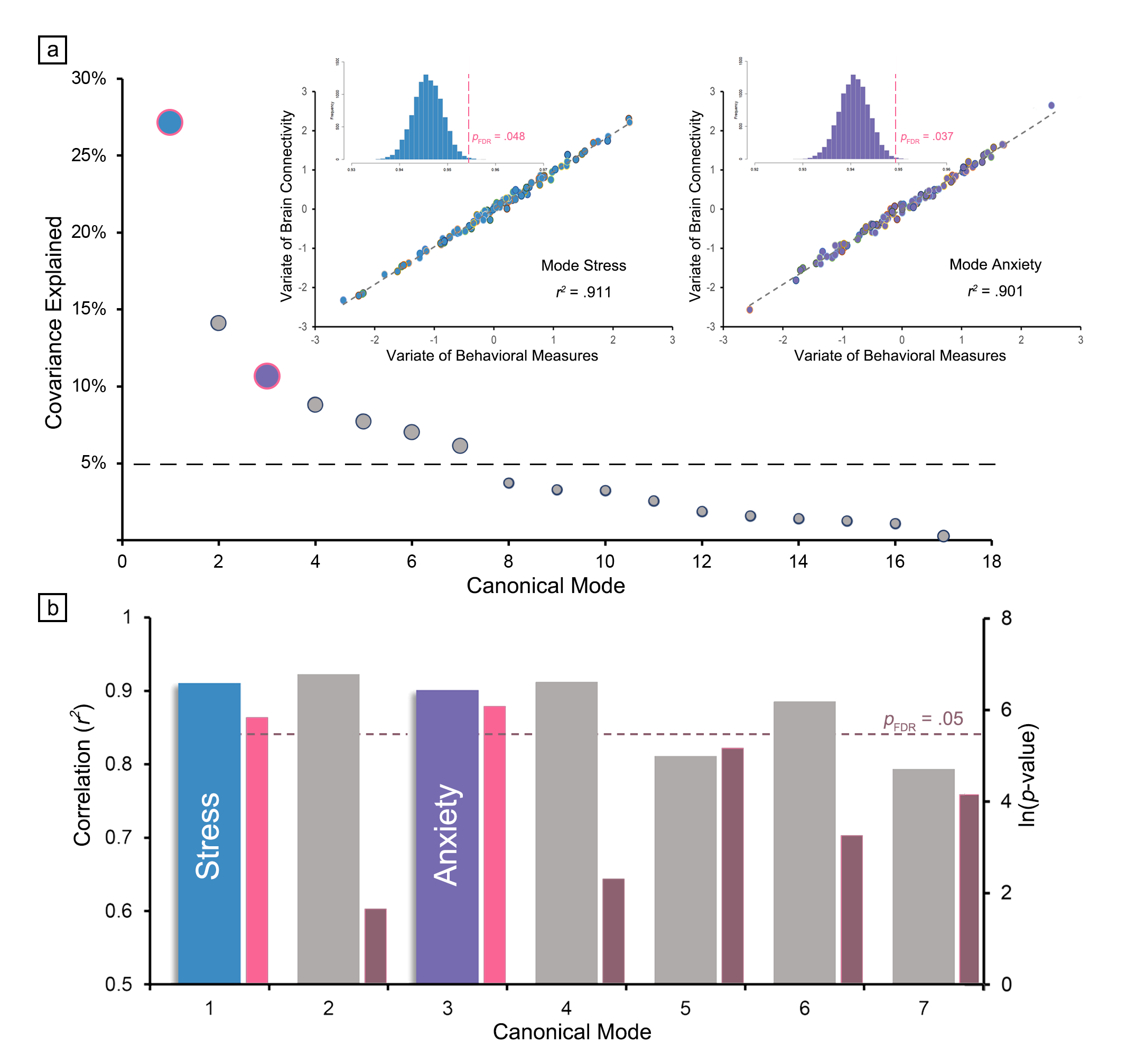
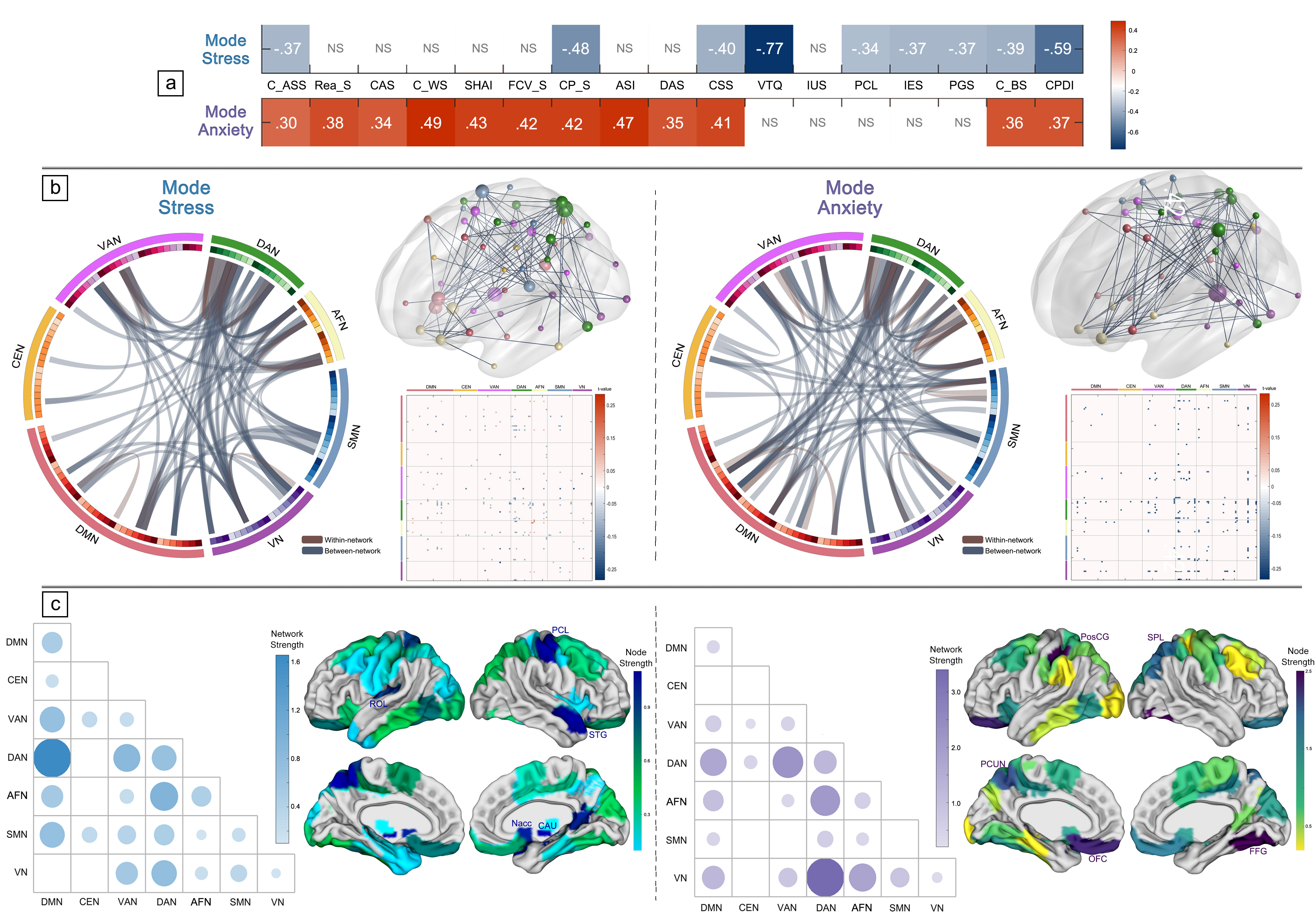
Mode stress and mode anxiety that underlie multivariate correlations between brain connectome and psychological measures were significant among those covariation modes (r2 = .911, PFDR = .048; r2 = .901, PFDR = .037, respectively). For both modes, most of the within-network links were assigned to DAN (network strength = 0.71 and 1.24, respectively). Mode stress was characterized by the highest loadings in connectivity between DAN and DMN among between-network pairs (network strength = 1.66), while connectivity between DAN and VN was remarkably prominent in mode anxiety (network strength = 3.40). By depicting the neuroanatomical distribution and canonical loadings of all seed regions, the top three regions with the highest node strength in mode stress were the paracentral lobule, caudate and temporal pole, and those in mode anxiety were the fusiform, postcentral gyrus, and orbitofrontal cortex. With the individualized models, we achieved robust predictions of mode stress and mode anxiety (mode stress: r = 0.37, MAE = 5.1, p < .001; mode anxiety: r = 0.28, MAE = 5.4, p = .005).Conclusions
In the investigation of mental health issues following the unprecedented COVID-19 pandemic, we used the pre-COVID neuroimaging data to predict the severity of negative affect during the pandemic in a general population. Notably, covariation patterns of mode stress and mode anxiety were identified, and the brain DAN network plays a critical role in both modes. Based on individualized covariation patterns, we may identify individuals who confer high vulnerability to pandemic-induced stress or anxiety symptoms with well-performing predictive modeling. Our findings may facilitate the understanding of neural correlates underlying pandemic-induced negative affect, and the susceptibility neuromarkers may serve as targets for early prevention and psychological intervention.Acknowledgements
We deeply thank Shiyu Ji from the Johns Hopkins Bloomberg School of Public Health for suggesting on statistical analysis. We also thank all the participating subjects at the Sichuan University.References
1. Zavlis O, Butter S, Bennett K, Hartman TK, Hyland P, Mason L, et al. How Does the COVID-19 Pandemic Impact on Population Mental Health? A Network Analysis of COVID Influences on Depression, Anxiety and Traumatic Stress in the UK Population. Psychol Med. 2021. 2021. https://doi.org/10.1017/S0033291721000635.
2. Wang C, Pan R, Wan X, Tan Y, Xu L, McIntyre RS, et al. A longitudinal study on the mental health of general population during the COVID-19 epidemic in China. Brain Behav Immun. 2020;87:40–48.
3. Shanahan L, Steinhoff A, Bechtiger L, Murray AL, Nivette A, Hepp U, et al. Emotional Distress in Young Adults during the COVID-19 Pandemic: Evidence of Risk and Resilience from a Longitudinal Cohort Study. Psychol Med. 2020. 2020. https://doi.org/10.1017/S003329172000241X.
4. Prout TA, Zilcha-Mano S, Aafjes-van Doorn K, Békés V, Christman-Cohen I, Whistler K, et al. Identifying Predictors of Psychological Distress During COVID-19: A Machine Learning Approach. Front Psychol. 2020;11:1–14.
5. Zhang J, Lu H, Zeng H, Zhang S, Du Q, Jiang T, et al. The differential psychological distress of populations affected by the COVID-19 pandemic. Brain Behav Immun. 2020;87:49–50.
6. Smith SM, Nichols TE, Vidaurre D, Winkler AM, Behrens TEJ, Glasser MF, et al. A positive-negative mode of population covariation links brain connectivity, demographics and behavior. Nat Neurosci. 2015;18:1565–1567.
7. Modabbernia A, Janiri D, Doucet GE, Reichenberg A, Frangou S. Multivariate Patterns of Brain-Behavior-Environment Associations in the Adolescent Brain and Cognitive Development Study. Biol Psychiatry. 2021;89:510–520.
8. Drysdale AT, Grosenick L, Downar J, Dunlop K, Mansouri F, Meng Y, et al. Resting-state connectivity biomarkers define neurophysiological subtypes of depression. Nat Med. 2017;23:28–38.9. Koutsouleris N, Kambeitz-Ilankovic L, Ruhrmann S, Rosen M, Ruef A, Dwyer DB, et al. Prediction Models of Functional Outcomes for Individuals in the Clinical High-Risk State for Psychosis or with Recent-Onset Depression: A Multimodal, Multisite Machine Learning Analysis. JAMA Psychiatry. 2018;75:1156–1172.
Figures