1010
High Temporal Resolution Head Motion Tracking using Pilot Tone and 3D Radials1Computational Radiology Laboratory, Boston Children's Hospital, Boston, MA, United States, 2Department of Radiology, Harvard Medical School, Boston, MA, United States, 3Advanced Clinical Imaging Technology, Siemens Healthineers International AG, Lausanne, Switzerland, 4Department of Radiology, Lausanne University Hospital and University of Lausanne, Lausanne, Switzerland, 5LTS5, École Polytechnique Fédérale de Lausanne, Lausanne, Switzerland
Synopsis
Keywords: Motion Correction, Brain
Radial acquisitions are inherently motion-robust and facilitate self-navigation, however the frequency of motion updates from navigator images is limited. Pilot tone (PT) enables continuous motion sensing, but estimation of quantitative motion parameters requires a subject-specific calibration. In this work, we propose (i) using PT motion detection to guide navigator-based motion estimation from a 3D radial acquisition and (ii) using these measurements to calibrate a PT motion model in order to provide high temporal resolution quantitative motion tracking. This hybrid approach demonstrates improved retrospective correction results with reduced blurring and facilitates PT motion tracking for subsequent scans.Introduction
Radial acquisitions are becoming an attractive option for imaging incompliant patients as motion artifacts are less severe and reconstruction of navigator images from subsets of spokes facilitates rigid-body head motion tracking.1,2 However, many spokes are required to reconstruct high-quality navigator images, leading to a trade-off between tracking accuracy and temporal resolution.Pilot tone (PT) is an emerging technology for motion sensing that employs a continuously transmitted RF signal with a frequency that can be detected in the oversampled region of the field of view.3–5 Coil-dependent PT signal changes due to motion can be measured with high temporal resolution; however, quantitative motion estimation from PT signals requires a subject-specific calibration.6,7
In this work, we propose using PT motion detection to identify subsets of radial spokes with consistent pose information for navigator-based head motion estimation. We then propose using these measurements to calibrate PT signals to facilitate quantitative motion tracking with high temporal resolution for improved retrospective correction.
Methods
Four volunteers (two females, two males, aged 34 ± 5 years) were scanned at 3T (MAGNETOM Prisma; Siemens Healthcare, Erlangen, Germany) with a 64-channel head coil after providing written, informed consent. Four gradient echo scans were acquired with a pseudo-random 3D golden angle sampling pattern8 including two “abrupt motion” scans where the volunteers repositioned their head every twelve seconds, one scan where the volunteers performed a periodic “figure-of-eight” motion, and one scan with no deliberate motion. Scan parameters included TE/TR 1.8/8 ms, FA 12°, FOV 256 mm, RBW 700 Hz/pixel, 1-mm isotropic resolution, 45,000 spokes, acquisition time 6 minutes.The PT signal was generated by a small wireless RF transmitter placed outside the scanner bore. The transmitted signal was recorded simultaneously with the oversampled k-space lines and extracted using a PT detection algorithm,3 followed by smoothing with a Savitzky-Golay filter. A PT-based motion detection signal was obtained using a coil clustering algorithm9 and used to bin spokes into motion-free variable-width subsets.
Navigator images were reconstructed at 2-mm resolution via an in-house NUFFT algorithm and co-registered in ITK (Insight Toolkit) using a mutual information cost function. Registration parameters and PT signals were input to a linear model:
$$\mathbf{y}=A\mathbf{x}$$
where $$$\mathbf{y}$$$ is the multi-channel PT signal amplitude, $$$\mathbf{x}$$$ is the six degrees-of-freedom rigid-body motion parameters, and the model matrix $$$A$$$ is trained by solving the inverse equation. High temporal resolution quantitative motion estimates were then obtained from the measured PT signals using this linear model. Fixed-width and PT-guided navigation, and calibrated PT motion estimates were used to retrospectively correct the acquired image data. We also investigated the ability of using a PT motion model calibrated on the first scan to provide quantitative motion estimates for subsequent scans. To quantify improvement in image quality, normalized root mean square error (NRMSE) and average edge strength (AES) were calculated for each reconstruction, normalized by the reference dataset.10
Results
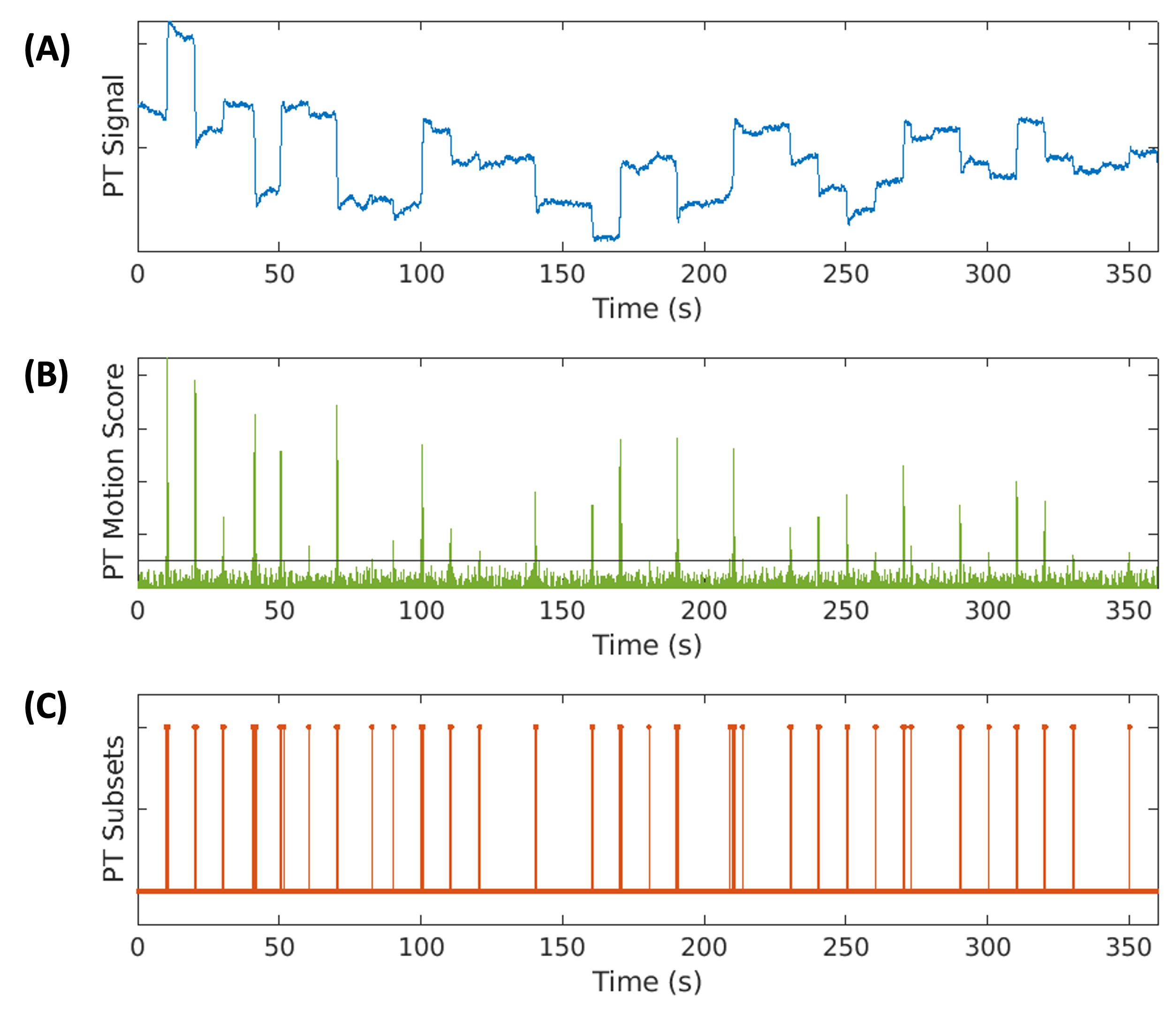
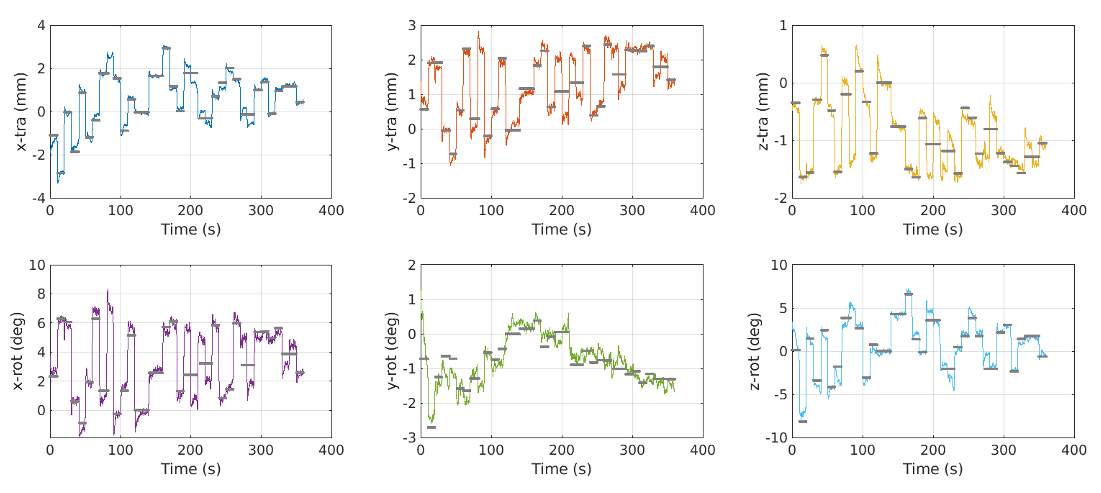
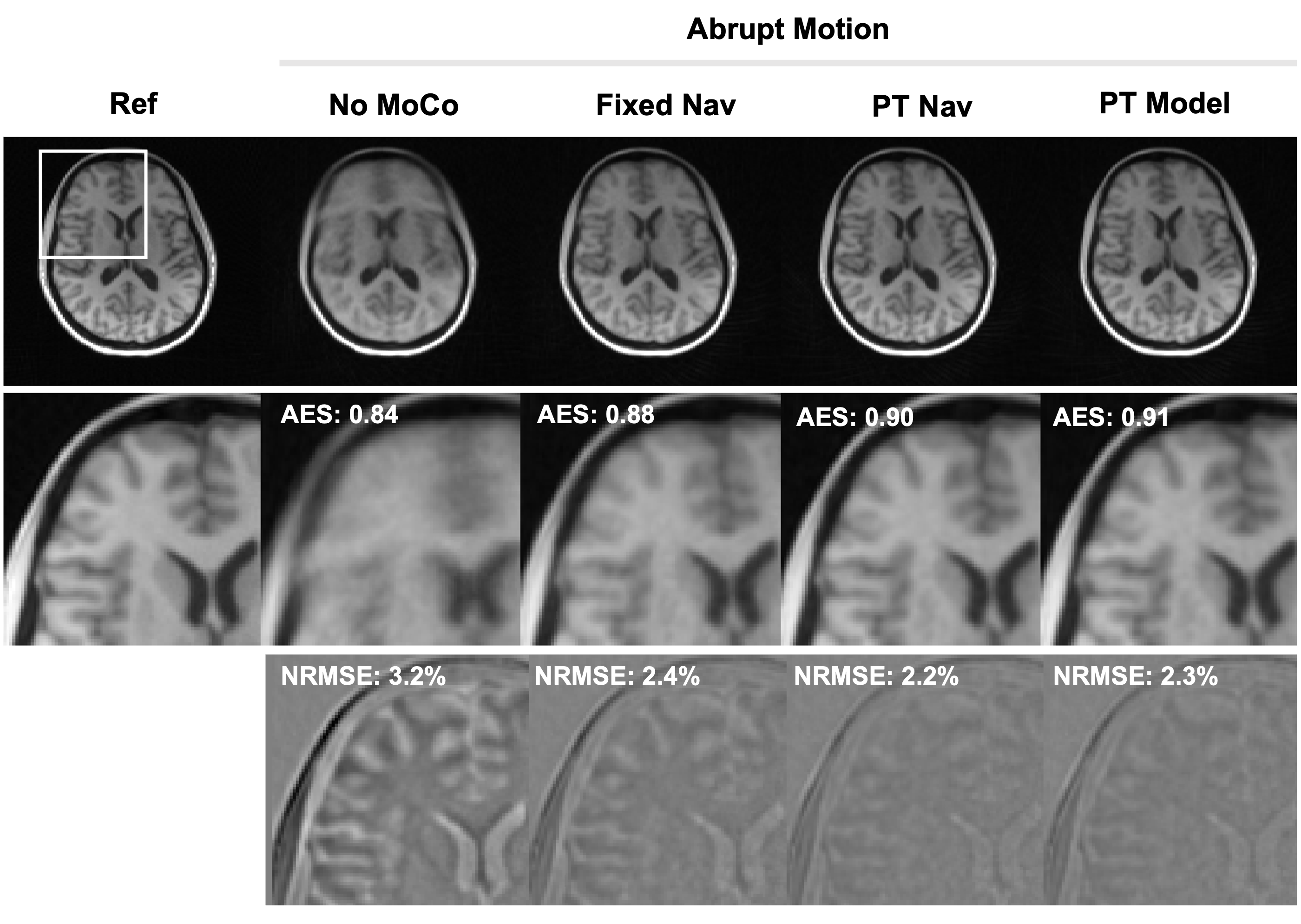
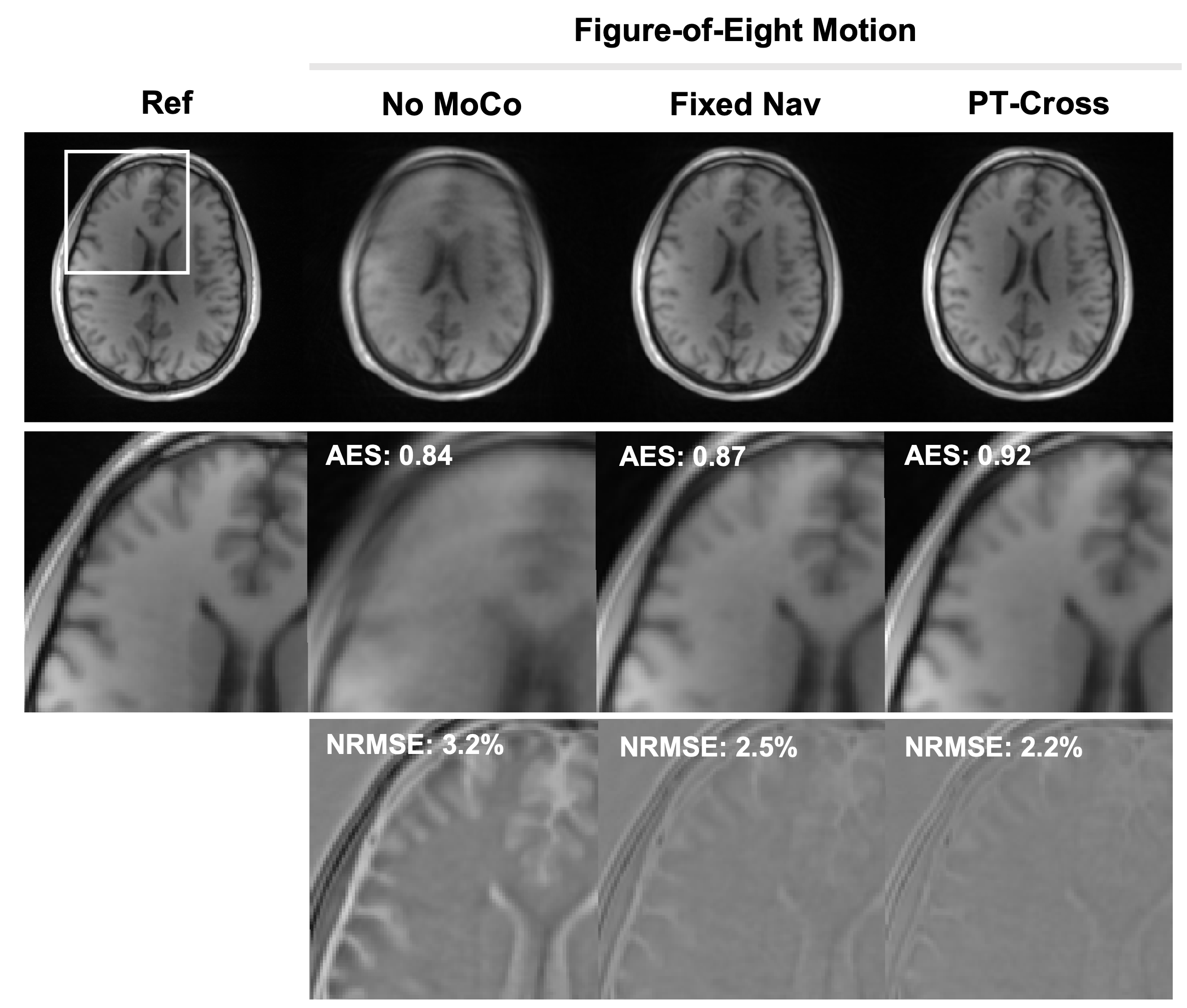
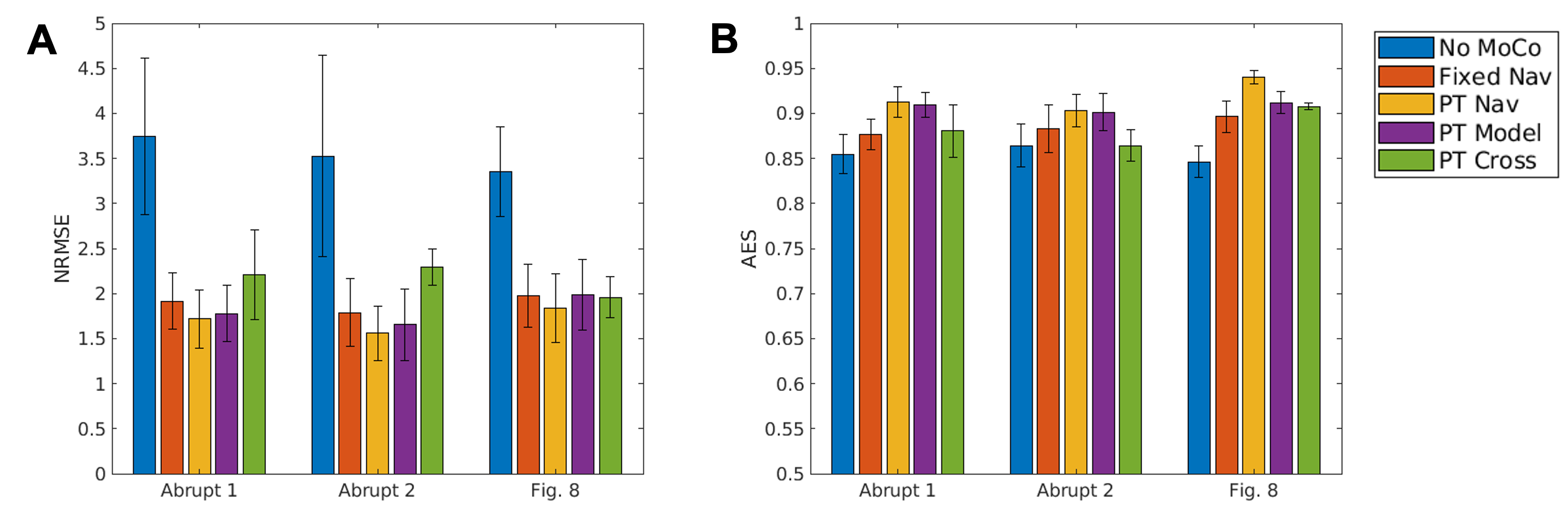
Figure 1 shows an example PT motion detection signal demonstrating how subsets of spokes with consistent pose information were identified by thresholding the PT motion score. A comparison of PT-guided navigator motion parameters and high temporal resolution (12.5 Hz) calibrated PT motion parameters is shown in Figure 2.Retrospective correction results for an abrupt motion scan with fixed-width navigation, PT-guided navigation and self-calibrated PT motion estimates are shown in Figure 3. A comparison of fixed-width navigation and cross-calibrated PT motion compensation for the figure-of-eight motion scan is shown in Figure 4. NRMSE and AES across all scans are summarized in Figure 5.
Across all abrupt motion scans, correction with PT-guided navigation and self-calibrated PT motion estimates yielded improvements in AES of 5.8% and 5.5%, respectively, compared to 2.5% for fixed-width navigation. Correction of figure-of-eight motion with PT motion estimates calibrated from the previous abrupt motion scan yielded an improvement in AES of 7.4% (compared to 5.9% for fixed-width navigation). Cross-calibrated PT motion correction results were more variable for the abrupt motion paradigm.
Discussion
Pilot tone is a versatile approach for motion tracking as it uses inexpensive hardware, and the PT signal may be acquired without any sequence modifications to provide motion information with each readout. With additional hardware, continuous motion tracking completely independent from sequence activity is possible. In this study, PT-guided navigator-based correction yielded improved image quality compared to aligning navigator images from fixed-width subsets of radial spokes. This approach also enabled calibration of a linear PT motion model to provide quantitative motion estimates with high temporal resolution. For scans with continuous motion, cross-calibrated PT motion tracking signals yielded reduced blurring compared to fixed-width navigator correction.Like FID navigators,11,12 quantitative PT motion tracking requires a per-session calibration. One potential advantage of using PT signals is they are largely independent of the underlying sequence. Preliminary results suggest that the calibrated PT motion model may be used to provide tracking information for subsequent scans; however, further work is needed to ensure the reliability of PT tracking information over time.
Conclusion
PT signals calibrated using a 3D radial acquisition provided accurate quantitative head motion estimates with high temporal resolution, facilitating improved retrospective correction. This hybrid method shows promise for calibrating a continuous motion signal to compensate for rapid, uncontrolled head motion in challenging patient groups.Acknowledgements
This work was supported in part by the National Institutes of Health (NIH) Office of the Director under award number S10 OD025111, in part by the NIH National Institute of Biomedical Imaging and Bioengineering (NIBIB) under award number R01 EB019483, and in part by the NIH National Institute of Neurological Disorders and Stroke (NINDS) under award number R01 NS121657. We thank the Center for Advanced Imaging Innovation and Research (CAI2R) at NYU for supplying the 3T Pilot Tone device used in this work.References
1. Kecskemeti, S. et al. Robust motion correction strategy for structural MRI in unsedated children demonstrated with 3D radial MPnRAGE. Radiology 289, 509–516 (2018).
2. Ljungberg, E. et al. Motion corrected silent ZTE neuroimaging. Magn Reson Med 88, 195–210 (2022).
3. Solomon, E. et al. Free-breathing radial imaging using a pilot-tone radiofrequency transmitter for detection of respiratory motion. Magn Reson Med 85, 2672–2685 (2021).
4. Falcão, M. B. L. et al. Pilot tone navigation for respiratory and cardiac motion-resolved free-running 5D flow MRI. Magn Reson Med 87, 718–732 (2022).
5. Vahle, T. et al. Respiratory motion detection and correction for MR using the pilot tone: applications for MR and simultaneous PET/MR exams. Invest Radiol 55, 153–159 (2020).
6. Wilkinson, T. et al. Pilot-tone motion estimation for brain imaging at ultra-high field using FatNav calibration. in Proc. Intl. Soc. Mag. Reson. Med., London, UK (2022).
7. Ludwig, J., Speier, P., Seifert, F., Schaeffter, T. & Kolbitsch, C. Pilot tone–based motion correction for prospective respiratory compensated cardiac cine MRI. Magn Reson Med 85, 2403–2416 (2021).
8. Wallace, T. E., Warfield, S. K. & Afacan, O. Robust retrospective correction of 3D golden-ratio radial MRI using electromagnetic tracking. in Proc. Intl. Soc. Mag. Reson. Med., Paris, France (2019).
9. Zhang, T. et al.Robust self-navigated body MRI using dense coil arrays. Magn Reson Med 76, 197–205 (2016).
10. Afacan, O., Wallace, T. E. & Warfield, S. K. Retrospective correction of head motion using measurements from an electromagnetic tracker. Magn Reson Med 83, 427–437 (2020).
11. Babayeva, M. et al. Accuracy and precision of head motion information in multi-channel free induction decay navigators for magnetic resonance imaging. IEEE Trans Med Imaging 34, 1879–1889 (2015).
12. Wallace, T. E., Afacan, O., Waszak, M., Kober, T. & Warfield, S. K. Head motion measurement and correction using FID navigators. Magn Reson Med 81, 258–274 (2019).
Figures