0865
Motion Compensated Structured Low-rank Reconstruction for Robust 3D Multi-shot EPI fMRI1Wellcome Centre for Integrative Neuroimaging, FMRIB, Nuffield Department of Clinical Neurosciences, University of Oxford, Oxford, United Kingdom, 2Department of Medical Biophysics, University of Toronto, Toronto, ON, Canada, 3Physical Sciences, Sunnybrook Research Institute, Toronto, ON, Canada
Synopsis
Keywords: Sparse & Low-Rank Models, Motion Correction, fMRI; 3D EPI
Structured low-rank (SLR) reconstruction has been successfully used in 3D multi-shot EPI for fMRI to improve its robustness to inter-shot phase variations. This work proposed a motion compensated structured low-rank (mcSLR) reconstruction, which further improves the robustness of 3D multi-shot EPI by joint modelling of both inter-shot motion and phase variations.Introduction
Structured low-rank (SLR) reconstruction has been successfully used in 3D multi-shot EPI imaging for fMRI to improve its robustness to physiologically induced inter-shot phase variations1, building on SLR methods developed for multi-shot diffusion imaging2. However, as SLR reconstruction relies on consistent image magnitude across different shots, inter-shot motion effects not only lead to motion artefacts and blurring for 3D multi-shot EPI, but also reduces the validity and effectiveness of SLR-constrained reconstruction. In this work, we improve the motion robustness of 3D multi-shot EPI fMRI by proposing a motion compensated SLR (mcSLR) reconstruction method, which jointly accounts for both inter-shot phase variations and inter-shot motion. Simulations and in vivo fMRI experiments at 7 T have been performed to validate the proposed method.Methods
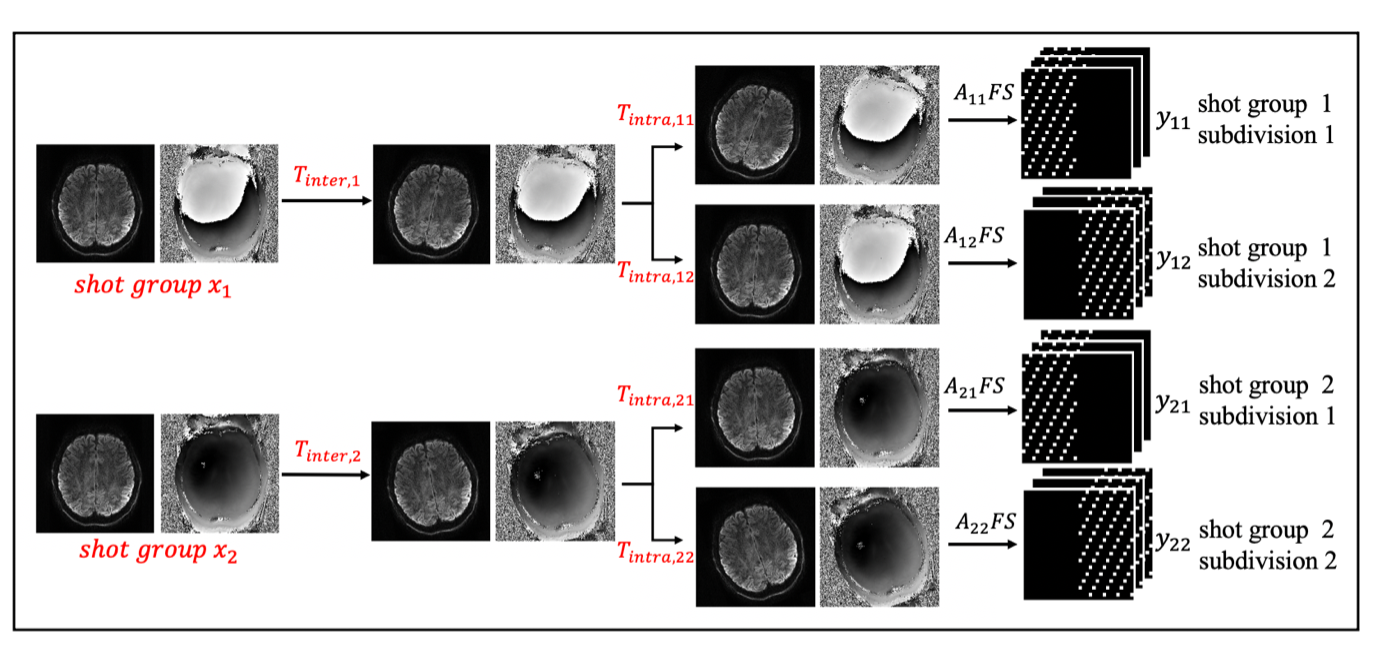
The SLR reconstruction for 3D multi-shot EPI fMRI1 partitions the shots into several shot groups, and jointly reconstructs an individual image for each shot group which are then sum-of-squares (SOS) combined. The proposed mcSLR reconstruction removes motion artefacts within and between shot groups, which facilitates improved SLR reconstruction. This is achieved by incorporating rigid-body motion transforms in the forward model. In line with the SLR formulation, we decompose motion into intra-shot group motion between different temporal subdivisions within each shot group, and inter-shot group motion between the images of different shot groups in the forward model. The cost function is formulated as:$$min\left \| ASFT_{intra}T_{inter}X-Y \right \|_{2}^{2}+\lambda \left \| HFX\right \|_{*}$$
where $$$X$$$ consists of images of all the shot groups. $$$T_{inter}$$$ is the inter-shot group motion transform. $$$T_{intra}$$$ is the intra-shot group motion transform. $$$F$$$ is Fourier transform. $$$S$$$ is sensitivity encoding. $$$A$$$ is sampling operator. The operator $$$H$$$ constructs block-Hankel structured matrix from the k-space of all the shot groups $$$FX$$$.
The image $$$X$$$ and motion parameters for $$$T_{intra}, T_{inter}$$$ are jointly estimated by alternating between three subproblems iteratively: 1) solve for $$$X$$$ with estimated motion parameters, 2) solve for $$$T_{inter}$$$ using an image-based registration method like FLIRT3, and 3) solve for $$$T_{intra}$$$ using the data consistency constraint between the image and the motion corrupted multi-channel k-space data of each subdivision like aligned reconstruction4,5. While intra-shot group motion is modelled, physiology and motion induced phase variations are only considered at the inter-shot group level to simplify the problem. To speed up convergence, the aligned reconstruction is performed first on a single shot group consisting of all the shots to initialize the motion estimates of mcSLR.
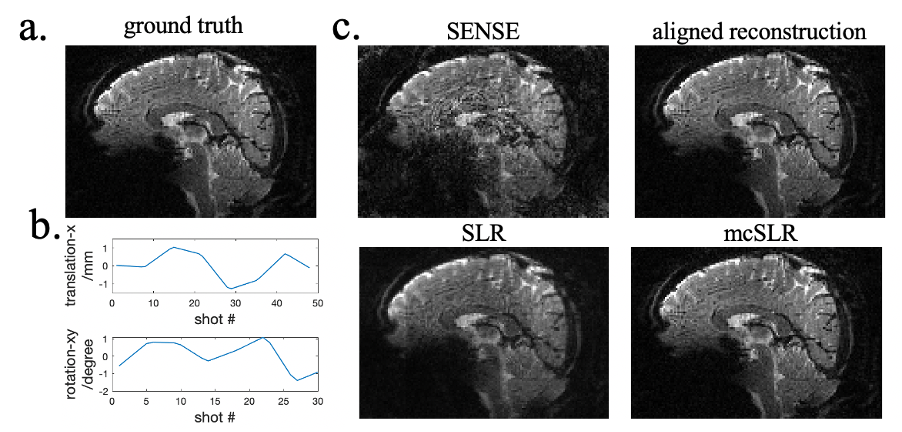
Simulation: A 2D slice from a 48-shot 3D EPI dataset with inter-shot motion and realistic phase variations was generated based on a 2D EPI time series acquired at 7T with 1.5mm isotropic resolution and TE/TR=20/40ms. Continuous in-plane motion was generated by interpolation from 8 motion samples which are randomly chosen within $$$[-1.5^{\circ},1.5^{\circ}]$$$for rotation and $$$[-1.5mm, 1.5mm]$$$ for 1D translation. 16 volumes were generated. The temporal resolution of motion estimates was 40ms.
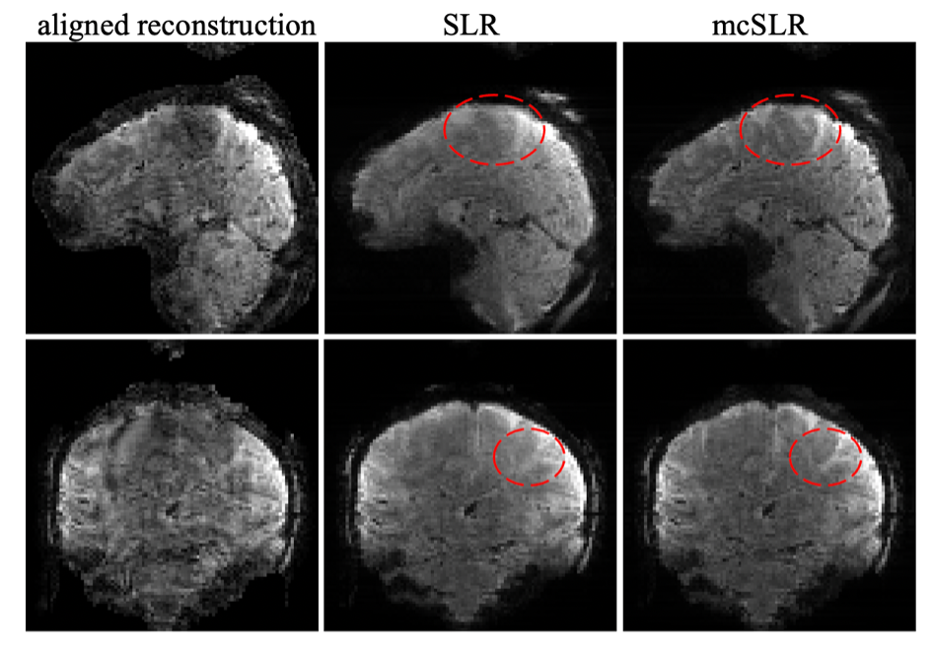
In vivo resting-state fMRI at 7T: 1.8mm isotropic resolution. TE/TR=22/45ms. Matrix size$$$=116\times116\times96$$$. The subject was instructed to move continuously during the scan. The temporal resolution of motion estimates was 270ms. The same CAIPI sampling with interleaved order along $$$k_{z}$$$1 at $$$R=2\times2$$$ was used for both simulation and in-vivo experiments.
Results
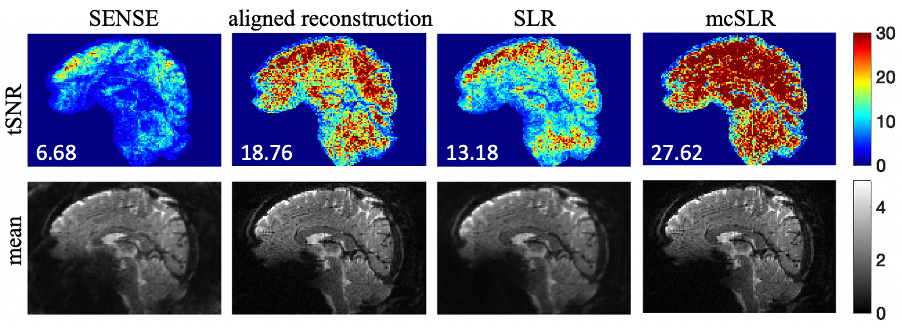
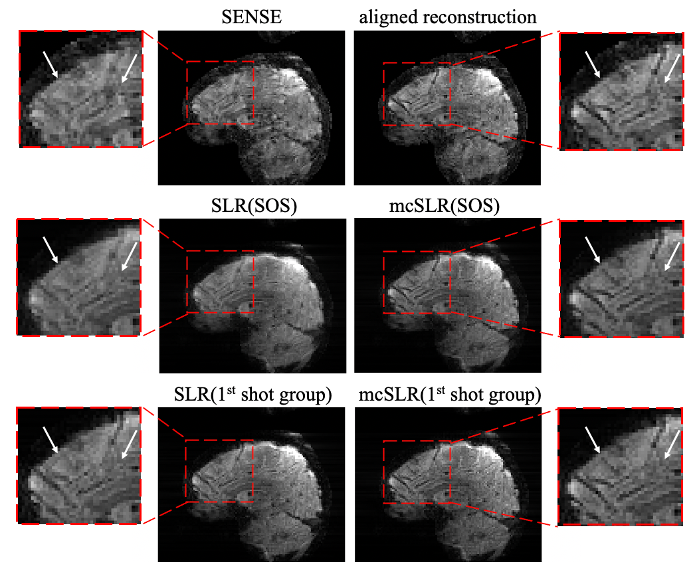
Different reconstructions of the simulation data are compared on one volume in Fig.2 and over the entire time course in Fig.3. The SLR reconstruction which considers only phase variations achieves a higher tSNR than a conventional SENSE reconstruction, but suffers from similar motion induced blurring. The aligned reconstruction, which only models motion, can largely remove the blurring but is still susceptible to inter-shot phase effects. In contrast, the proposed mcSLR which takes into account both motion and phase variations achieves a comparable deblurring performance and also a 47% higher tSNR compared to aligned reconstruction. Figs. 4&5 show two different volumes of the in vivo data. In Fig.4, the SLR reconstruction shows strong blurring and poor contrast between grey matter and white matter. Despite improved sharpness in the sagittal slice, the aligned reconstruction suffers from substantial artefacts, likely due to unaddressed inter-shot phase inconsistency. The mcSLR reconstruction, however, demonstrates superior image quality as well as improved sharpness and contrast that are necessary to disentangle small structures. In Fig.5, the mcSLR also achieves the best performance compared to other methods. The sharper delineation of small structures in both the SOS combined image and the first shot group image indicates successful motion correction within and between shot groups.Conclusion
The proposed mcSLR approach compensates for inter-shot motion, and thus improve the validity of SLR reconstruction, resulting in better image quality and higher SNR. Preliminary results suggest that the mcSLR approach is a promising way to improve the robustness of 3D multi-shot EPI to both inter-shot motion and phase variations.Acknowledgements
The Wellcome Centre for Integrative Neuroimaging is supported by core funding from the Wellcome Trust (203139/Z/16/Z). WW is supported by the Royal Academy of Engineering (RF201819\18\92). MC is supported by the Canada Research Chair Program.References
[1] Chen, X., Wu, W., Chiew, M., 2021. Respiratory fluctuations in 3D fMRI from inter-shot phase variations can be reduced by low-rank reconstruction of segmented CAIPI sampling. ISMRM 2021.
[2] Mani, M., Jacob, M., Kelley, D., Magnotta, V., 2017. Multi-shot sensitivity-encoded diffusion data recovery using structured low-rank matrix completion (MUSSELS). Magn Reson Med 78, 494-507.
[3] Jenkinson, M., Bannister, P., Brady, M., Smith, S., 2002. Improved Optimization for the Robust and Accurate Linear Registration and Motion Correction of Brain Images. Neuroimage 17, 825-841.
[4] Cordero-Grande, L., Teixeira, R.P.A., Hughes, E.J., Hutter, J., Price, A.N., Hajnal, J.V., 2016. Sensitivity encoding for aligned multishot magnetic resonance reconstruction. IEEE Transactions on Computational Imaging 2, 266-280.
[5] Cordero‐Grande, L., Ferrazzi, G., Teixeira, R.P.A., O'Muircheartaigh, J., Price, A.N., Hajnal, J.V., 2020. Motion‐corrected MRI with DISORDER: Distributed and incoherent sample orders for reconstruction deblurring using encoding redundancy. Magn Reson Med 84, 713-726.
Figures