0745
Improvement of Experimental SNR in Mock Transcranial MRgFUS System with Strategic Design of Transfer Medium and Transducer Ground Plane at 3T
Karthik Lakshmanan1,2, Ryan Brown1,2, Giuseppe Carluccio1,2, and Christopher M Collins1,2
1Radiology, NYU Grossman School of Medicine, New York, NY, United States, 2Center for Advanced Imaging Innovation and Research (CAI2R), New York University, New York, NY, United States
1Radiology, NYU Grossman School of Medicine, New York, NY, United States, 2Center for Advanced Imaging Innovation and Research (CAI2R), New York University, New York, NY, United States
Synopsis
Keywords: Non-Array RF Coils, Antennas & Waveguides, RF Arrays & Systems
We show that novel modifications to a mock Transcranial MR-guided Focused Ultrasound (TMRgFUS) system show potential to greatly improve MR performance. By using a transfer medium with reduced electric permittivity combined with slots in the transducer array ground plane we measure a 2-3 fold increase in SNR across the middle of a head-phantom portion of a mock TMRgFUS system.Introduction
Transcranial MRI-guided focused ultrasound (TMRgFUS) is used for many purposes, including treatment for essential tremor1. It requires both an array of ultrasound transducers with a common conductive ground and a large bath of fluid (transfer medium) suitable for both transmitting ultrasonic energy into the head and cooling the scalp. These systems are known to adversely affect the distribution of radiofrequency magnetic fields in 3T MRI. Previously we used simulations to show potential artifact reduction and significant increase in SNR and transmit efficiency with strategic selection of the relative electric permittivity in the transfer medium and slotting the ground plane in the transducer array2 (Figure 1). Here we confirm with experiments in a phantom designed to mimic the transducer array and upper portion of the human head with liquids of differing electric permittivity used in place of the transfer medium.Methods
Two hemispherical acrylic shells (diameters 35cm and 18cm) were mounted on a circular acrylic plate with nylon screws and silicone sealant to approximate the geometry of a transcranial MRgFUS transducer (ExAblate; InSightec) containing the upper portion of the human head (Figure 2, Figure 3). The smaller shell was filled with saline solution (1g NaCl/1L H20 for conductivity 0.21S/m, and food coloring). The outer compartment, was filled with either distilled water (relative electric permittivity of 78) or a mix of 55% isopropyl alcohol and 45% water by volume (relative permittivity near 40). The outer surface of the phantom was covered with copper tape except for longitudinal slots producing 8 equal segments. Slots were bridged with multiple large (390pF) capacitors to produce a continuous RF conductor when outer compartment was filled with water (“Original” configuration) and were left open when outer compartment was filled with low-permittivity mixture (“Modified” configuration). SNR and transmit efficiency were characterized on three orthogonal planes through middle of the smaller compartment in a 3T MRI system (Siemens Prisma) with the phantom in a custom-built stand for proper orientation, with the system body coil used in excitation and reception, and with a body phantom also placed on the bed. B1+ and SNR maps were acquired using TurboFLASH(3) (TE/TR-1.9/10000ms) and GRE acquisitions (with and without RF).Results
Figure 4 shows experimentally-measured maps of SNR normalized to sine of the flip angle, and transmit efficiency on three orthogonal planes passing through the middle of the smaller compartment in both Original and Modified configurations. In Original configuration, a band of near-zero signal is seen to pass through the upper portion of the inner compartment, similar to a dark region seen in images of the head in the ExAblate system at 3T. In Modified configuration the signal is many times higher in this region, but lower towards the inferior surface of the phantom. Discrepancy in trends of Tx efficiency and SNR at the top of the outer compartment are likely due to over-tipping there. On average in the smaller compartment on these three planes, the normalized SNR and transmit efficiency increase by a factor of 2-3 with the modified configuration (Table 1). At locations where the dark band occurs in the Original configuration, the increase in SNR can be much greater, as in Figure 3 and prior simulations2.Discussion
With slots in the ground plate of the transducer array and modified permittivity of the transfer medium, the B1 field pattern in the compartment corresponding to the head in a phantom mimicking a TMRgFUS system is increased by a factor of 2-3 on average, and by much more in regions where a dark band occurs in the Original configuration. While this dark band is eliminated in the Modified configuration, SNR is reduced at the inferior surface of the phantom, though considering that the simulations did not show this abrupt decrease in SNR, this may be an artifact arising at the non-anatomical surface of the phantom. Further evaluation and discussion are needed to weigh the potential benefits of using our Modified configuration in comparison to other recently-described methods for eliminating the dark-band through the middle of the brain, including introduction of conductors to the transfer medium4-6, use of receive coils designed to have little effect on ultrasound transmission7, or addition of salt to increase electrical conductivity of the transfer medium8 (though this last method would be expected to degrade overall SNR). Other questions, regarding suitability of the alcohol/water mixture as a medium for efficient transfer of ultrasonic waves into the head and for effective heat transfer from the scalp also require further investigation. We expect heat capacity of the mixture to be between that of water (4.18J/g/K) and alcohol (2.68J/g/K). Acoustic effects may be altered slightly, as the speed of sound is slightly lower in isopropyl alcohol (1170m/s) than in distilled water (1498m/s)9. It also would be necessary to ensure that alcohol/water mixture would not irritate skin after long periods of exposure or degrade the integrity of materials it is in contact with for long periods of time. Finally, for an actual TMRgFUS system it would be necessary to ensure effective ground is maintained at the ultrasonic frequencies (~500kHz-1MHz for transcranial FUS), which could be accomplished with strategic use of bandpass filters across the slots.Acknowledgements
This work has benefitted from funding by the National Institutes of Health through NIH R01 EB0021277 and NIH P41 EB017183 (CAI2R), and from discussions and correspondence with Kim Butts Pauly at Stanford.References
1. V Krishna et al., JAMA Neurology 2018;75(2):246-254
2. CM Collins et al., 2020 ISMRM, p. 1279
3. H-P Fautz et al., 2008 ISMRM, p.1247
4. X Yan et al., 2020 ISMRM, p. 0113
5. X Yan and W Grissom, US Patent application 2020/0360733 A1
6. R Hadley et al., 2020 ISMRM, p. 1268
7. J Corea et al., Scientific Reports 2018;8:3392
8. S Leung et al., J Therapeutic Ultrasound 2015;3:P27
9. https://www.rshydro.co.uk/sound-speeds/
Figures
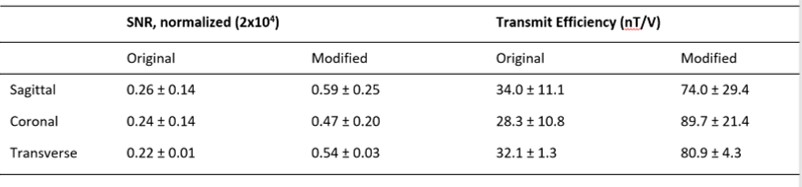
Table 1: Values
of SNR normalized to sine of flip angle and transmit efficiency for Original
and Modified configurations as averaged over each of three planes only within
the “head” portion of the phantom (inner compartment).
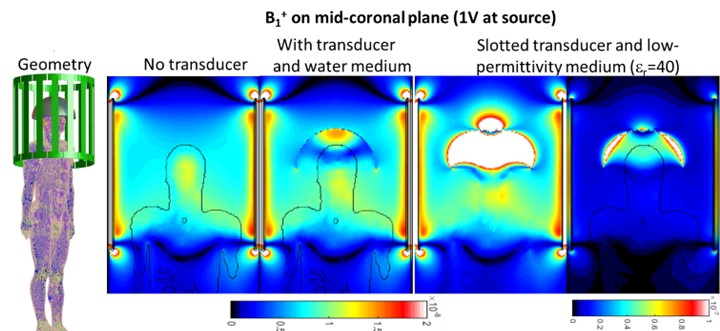
Figure 1. Simulations of B1+
from a birdcage coil for different configurations, including with no TMRgFUS system
present, with the “original” system and water medium, and with the modification
giving the best results – having a lower-permittivity medium and slotted ground
plane in the transducer array. In the far-right frame, the color scale maximum
is increased 5-fold to better show the distribution for the modified case.
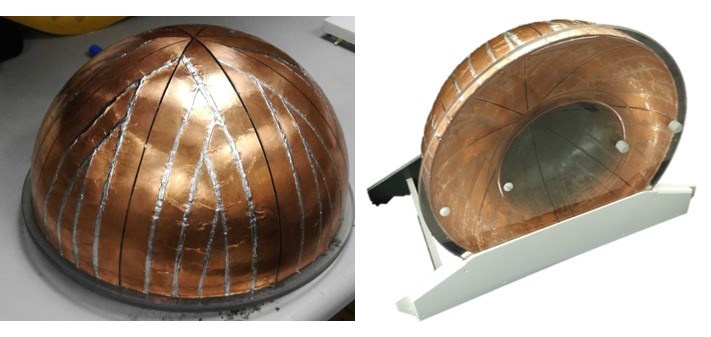
Figure 2. Phantom geometry. Inner
compartment representing the upper portion of head surrounded by outer
compartment covered with copper tape to represent the conductive ground of
ultrasonic transducer array. In “Original” configuration outer compartment was
filled with water and gaps in conductive surface were bridged with large
capacitors to produce a continuous conductor at RF frequencies. In “Modified”
configuration the outer compartment was filled with a mixture of water and
alcohol to produce a lower electric permittivity and the gaps in the conductive
surface were open.
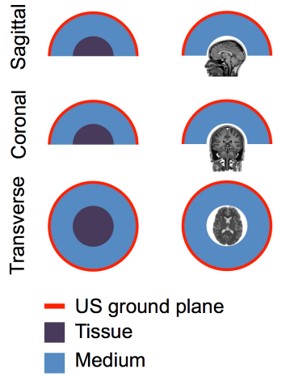
Figure
3. Schematic showing correlation of cross-sections through phantom (left) with
intended representation of cross-sections through head (right: head not to
scale).
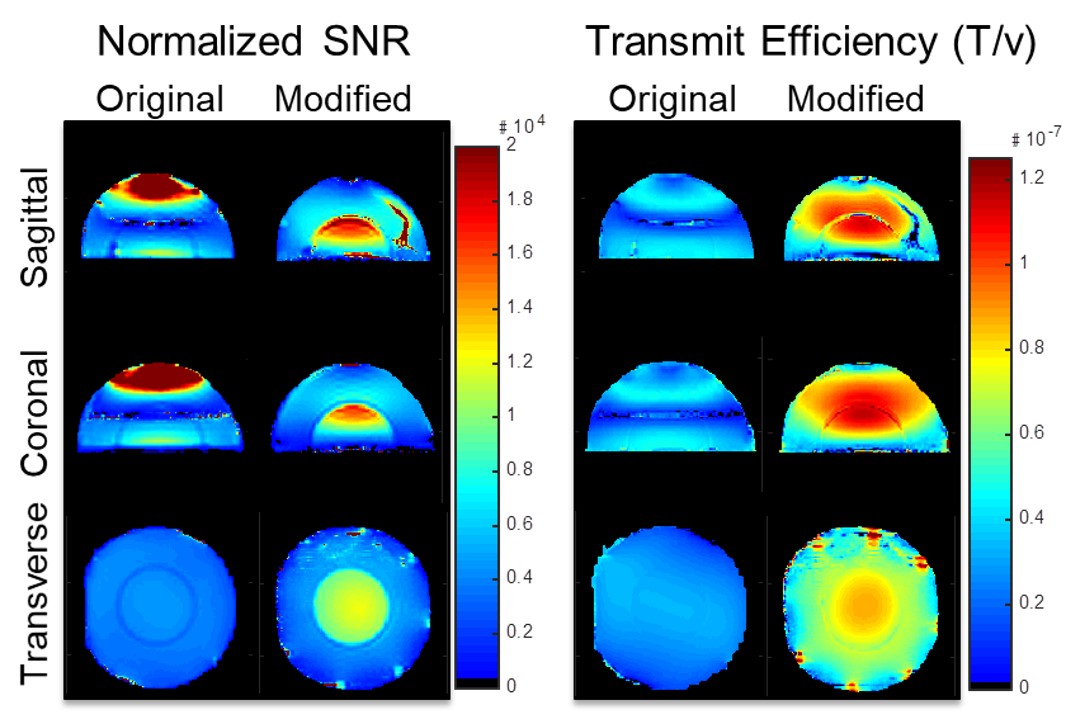
Figure 4. Measured SNR normalized
to sine of the flip angle and transmit efficiency for both Original and
Modified configurations on orthogonal planes passing approximately through the
middle of the inner compartment of the phantom.
DOI: https://doi.org/10.58530/2023/0745