0601
A method to assess the orientation of the maximum heating of an arbitrarily shaped object inside a homogeneous magnetic field
Umberto Zanovello1, Mario Chiampi1, Oriano Bottauscio1, Alessandro Arduino1, and Luca Zilberti1
1Istituto Nazionale di Ricerca Metrologica, Torino, Italy
1Istituto Nazionale di Ricerca Metrologica, Torino, Italy
Synopsis
Keywords: Safety, Gradients
The ISO/TS 10974 standard proposes a test method to assess the heating of a metallic AIMD due to switched gradient magnetic fields. Aiming at achieving a conservative evaluation, the standard suggests to evaluate the heating for the worst orientation of the AIMD inside a homogeneous harmonic magnetic field. The abstract presents a strategy to assess this orientation for an arbitrarily shaped metallic object. The strategy has been successfully tested numerically against expectations with a disk object and it has been applied to a realistic hip and knee implant.Introduction
The ISO/TS 10974 standard recognises switched gradient coil (GC) heating as one of the safety issues that need to be addressed to ensure safety of patients carrying active implantable medical devices (AIMD) [1]. In this regard, the standard proposes a test procedure aimed at measuring the temperature increase following defined exposure conditions. Among the requirements, the device under test (DUT) has to be placed inside a harmonic homogeneous magnetic field oriented along the direction that maximises the consequent heating. Whereas it is pretty straightforward to identify such a direction in the case of disk-like DUTs, this becomes more challenging when DUTs with complex shapes have to be tested [2]. In this abstract we propose and demonstrate a strategy to assess the worst exposure direction for an arbitrarily shaped DUT inside a homogeneous harmonic magnetic field.Methods
Let us consider three pairs of loop-coils placed over the faces of a cube oriented along the three main Cartesian directions. Each loop-coil pair is made of two coils in series sharing the same axis and placed over two opposite faces of the cube (Figure 1). Thanks to the coils arrangement, each coil pair is decoupled to the others and, when properly designed, it is able to generate an axial magnetic field in a given region of interest (ROI) with the desired spatial homogeneity. When the DUT is placed inside the ROI, under the assumption of lossless coil conductors, the power deposited inside the DUT by a real vector of currents I, is given by:$$P=\frac{1}{2}I^TRI\quad\text{(1)}$$
where R is a 3 ✕ 3 real matrix equal to the real part of the impedance matrix of the three pairs of loop-coils. Since R is real and symmetric, its eigenvectors represent an orthonormal basis of R3 and a generic current vector I can be written as:
$$I=V\alpha\quad\text{(2)}$$
where V is a 3 ✕ 3 orthogonal real matrix whose columns represent the eigenvectors of R, and α is a vector of real coefficients. Substituting (2) in (1):
$$P=\frac{1}{2}\alpha^T\Lambda\alpha\quad\text{(3)}$$
where Λ is the 3 ✕ 3 diagonal matrix of the eigenvalues of R. Maximising (3), as a function of the vector α, and subjected to the following constraint:
$$|B|^2(I)=s^2|I|^2 =s^2\alpha^T\alpha=1$$
where B is the magnetic flux density generated in the centre of the loop-coils by a current vector I and s are the coil sensitivities in tesla per ampere, it is possible to obtain the current vector, IMAX, that maximises the power deposition inside the DUT and therefore the worst B field orientation. Solving the maximisation problem through Laplace multipliers, it can be shown that IMAX corresponds to the eigenvector of R associated with its highest eigenvalue.
Results
The magneto-quasistationary solver of CST Studio Suite [3] has been used to obtain the presented results. All simulations have been carried out at 1750 Hz which is the frequency value that is expected to be specified by the next ISO standard [2]. In Figure 2 the worst orientations computed with the proposed procedure is compared with those expected by considering a disk made of CoCrMo (radius = 4 cm, thickness = 2 cm, σ = 1.16 MS/m) rotated in 22 different directions inside the three pairs of loop-coils. Each coil pair was made of two coils 54 cm apart with 24 cm radii and tetrahedra have been used for discretisation. In Figures 3 and 4 the worst orientation is reported for a hip and knee implant, respectively. The metallic components of the implants were made of CoCrMo alloy and the liners have been simulated as air. In this case, each coil pair was made of two coils 74 cm apart with 34 cm radii and hexahedra have been used for discretisation.Discussion and Conclusion
The analysis carried out with the disk object (Figure 2) highlighted the reliability of the proposed method with errors between the retrieved and real worst orientations always lower than 0.5 degrees. The proposed methods allowed retrieving the worst orientations for more complex objects (Figures 2 and 4), like a hip and knee implant, in less than 6 hours for the hip implant and less than 1 hour for the knee implant on an Intel Xeon CPU E5-2650 v3 processor. Whereas the ISO/TS 10974 standard relies on the temperature increase, all the considerations hereby proposed are relevant to power deposition. This however finds a justification in the good correlation between the power deposited into the implant and the consequent temperature increase [4]. The homogeneity of the magnetic field generated by each pair of loop-coils is a key point for the reliability of the proposed method. A Python code has been used to optimise the loop-coils geometry to achieve an acceptable compromise between magnetic field homogeneity and loop-coil sensitivities. The loop-coils arrangements allowed to achieve a magnetic field with relative variation lower than 5.2 % within a 5 cm radius spherical ROI (disk setup) and lower than 8.2 % within a 9 cm radius spherical ROI (hip and knee implant setups). Finally, both the magnetic field homogeneity and loop-coil sensitivities can be improved by arranging the loop-coil pairs in a Helmholtz configuration.Acknowledgements
The project (21NRM05 STASIS) has received funding from the European Partnership on Metrology, co-financed from the European Union’s Horizon Europe Research and Innovation Programme and by the Participating States.References
- International Organization for Standardization. Assessment of the Safety of Magnetic Resonance Imaging for Patients with an Active Implantable Medical Device. Technical Specification: [ISO/TS 10974]; 2018.
- Bassen H, Zaidi T. Parameters Affecting Worst-Case Gradient-Field Heating of Passive Conductive Implants. J Magn Reson Imaging. 2022; 56: 1197-1204.
- CST Studio Suite. https://www.3ds.com/products-services/simulia/products/cst-studio-suite/. Accessed November 9, 2022.
- Arduino, A, Bottauscio, O, Chiampi, M, et. al. A contribution to MRI safety testing related to gradient-induced heating of medical devices. Magn Reson Med. 2022; 88: 930- 944.
Figures
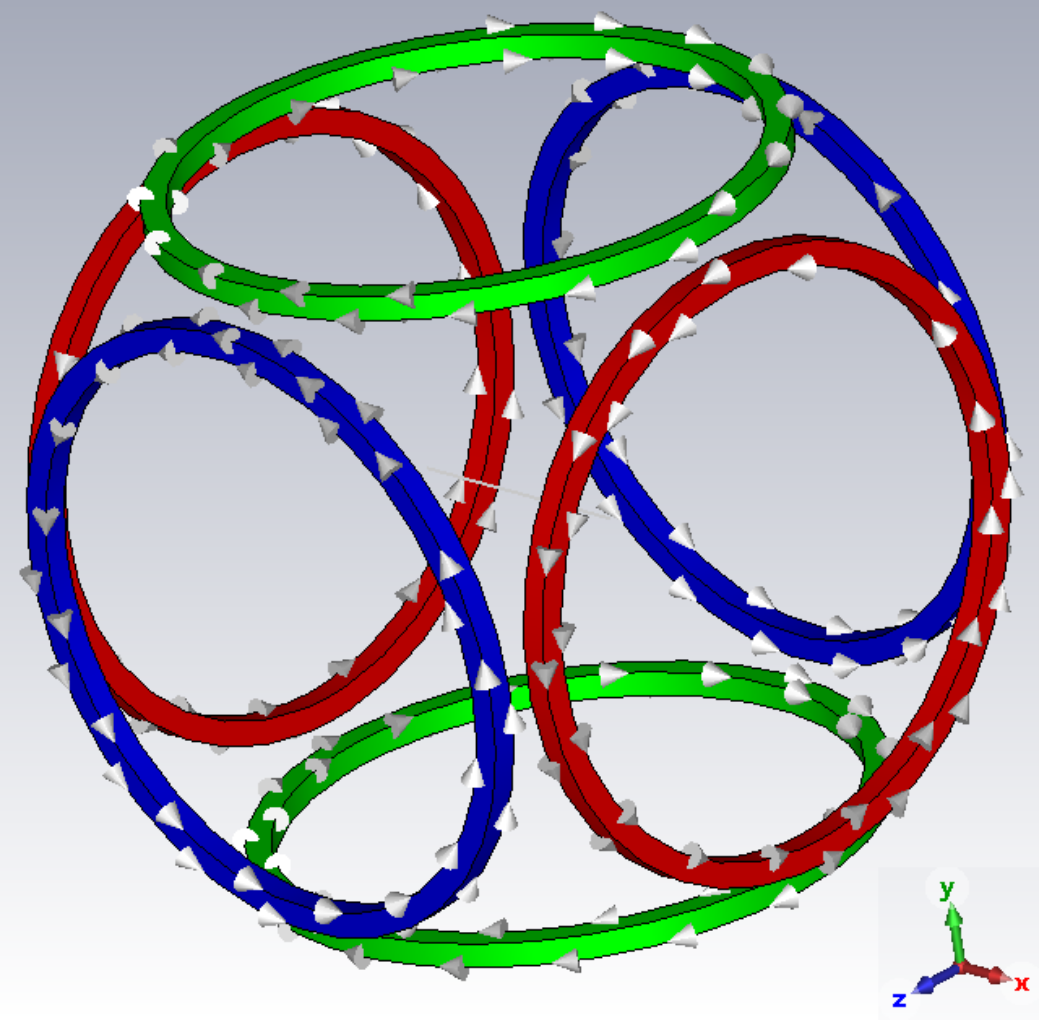
Figure 1: Reference setup showing the three loop-coil pairs arranged over the faces of a cube. The loop-coil pairs have been optimised to generate a magnetic field homogeneous inside a specific ROI and oriented along the axial direction of the relevant loop-coil pair
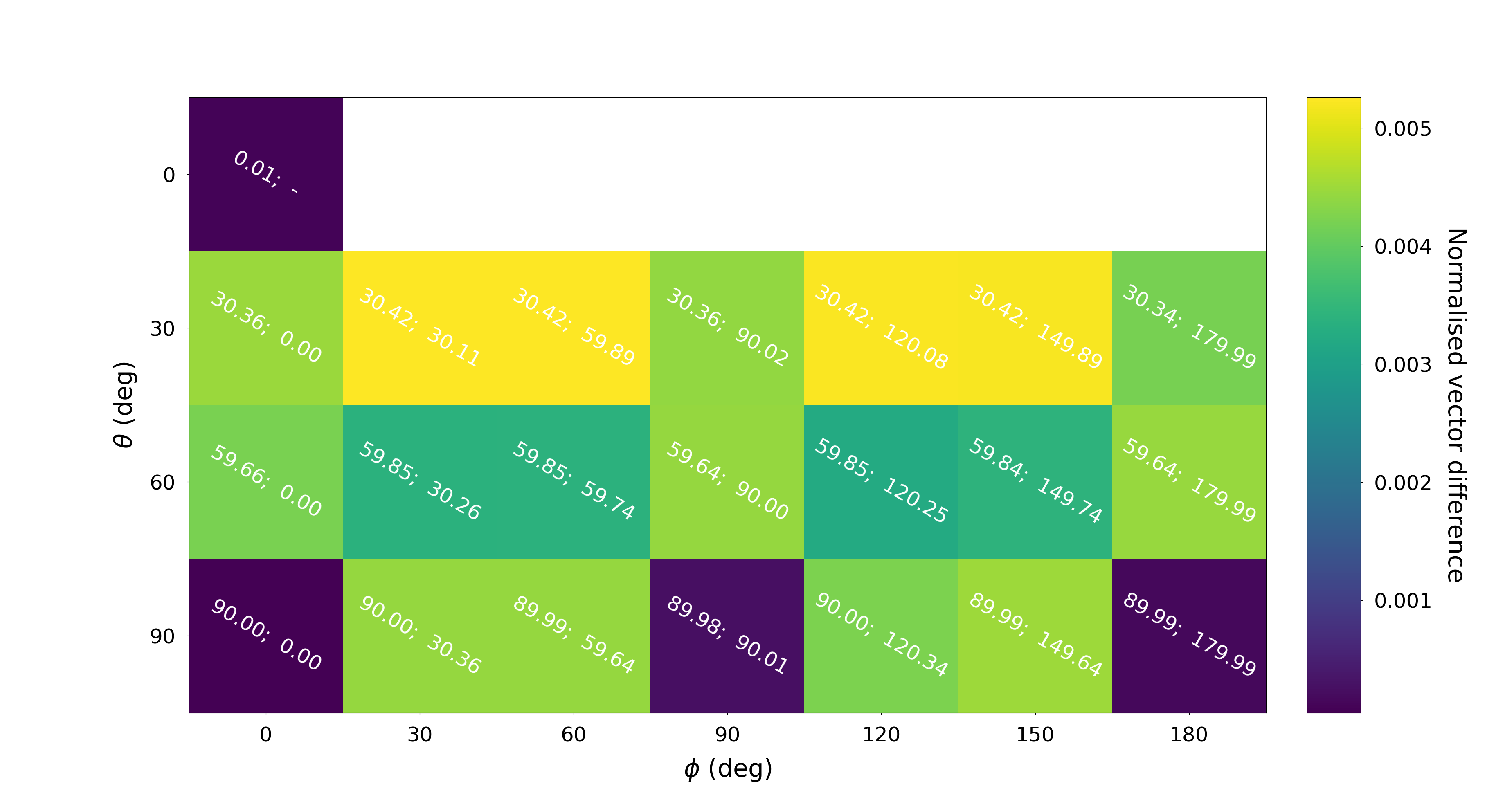
Figure 2: Retrieved (white values) θ (polar) and ɸ (azimuth) angles relevant to the worst magnetic field direction for a metallic disk oriented along 22 different directions inside the loop-coil pairs. For each configuration, the axes report the expected direction based on geometric considerations. The chromatic scale reports the difference, normalised to √2, between the unit vector normal to the disk surface and that oriented along the estimated worst magnetic field direction.
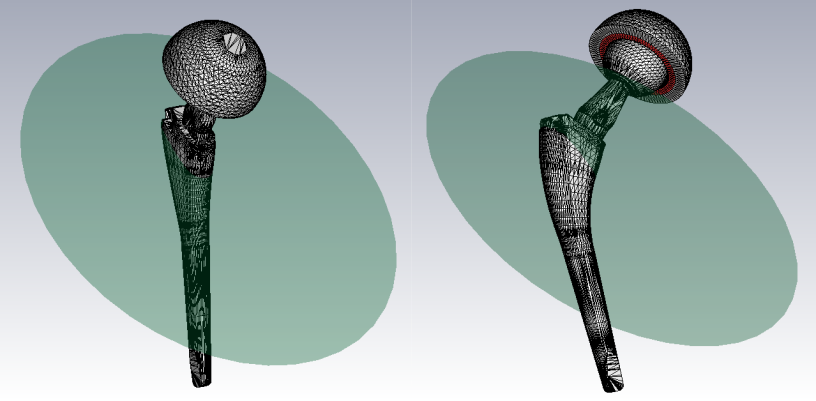
Figure 3: Analysis carried out for a hip implant. The worst direction is that normal to the green plane crossing the implant body.
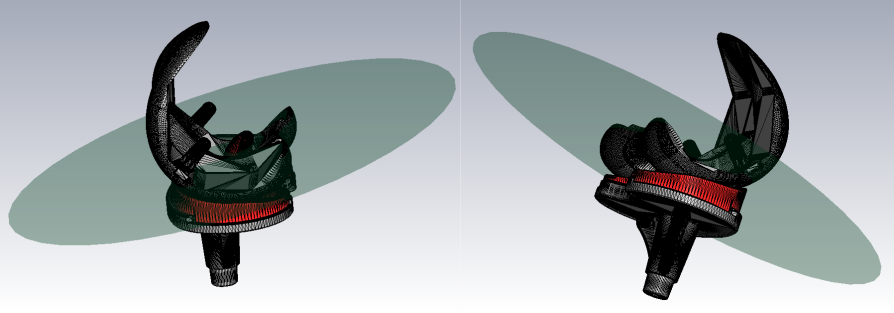
Figure 4: Analysis carried out for a knee implant. The worst direction is that normal to the green plane crossing the implant body.
DOI: https://doi.org/10.58530/2023/0601