0551
Interactive Cardiac Magnetic Resonance Imaging using jointly optimized spiral acquisition and deep artifact suppression network.1Institute of Cardiovascular Sciences, University College London, London, United Kingdom, 2Department of Cardiology, Royal Free London NHS Foundation Trust, London, United Kingdom, 3Department of Computer Science, University College London, London, United Kingdom
Synopsis
Keywords: Heart, Machine Learning/Artificial Intelligence, Interventional, Interactive
Interactive MR sequences have relatively low spatial and temporal resolution due to the limited acquisition and reconstruction time available. We propose to jointly optimize a variable density spiral acquisition and deep artifact suppression network (via a bandit-based approach) to maximize acquisition and reconstruction efficiency and provide interactive high spatio-temporal resolution images. The proposed approach was characterized in simulations and demonstrated prospectively in-vivo, offering promising performance with improved image quality and good handling of abrupt scan-plane changes.Introduction
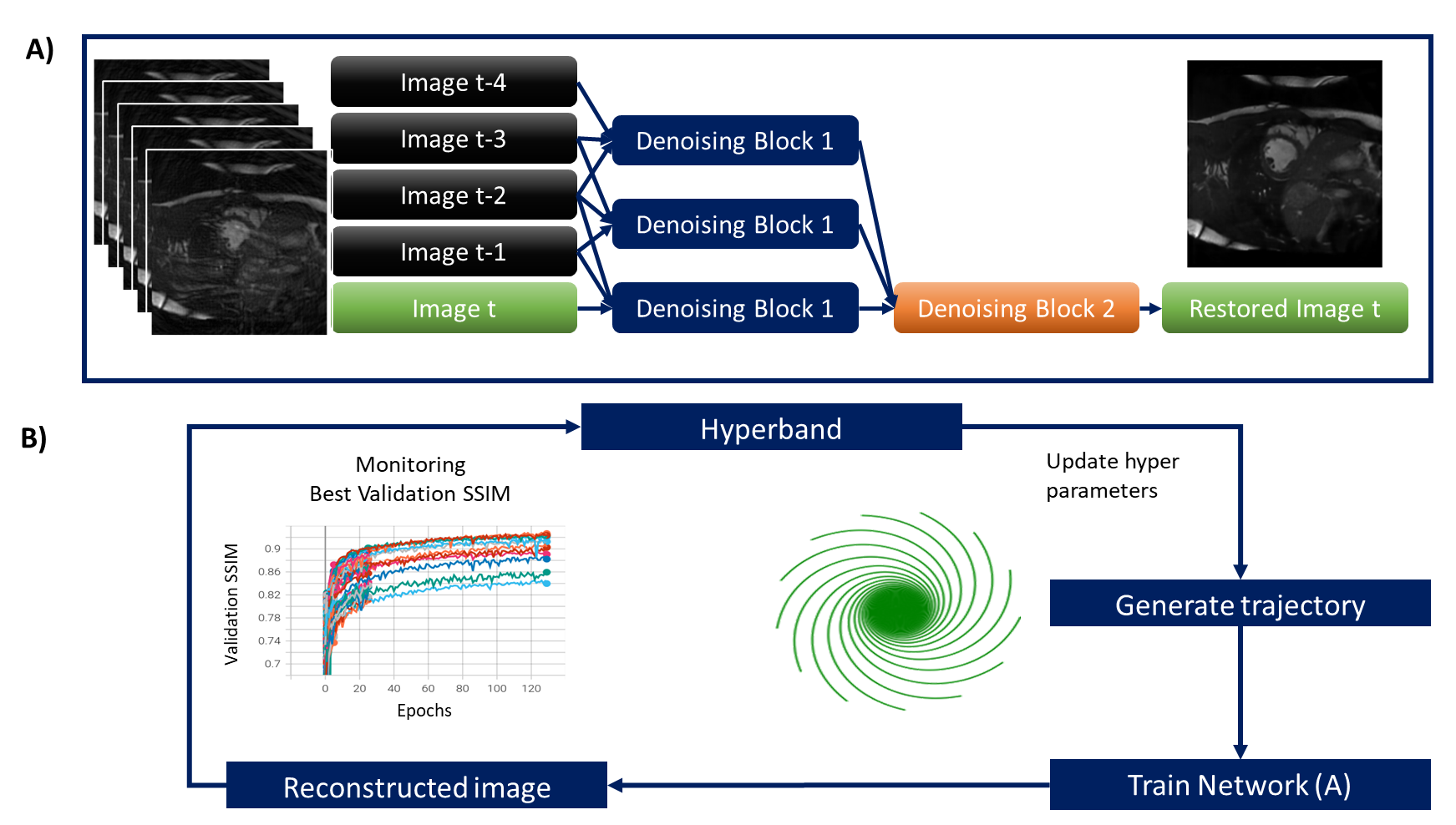
Cardiac interventions can be guided through real-time low latency magnetic resonance imaging (1). Interactive MR sequences have relatively low spatial and temporal resolutions due to the limited acquisition and reconstruction time available. We previously proposed deep artifact suppression using Long-Short-Term-Memory Convolutions for low latency image reconstruction of a radial undersampled bSSFP sequence (2). We aim at further improving the acquisition efficiency and reconstructed image quality, particularly during scan-plane changes by using spiral sampling.Variable density spiral trajectories are more efficient than radials but comes with many more degrees of freedom. Thus, we propose to jointly optimize the spiral sampling pattern and the fast deep artifact suppression network. For this work, we use a more recent network architecture: FastDVDnet (3), which has shown promising performance for real time video denoising.
For optimization, we propose a bandit-based approach, HyperBand (4), to efficiently select the best combination of variable density spiral trajectory and network weights for interactive imaging.
The optimized acquisition and reconstruction were investigated in simulations and prospectively in-vivo, resulting in low latency, high quality interactive imaging.
Methods
Machine learning framework:A variable density spiral trajectory design was parametrized as in (5). Using a Hyperband approach, 434 configurations of variable density spirals were investigated with a maximum of 130 epochs before selecting the best candidate according to SSIM. The trajectory parameters included:
1) the inner/outer k-space sizes and acceleration rates,
2) a density transition style (linear, quadratic or hanning),
3) interleave ordering (tiny golden angle or linear),
4) the range of acceptable TR,
5) a maximum temporal resolution.
This bandit approach enables an efficient trajectory search without requirements on the trajectory (i.e. derivability with respect to the loss).
Briefly for each spiral configuration, undersampled magnitude data was simulated from ground truth reference breath-hold Cartesian Cine images. The FastDVDnet results were monitored using SSIM of reconstructed images, and promising configurations are automatically investigated for longer. The deep learning framework is depicted in Figure 1.
Modifications to the original FastDVDnet included:
1) outputting the latest restored frame (instead of third latest) to limit latency,
2) removing global residual connections which hindered performance in our application,
3) removing batch normalization to preserve the relation between undersampled and ground truth images.
The framework and networks were implemented using TensorFlow/Keras (6), and TensorFlow-MRI (7).
Simulation Experiments:
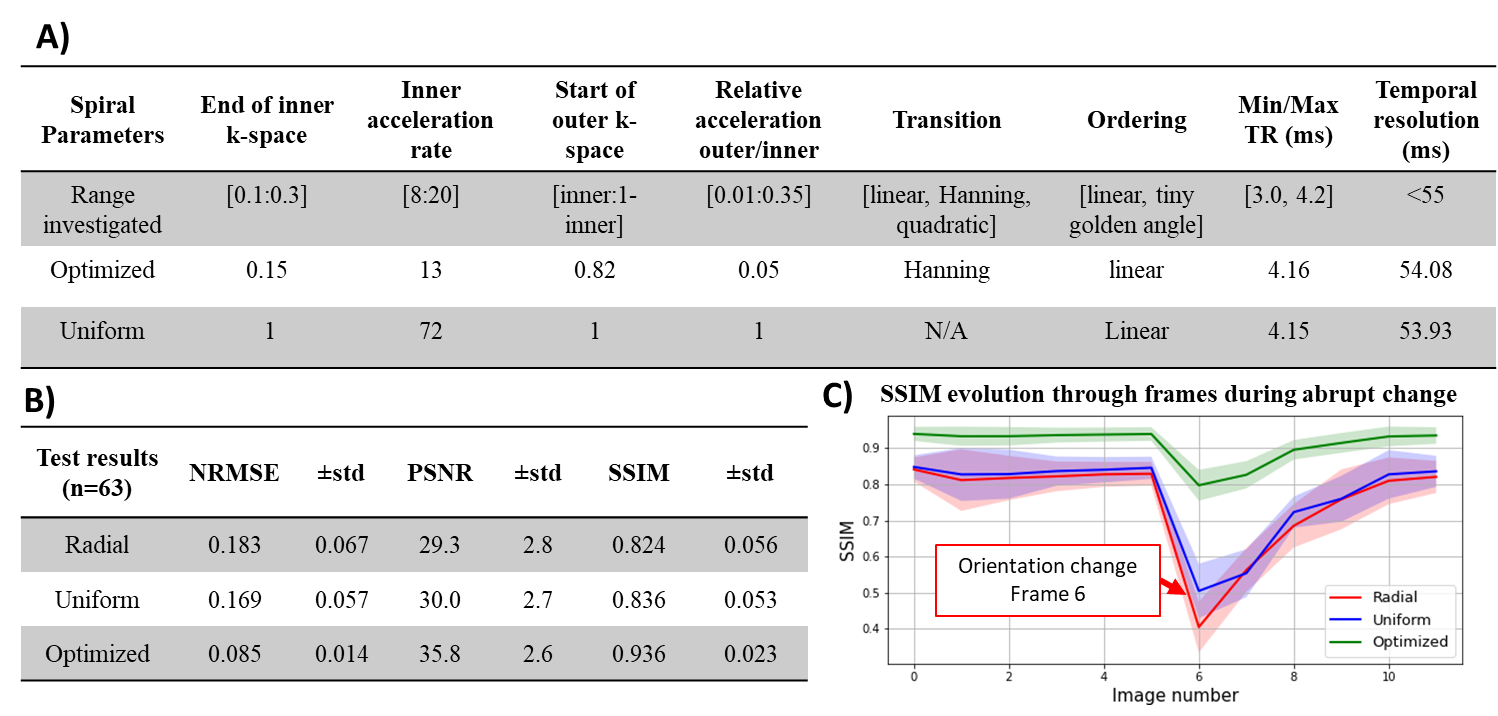
For comparison, the same architecture was trained with a 17 spokes tiny golden radial trajectory, a uniform spiral trajectory (with matching ordering and TR to the optimized spiral), as well as the optimized spiral trajectory. Simulations on the test set (N=63 2D+time slices in 7 different orientations, 5 consecutive frames per subject) compared NRMSE, PSNR and SSIM after deep artifact suppression, for each trajectory. Additionally, SSIM was quantified during simulated abrupt image changes.
Prospective Experiments:
Interactive data was prospectively acquired on a 1.5T (Aera; Siemens Healthineers AG, Erlangen, Germany) with the optimized trajectory using our prototype spiral interactive sequence (FA:70o, TR/TE=4.16/0.9ms, FOV=400x400mm, pixel size=1.67x1.67 mm2). During acquisition the data was passed on via Gadgetron (8), gridded and combined using sum-of-squares before deep artifact suppression. The data could then be visualized directly on the scanner platform.
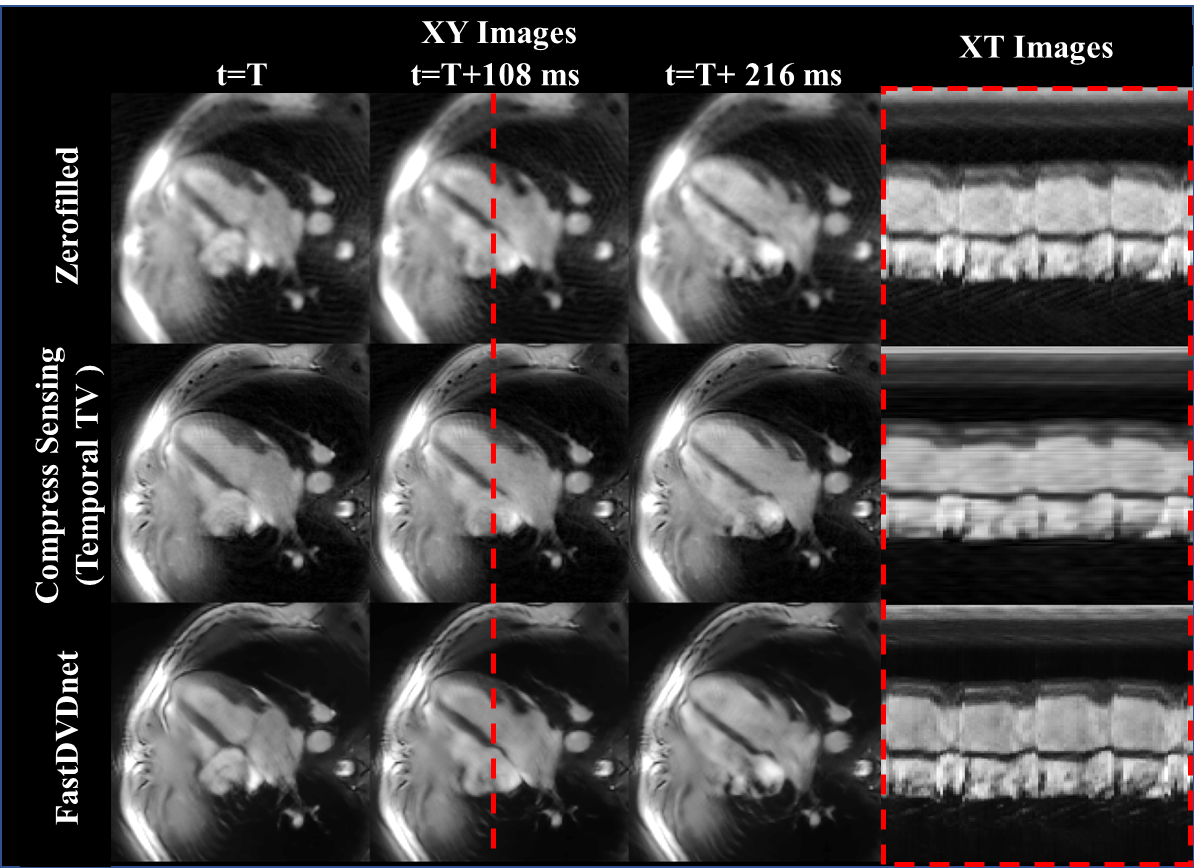
Offline experiments qualitatively compared compressed sensing (CS) with temporal total variation (alternating method of multipliers, 𝜆=5*10-5) and the proposed FastDVDnet reconstruction of the same data. CS and zerofilled reconstructions were performed using TensorFlow-MRI.
Results
Hyperband results:The explored range of values and selected parameters for the optimized spiral trajectory (plotted in Figure 1B) are shown in Figures 2A.
Simulation Experiments:
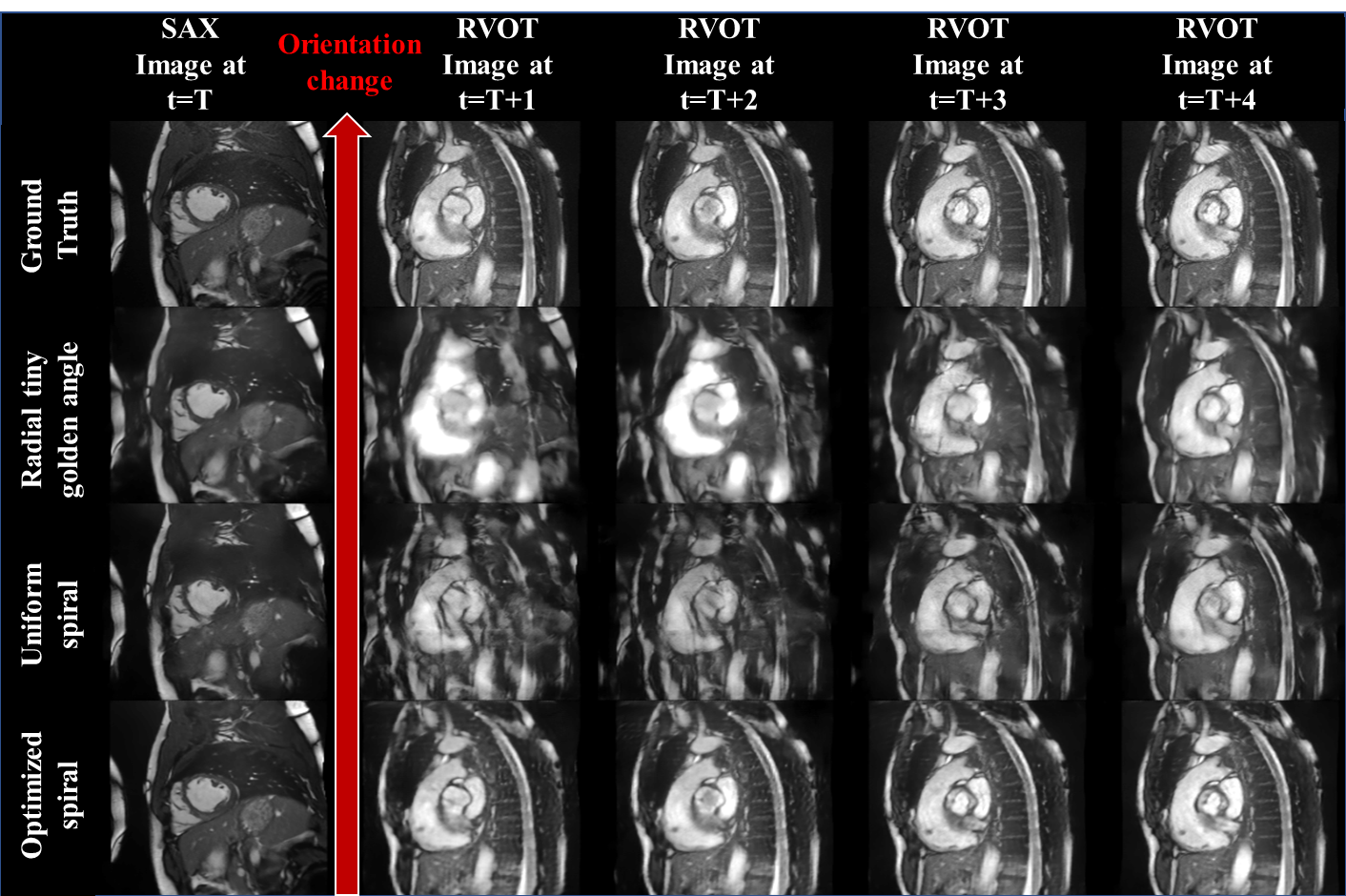
Quantitative metrics from the test set are shown in Figure 2B. For all metrics, the optimized variable density spiral outperforms radial/uniform spiral. The optimized sequence also showed better handling of transitions than the radial and uniform spiral sequences (Figure 2C and Figure 3).
Prospective Experiments:
Offline zerofilled, CS and proposed reconstructions of the same prospectively acquired data is shown in Figure 4.
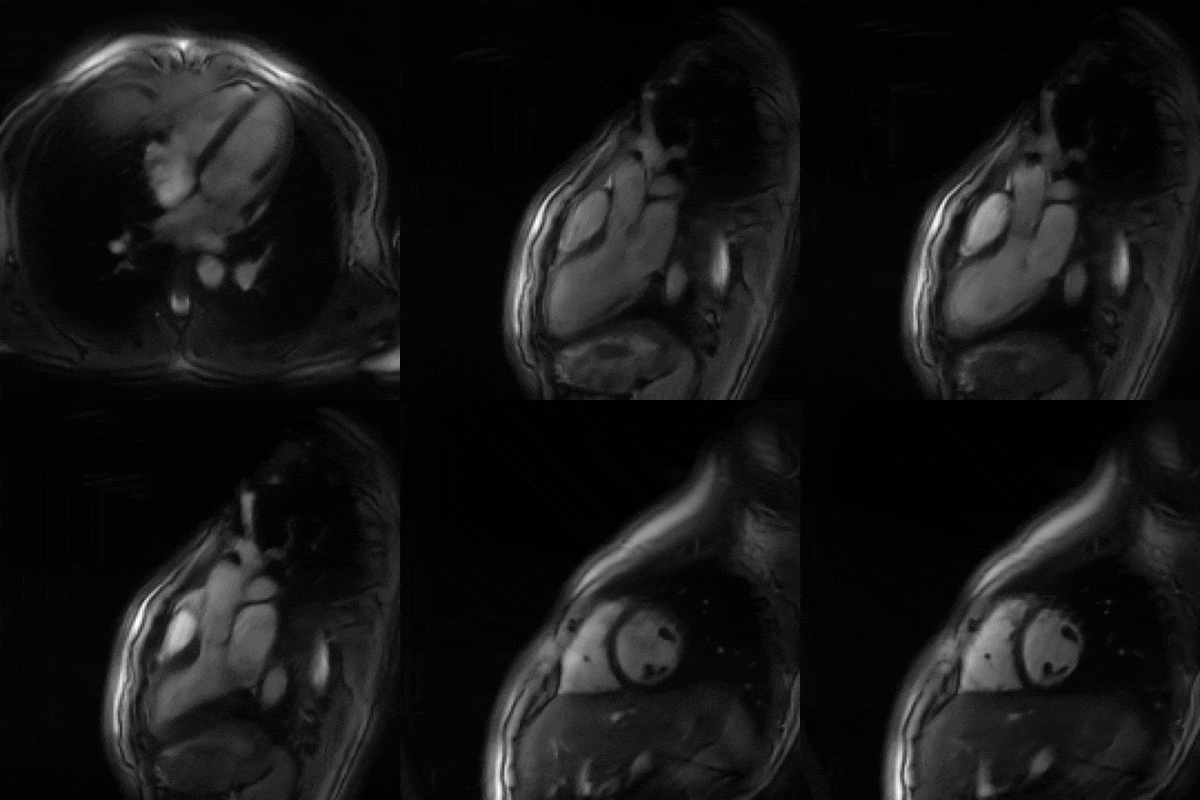
Deep artifact suppression took on average 21ms/frame and could be perform in parallel to zerofilled reconstructions enabling interactive imaging with near real time visualization of high-quality images, as can be seen in Figure 5 in a healthy subject with abrupt scan plane changes.
Discussion
A spiral trajectory was optimized through a bandit approach selecting a best candidate out of 434 parameterized combinations. Interestingly the selected trajectory was fully sampled in the central portion of k-space. Resulting gridded images appeared as lower resolution images with subtle moving artifacts. This combined with FastDVDnet (performing a deep artifact suppression/super resolution task) led to the restored images with the highest SSIM.FastDVDnet resulted in comparable image quality to CS, with sharper XT profiles, whilst also enabling low latency visualization (Figure 4). Cardiac motion was well depicted with good transitions during orientation changes (Figure 5).
Future works will focus on quantitative comparisons in a large patient population.
Conclusion
A jointly optimized spiral trajectory and FastDVDnet deep artifact suppression network for cardiac MR interactive imaging showed promising performance in terms of image quality, transitions between imaging planes and reconstruction times.Acknowledgements
This work was supported by UK Research and Innovation (MR/S032290/1), Heart Research UK (RG2661/17/20) and the British Heart Foundation (NH/18/1/33511, PG/17/6/32797).
References
1. Campbell-Washburn AE, Tavallaei MA, Pop M, et al. Real-time MRI guidance of cardiac interventions. Journal of Magnetic Resonance Imaging 2017;46:935–950 doi: 10.1002/jmri.25749.
2. Jaubert O, Montalt-Tordera J, Knight D, et al. Real-time deep artifact suppression using recurrent U-Nets for low-latency cardiac MRI. Magn Reson Med 2021;86:1904–1916 doi: 10.1002/MRM.28834.
3. Tassano M, France G, Delon J, Veit T. FastDVDnet: Towards Real-Time Deep Video Denoising Without Flow Estimation. 2020:1354–1363.
4. Li L, Jamieson K, DeSalvo G, Rostamizadeh A, Talwalkar A. Hyperband: A Novel Bandit-Based Approach to Hyperparameter Optimization. Journal of Machine Learning Research 2016;18:1–52.
5. Pipe JG, Zwart NR. Spiral trajectory design: A flexible numerical algorithm and base analytical equations. Magn Reson Med 2014;71:278–285 doi: 10.1002/MRM.24675.
6. Abadi M, Barham P, Chen J, et al. TensorFlow: A System for Large-Scale Machine Learning TensorFlow: A system for large-scale machine learning. Proceedings of the 12th USENIX Symposium on Operating Systems Design and Implementation 2016:265–283.
7. Montalt Tordera J. TensorFlow MRI. 2022 doi: 10.5281/ZENODO.7120930.
8. Hansen MS, Sørensen TS. Gadgetron: An open source framework for medical image reconstruction. Magn Reson Med 2013;69:1768–1776 doi: 10.1002/mrm.24389.
Figures