0549
Highly-Accelerated Real-Time Myocardial Tagging for Exercise CMR at 3T
Manuel A Morales1, Siyeop Yoon1, Ahmed Fahmy1, Jennifer Rodriguez1, Daniel B Herzka2, Warren J Manning1, and Reza Nezafat1
1BIDMC, Boston, MA, United States, 2Case Western Reserve University, Cleveland, OH, United States
1BIDMC, Boston, MA, United States, 2Case Western Reserve University, Cleveland, OH, United States
Synopsis
Keywords: Heart, Pulse Sequence Design
Combined cardiac MRI and exercise (Ex-CMR) is a stress imaging test with promising applications in cardiovascular disease (CVD). Ex-CMR myocardial tagging could provide insights into myocardial deformation post-exercise. We sought to develop an SSFP-based highly-accelerate (12-fold) free-breathing ECG-free real time tagging sequence for quantification of beat-to-beat variation of myocardial deformation at rest and after exercise. The proposed real time sequence achieved a spatiotemporal resolution of 2 x 2 mm2 and 27.6 ms. Feasibility of real time imaging at 3T post-exercise was demonstrated in patients with heart failure with preserved (HFpEF) and reduced (HFrEF) ejection fraction.Introduction
Exercise cardiovascular magnetic resonance (Ex-CMR) is a stress imaging test with promising applications in cardiovascular disease (CVD). Ex-CMR myocardial tagging could provide insights into myocardial deformation post-exercise. However, current ECG-segmented gradient-echo myocardial tagging sequences are not robust for this task. The goal of our study is to develop a real-time myocardial tagging sequence that can be used for quantification of beat-to-beat variation of myocardial deformation after exercise.Methods
Real-time tagging was implemented as an SSFP-based sequence (Fig. 1). A fat saturation pulse was applied upon detection of the cardiac trigger to avoid off-resonance artifacts. Tagging preparation consisted of 8 mm tag lines placed perpendicular to the phase encoding (PE) direction. This approach was necessary to allow higher imaging acceleration based on PE k-space undersampling while preserving spectral harmonics. Magnetization catalyzing pulses are typically used after tagging preparation when SSFP is combined with tagging. In this work, five linearly increasing ramp-up pulses were used to reduce signal oscillations during the approach to steady state. This amount was selected to minimize the imaging time delay after application of the tags, which was particularly important during post-exercise imaging due to elevated heart rates. Imaging parameters were matrix size = 176 × 176, spatial resolution = 2.0 × 2.0 mm2, slice thickness = 8 mm, distance factor = 150%, bandwidth = 1235 Hz/Px, echo time = 1.1 ms, repetition time (TR) = 2.5 ms, temporal resolution = 27.6 ms and flip angle = 30 degrees. In addition, images were collected with 2-fold PE undersampling and CS rate 6, which resulted in a total acceleration rate = 12. A breath-hold ECG-gated segmented sequence was implemented for comparison. With few exceptions, all imaging parameters were identical to those used for real time tagging. First, imaging was divided over 8 heartbeats. Second, a magnetization storing α / 2 pulse was placed TR / 2 after imaging was completed for a given heartbeat. Also, images were acquired with GRAPPA rate 2, and retrospective ECG gating with 25 cardiac phases calculated. Reconstruction consisted of vendor-provided CS reconstruction per beat to create images from 6-fold under-sampled k-space data. However, the reconstructed images were blurry due to 2-fold reduced PE undersampling. Thus, a resolution enhancement generative adversarial inline network (REGAIN) was used to generate images with spatial resolution comparable to fully sampled PE data (Fig. 2). Briefly, REGAIN enhances the spatial resolution of images in the phase-encoding direction from the low-resolution inputs, which enables further acceleration by reduction of PE lines. The network was trained using a pair of ground truth and synthesized zero-padded low-resolution images generated using raw k-space data. In this study, REGAIN recon was readily used to deblur low-resolution CS-reconstructed tagging images without any modification to the pre-trained network. REGAIN was implemented inline (i.e., in-scanner). Therefore, the 12-fold accelerated k-space tagging data were reconstructed in-scanner in real-time, and images were available upon completion of scan. Images were acquired at 3T. A cohort consisting of 27 patients with CVD (54 ± 16 years) and 18 healthy subjects were prospectively recruited to undergo cardiac MRI. A subset of the subjects (15 healthy, 14 patients) participated in an Ex-CMR protocol. Performance was initially evaluated by comparing ECG-segmented and real time tagging imaging at rest. Tagging images were collected in the short-axis views at basal, mid-ventricular and apical levels. Subsequently, a subset of the subjects participated in an Ex-CMR protocol (Fig. 3). Protocol consisted of one additional real time acquisition at rest for reproducibility assessment, and another one during post-exercise to assess response to stress. An open-source method for landmark tracking based on tagging images was used to generate measurements of mid-wall global circumferential strain (mwGCS). The agreement between ECG-segmented and real time measurements of mwGCS was assessed using linear regression and Pearson correlation coefficient, r. Repeatability of mwGCS measures was assessed using the infraclass correlation coefficient (ICC). Differences between rest and post-exercise mwGCS in health subjects were evaluated using a paired t-test. A p-value < 0.05 was considered significant.Results
SSFP-based ECG-segmented and real-time tagging showed comparable deformation at rest. There was an excellent correlation (r = 0.83) between ECG-segmented and real time measurements of mwGCS. Linear regression showed 88% [0.82, 0.93] agreement between sequences (Fig. 4a). Repeatability was good to excellent (ICC = 0.99 [0.76, 0.95]) (Fig. 4b). Real time tagging enabled imaging of the augmented myocardial deformation as a response to exercise, which was strong in healthy subjects (Fig. 5a, b). Quantification of deformation in healthy subjects showed that there was a significant change in mwGCS as a response to exercise of 5.2 ± 2.7%. Deformation response was well visualized in patients with heart failure with preserved (Fig. 5c) and reduced (Fig. 5d) ejection fraction.Conclusion
We developed highly accelerated SSFP real-time tagging at 3T, reconstructed with CS and REGAIN, with 28.8 ms temporal resolution for evaluation of beat-to-beat myocardial deformation post-exercise. We also demonstrated the feasibility of real time tagging imaging post-exercise in patients with HFpEF and HFrEF.Acknowledgements
No acknowledgement found.References
No reference found.Figures
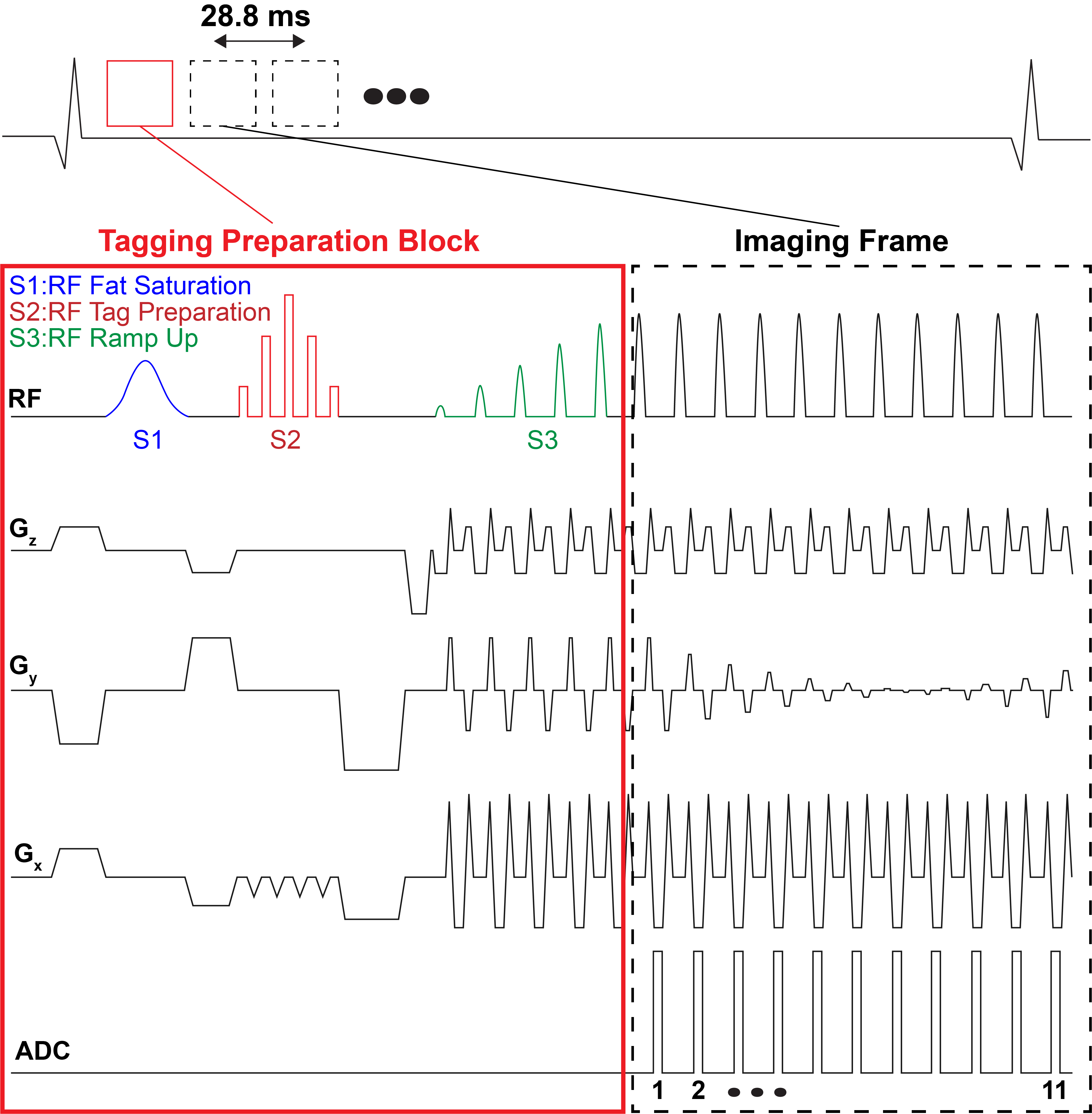
Figure 1. Highly-accelerated real-time
tagging at 3T. Steady-state
free-precession imaging has higher signal-to-noise ratio than gradient-echo and
is thus more robust to high acceleration rates. Tag lines were perpendicular to
phase-encoding to preserve harmonics. Off-resonance artifacts were reduced by
using fat-saturation (S1) and steady-state ramp-up (S3) pulses. Only five pulses
were used to minimize the delay between tag preparation (S2) and the first
imaging frame.

Figure 2. Tagging imaging
reconstruction workflow. (a) A resolution
enhancement generative adversarial inline network (REGAIN) architecture was
previously trained to deblur cine images. REGAIN was developed using
breath-hold electrocardiogram-gated segmented cine for training. (b)
Reconstruction consisted of vendor-provided compressed sensing (CS)
reconstruction per beat to create images from 6-fold under-sampled k-space
data. Resulting blurred images (with 2-fold reduced phase encoding spatial
resolution) were used as input to REGAIN.
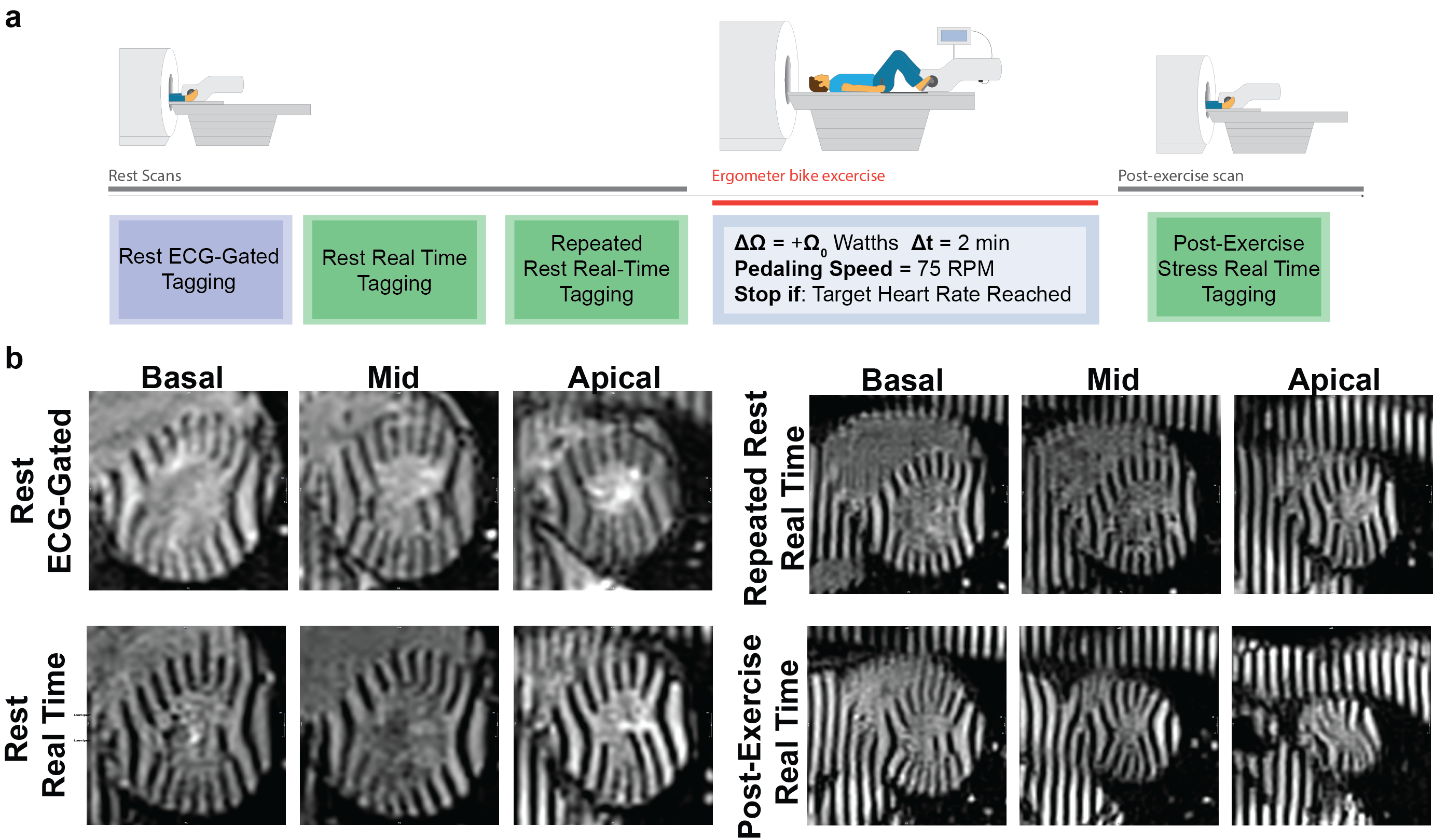
Figure 3. Exercise Tagging
protocol. Rest scans consisted of
breath-hold, ECG-gated segmented followed by proposed free-breathing
ECG-free real-time tagging. Real time tagging acquisition was repeated once
to assess repeatability. After rest imaging, subjects were removed from scanner bore and were exercise in supine position. After reaching target
heart rate or exhaustion, subjects were immediately placed back inside scanner bore for post-exercise stress imaging. This consisted of a repetition
of the real-time tagging sequence. b) representative images for one
subject.
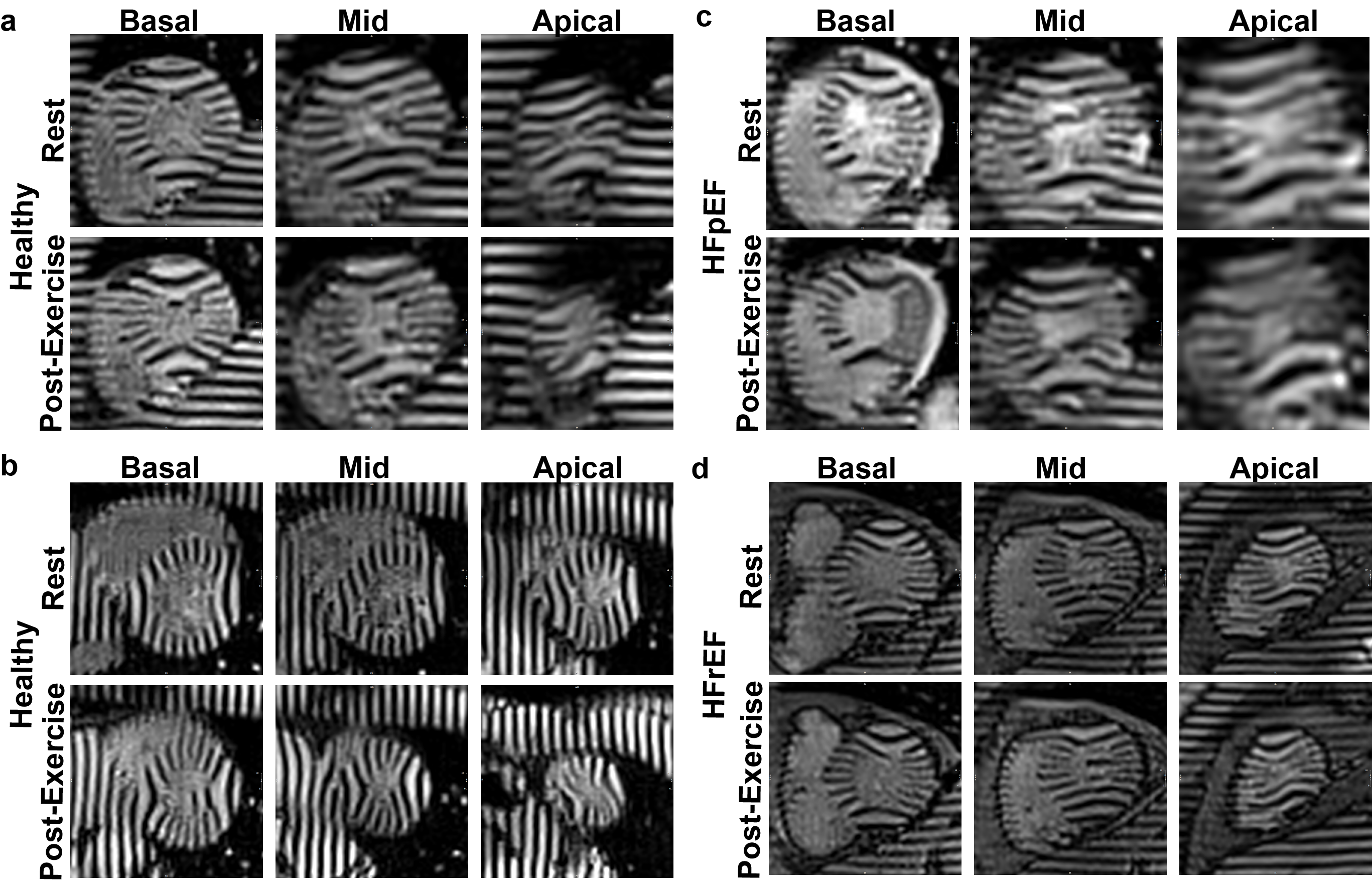
Figure 4. Evaluation of mid-wall global
circumferential strain (mwGCS). (a) Tagging images were collected at rest with breath-hold
ECG-segmented as well as free-breathing real time tagging sequences.
Measurements of mwGCS were obtained from tagging images in the short axis view
at basal, mid and apical levels. The average strain value across slices
obtained with both sequences was compared. (b) The free-breathing real time tagging sequence was repeated to
evaluate intra-subject repeatability of mwGCS measures.

Figure 5. Rest and post-exercise real time
tagging. (a, b)
Augmented deformation post-exercise is evident in healthy subjects. (c)
A 54-year-old female with HFpEF at rest and after performing 10W resistance
protocol. Heart rate (HR) increased from 58 pbm to 99 pbm. Images at end
systole showed reduced right ventricular volume and augmented left ventricular
deformation, particularly in the mid inferolateral region. Note fat surrounding
basal lateral left ventricular wall. (d) 55-year-old female with HFrEF whose
HR increased from 62 bpm to 91 bpm with 10W protocol.
DOI: https://doi.org/10.58530/2023/0549