0532
Multi-echo RF spatial phase encoding for gradient-free imaging in a nonuniform B0-field at low-field1Biomedical Engineering, Yale University, New Haven, CT, United States, 2Radiology and Biomedical Imaging, Yale University, New Haven, CT, United States
Synopsis
Keywords: Pulse Sequence Design, Low-Field MRI
The cost and complexity of MR scanners can be significantly reduced by eliminating conventional linear gradient coils, and instead using RF coils for spatial encoding. Here we have developed a novel multi-echo RF phase encoding pulse sequence that exploits the Bloch-Siegert shift for nonlinear spatial encoding in a nonuniform, field-cycling, low-field MR system. Phantoms of varying sizes were successfully imaged using this pulse sequence, demonstrating that this technique can be used to perform gradient-free imaging in an inhomogeneous B0-field at low-field.Introduction
A growing body of research explores the development of low-field, open MRI scanners for low cost, highly accessible, point-of-care screening [1, 2]. However, much of the work in this area has focused on utilizing a conventional closed-bore geometry for both magnet and gradient coils which presents significant design constraints for MRI. Spatial encoding using radiofrequency (RF) coils is a promising solution to opening up the scanner design, but current methods focus on linear B1-fields or cylindrical geometries [3-5] which introduces complexities when trying to create on open MR system. In this work, we present a novel pulse sequence that exploits the Bloch-Siegert shift [6] imparted by an off-resonance pulse to perform gradient-free, nonlinear spatial encoding using a multichannel RF planar array, in a low-field MR system.Methods
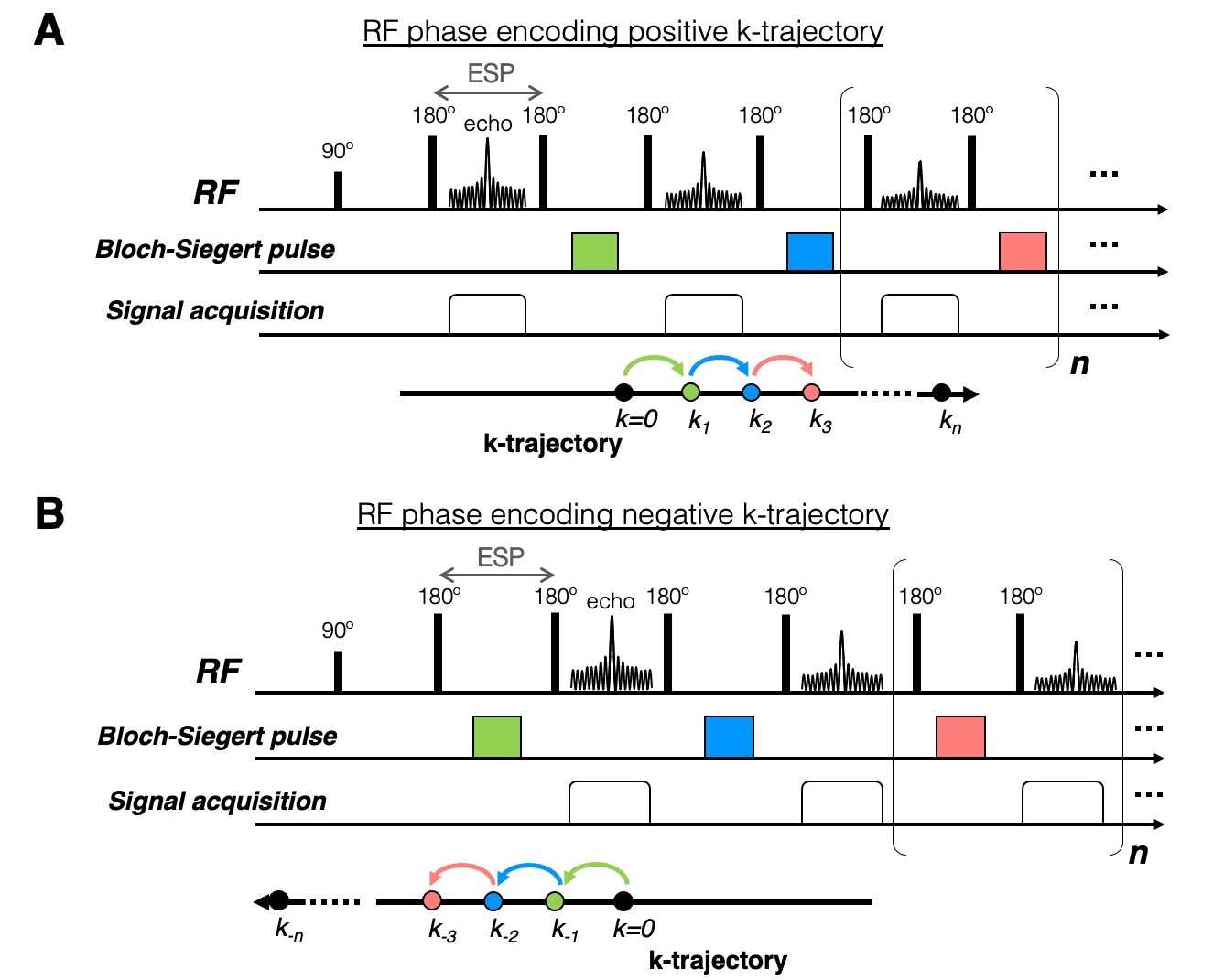
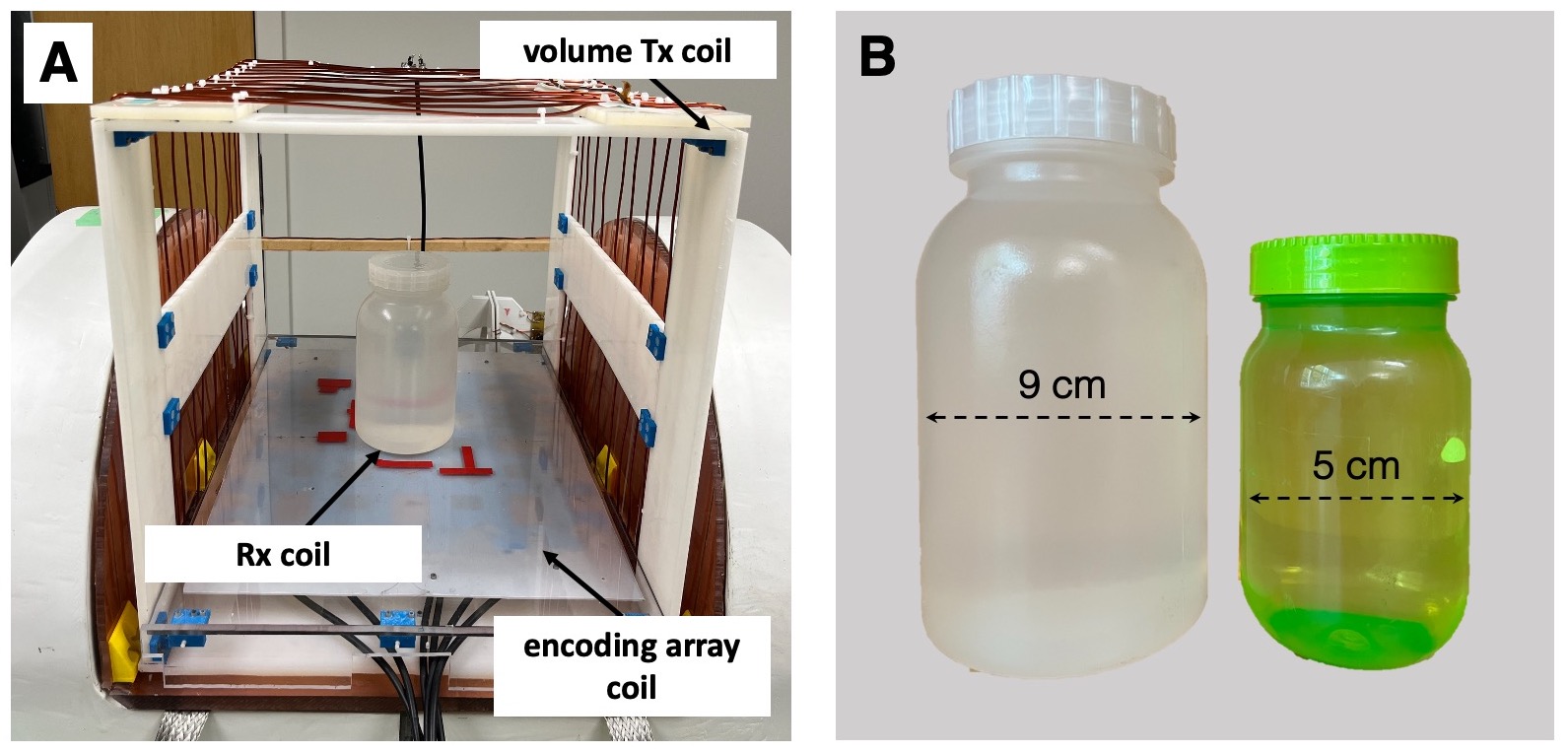
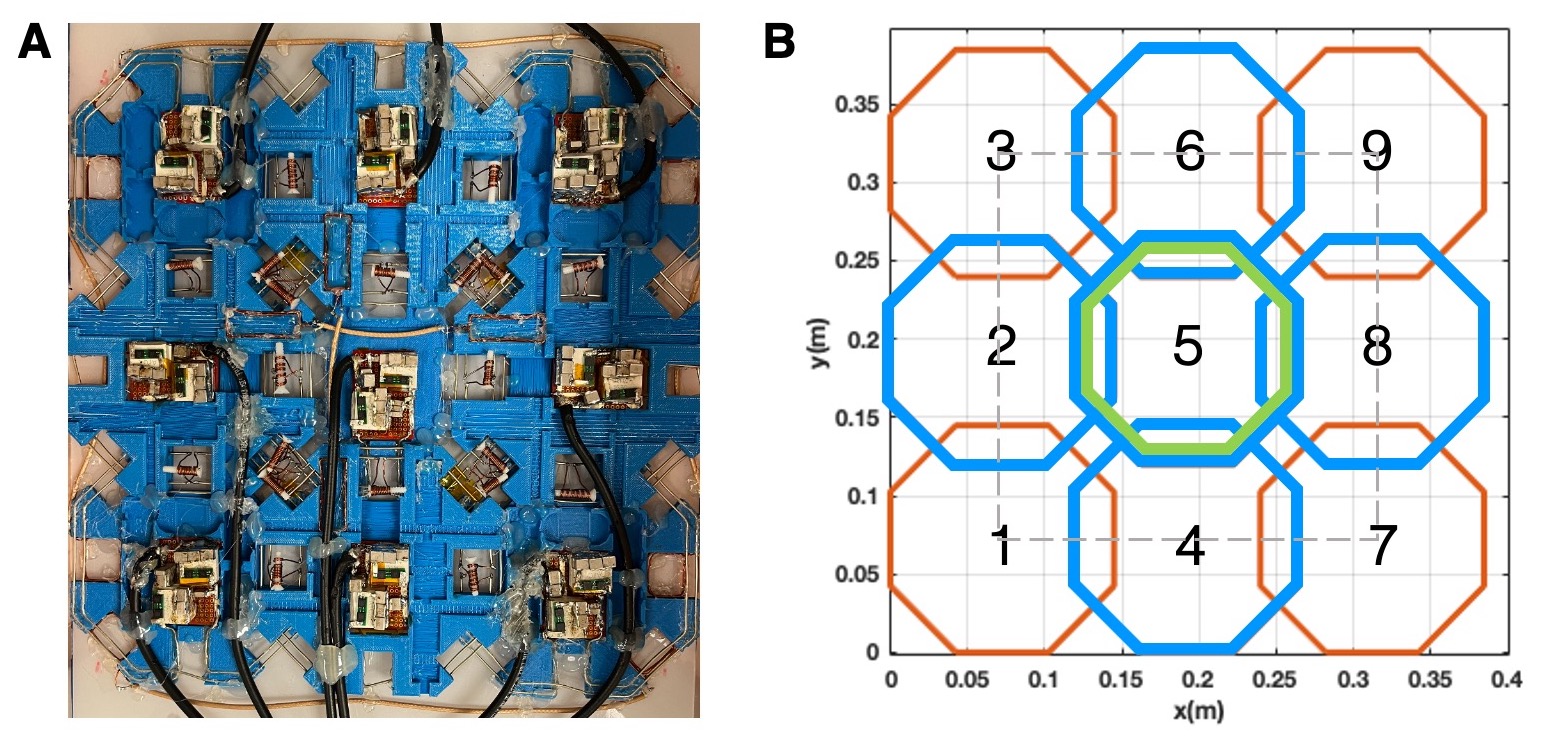
Figure 1 shows the multi-echo encoding CPMG sequence used in this study. In this sequence an excitation pulse is followed by a train of refocusing pulses interleaved with Bloch-Siegert off-resonance pulses. These pulses act much like a blipped phase encode gradient in conventional turbo spin echo imaging; after acquisition of the first spin echo (k0), each subsequent echo accumulates phase allowing for extended acquisition along a k-trajectory, noting that different parts of the image will have different k-space trajectories. To obtain a full encoding trajectory using blipped RF, the off-resonance pulses were first applied to even echoes, acquiring k0 to kn (Figure 1A), then again on odd echoes, acquiring k0 to k-n (Figure 1B). 320 echoes were acquired with 160 averages, and an ESP=1.3ms.Experiments were conducted on a single-sided, low-field electromagnet [7] featuring a nonuniform main magnetic field. To make it possible to image in the presence of a nonuniform B0-field, the system is designed to use field cycling, such that spins are polarized at a high field (0.6T) and imaged at a lower field (24mT), thereby minimizing field inhomogeneity effects while improving polarization. The experimental setup and the phantoms imaged are shown in Figure 2A and B respectively. A large, Tx-only volume coil placed inside the MR scanner was used to transmit the 90/180 pulses. A switch tuned RF planar array coil was positioned at the base of the magnet to transmit the off-resonance Bloch-Siegert pulses for spatial encoding (Figure 3A) and to receive the NMR signal. Figure 3B shows a diagram of this 3x3 RF planar array. Five channels in the array were used for nonlinear spatial encoding (blue), and a single channel in the center of the FOV for receive (green).
Results
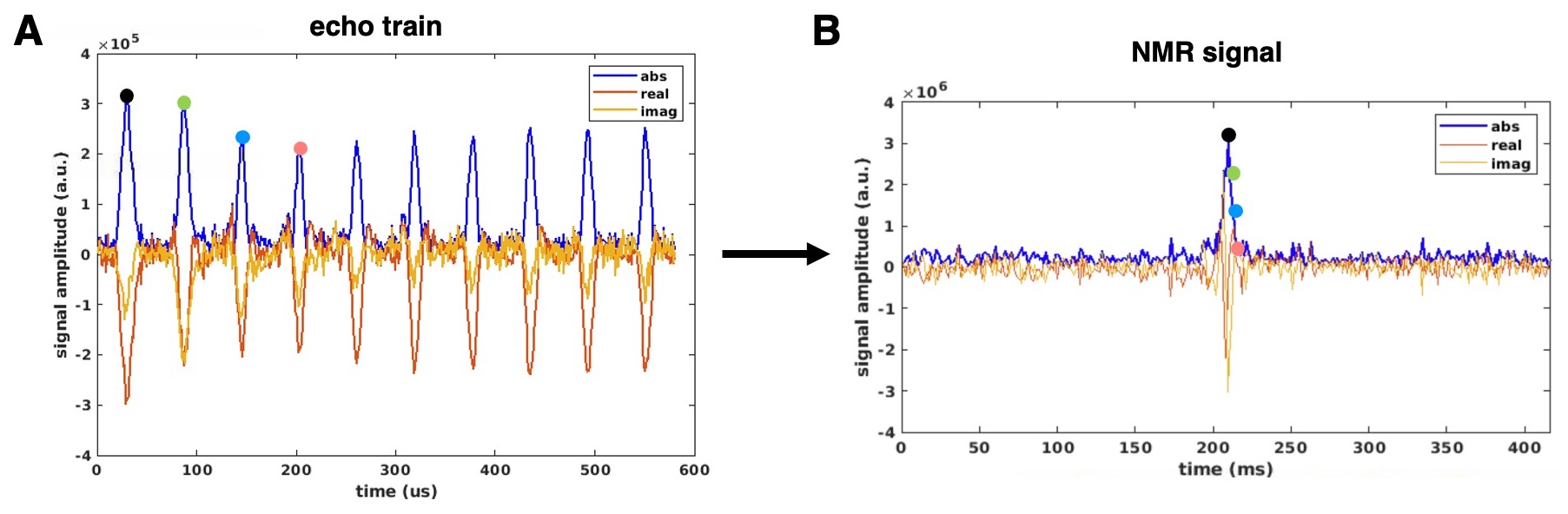
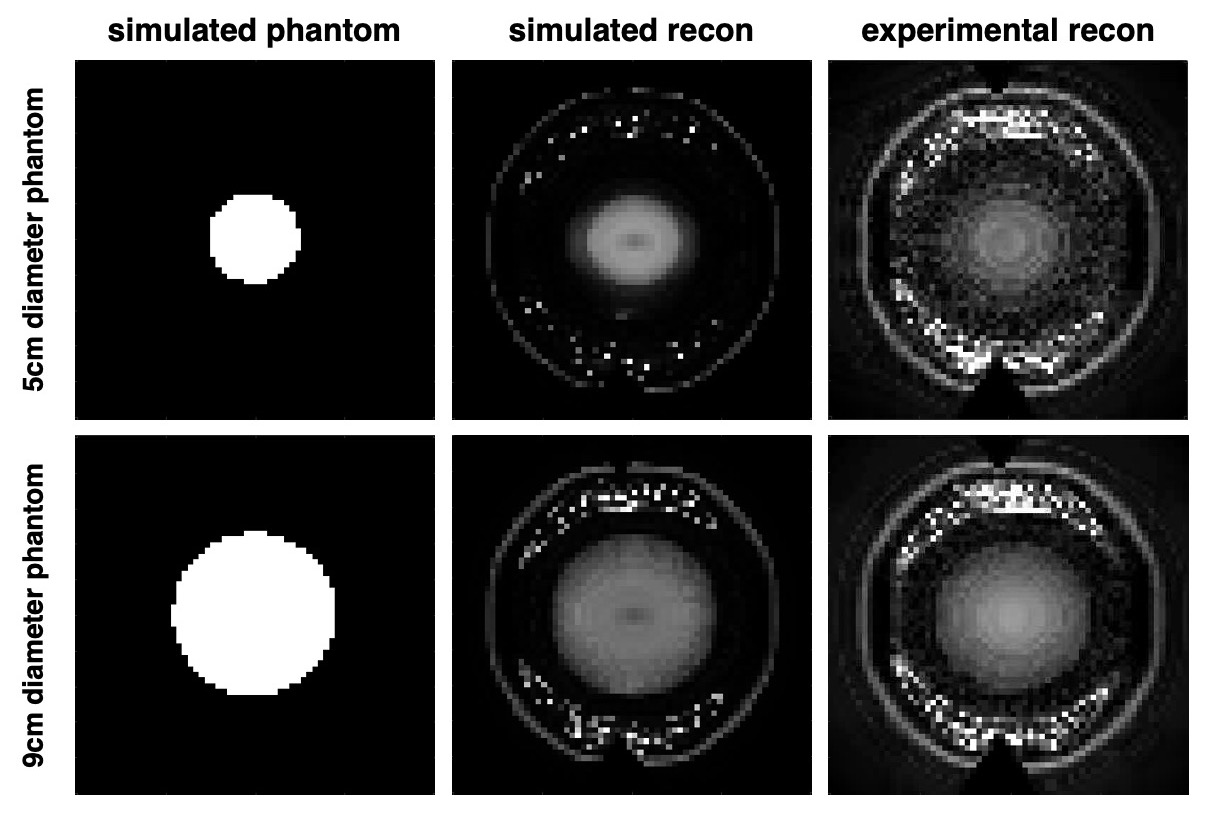
Encoding patterns were created by selecting subsets of two and three coils to transmit the Bloch-Siegert pulses from the five transmit channels. Figure 4A shows an example of a positive k-trajectory echo train generated by a single encoding pattern. From this raw data, the full k-trajectory is formed by re-ordering the midpoints of each echo (Figure 4B). It is important to note that since the spatial encoding fields are nonlinear, k-space traversal is also nonlinear, so each echo contains both kx and ky information.Images were reconstructed using the conjugate gradient method for algebraic reconstruction with nonlinear encoding fields [8]. The algorithm used encoding field maps calculated from the Biot-Savart for each transmit channel. Image reconstruction was performed with 8 encoding patterns, over a 64x64 matrix for a 20cmx20cm FOV. The last column in Figure 5 shows the 2D image of each of the bottle phantoms. For comparison, a Bloch simulation of the experiment was also conducted using the same encoding field patterns and maps previously described. The first and second columns in Figure 5 show the digital phantoms used to simulate the MR signal, as well as the corresponding 2D reconstruction results.
Discussion
We have developed a novel multi-echo encoding pulse sequence that exploits the Bloch-Siegert shift for nonlinear spatial phase encoding. This sequence has a short echo time, and utilizes a series of short RF refocusing pulses in combination with high power off-resonance pulses to allow for extended acquisition of k-space within a single TR.Overall, the results demonstrate the feasibility of using this technique to perform spatial encoding and gradient-free imaging in a nonuniform field. The 2D images show that with just 8 encoding patterns, we can still clearly delineate phantom geometries and boundaries. The experimental results also match the expected simulated results, with similar bright areas, and rings seen in both images. These artifacts come from high frequency noise that can be eliminated by receiving signal on multiple channels instead of just one, and by incorporating electromagnetic interference (EMI) correction methods. Future work will focus on expanding this multi-echo encoding technique to include more encoding patterns and receive channels for imaging over a larger FOV.
Conclusion
In this study, we have shown that gradient-free imaging is possible in a single-sided, low-field open magnet system with an inhomogeneous B0-field. By eliminating the uniform B0-field requirement and need for conventional cylindrical gradients, we can design MR systems in any size or shape, thereby increasing access to low-cost, application specific MR imaging.Acknowledgements
No acknowledgement found.References
1. Nasri, J., et al., Office-based, point-of-care, low-field MRI system to guide prostate interventions: recent developments. EMJ Urology, 2021: p. 83-90.
2. McDaniel, P.C., et al., The MR Cap: A single-sided MRI system designed for potential point-of-care limited field-of-view brain imaging. Magnetic resonance in medicine, 2019. 82(5): p. 1946-1960.
3. Katscher, U., J. Lisinski, and P. Börnert, RF encoding using a multielement parallel transmit system. Magnetic Resonance in Medicine, 2010. 63(6): p. 1463-1470.
4. Stockmann, J.P., et al., Transmit Array Spatial Encoding (TRASE) using broadband WURST pulses for RF spatial encoding in inhomogeneous B0 fields. (1096-0856 (Electronic)).
5. Sun, H., S. Yong, and J.C. Sharp, The twisted solenoid RF phase gradient transmit coil for TRASE imaging. Journal of Magnetic Resonance, 2019. 299: p. 135-150.
6. Bloch, F. and A. Siegert, Magnetic Resonance for Nonrotating Fields. Physical Review, 1940. 57(6): p. 522-527.
7. Constable, R.Todd., et al., Design of a novel class of open MRI devices with nonuniform B0, field cycling, and RF spatial encoding. in 27th ISMRM Annual Meeting. 2019. Montreal, QC, Canada.
8. Wan, Y.Q., Maolin, Galiana, Gigi, Constable R. Todd. Nonlinear RF spatial encoding with multiple transmit coils based on Bloch-Siegert shift. in 24th ISMRM Annual Meeting 2016.
Figures