0530
Multiphoton Simultaneous Multislice Imaging with CAIPIRINHA Phase Encoding1Electrical Engineering and Computer Sciences, University of California, Berkeley, Berkeley, CA, United States, 2Helen Wills Neuroscience Institute, University of California, Berkeley, Berkeley, CA, United States
Synopsis
Keywords: RF Pulse Design & Fields, RF Pulse Design & Fields, Multiphoton, SAR
Simultaneous multislice (SMS) imaging methods reduce scan time but increase specific absorption rate (SAR) because of additional radiofrequency (RF) pulses required for exciting multiple slices. Multiphoton excitation was recently proposed to significantly reduce SAR for SMS imaging. In this work, we further developed a phase-modulated multiphoton SMS excitation method that achieves CAIPIRINHA-type controlled aliasing, which improves image reconstruction quality significantly. Images obtained with our custom multiphoton CAIPIRINHA-SMS sequence have reduced aliasing artifacts and higher SNR compared to images obtained with a multiphoton SMS sequence without CAIPIRINHA. For a three-slice design, SAR is reduced by a factor of two.INTRODUCTION
Simultaneous multislice (SMS) imaging techniques provide accelerated imaging with little to no loss in SNR by simultaneously exciting multiple slices and disentangling them with coil sensitivities1. However, the multislice pulses used have high SAR and coil sensitivities may not be enough to disentangle closely spaced slices. Here, we use multiphoton excitation2,3 to produce reduced-SAR multislice pulses and “Controlled aliasing in parallel imaging results in higher acceleration” (CAIPIRINHA) to improve reconstruction quality by shifting the simultaneously excited slices with respect to each other4.Multiphoton MRI is a novel technique that generates excitation by using multiple magnetic fields with frequencies different from the Larmor frequency. Here, we use fast oscillating gradients to produce a secondary RF field at kHz frequencies and excite multiple multiphoton resonances simultaneously, each corresponding to a distinct slice. Because the phases of excited slices depend on both the traditional RF field and the RF field provided by the oscillating gradients, we can interestingly change the phase of the oscillating gradient to produce the phase-modulation needed for CAIPIRINHA while reducing SAR.
THEORY
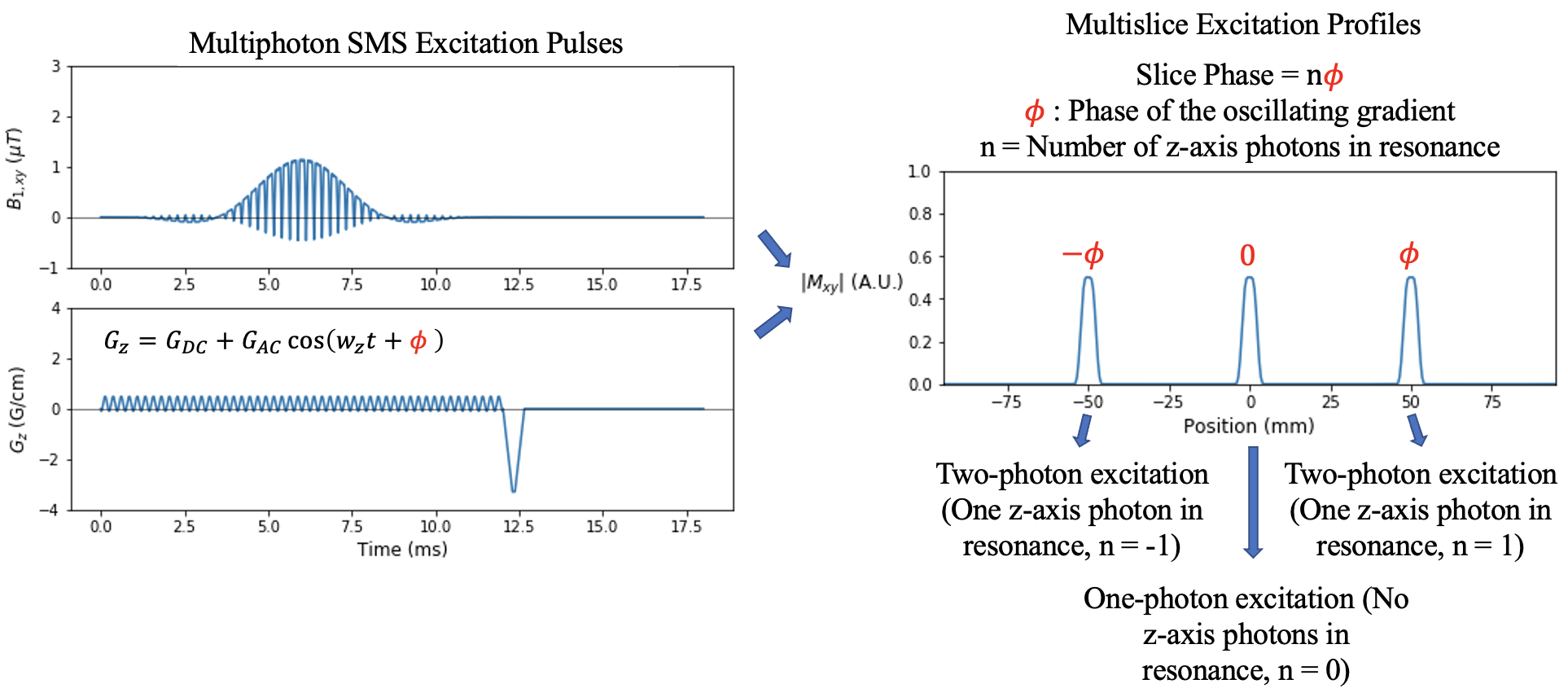
Applying a z-direction RF field in addition to the traditional xy-polarized RF field results in multiphoton resonances2. A fast-oscillating gradient field can provide a spatially varying z-direction RF field which excites multiphoton resonances at spatial locations where the following resonance condition is met$$\omega_{xy}=\gamma\left(B_{0}+\overrightarrow{G_{DC}}\cdot\overrightarrow{r}\right)+n\omega_{z}$$
$$$B_{0}$$$ is the main magnetic field, $$$\omega_{xy}$$$ and $$$\omega_{z}$$$ are the frequencies of xy-plane and z-axis $$$B_{1}$$$ fields, respectively. $$$G_{DC}$$$ is the amplitude of the slice-select gradient on which the oscillating gradient field is superimposed, and n is the number of z-axis photons in the resonance. In this work, three slices are excited simultaneously, which correspond to $$$n=-1,0,1$$$ in the resonance equation.
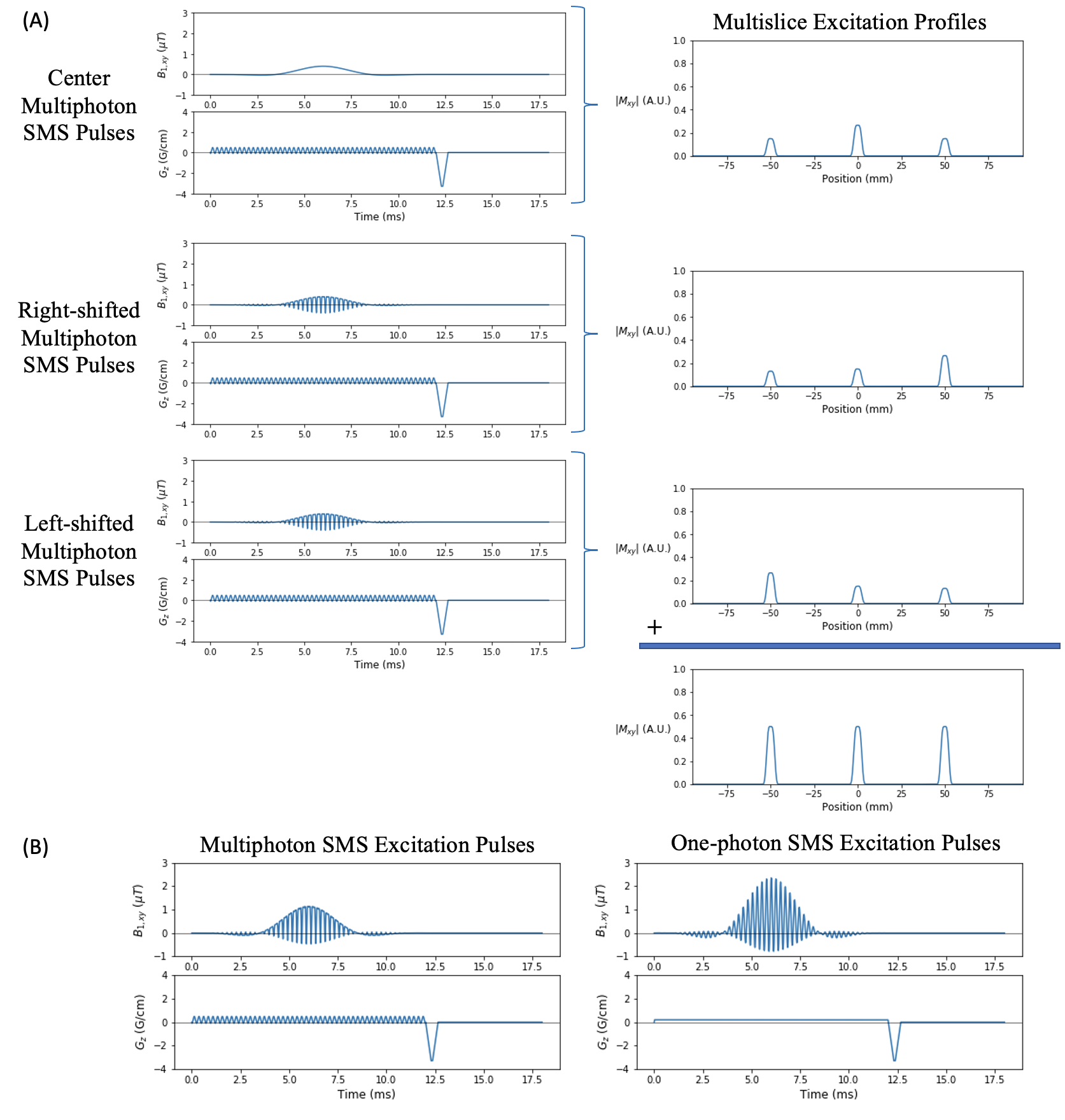
Since the RF field created by oscillating gradients is spatially varying, the effective $$$B_{1}$$$ field, and consequently, the flip angles of simultaneously excited slices will also be spatially varying. Three scaled-down and shifted versions of the multiphoton excitation pulse are summed to achieve equal flip angles for the three simultaneously excited slices as shown in Figure 1-A. Figure 1-B shows the summed multiphoton SMS excitation pulses and their one-photon counterparts. As one-photon SMS requires the summation of three unscaled, shifted SLR pulses, one-photon excitation RF pulse has higher amplitude, indicating the increased (by a factor of two) SAR.
In conventional SMS, CAIPIRINHA enables controlled aliasing by phase-shifting the RF pulses of each slice. This strategy, however, does not work for multiphoton SMS excitation because all slices share the same xy-plane $$$B_{1}$$$ field. Instead, it turns out since the number of z-photons involved in each resonance is different, the effect of the z-photon phase is also different for each slice6. As shown in Figure 2, when three sagittal slices are excited with an oscillating gradient of the form $$$G_{AC}cos\left(\omega_{z}t+\phi\right)$$$, where $$$G_{AC}$$$ is the amplitude and $$$\phi$$$ is the phase of the gradient, the center slice $$$\left(n=0\right)$$$, has a phase of $$$0^{\circ}$$$. Left and right slices $$$\left(n=\pm1\right)$$$, have phases of $$$-\phi$$$ and $$$\phi$$$, respectively. A phase change of $$$+\Delta\phi$$$ on the oscillating gradient, the source of the z-photons, changes the phases of the left, center, and right slices by $$$-\Delta\phi$$$ , $$$0$$$, and $$$+\Delta\phi$$$ , respectively. We propose to control the phase of each slice individually and shift aliased slices by modulating the oscillating gradient phase.
METHODS
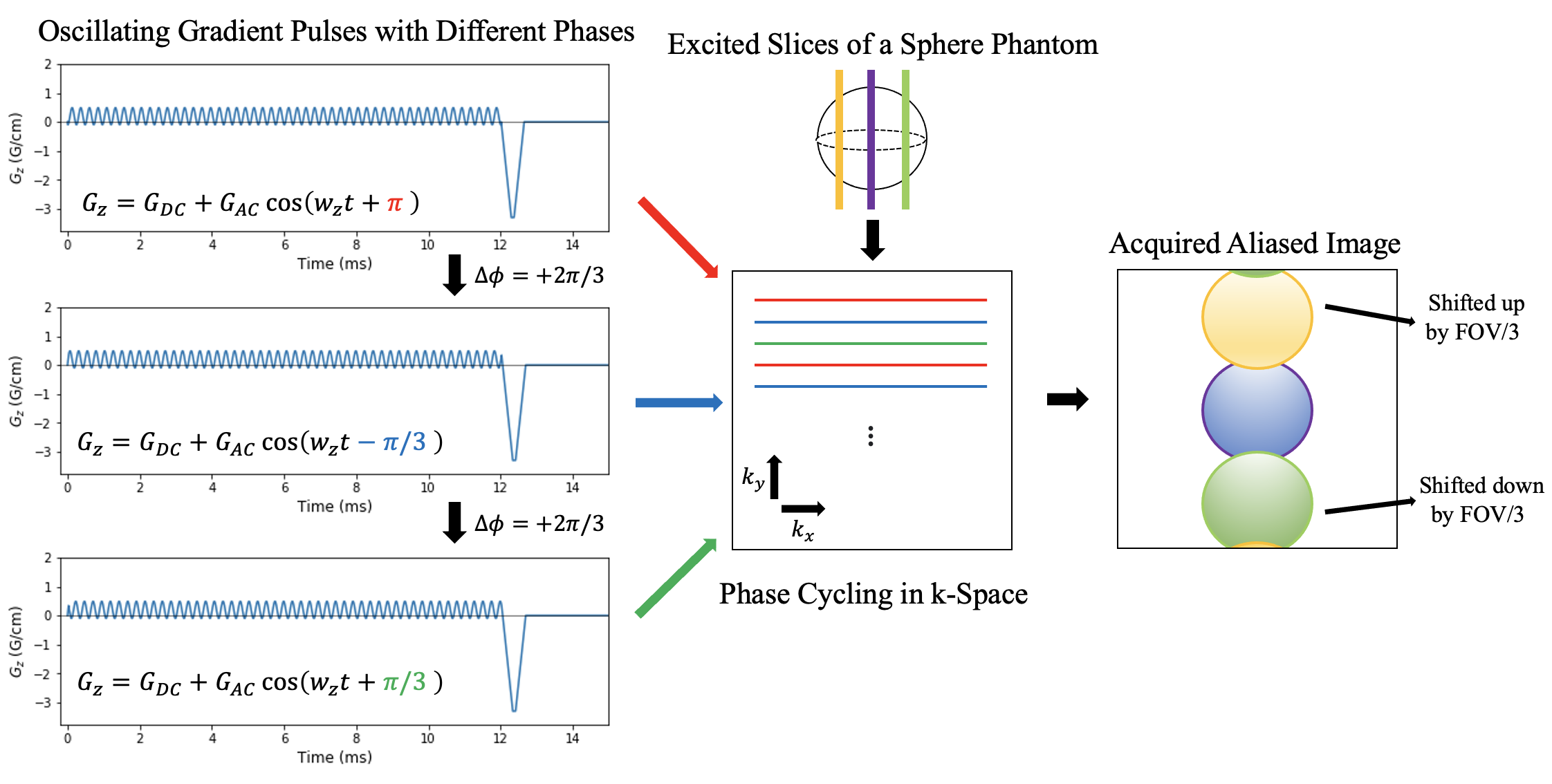
A custom gradient-echo multiphoton SMS sequence was written using HeartVista (HeartVista, Inc., Los Altos, CA) and implemented on a 3T GE MR750w scanner equipped with a 22-channel head-and-neck receiver array. Each multiphoton excitation pulse produces excitation equivalent to three $$$30^{\circ}$$$ SLR RF pulses by using xy-plane RF combined with $$$0.293\:G/cm$$$ sinusoidal gradients oscillating at $$$4.167\:kHz$$$ superimposed on a $$$0.196\:G/cm$$$ slice-select gradient. Three $$$5\:cm$$$ apart and $$$5\:mm$$$ thick sagittal slices were excited. For CAIPIRINHA, the center slice was left unshifted, while the left and right slices were shifted up and down by FOV/3, respectively. The shifts were obtained by increasing the phase of the oscillating gradients by $$$2\pi/3$$$ at every phase encoding step as shown in Figure 3. Due to $$$2\pi$$$ periodicity of the phases, only three different excitation pulses with oscillating gradient phases of $$$\pi$$$, $$$-\pi/3$$$ and $$$+\pi/3$$$ were needed.The reconstruction was done using the slice-GRAPPA5 method and a calibration scan, where each slice was excited individually, was taken immediately before the SMS scan to estimate GRAPPA kernels. The slice-GRAPPA algorithm was modified to take into account CAIPIRINHA shifts.
RESULTS
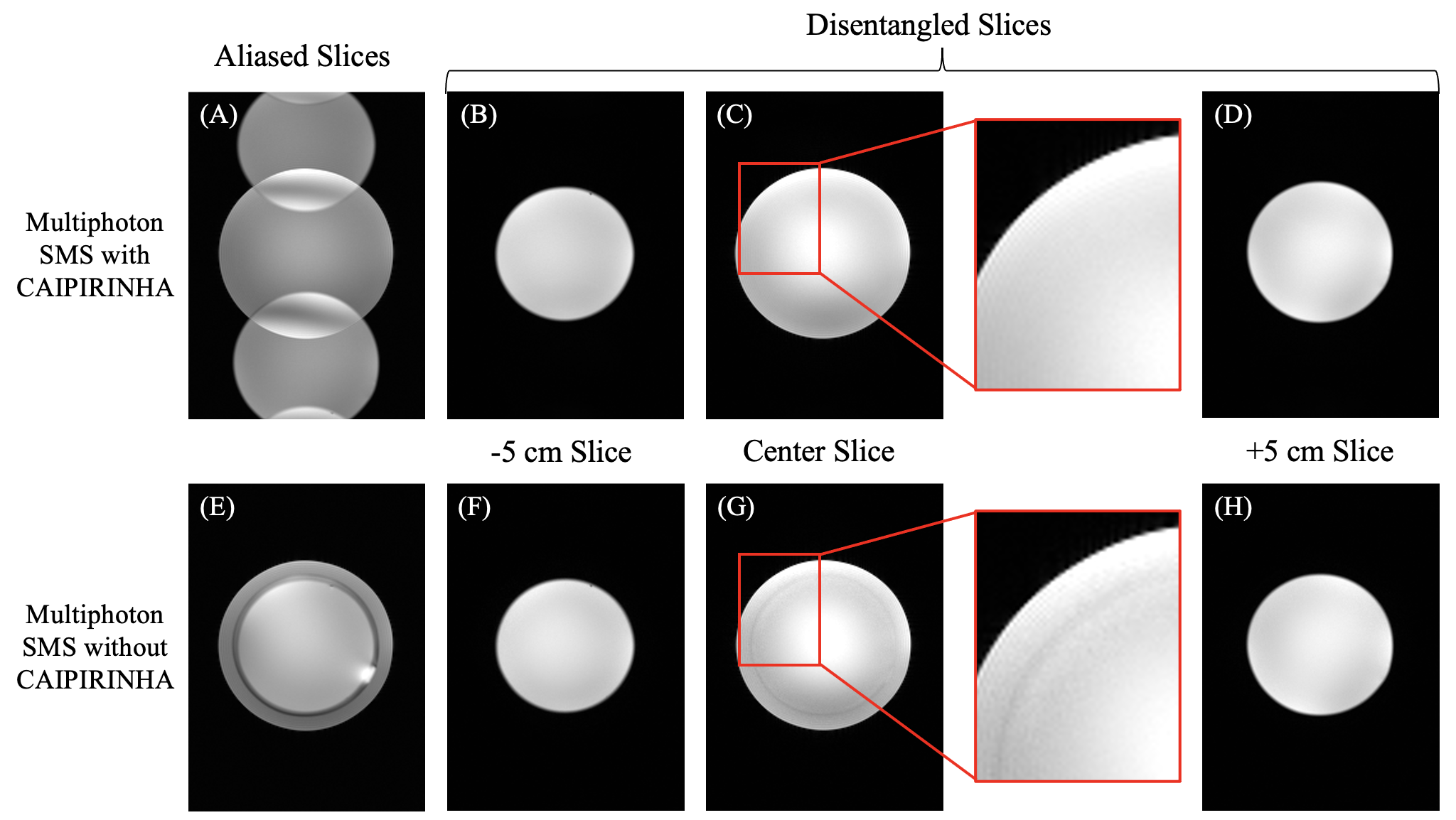
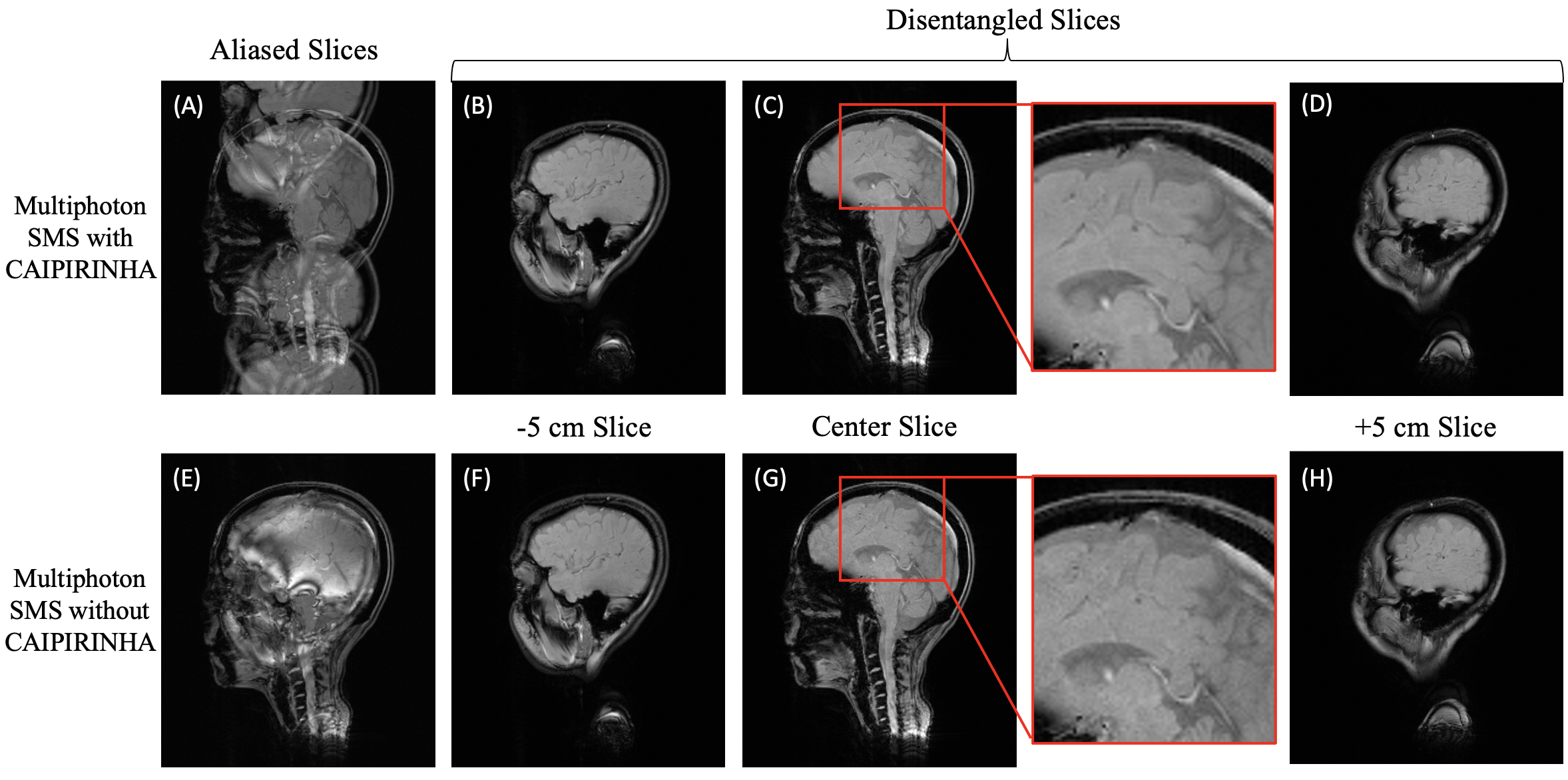
A custom multiphoton CAIPIRINHA-SMS sequence was used for both phantom and in vivo studies. Aliased images of the slices and their disentangled versions are given in Figures 4 and 5. Aliasing artifacts in the center slice in Figure 4-C are removed when CAIPIRINHA shifts are implemented as shown in Figure 4-G. Figure 5 shows the significant SNR gain obtained by the addition of CAIPIRINHA.DISCUSSION AND CONCLUSION
We have implemented CAIPIRINHA for SMS imaging with multiphoton MRI for reduced SAR (reduced by a factor of 2 in our case). The CAIPIRINHA implementation was done by modulating the phase of the oscillating gradients used in multiphoton excitation. Disentangled images were shown to be free of aliasing artifacts and have significantly higher SNR compared to their counterparts acquired and reconstructed without CAIPIRINHA shifts.Acknowledgements
This work was supported in part by NIH grant R21EB030157. The authors thank Ekin Karasan and Jingjia Chen of UC Berkeley for discussions and assistance with pulse sequence design.References
1. Barth M, Breuer F, Koopmans PJ, Norris DG, Poser BA. Simultaneous multislice (SMS) imaging techniques. Magnetic Resonance in Medicine. 2016; 75: 63-81. doi:https://doi.org/10.1002/mrm.25897.2.
2. Han V, Liu C. Multiphoton magnetic resonance in imaging: A classical description and implementation. Magnetic Resonance in Medicine. 2020;84(3):1184-1197. doi:https://doi.org/10.1002/mrm.28186.3.
3. Ipek TD, Han V, Chen J, Liu C. Simultaneous Multislice Imaging Using Multiphoton MRI. Proceedings of the International Society for Magnetic Resonance in Medicine; 2022;30:2934.4.
4. Breuer FA, Blaimer M, Heidemann RM, Mueller MF, Griswold MA, Jakob PM. Controlled aliasing in parallel imaging results in higher acceleration (CAIPIRINHA) for multi-slice imaging. Magn Reson Med. 2005 Mar;53(3):684-91. doi:10.1002/mrm.20401.5.
5. Setsompop K, Gagoski BA, Polimeni JR, Witzel T, Wedeen VJ, Wald LL. Blipped-controlled aliasing in parallel imaging for simultaneous multislice echo planar imaging with reduced g-factor penalty. Magn Reson Med. 2012 May;67(5):1210-24. doi: 10.1002/mrm.23097.6.
6. Han V, Chi J, Liu C. Pulsed Selective Excitation in Multiphoton MRI. Proceedings of the International Society for Magnetic Resonance in Medicine; 2022;30:0451.
Figures