0524
Multi-Task Radiomics Approach for Prediction of IDH Mutation Status and Early Recurrence of Gliomas from Preoperative MRI1Shanghai Key Laboratory of Magnetic Resonance, East China Normal University, Shanghai, China, 2Department of MRI, The First Affiliated Hospital of Zhengzhou University, Zhengzhou, China, 3MR Scientific Marketing, Siemens Healthcare, Shanghai, China
Synopsis
Keywords: Tumors, Brain
We retrospectively enrolled 243 patients to develop a multi-task radiomics approach to predict IDH mutation status and early recurrence simultaneously in patients with WHO II-IV gliomas from preoperative multi-parametric MRI (mp-MRI). Firstly, multi-task LASSO was performed to find features shared between the two tasks, which were then combined with task-specific features selected recursively to build radiomics models. The models achieved test AUCs of 0.826 and 0.770 for IDH mutation status identification and early recurrence prediction, respectively. Shared features enabled the models to achieve satisfactory performance with minimum number of features, avoiding overfitting and making the models more interpretable.Introduction
Gliomas are the most common and lethal malignant primary brain tumors with significant mortality and morbidity1. The isocitrate dehydrogenase gene (IDH) mutation status is suggested by the World Health Organization as an essential biomarker for subtyping of glioma and associated with survival rate2. Therefore, a non-invasive method to identify IDH mutation status, including IDH-wild (IDH-W) and IDH-mutant (IDH-M) is desirable. Patients with gliomas suffer from a high recurrence rate3, thus early and accurate prognosis is essential for patient management.These two problems have been studied by radiomics4-5. However, as far as we know, models for IDH mutation status identification and early recurrence prediction were built separately. Since previous studies showed that IDH mutation status is highly related to prognosis6, we hypothesized that there may be a shared set of biomarkers for IDH mutation status identification and early recurrence prediction, and finding these biomarkers may help to understand the connections between the two problems and improve the clinical diagnosis and treatment of glioma patients. Therefore, we proposed a new approach which combines shared features and task-specific features to identify IDH mutant status and predict early recurrence simultaneously.
Methods
A total of 243 patients were enrolled with preoperative T1 weighted (T1W), T2 weighted (T2W), post-Gadolinium T1 weighted (T1Gd), and T2 fluid-attenuated inversion-recovery (T2-FLAIR) imaging. They were randomly split into a training cohort (n = 170, IDH-M/IDH-W = 65/105, early recurrence/later recurrence = 102/68) and an independent testing cohort (n = 73, IDH-M/IDH-W = 30/43, early recurrence/later recurrence = 44/29). A volume of interest (VOI) containing the entire tumor and peritumoral edema was manually drawn by two experienced radiologists.Feature extraction was performed with PyRadiomics (version 3.0) according to IBSI recommendations. For each case, a total of 382 features were extracted, including 14 shape features extracted from VOI, 17 first-order features and 75 texture features extracted from each of the T1W, T2W, T1Gd, and T2-FLAIR images.
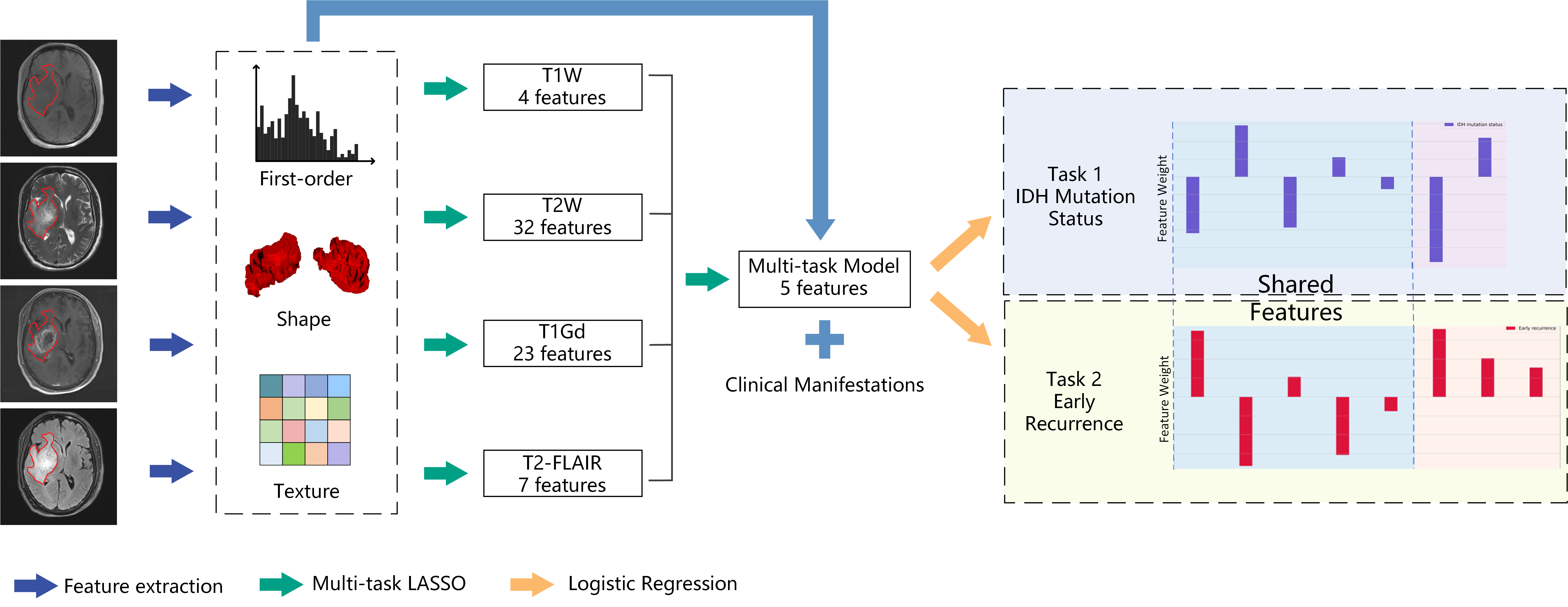
The whole workflow is illustrated in Figure 1. First, for each of the 4 sequences, we built a scout model using multi-task LASSO (scikit-learn, version 0.24.1) to find features shared by the two tasks. The average area under curve (AUC) over a 5-fold cross-validation of two tasks was used to determine the number of features of each model. Features retained in single-sequence models were then combined and multi-task LASSO was performed to build a multi-sequence multi-task model and determine the number of shared features. Second, for each task, shared features in multi-task model were used as a starting feature set and sequential feature selection (SFS)7 was used to select task-specific features from the remaining features. Logistic regression was used for classification and the number of task-specific features was determined by the highest average AUC in a 5-fold cross-validation.
Results
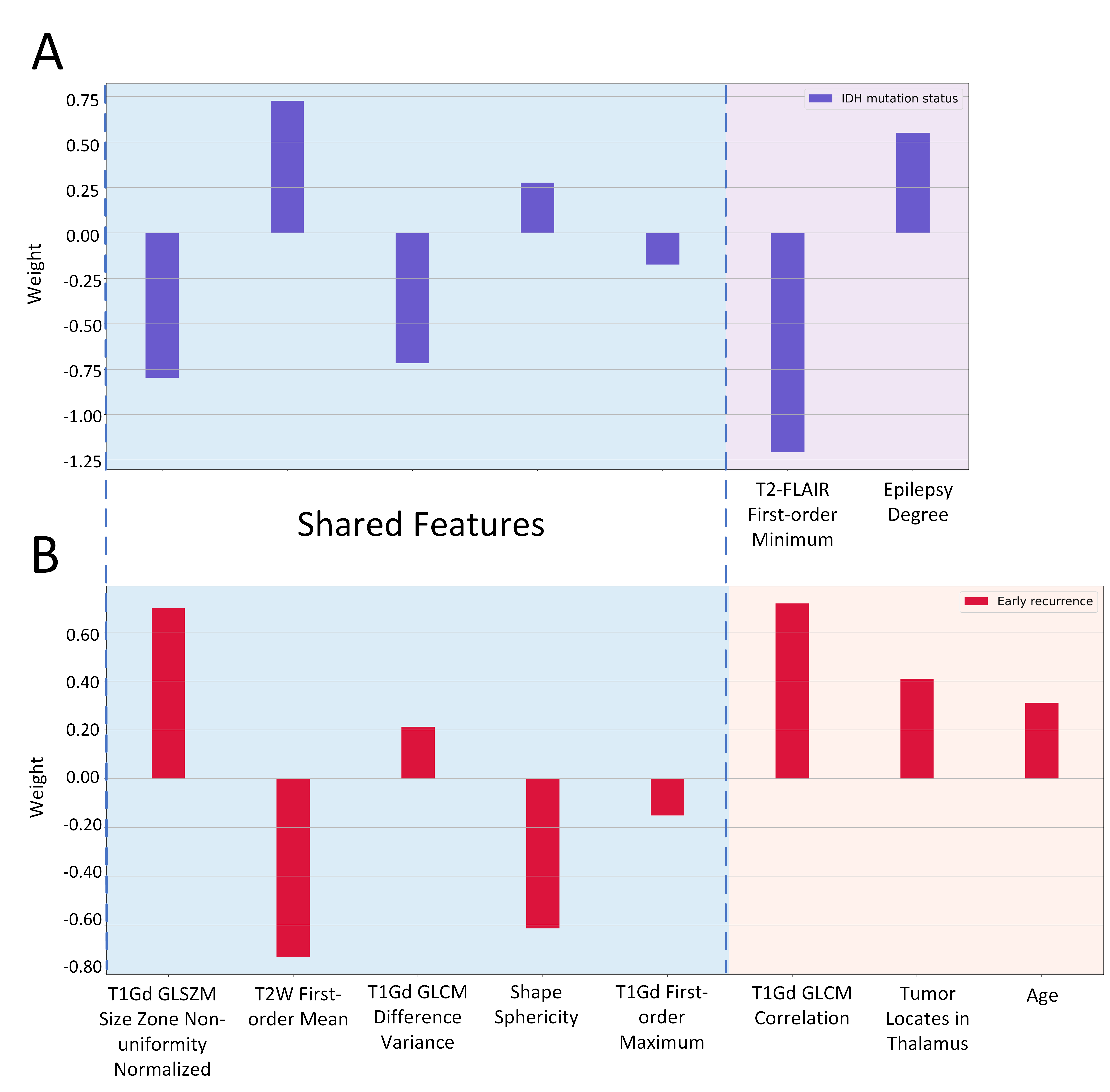
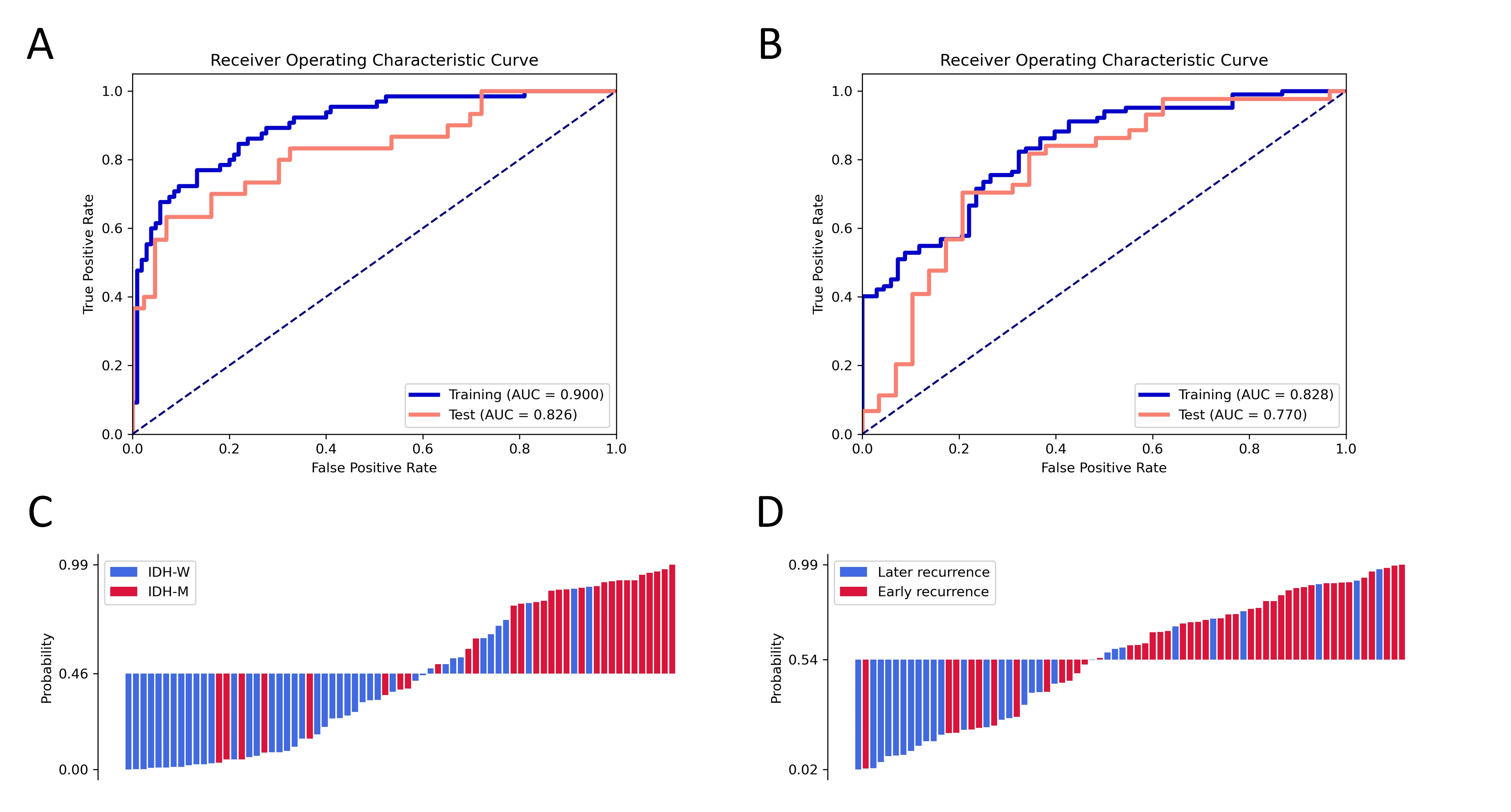
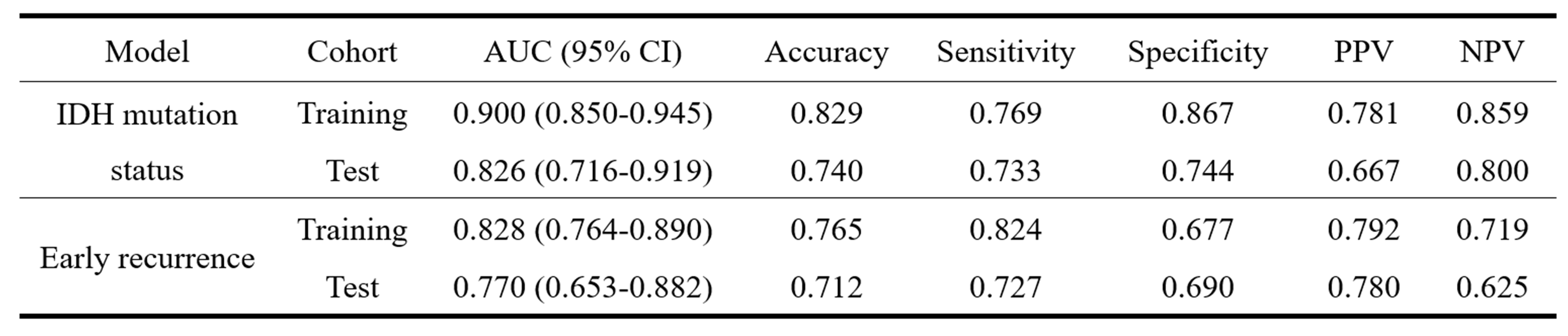
Five features shared by the two tasks were retained in the multi-sequence multi-task model. For the identification of IDH mutation status, 7 features (5 shared/2 task-specific) achieved a training AUC of 0.900 (95% confidence interval (CI): 0.850 -0.945) and a test AUC of 0.826 (95% CI: 0.716-0.919). For the prediction of early recurrence, 8 features (5 shared/3 task-specific) achieved a training AUC of 0.828 (95% CI: 0.764-0.890) and a test AUC of 0.770 (95% CI: 0.653-0.882). Features with their corresponding weights in each task were shown in Figure 2. Receiver operating characteristic (ROC) curves in training and test cohorts, waterfall plots in test cohort were illustrated in Figure 3. Statistics analysis was listed in Table 1.Discussion and Conclusion
In this study, we proposed a new multi-task radiomics approach for IDH mutation status identification and early recurrence prediction. While there have been many radiomics studies for both problems4-5, this study is different from them in that multi-task approach was used to find 5 features shared between the two tasks. This not only makes full use of the associations between IDH mutation status and early recurrence to simplify the model and avoid overfitting, but also provides a new approach for finding more generalized biomarkers and for better understanding of the underlying connections. Furthermore, the distinctiveness of different tasks was also acknowledged by incorporating task-specific features with SFS.Our results suggest that features from preoperative T1Gd, T2W, and tumor shape were important in the diagnosis and prognosis of glioma patients since they are associated with both IDH genotype and early recurrence. Shared features indicate that IDH mutation status were significantly associated with early recurrence in patients with gliomas, and IDH-W gliomas are more likely to have early recurrence than IDH-M. These findings are consistent with previous studies8. Clinical features included in the model showed that patients with epilepsy symptoms were more likely to have IDH-M than those without epilepsy. Patients with tumors locating near the thalamus and older patients were more likely to have early recurrence.
In conclusion, we proposed a new multi-task radiomics approach that combines shared features and task-specific features to identify IDH genotype and predict early recurrence from preoperative MRI and achieved good performance. This approach can be easily used to study multiple associated clinical problems simultaneously to find valuable shared biomarkers. We plan to implement this method in our open-source software for radiomics study.
Acknowledgements
This work was supported partially by the National Natural Science Foundation (61731009) and Xing-Fu-Zhi-Hua Foundation of ECNU.References
1. Weller M, Wick W, Aldape K, et al. Glioma. Nat Rev Dis Primers. 2015; 1:15017.
2. Komori T. Grading of adult diffuse gliomas according to the 2021 WHO classification of tumors of the central nervous system. Lab Invest. 2022; 102:126–133.
3. Wang T, Niu X, Gao T, et al. Prognostic factors for survival outcome of high-grade Multicentric glioma. World Neurosurg. 2018; 112:269-277.
4. Bhandari AP, Liong R, Koppen J, et al. Noninvasive determination of IDH and 1p19q status of lower-grade gliomas using MRI radiomics: a systematic review. AJNR Am J Neuroradiol. 2021; 42:94-101.
5. Wang J, Yi X, Fu Y, et al. Preoperative magnetic resonance imaging radiomics for predicting early recurrence of glioblastoma. Front Oncol. 2021; 11:769188.
6. Gravendeel LAM, Kouwenhoven MCM, Gevaert O, et al. Intrinsic gene expression profiles of gliomas are a better predictor of survival than histology. Cancer Res. 2009; 69:9065-9072.
7. Jain A, Zongker D. Feature selection: evaluation, application, and small sample performance. IEEE Trans Pattern Anal Mach Intell. 1997; 19:153-158.
8. Ichimura K. Molecular pathogenesis of IDH mutations in gliomas. Brain Tumor Pathol. 2012; 29:131–139.
Figures