0510
Preoperatively Grading Rectal Cancer with the Continue Time Random Walk DWI model.
Zhijun Geng1, Shaolei Li2, Yunfei Zhang2, Yongming Dai2, and Chuanmiao Xie1
1Sun Yat-sen University Cancer Center, Guangzhou, China, 2MR Collaboration, Central Research Institute, United Imaging Healthcare, Shanghai, China
1Sun Yat-sen University Cancer Center, Guangzhou, China, 2MR Collaboration, Central Research Institute, United Imaging Healthcare, Shanghai, China
Synopsis
Keywords: Pelvis, Diffusion/other diffusion imaging techniques
This study evaluates a new pre-operatively method to grade rectal cancer based on Continue Time Random Walk (CTRW) model. The method is to calculate three parameters of the CTRW model by fitting the model with DWI signal and a series of b-values and to differentiate low- and high-grade tumors by fitting a logistic regression with different combinations of parameters. An additional k-mean clustering analysis is performed to evaluate how differentiable the low and high-grade groups are in the CTRW parameters’ phase space. Our study shows that CTRW model has the potential to accurately grade rectal cancer.Introduction
The Continue Time Random Walk (CTRW), an extension of the FROC diffusion model, is a relatively new and advanced DWI technique that is currently used less frequently in the pelvis. The CTRW diffusion model recognizes intravoxel diffusion heterogeneity in both time and space. These diffusion heterogeneities can directly reflect intravoxel structural heterogeneity, which is related to tissue complexity and micro-environment1. In this study, we evaluate the diagnostic performance of CTRW model for non-invasively and pre-operatively grading the rectal cancer.Methods
A total of 27 patients with 14 low-grade (grade 1 and 2) and 13 high-grade (grade 3) were recruited into this prospective study. All patients received the MRI examination with a 3.0 T scanner (uMR 780, United-Imaging Healthcare, Shanghai, China). The parameters (D, α, and β) of the CTRW model were estimated by fitting,$$S(b) = S_0 E_{\alpha}(-(bD)^{\beta})$$
where Eα is a Mittag-Leffler function of the α order, β corresponds to spatial diffusion heterogeneity, and both α and β are bounded in the range of 0 and 1. Different combinations of CTRW parameters were performed to grade rectal cancer. Pearson correlation analysis was applied to evaluate the correlations. The receiver operating characteristic analysis (ROC) was performed for evaluating the diagnostic performance. Binary logistic regression and k-means clustering models were established via integrating different parameters for screening the most sensitive parameter.
Results
The maps of parameters are calculated in the region of both low- and high-grade tumor as shown in Figure 1. The color maps are created using a jet colorbar from Matlab. For individual parameters, D and β are significantly lower for high-grade than low-grade rectal cancer (p-values: D: <0.05, α: 0.423, β: <0.05; high-grade: D = 1.13 ± 0.13 μm2/ms, β = 0.67 ± 0.05; low-grade: D = 1.30 ± 0.12 μm2/ms, β = 0.89 ± 0.14). ROC analysis with individual parameters suggests that β gives the largest AUC (0.940) as shown in Figure 2B. The better discrimination was achieved with the combination of different parameters. The performance of the k-means clustering and logistic regression analysis based on all four combinations of the CTRW parameters [(D,α,β), (D,α), (D,β), (α,β)] are computed. The ROC analysis suggested the combinations of (D,α,β) and (D,β) yield the largest AUC (0.984). ROC analysis result is shown in Figure 2A. The k-means analysis showed that (α,β) produced highest diagnostic accuracy (85%), sensitivity (100%) and specificity (71%).Discussion
In this study, we have demonstrated the feasibility to differentiate low- from high-grade rectal tumors using a set of new parameters (D, α, and β) obtained from a CTRW model. D is an anomalous diffusion coefficient, similar with ADC, may have association with cellularity and β is related to spatial diffusion heterogeneity, which represents the mean free length of water molecules diffuse1. Our results have shown significant differences in D and β (p < 0.05) as well as joint parameters between two tumors groups. The high-grade tumors exhibite considerably lower values of D and β, compared with the low-grade ones. Using an independent ROC analysis, we have demonstrated that combinations of the CTRW parameters can improve the predictive quality with a larger AUC (0.984) than using D alone (AUC = 0.819). On the other hand, α, another parameter reflecting temporal diffusion heterogeneity, between low- and high-graded tumors is not significantly different. For the ROC analysis, shown in Fig. 2B, α shows no significant value for diagnosis.Conclusion
It concluded that CTRW model provides a set of novel diffusion parameters that holds great potential in accurately grading rectal cancer.Acknowledgements
No acknowledgementsReferences
1. Karaman MM, Sui Y, Wang H, et al. Differentiating low- and high-grade pediatric brain tumors using a continuous-time randomwalk diffusion model at high b-values. Magn Reson Med. 2016;76(4):1149-1157.Figures
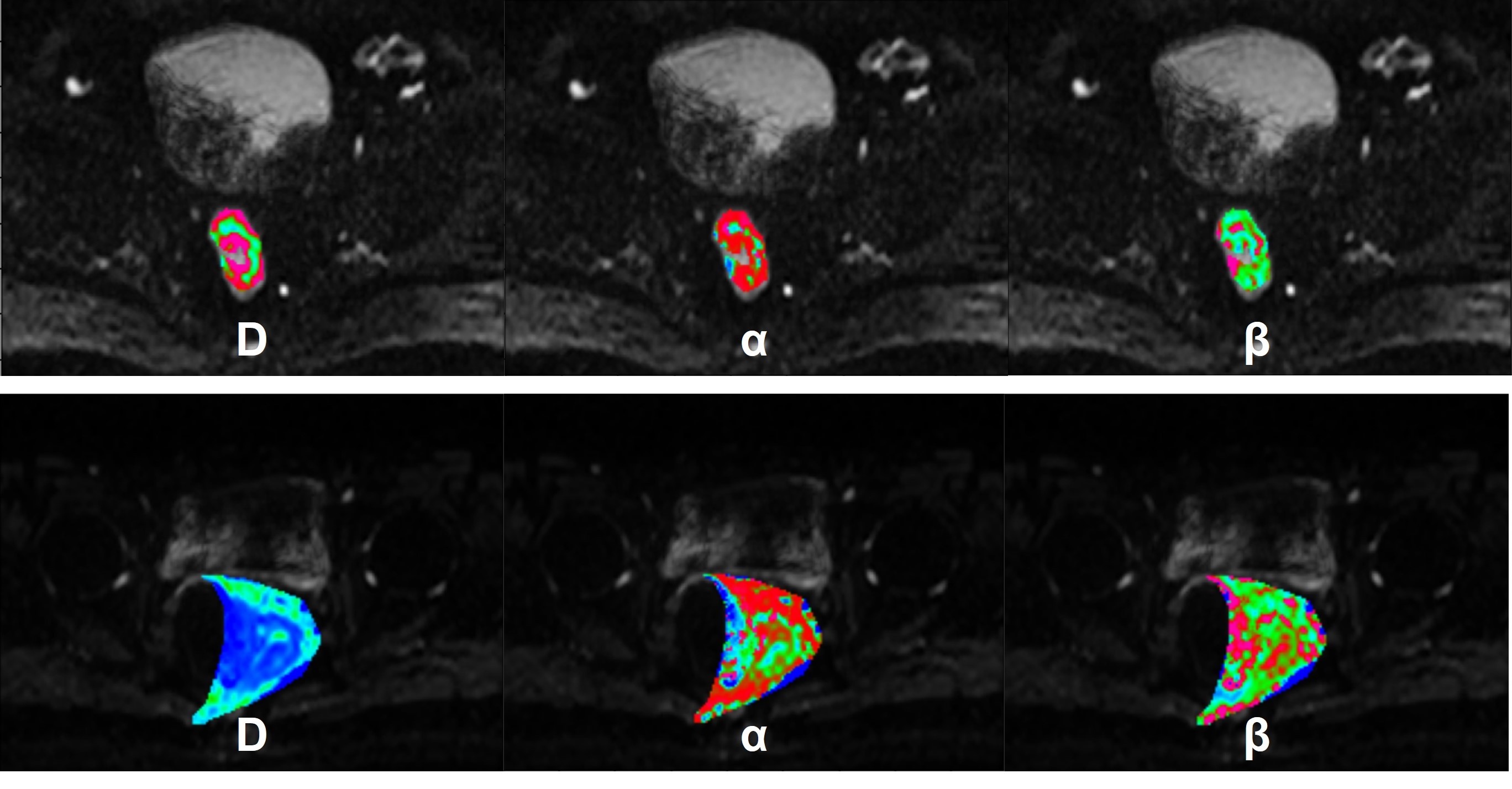
Figure 1: Examples of DWI image of low-grade (top row) and high-grade (bottom row) with b = 500 s/mm2. Maps of D, α, and β from a CTRW model are demonstrated by color in the tumor region are overlapped in DWI images.
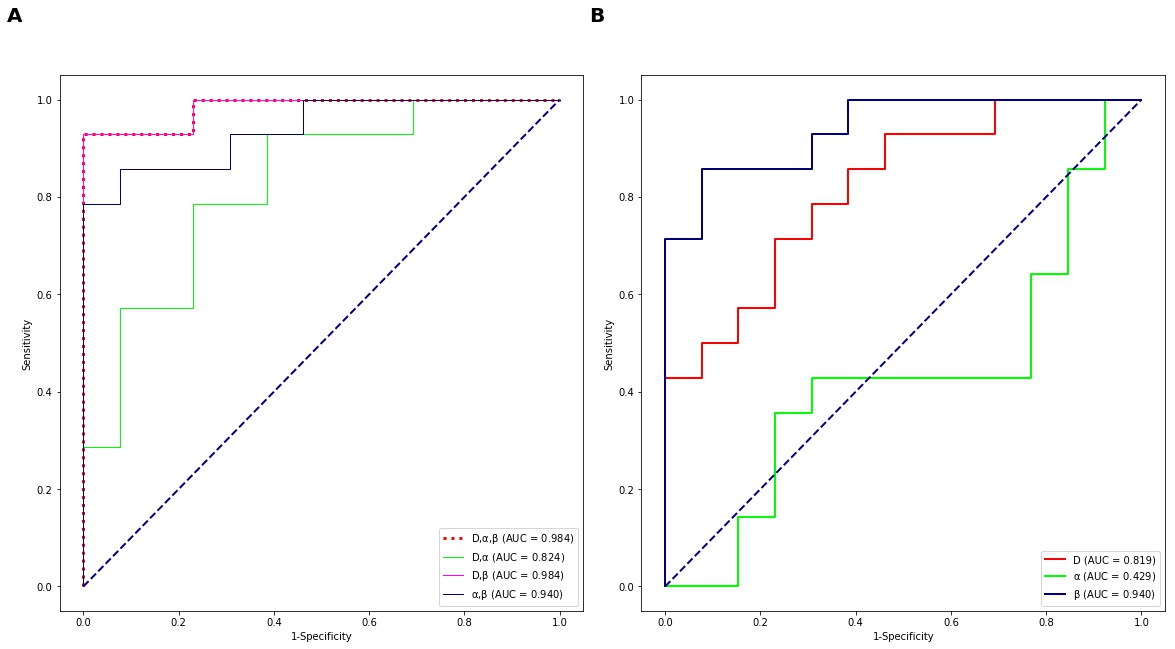
Figure 2: (A) ROC curves of different combinations of parameters, (D,α,β), (D,α), (D,β), and (α,β), for discriminating low- and high-graded tumors. (B) ROC curves of different parameters (D, α, and β) for discriminating low- and high-graded tumors.
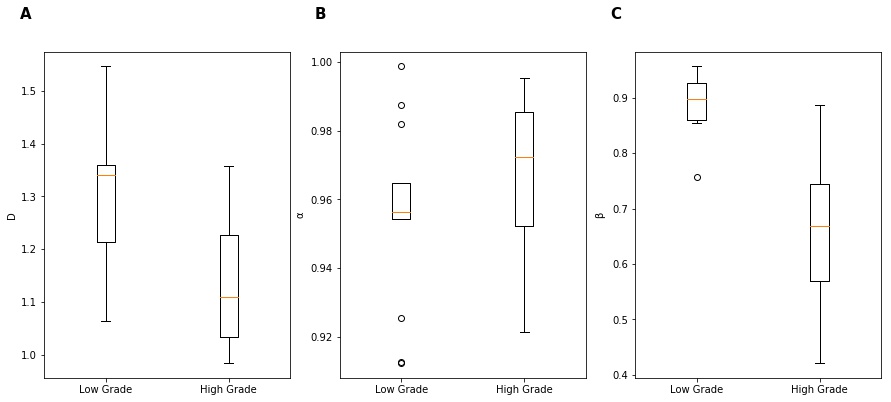
Figure 3: Box plots of individual CTRW parameters (A) D value (unit: μm2/ms); (B) α value; (C) β value.
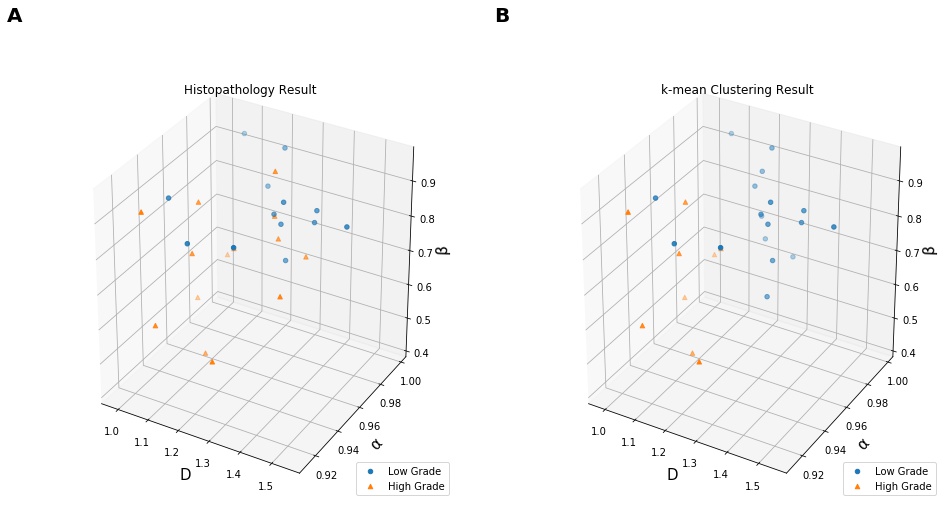
Figure 4: Three-dimensional scatter plots of the mean CTRW parameters, (D, α, and β), with colorization based on histopathology (A), and based on k-means clustering analysis results (B). Each dot represents a low-grade (in blue) or high-grade patients (in orange).
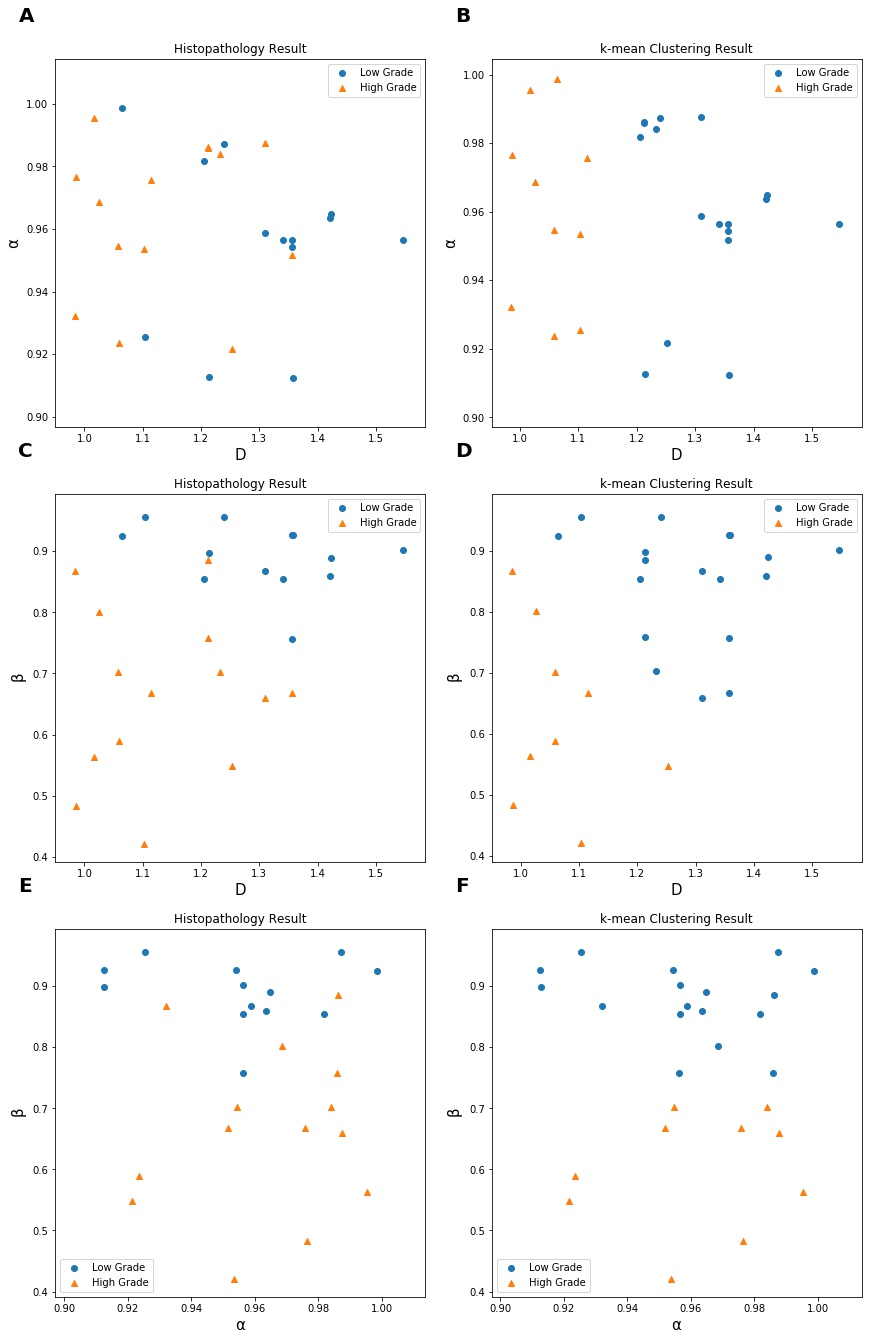
Figure 5: 2D scatter plots of the combinations of CTRW parameters, with colorization based on histopathology (A) D and α, (C) D and β, (E) α and β , and based on k-means clustering analysis results (B) D and α, (D) D and β, (F) α and β. Each dot represents a low-grade (in blue) or high-grade patients (in orange).
DOI: https://doi.org/10.58530/2023/0510