0371
Minimizing SAR for SNR-Efficient Pseudo-Continuous Arterial Spin Labeling at 7T1Wellcome Centre for Integrated Neuroimaging, FMRIB, Nuffield Department of Clinical Neuroscience, University of Oxford, Oxford, United Kingdom, 2Department of Medical Biophysics, University of Toronto, Toronto, ON, Canada, 3Physical Sciences, Sunnybrook Research Institute, Toronto, ON, Canada
Synopsis
Keywords: Arterial spin labelling, High-Field MRI
Interest in 7T PCASL is increasing due to the large potential increases in SNR. However, PCASL is a relatively high SAR technique, requiring TRs to be extended with deadtime at 7T, which reduces SNR-efficiency and some of the benefit of moving to 7T. Here, we demonstrate that using VERSE to reduce the SAR of both the PCASL and background suppression pulses can reduce TRs by almost 25%, leading to an improvement in tSNR-efficiency compared to an equivalent non-VERSE scan. We reduced the off-resonance sensitivity that VERSE introduces to the background suppression pulses by carefully optimizing the phase waveform.
Introduction
Interest in 7T arterial spin labeling (ASL) is increasing due to the large potential SNR increases that will enable high-spatial resolution perfusion imaging1 and robust measurement of white matter blood flow.2 However, pseudo-continuous ASL (PCASL) (the ASL technique with the highest potential SNR) is relatively high SAR, requiring either labeling durations (LD) to be reduced3 (reducing signal) or TRs to be extended with deadtime4–6 (reducing SNR-efficiency).Previous studies have used VERSE7,8 to reduce the SAR of the PCASL pulses,5,6,9 though many studies have not used background suppression (BGS) due to the high SAR burden of the commonly used adiabatic inversion pulses, which requires the TR to be further increased. However, not using BGS will result in much higher physiological noise, which typically dominates in ASL.
Here, we demonstrate the SAR reduction achievable when applying VERSE to both the PCASL and BGS pulses, optimizing the BGS for robustness to B0 and B1+ inhomogeneity, and how this enables TRs to be reduced (increasing SNR-efficiency).
Methods
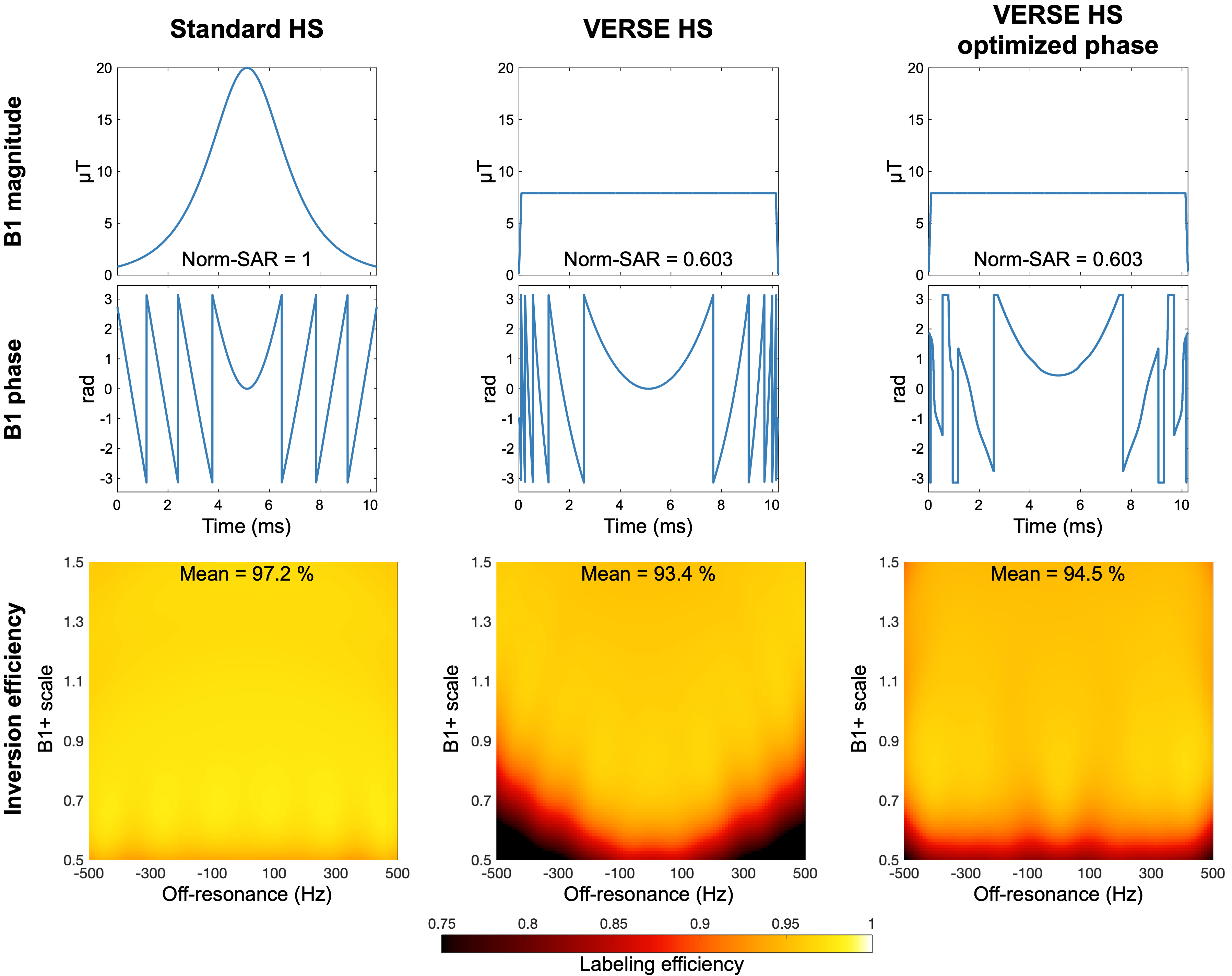
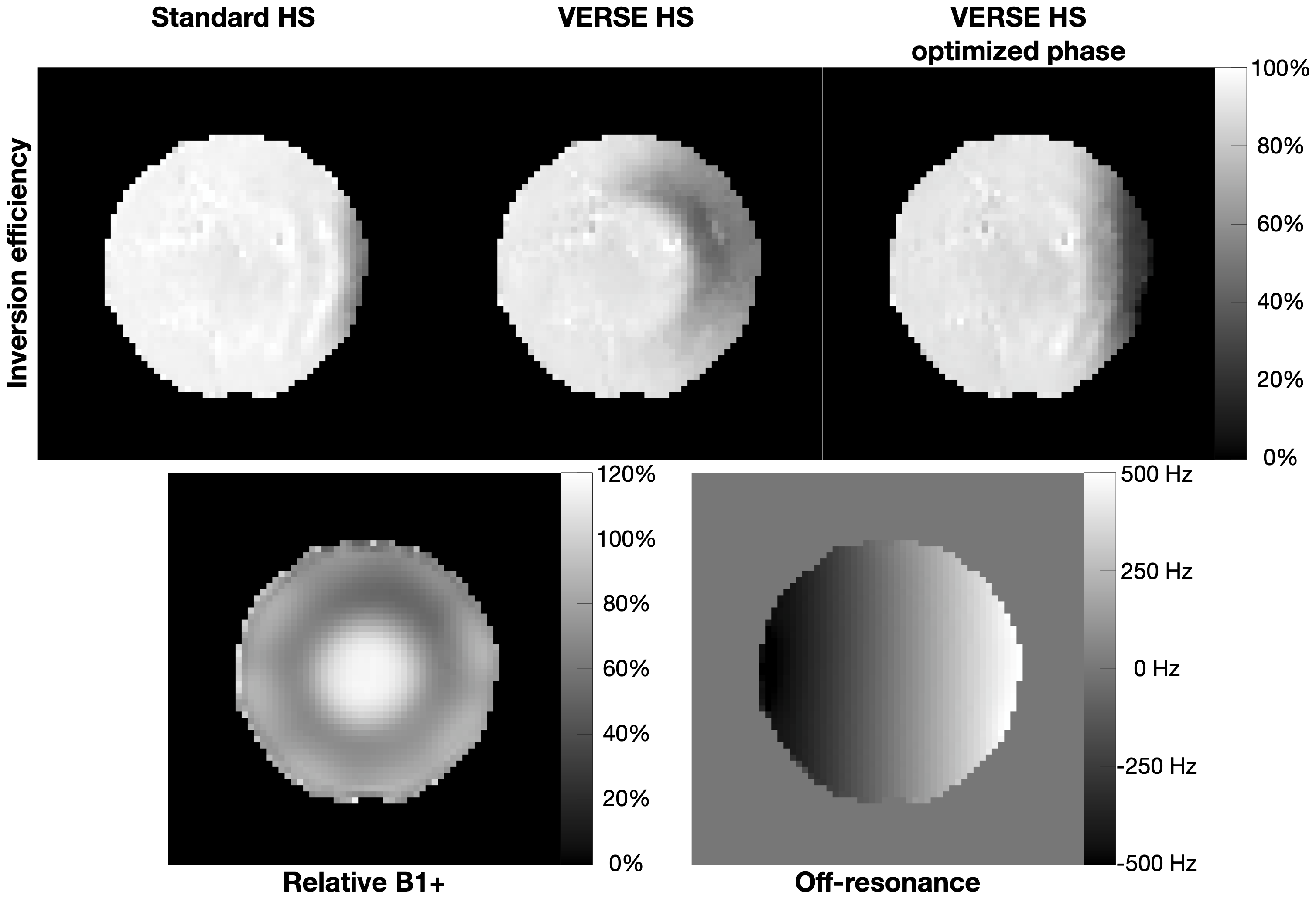
We implemented an online iterative minimum-SAR VERSE algorithm, similar to previous works,7,8 to maximally reduce the PCASL SAR while maintaining identical pulse duration and satisfying gradient constraints (amplitude 70 mT/m, slew-rate 200 T/m/s). A 10.24 ms non-spatially selective hyperbolic secant (HS) RF pulse was analytically VERSEd to a minimum-SAR trapezoidal amplitude shape with 100 µs ramps. The µ-values of the standard and VERSE HS pulses were separately optimized to maximize inversion efficiency across B1+±50% and B0±500 Hz in simulations. The β-value was chosen to achieve a 4% amplitude truncation for the standard HS pulse.10 To improve the off-resonance robustness of the VERSE HS pulse without increasing SAR, the RF phase waveform was pointwise optimized to maximize inversion efficiency across the same B1+ and B0 ranges.To evaluate the inversion efficiency of the non-selective BGS inversion pulses, saturation-inversion-recovery data were acquired in a phantom with an off-resonance profile of -500 Hz to +500 Hz across the slice and max-B1+ set at 80%.
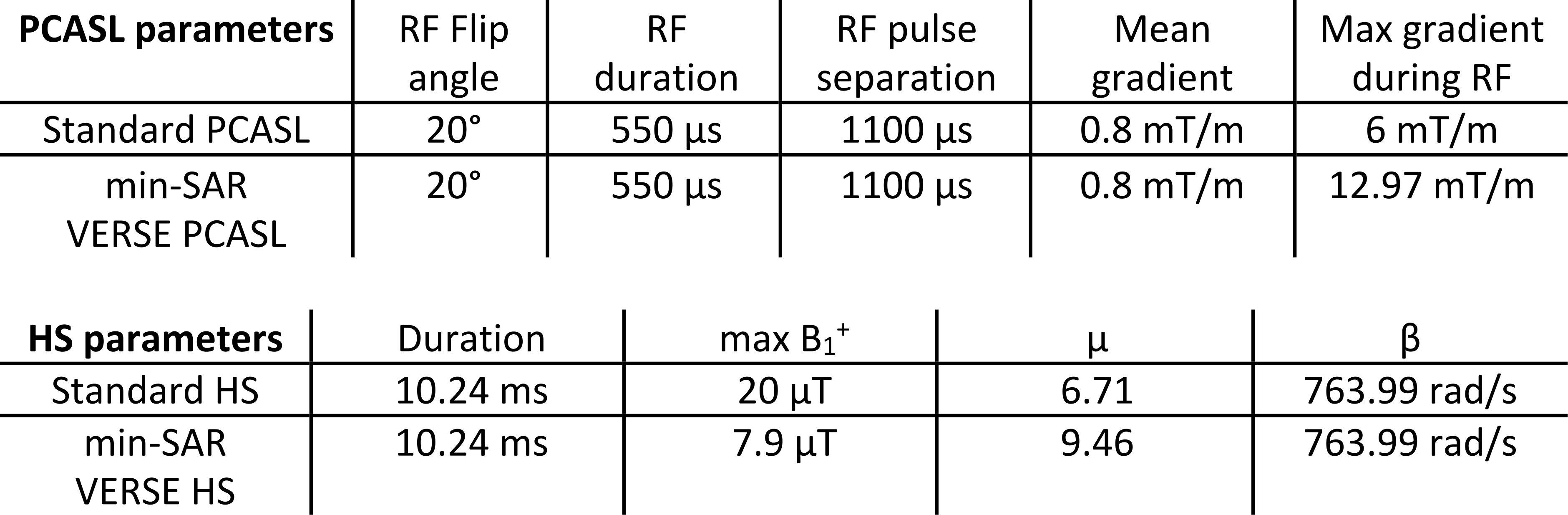
Scan-duration matched single-PLD (post-labeling delay) data were acquired in a single subject to demonstrate the sequence SAR burden with and without VERSE. Normal-level SAR constraints were used. Scan details: scan duration 4:30 min, LD=1500 ms, PLD=1800 ms, WET presaturation,11 two BGS pulses, 12 slices, GE-EPI readout, resolution 3x3x4 mm3. Figure 1 describes the PCASL and HS parameters. The labeling plane was placed above the circle of Willis and the B1+-transmit efficiency was accounted for by increasing the nominal PCASL flip angle. Off-resonance during the PCASL preparation was not corrected. Data were acquired on a Siemens 7T Magnetom system using a 1Tx/32Rx head-coil.
Results
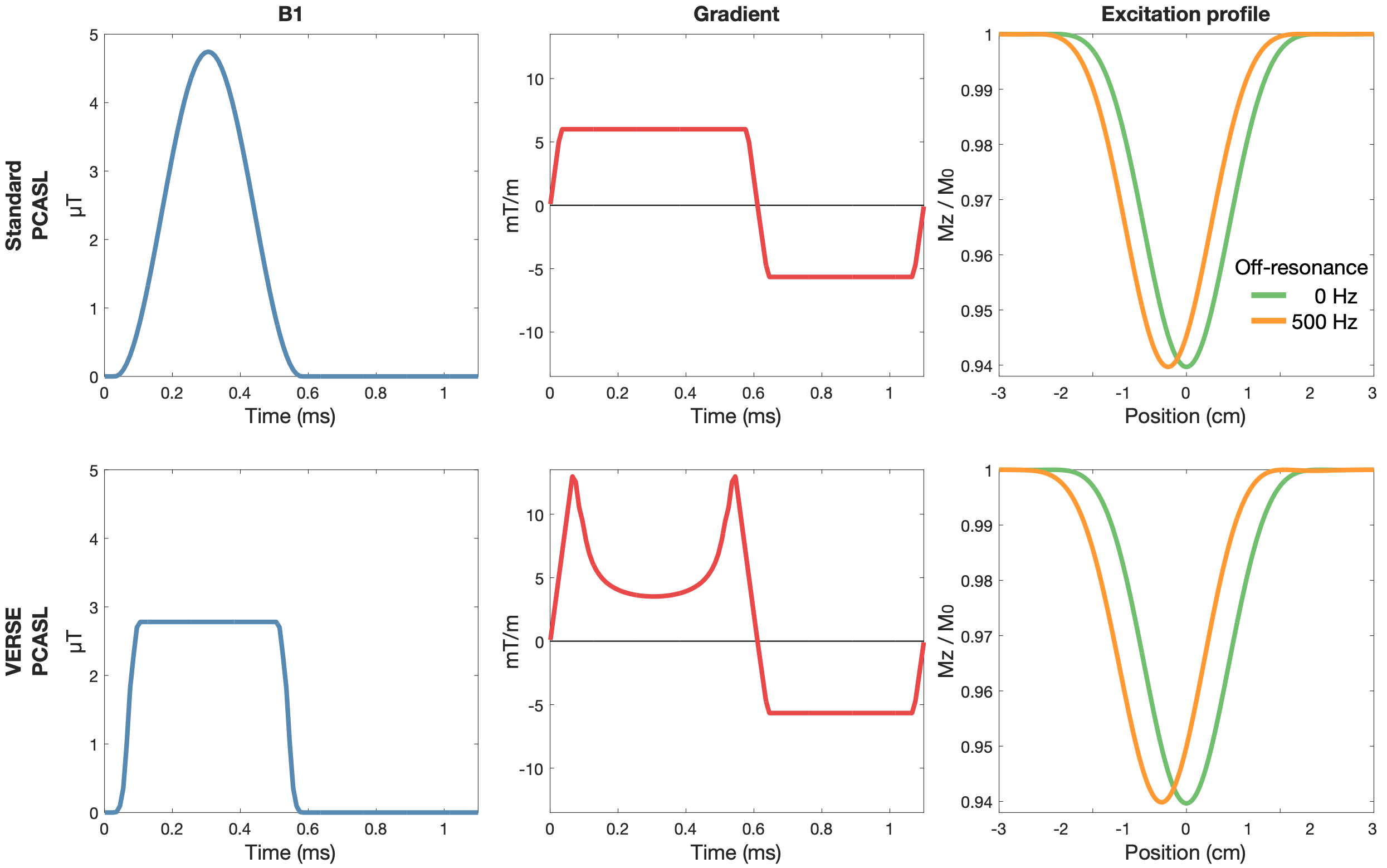
VERSE reduced the PCASL SAR by 24.5% (Figure 2) without greatly affecting the off-resonance behavior due to the short pulse duration, as found previously.5,6,8 After increasing the PCASL flip angle by 50% to account for low transmit efficiency at the labeling plane, the PCASL preparation accounted for 80.5% of the total sequence SAR, meaning overall SAR was reduced by 19.7%. VERSE reduced the HS SAR by 39.7% (Figure 3). The two standard HS pulses represented 11.8% of the sequence SAR, thus reducing total SAR by 4.7%. Together, the use of VERSE reduced the total sequence SAR by 24.5%.The inversion efficiency simulation and phantom measurements in Figure 3 and Figure 4 demonstrate that optimizing the VERSE HS phase waveform improved the mean inversion efficiency across the targeted B1+ and B0 range, though the inversion efficiency of the standard HS pulse was not quite reached.
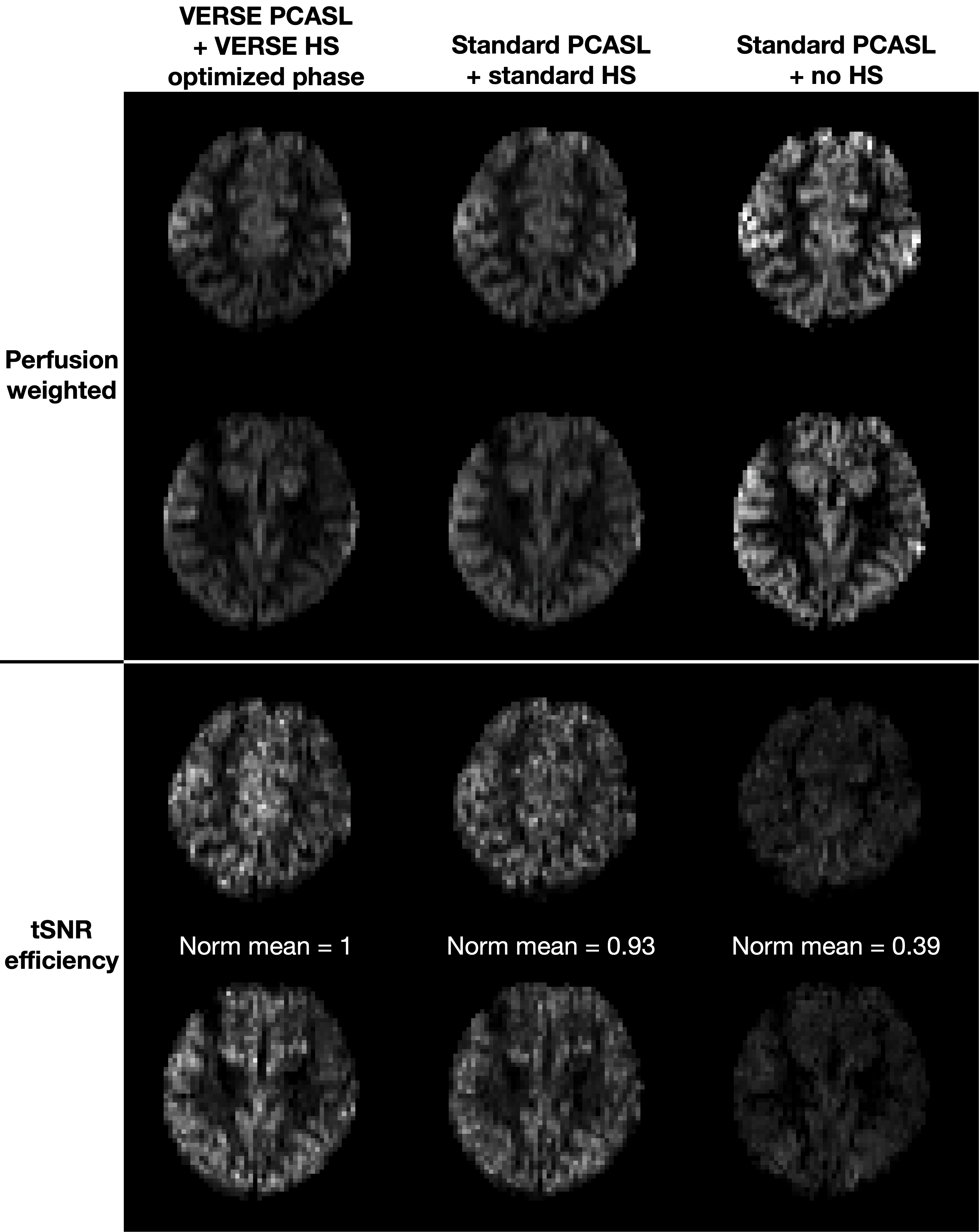
In vivo, using VERSE with the PCASL and BGS pulses reduced the minimum possible SAR-constrained TR from 8872 ms to 6697 ms for the subject tested, a 24.5% reduction. As a result, the VERSE scan had a higher tSNR-efficiency than when VERSE wasn't used (Figure 5). Even when BGS was not used in the non-VERSE scan, the minimum possible TR was 7819 ms, 16.8% longer than when BGS was used in the VERSE scan.
Discussion
We demonstrated that using VERSE for both the PCASL and BGS pulses can reduce SAR by 24.5%, reducing TRs by the same amount at 7T, improving SNR-efficiency. Optimizing the phase waveform of the VERSE HS BGS pulses can reduce the off-resonance sensitivity introduced by the VERSE process, yielding ~40% decrease in BGS SAR with only a relatively minor reduction in inversion efficiency.Previous studies3,6 have proposed reducing the PCASL pulse duration and inter-pulse gap to improve the labeling off-resonance robustness. However, this can reduce the potential SAR benefits possible with VERSE due to gradient slew-rate constraints.3 Instead, we argue that off-resonance effects would ideally be actively corrected during labeling12 and/or with dynamic B0 shimming13 after a fast field-map acquisition, allowing the PCASL RF duration and inter-pulse gap to be longer. This enables a greater reduction in SAR using VERSE, yielding more SNR-efficient minimum TRs.
Conclusions
VERSE is a relatively simple method to reduce SAR for 7T PCASL acquisitions, improving SNR-efficiency by enabling shorter TRs. Further SAR reductions could be achieved by increasing the PCASL RF duty cycle6 (increasing the RF duration while keeping the inter-pulse spacing fixed) and applying VERSE to the readout excitations.Acknowledgements
The Wellcome Centre for Integrative Neuroimaging is supported by core funding from the Wellcome Trust (203139/Z/16/Z). This study was supported by a Sir Henry Dale Fellowship jointly funded by the Wellcome Trust and the Royal Society (Grant Number 220204/Z/20/Z). MC is supported by the Canada Research Chairs Program. The authors thank James L. Kent, Matthijs H.S. de Buck, and Aaron T. Hess for their help with 7T scanning.References
1. Shao X, Guo F, Shou Q, et al. Laminar perfusion imaging with zoomed arterial spin labeling at 7 Tesla. NeuroImage. 2021;245:118724. doi:10.1016/j.neuroimage.2021.118724
2. Gardener AG, Jezzard P. Investigating white matter perfusion using optimal sampling strategy arterial spin labeling at 7 Tesla. Magn Reson Med. 2015;73(6):2243-2248. doi:10.1002/mrm.25333
3. Wang K, Ma SJ, Shao X, et al. Optimization of pseudo-continuous arterial spin labeling at 7T with parallel transmission B1 shimming. Magn Reson Med. 2022;87(1):249-262. doi:10.1002/mrm.28988
4. Saïb G, Koretsky AP, Talagala SL. Optimization of pseudo-continuous arterial spin labeling using off-resonance compensation strategies at 7T. Magnetic Resonance in Medicine. 2022;87(4):1720-1730. doi:10.1002/mrm.29070
5. Meixner CR, Eisen CK, Schmitter S, et al. Hybrid -shimming and gradient adaptions for improved pseudo-continuous arterial spin labeling at 7 Tesla. Magnetic Resonance in Medicine. 2022;87(1):207-219. doi:10.1002/mrm.28982
6. Boland M, Stirnberg R, Pracht ED, Stöcker T. Robust and SAR-efficient whole-brain pseudo-continuous ASL at 7T. In: Proceedings of the 29th Annual Meeting of the ISMRM, Virtual. ; 2019:4963.
7. Conolly S, Nishimura D, Macovski A, Glover G. Variable-rate selective excitation. J Magn Reson 1969. 1988;78(3):440-458. doi:10.1016/0022-2364(88)90131-X
8. Hargreaves BA, Cunningham CH, Nishimura DG, Conolly SM. Variable-rate selective excitation for rapid MRI sequences. Magn Reson Med. 2004;52(3):590-597. doi:10.1002/mrm.20168
9. Tong Y, Jezzard P, Okell TW, Clarke WT. Improving PCASL at ultra-high field using a VERSE-guided parallel transmission strategy. Magnetic Resonance in Medicine. 2020;84(2):777-786. doi:10.1002/mrm.28173
10. Payne GS, Leach MO. Implementation and evaluation of frequency offset corrected inversion (FOCI) pulses on a clinical MR system. Magn Reson Med. 1997;38(5):828-833. doi:10.1002/mrm.1910380520
11. Golay X, Petersen ET, Hui F. Pulsed Star Labeling of Arterial Regions (PULSAR): A robust regional perfusion technique for high field imaging. Magn Reson Med. 2005;53(1):15-21. doi:10.1002/mrm.20338
12. Berry ESK, Jezzard P, Okell TW. Off-resonance correction for pseudo-continuous arterial spin labeling using the optimized encoding scheme. NeuroImage. May 2019:272. doi:10.1016/j.neuroimage.2019.05.083
13. Koch KM, McIntyre S, Nixon TW, Rothman DL, de Graaf RA. Dynamic shim updating on the human brain. J Magn Reson. 2006;180(2):286-296. doi:10.1016/j.jmr.2006.03.007
Figures