0313
Virtual coil concept with multi-scale low-rank for real-time cardiac MR at 0.55T1Department of Radiology, University of Michigan, Ann Arbor, MI, United States
Synopsis
Keywords: Heart, Low-Field MRI
Real-time MR applications are often highly undersampled due to the high temporal resolution required. Here, we propose a novel linear forward model combining virtual coils and multi-scale low-rank to enable highly accelerated real-time cardiac MR. The virtual coil concept leverages Hermitian symmetry, whereas multi-scale low-rank attempts to model real-time motion as a combination of subspaces across multiple image scales. Experiments in five healthy subjects demonstrate a considerable improvement in image quality over conventional iterative SENSE, enabling real-time cardiac imaging at 0.55T.INTRODUCTION:
Cardiac MR is a powerful technique for the evaluation of myocardial structure and function, where cine imaging is key for functional assessment. Cine data are commonly acquired during a breath-hold, using ECG-gating to ensure k-space data are assigned to the appropriate cardiac phase. However, respiratory drifts may occur and the cardiac cycle is susceptible to variations due to underlying disease and/or natural respiratory sinus arrhythmia.Free-breathing, real-time cardiac MR is an alternative approach that can bypass the limitations of breath-hold, gated cine scans. However, it is challenging in practice to collect MRI data at a high enough spatial resolution in real-time to both resolve motion and provide high-resolution images. This is particularly challenging at lower field strengths, due to reduced SNR and the reduced channel count on lower cost commercial systems. At 1.5T and above, methods using coil sensitivity variations (iterative SENSE1, through-time GRAPPA2), spatio-temporal redundancy (k-t PCA3), compressed sensing (k-t Sparse SENSE4), joint image/coil reconstructions (NLINV5), partial separability (PS-Sparse6), and low-rank plus sparse methods (L+S7) have been applied to enable real-time cardiac imaging. Most of these methods rely on computationally demanding non-linear formulations, limiting practical application. However, it may be possible to reduce the complexity of the problem by leveraging multiple low-rank subspaces in a linear formulation. These subspaces can be created over multiple image scales, from small neighbourhoods up to the global (image) scale. Such Multi-Scale Low-Rank approaches8 have been shown to offer superior performance compared to methods such as low-rank plus sparse.
In this work, we incorporate a multi-scale low-rank approach into the forward model to form spatially resolved subspaces (i.e. one subspace per pixel location). Additionally, we combine this model with the Virtual Coil Concept, which leverages Hermitian symmetry to further improve the well-posedness of highly undersampled real-time reconstructions, while maintaining the advantages of a linear formulation. We demonstrate the use of this model for real-time cardiac MRI at 0.55T.
METHODS:
The proposed virtual-coil multi-scale low-rank approach can be described by the following formulation:$$\boldsymbol{\hat{y}=argmin_y}\begin{Vmatrix}\boldsymbol{SF\begin{bmatrix}\boldsymbol{P}\\\boldsymbol{P*}\end{bmatrix}\begin{bmatrix}\boldsymbol{C}\\\boldsymbol{C*}\end{bmatrix}U_{MS}y-\begin{bmatrix}\boldsymbol{s}\\\boldsymbol{s'}\end{bmatrix}}\end{Vmatrix}_2^2,[eq.1]$$
where $$$\boldsymbol{S}$$$ is the sampling trajectory; $$$\boldsymbol{F}$$$ is the Fourier transform; $$$\boldsymbol{P}$$$ is the image phase; $$$\boldsymbol{C}$$$ are coil sensitivities; $$$\boldsymbol{s}$$$ are the acquired data, where $$$\boldsymbol{s'(k)=s^*(-k)}$$$ (with $$$\boldsymbol{k}$$$ denoting k-space coordinate); and $$$\boldsymbol{U_{MS}=[U_1,U_2,...U_{Ns}]^T}$$$, considering $$$N_s$$$ scales, where $$$\boldsymbol{U_s}$$$ corresponds to the subspace estimated at a given image scale. Moreover, $$$\boldsymbol{U_s}$$$ contains pixel-resolved subspaces, i.e. it is a matrix of size NyNxNtxNr, where Ny and Nx are image dimensions, Nt is the number of frames in the real-time series and Nr is the rank of the subspace. Conversely, $$$\boldsymbol{y=[y_1,y_2,...y_{Ns}]^T}$$$ , where $$$\boldsymbol{y_s}$$$ are the singular images of the real-time series, relative to the s-th compression. Different $$$\boldsymbol{U_s}$$$ will capture motion of the real-time series at different scales, and with different levels of robustness to noise.
Here, we have considered $$$N_s=6$$$ windows (scales) to estimate pixel-wise subspaces $$$\boldsymbol{U_s}$$$, using window sizes of [3, 5, 9, 17, 33, 65]. The effective rank at each pixel location and each scale was automatically determined by the Marchenko-Pastur distribution.9 In the proposed framework (Fig.1), these subspaces are estimated from a preliminary virtual coil concept reconstruction. Similarly, the image phase required for the virtual coil component is estimated from a preliminary zero-filled reconstruction. The proposed virtual-coil multi-scale low-rank formulation (eq. [1]) can be solved with a standard algorithm like the Conjugate Gradient.
EXPERIMENTS:
The proposed virtual-coils + multi-scale low-rank formulation was evaluated using data from five healthy subjects at 0.55T (Free.Max, MAGNETOM Siemens, Erlangen, Germany) using a 6-channel cardiac array and 8-channels from the spine array. Imaging parameters included one short axis slice; field of view (FOV) = 280x280 mm2; 8 mm slice thickness; resolution = 2.2x2.2 mm2; TE/TR = 1.8/6.3 ms; flip angle = 105º; bSSFP readout; golden-angle spiral; 768 excitations acquired in 4.8s during free-breathing without ECG gating. Real-time series were reconstructed with iterative SENSE, and with the proposed approach targeting a ~60 ms temporal resolution (10 spiral interleaves per frame).RESULTS:
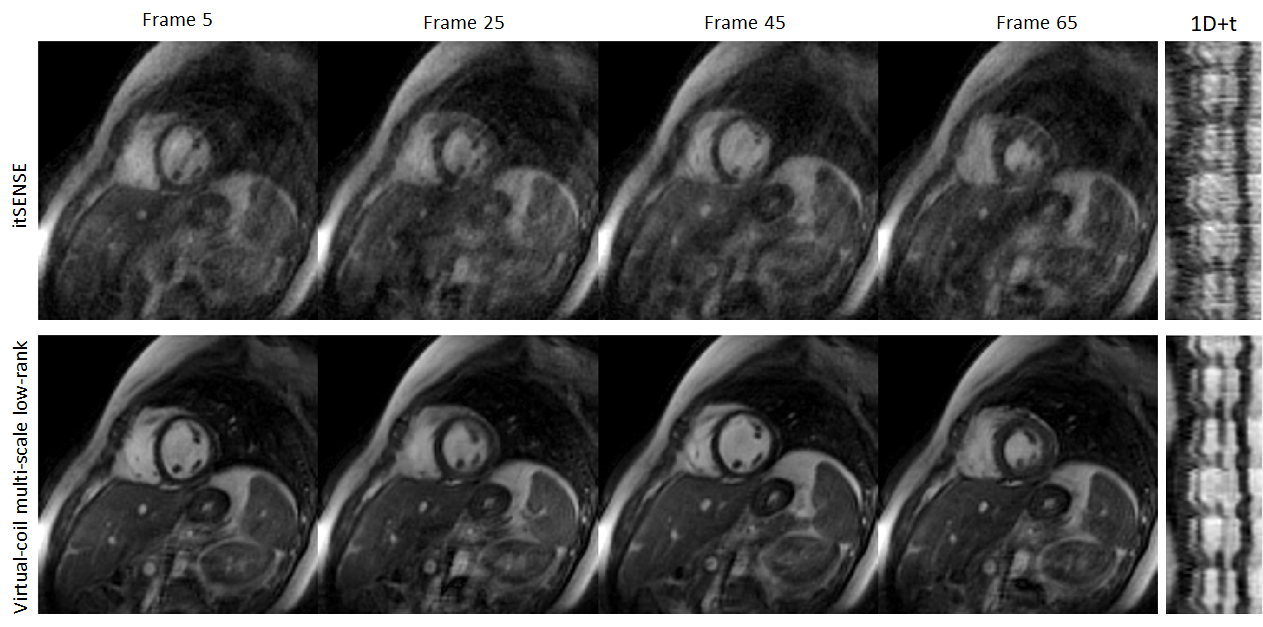
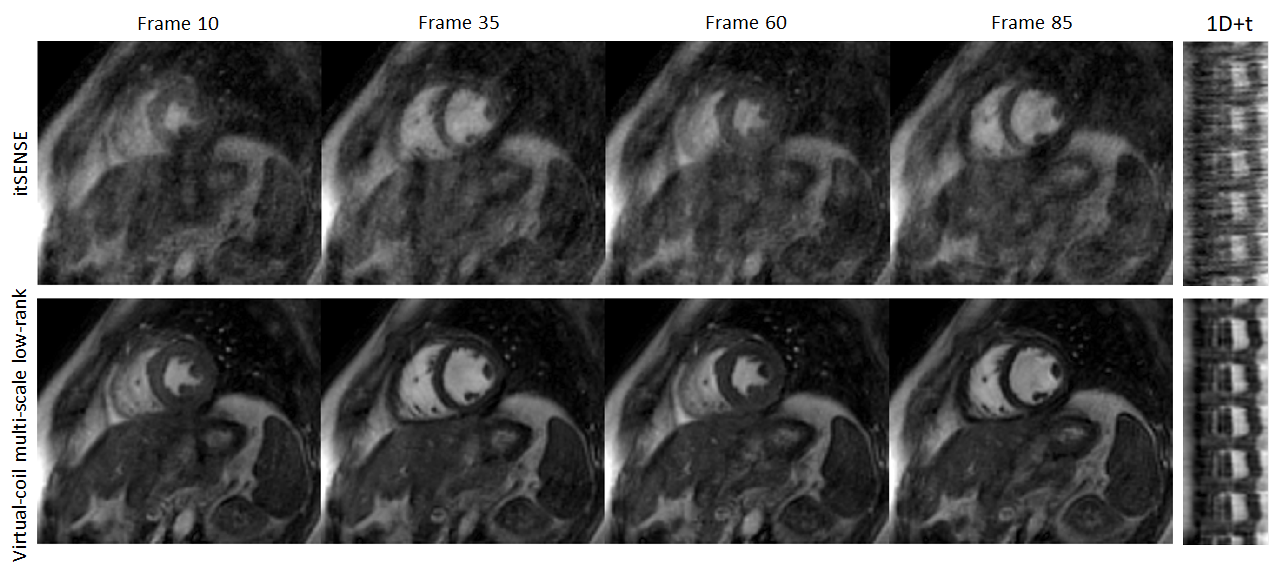
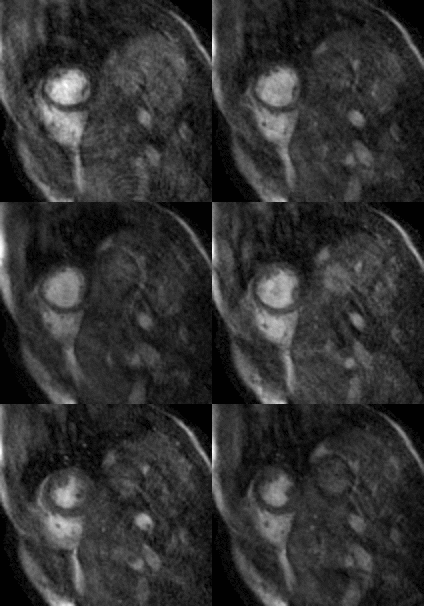
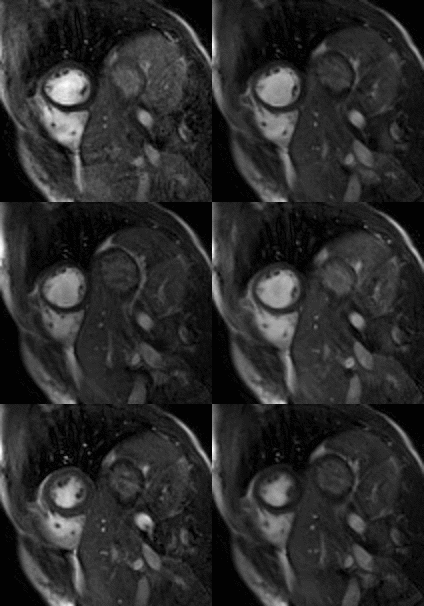
Considerable aliasing remains after reconstruction using iterative SENSE, producing noise amplification, and also coherent artefacts that affect image contrast. However, the majority of these artefacts are suppressed with the proposed virtual-coil + multi-scale low-rank, shown in Fig.2 and Fig.3. Temporal profiles in these figures further indicate that the proposed approach correctly resolves real-time cardiac and respiratory motion with higher fidelity than iterative SENSE, while maintaining the dynamics of small structures like the papillary muscles. An animated series from a representative subject is shown in Fig.4/Fig.5, where a considerable improvement in image quality is achieved with the virtual-coils + multi-scale low-rank formulation.CONCLUSION:
By combining virtual coils with multi-scale low-rank reconstruction, real-time cardiac MR imaging can be performed at 0.55T without the need for a non-linear model. Given the lower SNR and reduced channel count on this system, reconstruction approaches which have been successful at higher field strengths such as iterative SENSE may not perform as expected, and thus novel methods such as the approach explored here may be required. One drawback is that the proposed framework requires estimation of large subspaces; however, these can themselves be compressed (and their computation optimized). Future work will explore properties of multi-scale low-rank for motion resolved imaging in a larger subject cohort.Acknowledgements
This work was supported by the NIH (R01 HL153034, R01HL163991, R01HL163030) and Siemens Healthcare.References
1. Pruessmann KP, Weiger M, Börnert P, Boesiger P. Advances in sensitivity encoding with arbitrary k‐space trajectories. Magnetic Resonance in Medicine: An Official Journal of the International Society for Magnetic Resonance in Medicine. 2001 Oct;46(4):638-51.
2. Seiberlich N, Ehses P, Duerk J, Gilkeson R, Griswold M. Improved radial GRAPPA calibration for real‐time free‐breathing cardiac imaging. Magnetic resonance in medicine. 2011 Feb;65(2):492-505.
3. Pedersen H, Kozerke S, Ringgaard S, Nehrke K, Kim WY. k‐t PCA: temporally constrained k‐t BLAST reconstruction using principal component analysis. Magnetic Resonance in Medicine: An Official Journal of the International Society for Magnetic Resonance in Medicine. 2009 Sep;62(3):706-16.
4. Feng L, Srichai MB, Lim RP, Harrison A, King W, Adluru G, Dibella EV, Sodickson DK, Otazo R, Kim D. Highly accelerated real‐time cardiac cine MRI using k–t SPARSE‐SENSE. Magnetic resonance in medicine. 2013 Jul;70(1):64-74.
5. Zhang S, Uecker M, Voit D, Merboldt KD, Frahm J. Real-time cardiovascular magnetic resonance at high temporal resolution: radial FLASH with nonlinear inverse reconstruction. Journal of Cardiovascular Magnetic Resonance. 2010 Dec;12(1):1-7.
6. Zhao B, Haldar JP, Christodoulou AG, Liang ZP. Image reconstruction from highly undersampled (k, t)-space data with joint partial separability and sparsity constraints. IEEE transactions on medical imaging. 2012 Jun 8;31(9):1809-20.
7. Otazo R, Candes E, Sodickson DK. Low‐rank plus sparse matrix decomposition for accelerated dynamic MRI with separation of background and dynamic components. Magnetic resonance in medicine. 2015 Mar;73(3):1125-36.
8. Ong F, Lustig M. Beyond low-rank+ sparse: Multiscale low-rank matrix decomposition. IEEE journal of selected topics in signal processing. 2016 Mar 23;10(4):672-87.
9. Marčenko VA, Pastur LA. Distribution of eigenvalues for some sets of random matrices. Math USSR-Sbornik. 1967;1:457-483.
Figures
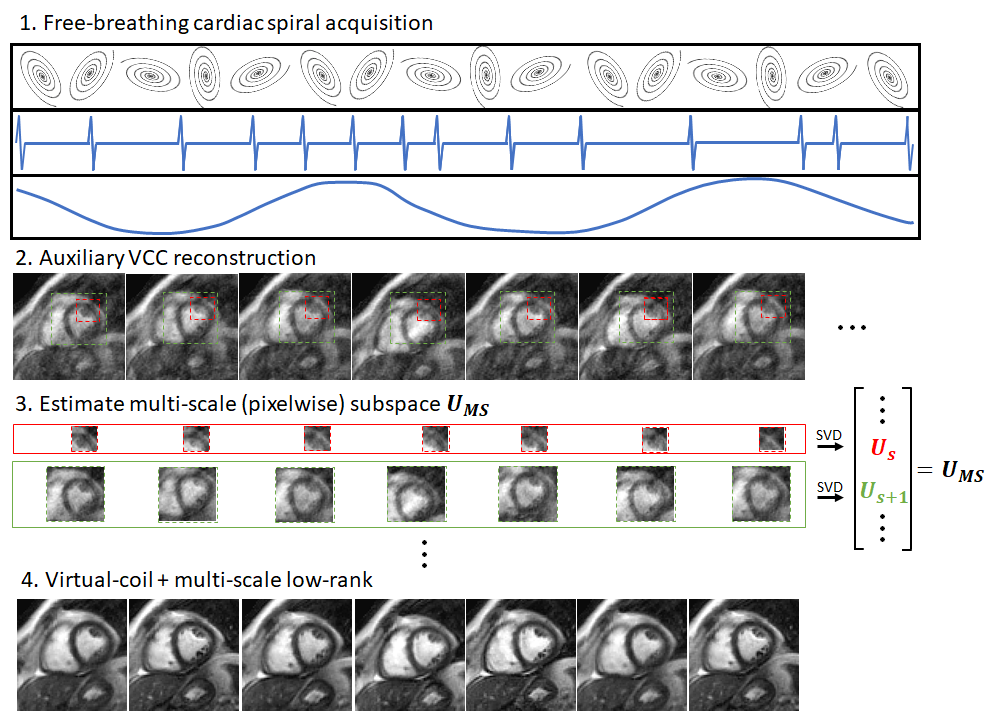
Diagram of the proposed approach.
1. Data is acquired free-breathing with a golden-angle spiral.
2. A preliminary Virtual Coil Concept (VCC) reconstruction is employed (considering phase estimated from a zero-filled reconstruction), yielding an initial estimate of the real-time series.
3. A set of subspaces Us are derived from these images at multiple scales, (and for each pixel location) to construct UMS.
4. Phase and multi-scale low-rank subspaces are incorporated into the proposed (linear) forward model, enabling low-field real-time cardiac MR.