0310
Artifact reduction for real-time spiral MRI using out-in sampling at 0.55T1Ming Hsieh Department of Electrical and Computer Engineering, University of Southern California, Los Angeles, CA, United States
Synopsis
Keywords: Low-Field MRI, Low-Field MRI, Speech, RT-MRI
We demonstrate reduced artifacts for real-time MRI of speech production at 0.55T with a gradient echo sequence using spiral out-in sampling, and constrained image reconstruction. This approach avoids banding artifacts experienced by spiral bSSFP sequences, and exhibits reduced blurring artifact compared to a spiral out gradient echo sequence at the same readout duration.Introduction
Real-time MRI (RT-MRI) is a valuable tool for capturing complex spatio-temporal coordination of vocal articulators during human speech production1. Spiral acquisitions are desirable due to their high scan efficiency and resilience to motion artifacts; they have produced high spatial (1~3 mm) and temporal (12~40ms) resolution when combined with advanced image reconstruction2.Spiral trajectories are primarily limited by off-resonance adjacent to air-tissue interfaces. Blurring artifacts and/or banding artifacts due to off-resonance degrade image quality most significantly at air-tissue interfaces, which are the exact areas of interest for speech imaging. For this reason, current speech RT-MRI studies are most often conducted using short readouts on the lowest possible field strength (e.g., 1.5T) commercial MRI scanners3. Recently, contemporary 0.55T MRI equipment with high-performance gradient system have demonstrated improved capability in doing real-time imaging1,3,4,5, largely due to the reduced off-resonance, reduced SAR, and feasibly scaled relativity (shorter T1 and longer T2). Lim et al has demonstrated a real-time bSSFP sequence to provide high SNR speech images5. However, bSSFP is sensitive to banding artifacts and is especially problematic at air-tissue boundaries such as the velum and hard palate.
In this work, we develop and optimize a spiral out-in GRE pulse sequence for real-time speech production imaging at 0.55T. Spiral out-in sampling captures two gradient echoes, allowing for reconstructions at two echo times. In each reconstruction, the effective phase accumulation is halved compared to that of a spiral out trajectory with an equivalent readout time. This allows us to use a longer readout for spiral out-in which greatly reduces blurring artifacts due to off-resonance and improves the SNR for GRE imaging. We compare the spiral out-in GRE sequence with spiral out bSSFP and GRE sequence in terms of banding and blurring artifacts.
Methods
Experiments: Experiments were performed using a whole-body 0.55T system (prototype MAGNETOM Aera, Siemens Healthineers, Erlangen, Germany) equipped with high-performance shielded gradients (45 mT/m amplitude, 200 T/m/s slew rate)6. We used a custom 8-channel upper airway coil that has four elements on each side of the jaw7. Two healthy adult volunteers were scanned, after providing written informed consent.Acquisition: Imaging was performed with the RTHawk real-time imaging platform (HeartVista Inc., Los Altos, CA, USA). Volunteers performed two stimuli – to count 1 to 5 at a normal speed and to open the mouth. The open mouth position is common during human speech production and is likely to generate large off-resonance while counting from 1 to 5 allows us to capture the complex coordination of vocal articulators.
Reconstruction: Reconstruction employed a temporal finite difference8 constraint, and was implemented in MATLAB (Mathworks, USA), and performed offline, with the reconstruction parameter previously determined5. Spiral trajectory was corrected with measured gradient impulse response function9,10.
Results
Figure 2 shows the ideal flip angle of each sequence based on a magnitude simulation of different TR values for spiral out-in GRE, and spiral out bSSFP and GRE. The flip angles chosen for spiral out-in GRE, spiral out bSSFP and GRE were chosen based on the peak magnitude simulation. bSSFP offers a relatively consistent signal profile with varying TRs, whereas GRE provides a higher signal intensity with longer TR.Figure 3 illustrates reconstructed images for spiral out-in GRE, spiral out bSSFP and GRE with a count 1-5 stimulus for varying readout durations. For spiral out GRE, a longer readout may be more desirable in terms of SNR, however, the tradeoff is that it suffers from increased blurring (green arrows) whereas spiral out bSSFP suffers from banding artifacts (yellow arrows). The spiral out-in images, especially at longer readout times (15.05 ms), shows severely less blurring compared to a typical spiral out GRE sequence.
Figure 4 illustrates the intensity profiles through the velum and upper tongue with a count 1-5 stimulus. The time intensity profile highlights the reduced off-resonance artifact for out-in sampling typically present in longer readout spiral out GRE sequences.
Discussion
With a two-echo sequence, there are opportunities to explore off-resonance correction with a dynamic field map. Although there are fewer off-resonance artifacts (e.g. blurring) at 0.55T with spiral out-in sampling compared to a typical spiral out GRE sequence, it can still benefit from correction. The dynamic off-resonance correction may allow for highly reduced blurring at commercial field strengths (1.5-3T).Conclusion
We demonstrate improved artifact reduction for spiral-based RT-MRI imaging via out-in sampling. Spiral out-in offers less blurring compared to spiral out GRE sequences with the same readout and does not have banding artifacts typically present in spiral out bSSFP sequences. With a two-echo sequence, out-in sampling also leaves the potential for dynamic off-resonance correction.Acknowledgements
We acknowledge grant support from the National Science Foundation (#1828736) and research support from Siemens Healthineers. We thank Nam Gyun Lee for his insight and support on this project.References
1. Nayak KS, Lim Y, Campbell-Washburn AE, Steeden J. Real-time magnetic resonance imaging. J Magn Reson Imaging. 2020; Early view. doi:10.1002/jmri.27411
2. Lingala SG, Sutton BP, Miquel ME, Nayak KS. Recommendations for real-time speech MRI. J Magn Reson Imaging. 2016;43(1):28-44.
3. Tian Y, Lim Y, Nayak KS. Real-Time Water Fat Imaging at 0.55T with Spiral Out-In Out-In Sampling. In: ISMRM 31st Scientific Session. 2022:0317.
4. Lim Y, Cui SX, Szabo RM, Boutin RD, Chaudhari AJ, Nayak KS. Feasibility of real-time MRI of the actively moving wrist at 0.55 Tesla. In: ISMRM 31st Scientific Session. 2022:1413.
5. Lim Y, Nayak KS. Real-time MRI of speech production at 0.55 Tesla. In: ISMRM 31st Scientific Session. 2022:0755.
6. Campbell-Washburn AE, Ramasawmy R, Restivo MC, Bhattacharya I, Basar B, Herzka DA, Hansen MS, Rogers T, Bandettini WP, McGuirt DR, et al. Opportunities in interventional and diagnostic imaging by using high-performance low-field-strength MRI. Radiology. 2019;293(2):384-393.
7. Muñoz F, Lim Y, Cui SX, Stark H, Nayak KS. Evaluation of a novel 8-channel RX coil for speech production MRI at 0.55 T. MAGMA. 2022 Aug 20. doi: 10.1007/s10334-022-01036-0. Epub ahead of print. PMID: 35986790.
8. Lingala SG, Zhu Y, Kim Y-C, Toutios A, Narayanan S, Nayak KS. A fast and flexible MRI system for the study of dynamic vocal tract shaping. Magn Reson Med. 2016;77(1):112:125.
9. Robison RK, Li Z, Wang D, Ooi MB, Pipe JG. Correction of B0 eddy current effects in spiral MRI. Magn Reson Med. 2019;81(4):2501-2513.
10. Campbell-Washburn AE, Xue H, Lederman RJ, Faranesh AZ, Hansen MS. Real-time distortion correction of spiral and echo planar images using the gradient system impulse response function. Magn Reson Med. 2016;75(6):2278-2285.
Figures
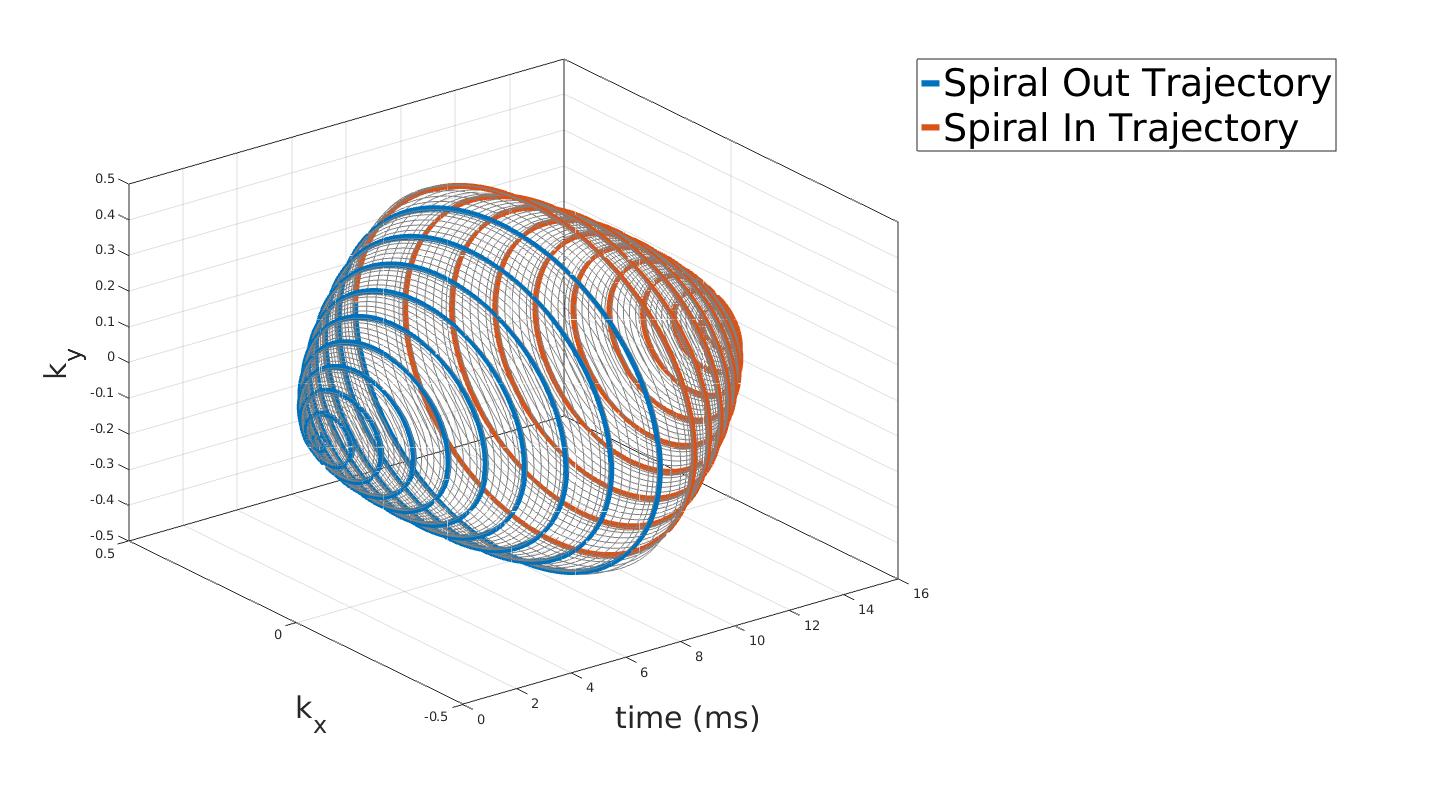
Figure 1: Trajectory of the spiral out-in sequence.
(blue) spiral out trajectory, (orange) spiral in trajectory
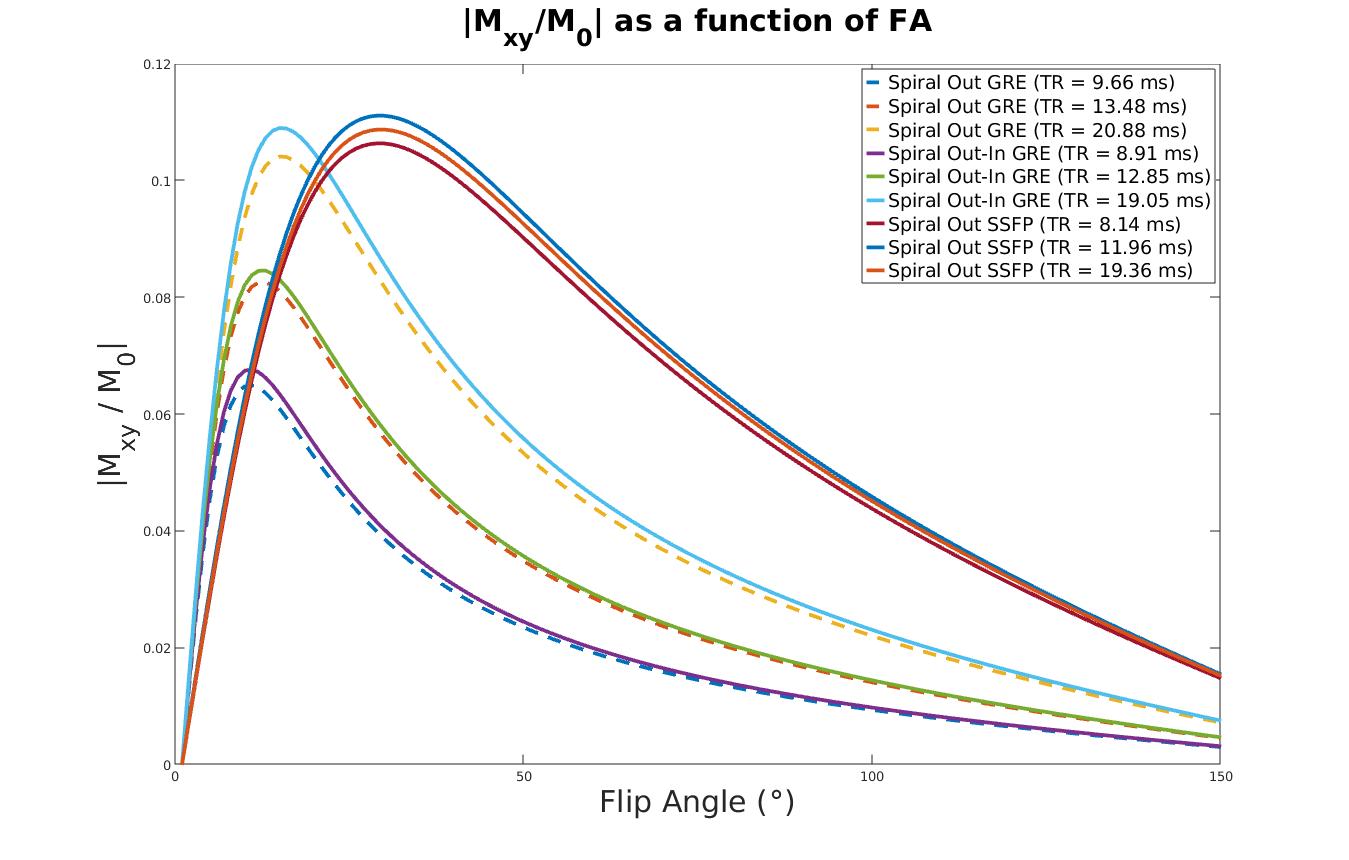
Figure 2: Simulation results of the steady-state signal of spiral out-in GRE, spiral out bSSFP and GRE in human tongue muscle at 0.55T (T1/T2=660/43ms) as a function of flip angle.
GRE sequences provide a higher signal intensity at a longer TR whereas bSSFP offers a consistent signal intensity independent of TR. The simulation considered SNR as a relationship of duty cycle.
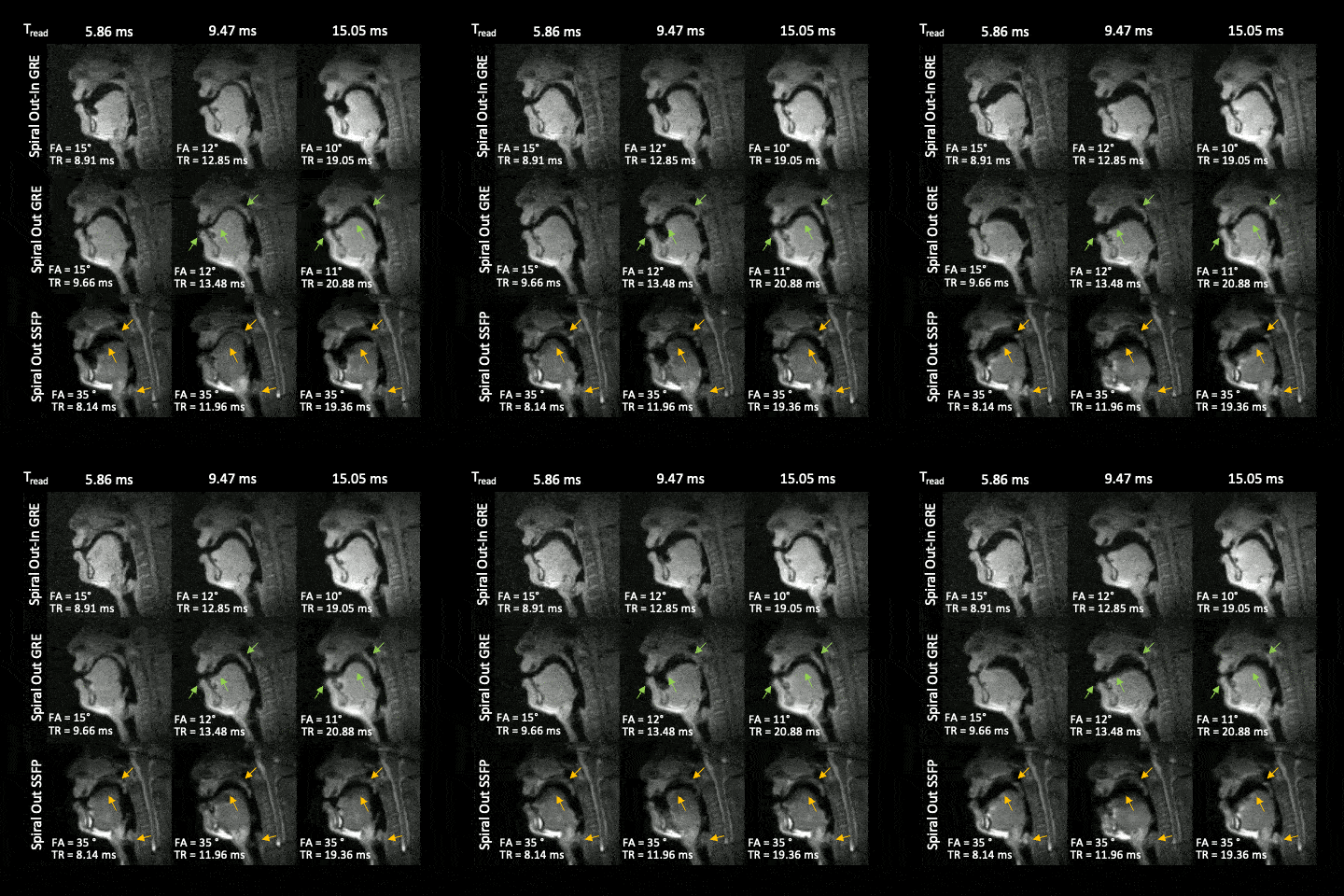
Figure 3 (animated GIF): Comparison of spiral out-in GRE and spiral out bSSFP and GRE sequences for different readout times.
Spiral out-in GRE offers fewer blurring artifacts at increased readout times. Spiral out GRE shows increased blurring artifacts (green arrows) as the readout is increased. Apparent SNR increases as TR goes up higher for GRE sequences. bSSFP at all TR can offer better SNR, however, the characteristic banding artifact (yellow arrows) becomes severe, especially around air-tissue boundaries.
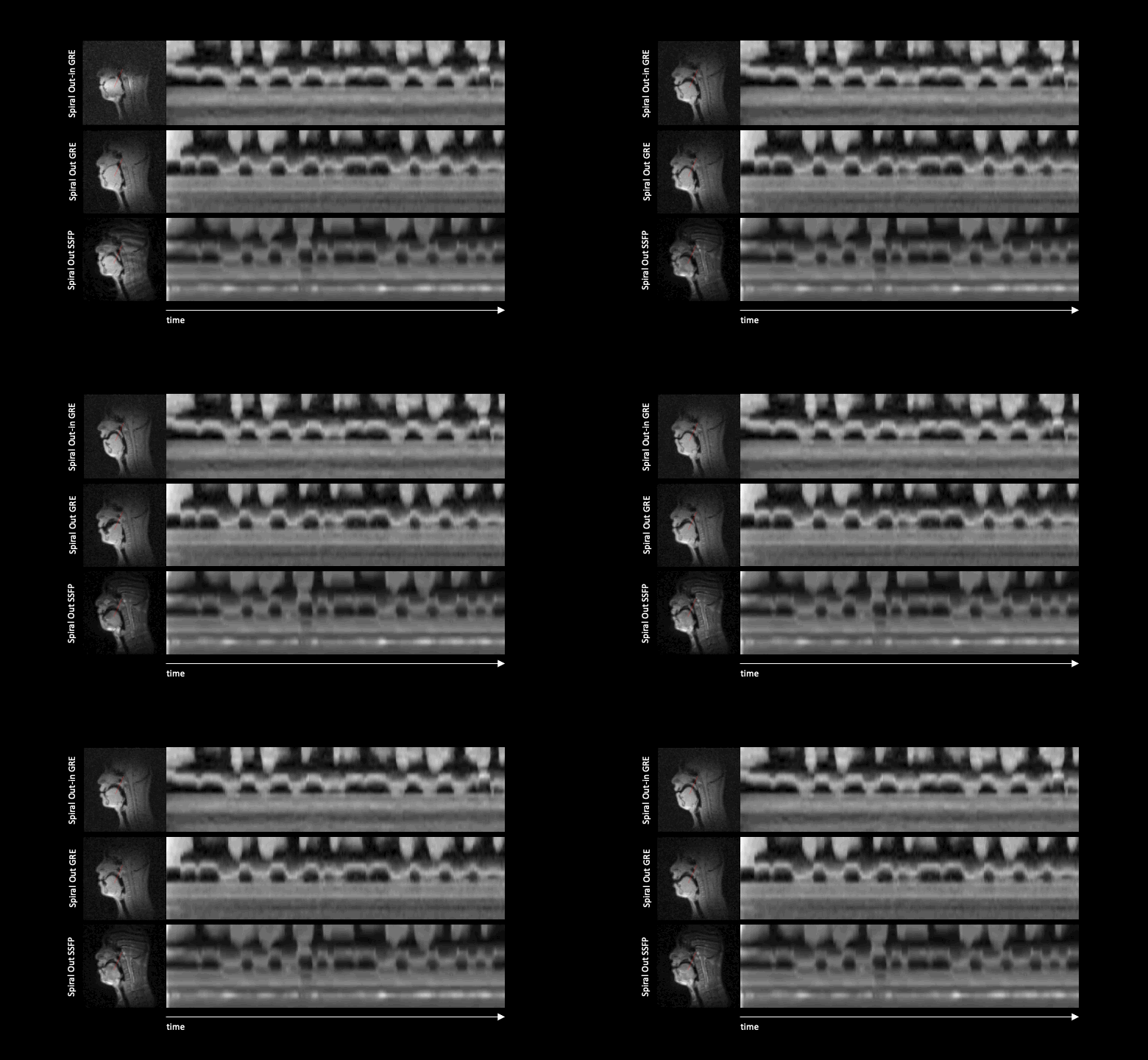
Figure 4 (animated GIF): Comparison of spiral out-in GRE and spiral out bSSFP and GRE images (Tread = 15.05 ms) with intensity vs time plots of a volunteer for a count 1 to 5 stimulus.
An intensity profile placed from the velum to the upper tongue is shown. Spiral out-in demonstrates less blurring artifacts compared to the spiral out GRE sequence.