0211
A self-decoupled 16-channel transmit, 80-channel receive array for 10.5 Tesla human head imaging1Center for Magnetic Resonance Research, University of Minnesota, Minneapolis, MN, United States
Synopsis
Keywords: RF Arrays & Systems, RF Arrays & Systems
We present a splittable 16-channel self-decoupled (SD)1 transmit/receive (Tx/Rx) loop array combined with a 64-channel receive-only (Rx) loop array to generate a 80Rx/16Tx array for human head imaging at 10.5 Tesla. Compared to the previously presented SD transmitter, we designed, miniaturized, and integrated the MR system interface, including custom transmit/receive switches and preamplifiers, into the coil housing. We also implemented our new custom 128 receiver system, which supported this combined 80 channel receive configuration. Experimental MR results demonstrate advantages over our previous 16-channel transmit-only SD array and substantially increased central SNR with the 80-channel compared to the 64-Rx only configuration.
Introduction
It has been shown that at Ultra High Fields (UHF) it can be beneficial to integrate the required transmit array elements as transceivers into the overall receive array structure for higher SNR2-5 and parallel imaging performance6. This phenomenon can be attributed to the receive-only array having increased sensitivity near the periphery, while the volume-like transceiver coil has greater sensitivity in the central region. Here we have taken our previously published work on self-decoupled (SD) transmit coil arrays7 one step further with the design and integration of the MR system interface into the coil housing. We integrated the required RF frontend electronics closer to the transceiver array coil elements for improved transmit efficiency and receive sensitivity. Significant SNR gains were realized in the central region of the head with the inclusion of the transceiver elements to increase the number of receive channels from 64 to 80. With the recent extension of the receiver frontend on our 10.5 Tesla (T) MR system from 64 channels to 128 channels, we were able to receive on all 80 combined transceiver/receiver channels. In addition to these hardware improvements, we aimed to modify the overall device design to achieve improved workflow for the investigators and their subjects.Methods
A dual row 16-channel SD transmit array was mounted on a splittable 28.5 cm ID cylindrical former (see Fig. 1); this coil arrangement replicates our previously published 10.5 T SD transmit array7. Custom transmit/receive (TR) switches (Fig. 2) were designed and optimized for 447 MHz, the 1H Larmor frequency at 10.5 T, then miniaturized to fit within the coil housing in order to be compatible with a head gradient insert coil. The integrated MR system interface has reduced the overall losses in the transmission path (defined as the complete interface from the connection at the MR system patient table through to the coil element, including the TR switches and cabling), by 1 dB. Looking closer at the miniaturized TR switches we observed -0.38 dB of through losses with a phase balance of 2.5°, along with -51.0 dB of isolation of the integrated low input impedance preamplifier (WanTcom, Chanhassen, MN), which protected them from damage during the transmit pulse. The preamplifiers provide 28.0 dB of gain during acquisition, while the transmitter input port is isolated by an average of -45.7 dB. Resonant cable traps8,9 were added to all of the coaxial cables on the system side of the TR switches to mitigate cable interactions, while sleeve-type cable traps9 were added to each coil element feed cable to reduce common mode currents from the coil elements. A 64-channel receive-only array10 was built onto a human head shaped former and can be easily installed and removed due the split housing design of the 16-channel transmit/receive array. This receive-only array insert had minimal interaction with the 16-channel SD transceiver array. After the device had gone through a safety validation process with both our internal review board (IRB) and the US FDA, experimental human data was acquired on our Siemens MAGNETOM 10.5 T MR system outfitted with 16 transmit channels and 128-ch receive channels. SNR data were acquired with fully sampled 2D GRE sequences with a long TR for full relaxation at 10.5 T, noise images were acquired with identical parameters with exception to the flip angle set to 0 and TR reduced. SNR was normalized to flip angle and converted to intrinsic SNR as previously described11.Results and Discussion
In addition to improving the workflow from our previous designs, the miniaturization and integration of the MR system interface into the coil housing (Figs. 1, 2) has experimentally demonstrated an increase in global SNR (Fig. 3). The use of larger transceiver coil element(s) that are excited with an optimized subject-specific B1+ volume-like shim during transmission and then used as additional independent receive elements during acquisition has proved beneficial as shown by our improvements in central SNR in multiple phantoms (Fig. 4); SNR gains of ~25% and ~70% were measured over the phantom within a 1 cm radius circle, located either in the geometrical center of the phantom or over a region showing the maximal gains. Similar gains were observed in human subjects (Fig. 5). With the integration of the system interface, the self-decoupled transmit/receive coil elements also employ preamplifier decoupling techniques12, which aid in coil isolation during the receive acquisition. These improvements to our previous work7,13 have allowed us to configure an easy to use 16-channel transmit, 80-channel receive coil assembly that has been validated for use on human subjects. Importantly this non-overlapped self-decoupled transceiver coil supports splittable housing designs with no electrical contacts (Fig. 2), making it easier to position a variety of receiver coil arrays, subjects, as well as fMRI and positioning apparatus, thus increasing the available subject population in a variety of medical research applications.Acknowledgements
This research was funded by NIH U01 EB025144, BTRC P41 EB027061, NIH S10 RR029672 grants.
References
1. Yan, X., Gore, J. C. & Grissom, W. A. Self-decoupled radiofrequency coils for magnetic resonance imaging. (2018) Nat Commun 9, 3481.
2. Adriany, G., Auerbach, E. J., Snyder, C. J., Gozubuyuk, A., Moeller, S., Ritter, J., Van de Moortele, P. F., Vaughan, T. & Ugurbil, K. A 32-channel lattice transmission line array for parallel transmit and receive MRI at 7 tesla. (2010) Magn Reson Med 63, 1478-1485.
3. Gosselink, M., Hoogduin, H., Froeling, M. & Klomp, D. W. J. No need to detune transmitters in 32-channel receiver arrays at 7 T. (2021) NMR Biomed 34, e4491.
4. Avdievich, N. I., Nikulin, A. V., Ruhm, L., Magill, A. W., Glang, F., Henning, A. & Scheffler, K. A 32-element loop/dipole hybrid array for human head imaging at 7 T. (2022) Magn Reson Med 88, 1912-1926.
5. Avdievich, N. I., Giapitzakis, I. A., Bause, J., Shajan, G., Scheffler, K. & Henning, A. Double-row 18-loop transceive-32-loop receive tight-fit array provides for whole-brain coverage, high transmit performance, and SNR improvement near the brain center at 9.4T. (2019) Magn Reson Med 81, 3392-3405.
6. Lagore, R. L., Moeller, S., Zimmermann, J., DelaBarre, L., Radder, J., Grant, A., Ugurbil, K., Yacoub, E., Harel, N. & Adriany, G. An 8-dipole transceive and 24-loop receive array for non-human primate head imaging at 10.5 T. (2021) NMR Biomed 34, e4472.
7. Waks, M., Tavaf, N., Lagore, R., Jungst, S., Radder, J., Grant, A., DelaBarre, L., Moortele, P. V. d., Adriany, G. & Ugurbil, K. A 16-channel splitable non-overlapped self-decoupled loop transmitter for 10.5 Tesla human head imaging. in Proc. 2022 ISMRM. 4109.
8. Seeber, D. A., Jevtic, I. & Menon, A. Floating shield current suppression trap. (2004) Concept Magn Reson B 21b, 26-31.
9. Terman, F. Radioengineer’s Handbook. (Mc Graw Hill, 1943).
10. Tavaf, N., Lagore, R., Jungst, S., Radder, J., Grant, A., Auerbach, E., Moeller, S., Ugurbil, K., Adriany, G. & Van de Moortele, P. A Self-decoupled 64 Channel Receive Array for Human Brain MRI at 10.5T. in Proc. Intl Soc Mag Reson Med 29. 179.
11. Ugurbil, K., Auerbach, E., Moeller, S., Grant, A., Wu, X., Van de Moortele, P. F., Olman, C., DelaBarre, L., Schillak, S., Radder, J., Lagore, R. & Adriany, G. Brain imaging with improved acceleration and SNR at 7 Tesla obtained with 64-channel receive array. (2019) Magn Reson Med 82, 495-509.
12. Roemer, P. B., Edelstein, W. A., Hayes, C. E., Souza, S. P. & Mueller, O. M. The NMR phased array. (1990) Magn Reson Med 16, 192-225.
13. Adriany, G., Radder, J., Tavaf, N., Lagore, R., Jungst, S., Woo, M. K., Grant, A., Eryaman, Y., B, Z., Gunamony, S., Lattanzi, R., K., U. & Van de Moortele, P. F. Evaluation of a 16-Channel Transmitter for Head Imaging at 10.5T in 2019 International Conference on Electromagnetics in Advanced Applications (ICEAA). 1171-1174 (IEEE).
Figures
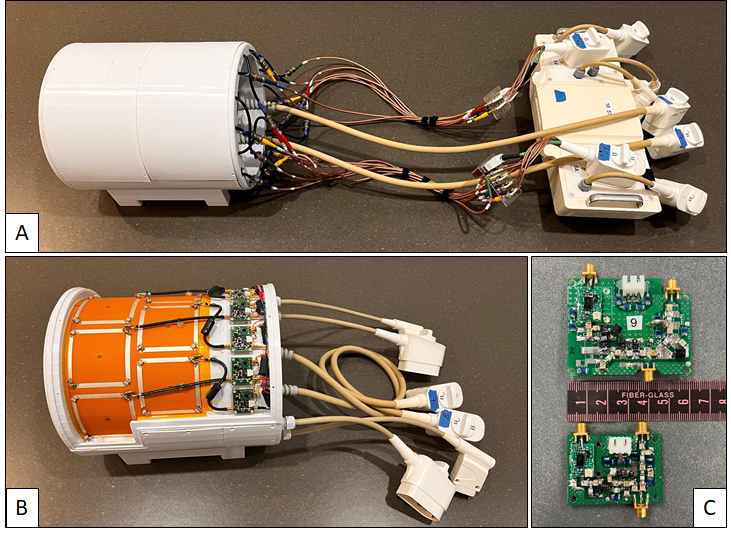
Fig. 1: Evolution of the 16-ch self-decoupled transmit coil (shown with the 64-ch receive-only insert): (A) original one-piece design “SD1” with external system interface, (B) current split design “SD3” and miniaturized integrated system interface, (C) the miniaturization of the integrated TR switches with preamplifiers.
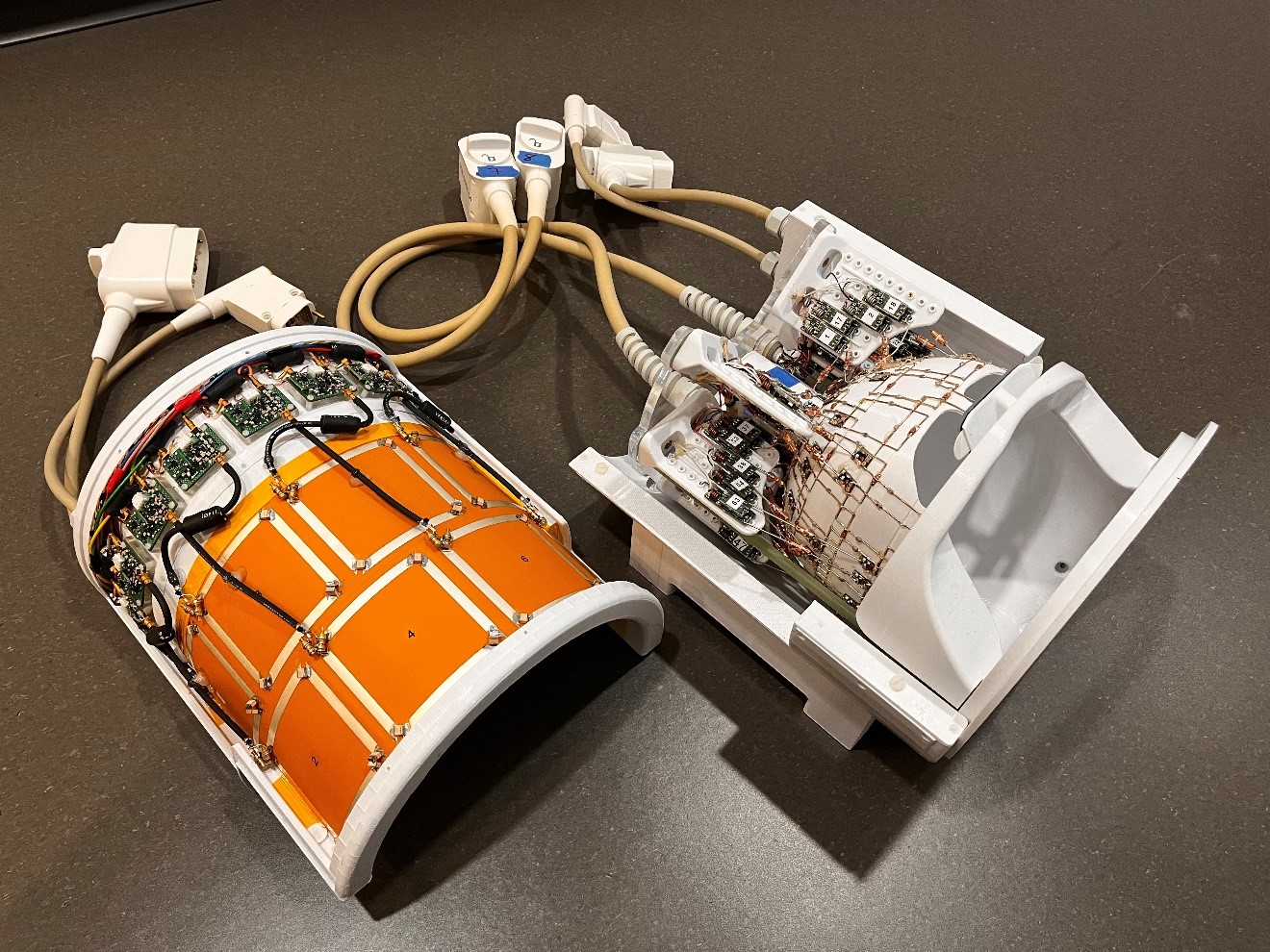
Fig. 2: 16-ch transmit “SD3”, 80-ch receive coil configuration, with splittable 16-ch SD Tx/Rx array coil with miniaturized integrated system interface and 64-ch receive-only array insert.
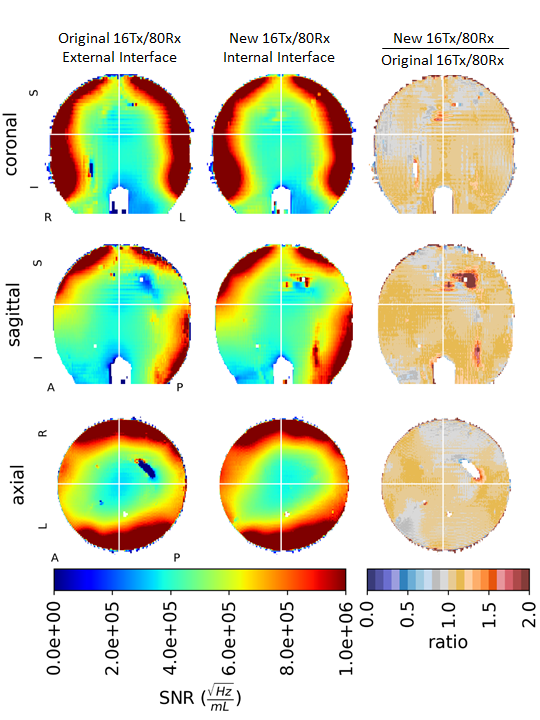
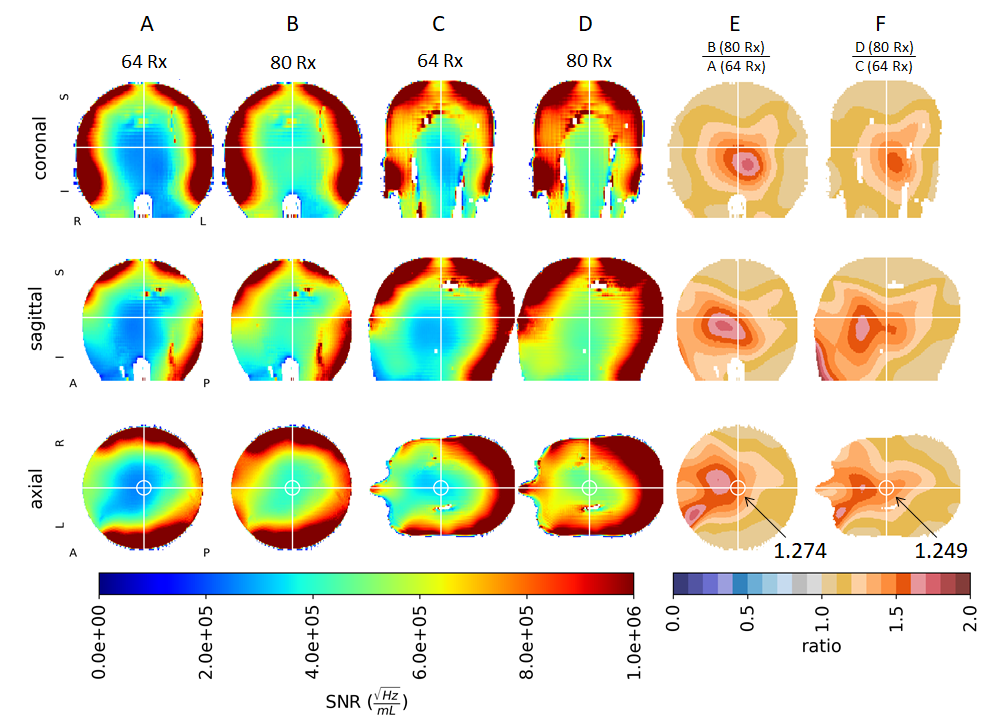
Fig 4: Comparison of experimental SNR between 64 and 80 Rx channels using a 16-ch transmitter “SD3” as both Tx-only and Tx/Rx modes, resulting in 64 Rx and 80 Rx respectively. Shown are: 16Tx/64Rx in a lightbulb-shaped uniform phantom (A), and head-shaped “Diana” uniform phantom (C), vs. 16Tx/80Rx in a lightbulb-shaped uniform phantom (B), and head-shaped “Diana” uniform phantom (D). SNR ratio maps (E, F) show ~25% improvement within a 1cm radius ROI located in the central region of the phantom, and ~70% gain over same sized ROI placed in regions showing maximal gain.
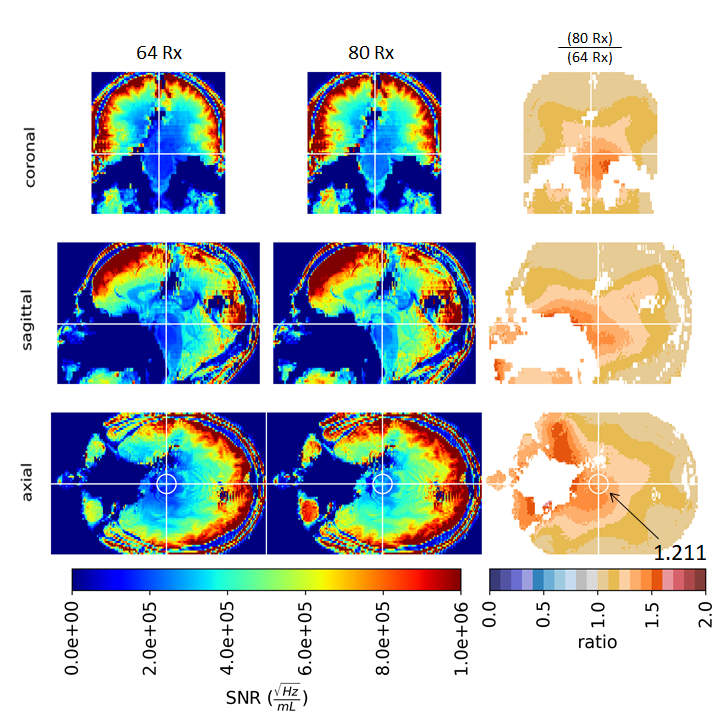
Fig 5: Comparison of experimental SNR in human brain between 64 and 80 Rx channels using a 16-ch transmitter “SD1” with external interface as both Tx-only and Tx/Rx modes, resulting in 64 Rx and 80 Rx respectively. Shown are: 64-ch Rx (Left), 80-ch Rx (Center), both with external interface. SNR ratio maps (Right) show ~21% improvement, within a 1cm radius ROI located in the central region. Voids in the figures can be attributed to masking/thresholding error during the calculation process.