0206
Eliminating Banding Artifacts in bSSFP using Parallel Transmission1Centre for Advanced Imaging, University of Queensland, St Lucia, Australia, 2ARC Training Centre for Innovation in Biomedical Imaging Technology, University of Queensland, St Lucia, Australia, 3School of Information Technology and Electrical Engineering, University of Queensland, St Lucia, Australia, 4Siemens Healthcare Pty Ltd, Brisbane, Australia
Synopsis
Keywords: Parallel Transmit & Multiband, RF Pulse Design & Fields
In this work, we demonstrate a parallel transmit implementation of the bSSFP sequence at 7 Tesla. The bSSFP sequence is one of the most efficient acquisition strategies however highly sensitive to B0 inhomogeneity which creates undesirable banding artefacts. A tailored pair of pTx pulses can be used to induce the desired steady-state magnetisation behaviour at all spatial locations regardless of the off-resonance frequency due to B0 inhomogeneity. Shown through simulation and experimental validation, we were able to capture signal in one acquisition with significant mitigation of banding artifacts and improvement in signal uniformity without SNR loss and time penalty.Introduction
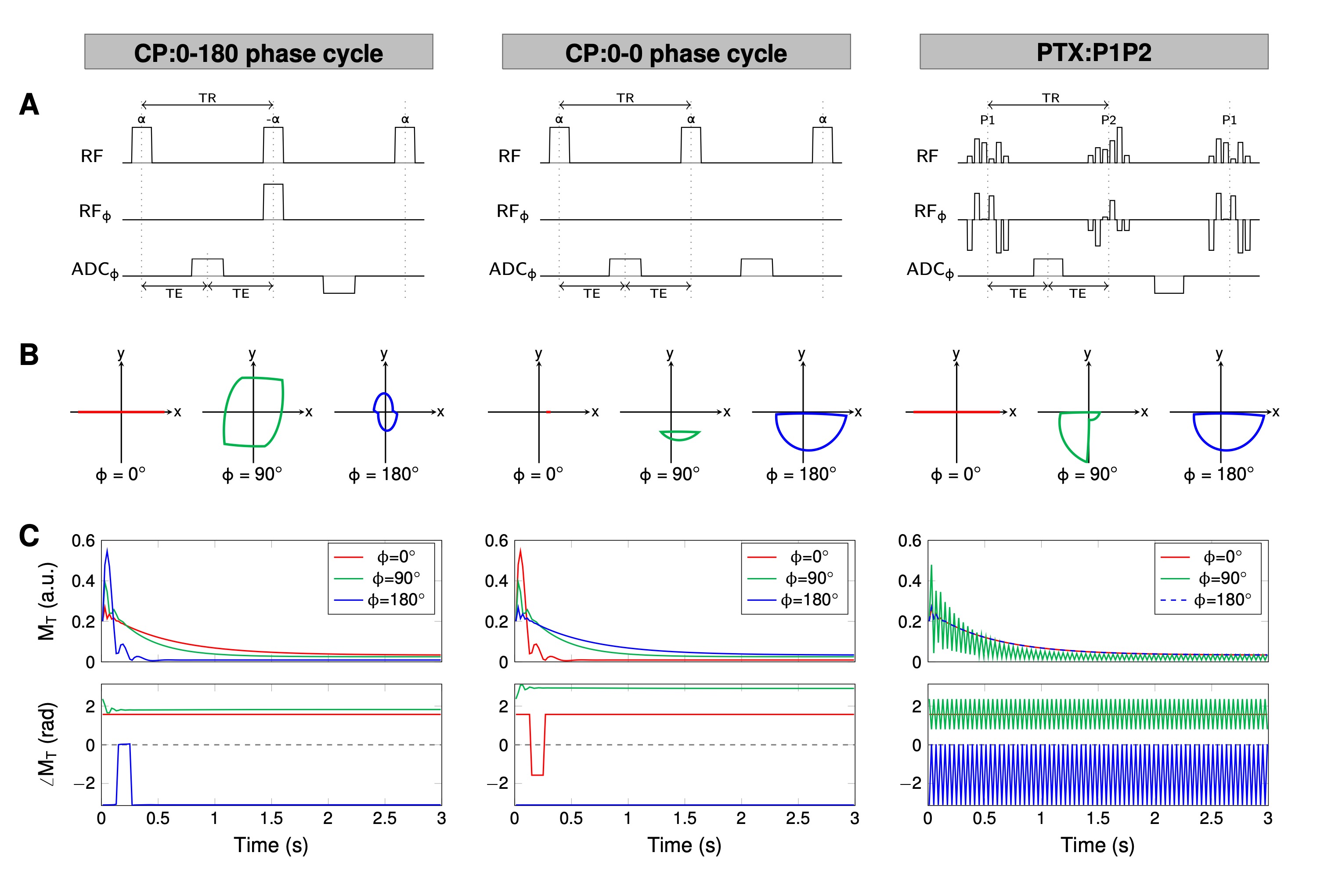
The balanced steady-state free precession (bSSFP) sequence is one of the most efficient acquisition strategies1. The signal is formed by a steady-state that oscillates back and forth to maintain a large magnetisation. Minor off-resonance and T2’ effects are mitigated by a spin-echo like refocussing effect at TE=TR/2. However, as the accumulated phase per TR approaches 180$$$^\circ$$$ the refocusing mechanism breaks down and the signal disappears (Fig.B,C), typically manifested as banding artifacts. Here we demonstrate the design of a pair of tailored parallel transmit (pTx) pulses that force all magnetisation to oscillate in the desired steady-state regardless of their B0 off-resonance frequency. This approach allows us to capture complete signal in one acquisition without banding artifacts.Theory
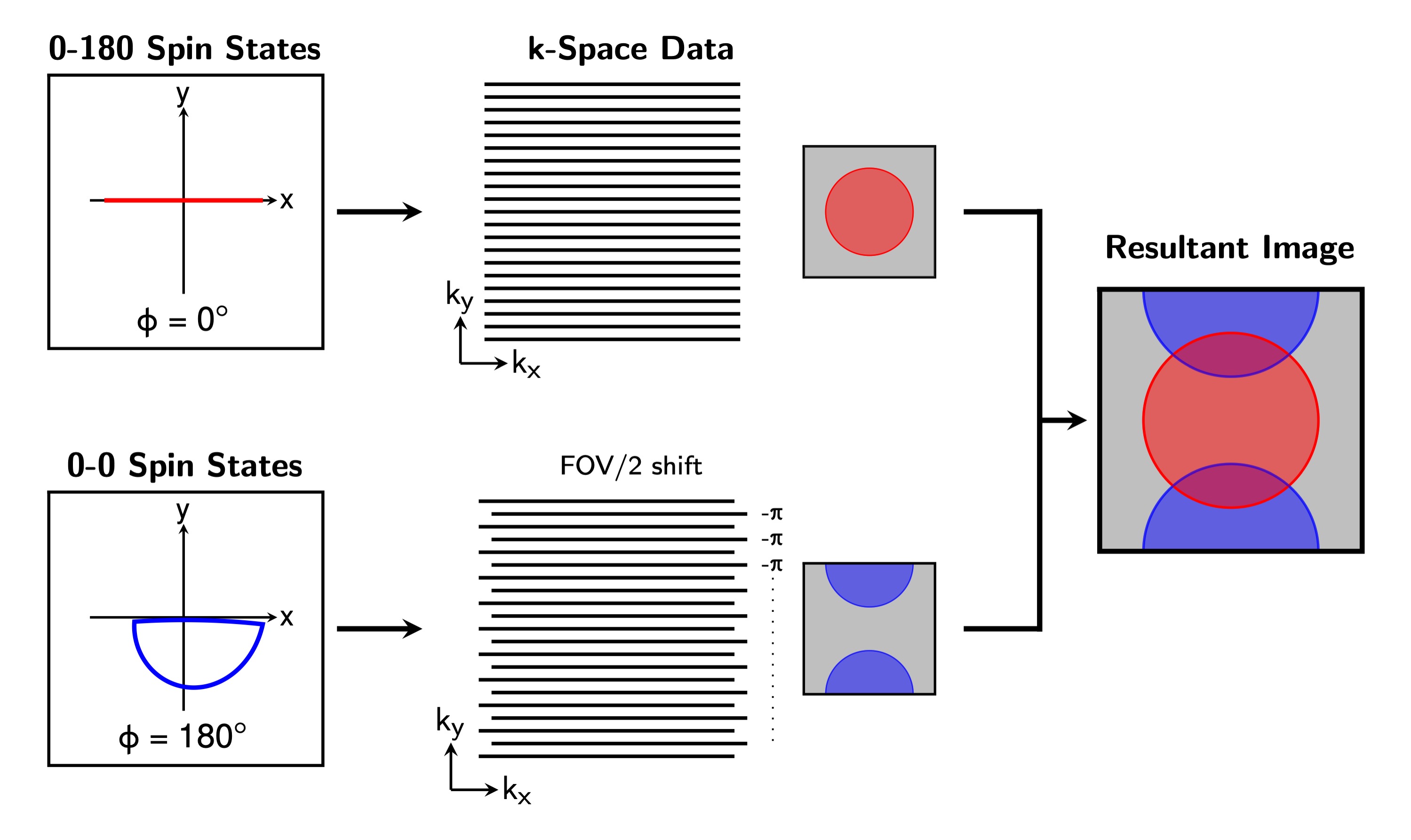
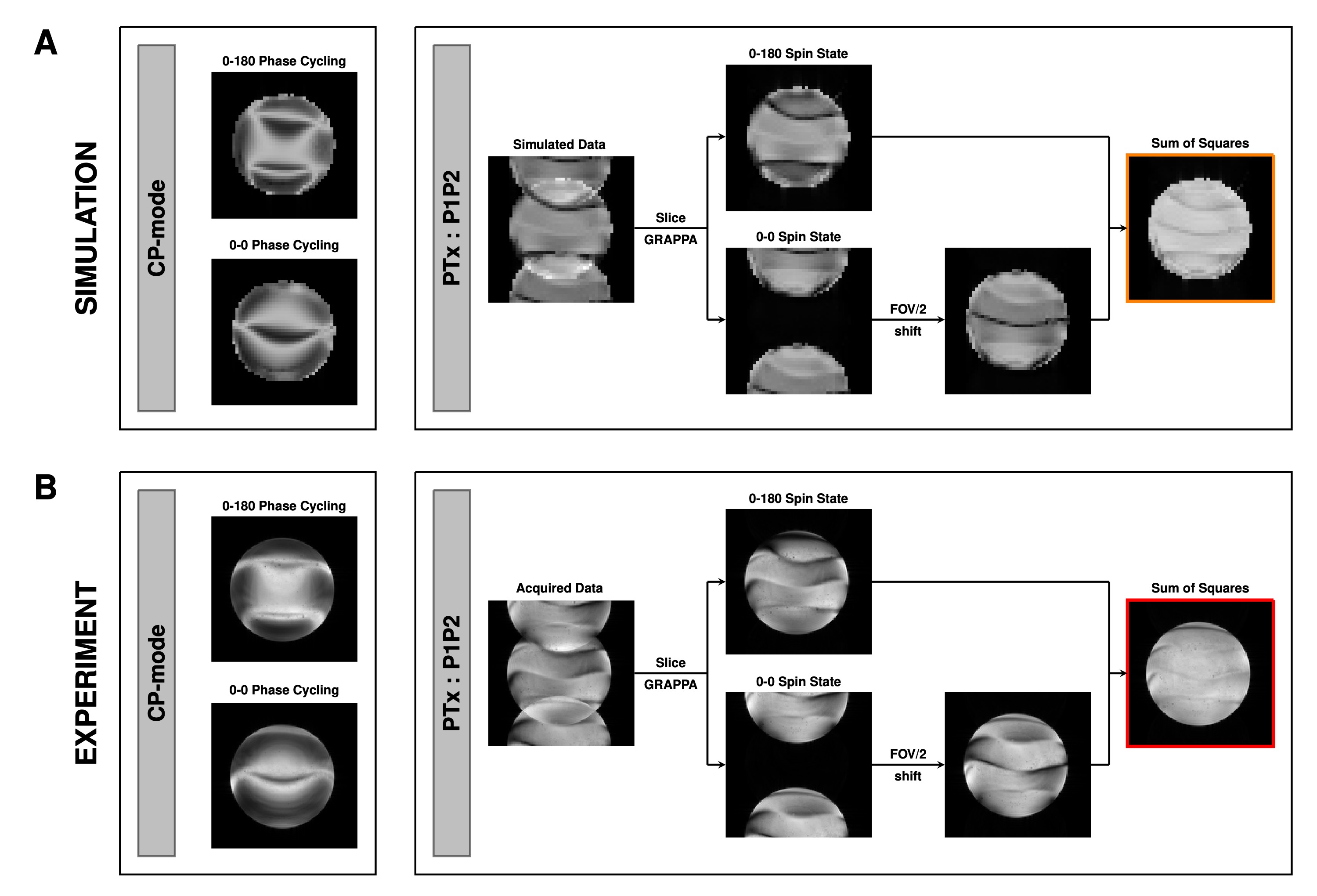
The banding artifacts observed in bSSFP can be moved by changing the phase cycle between RF pulses. For example, a combination of two acquisitions, one with a 0-180 and the other with 0-0, can be combined to fill in each other’s signal voids2. However, this is inefficient and sensitive to motion. Using pTx we can design a pair of pulses to induce different phase cycling patterns at different spatial locations in one single acquisition (Fig.1-PTX:P1P2), while also providing uniform flip-angle (FA). To accomplish this, a phase difference of dB0*TR is enforced between the target phase profiles of the pulse pair in the design optimization, compensating for the spin dephasing accumulated due to off-resonance over one TR. As a result, spatially on resonant spins will experience 0-180$$$^\circ$$$ phase cycling whereas the spins accumulating close to 180$$$^\circ$$$ dephasing will experience no phase cycling. This also means, that every other TR, the phase of this population of spins will be 180$$$^\circ$$$ out of phase with respect to the analogue to digital converter (ADC) (Fig.2). This, in turn, shifts the signal from these spins by half FOV in the image. In essence, this can be interpreted as two virtual slices superimposed into one image (one for each spin population), mimicking the effect of a CAIPI blip. Hence, the superimposed virtual “slices” can be separated and re-combined using Slice-GRAPPA3.Methods
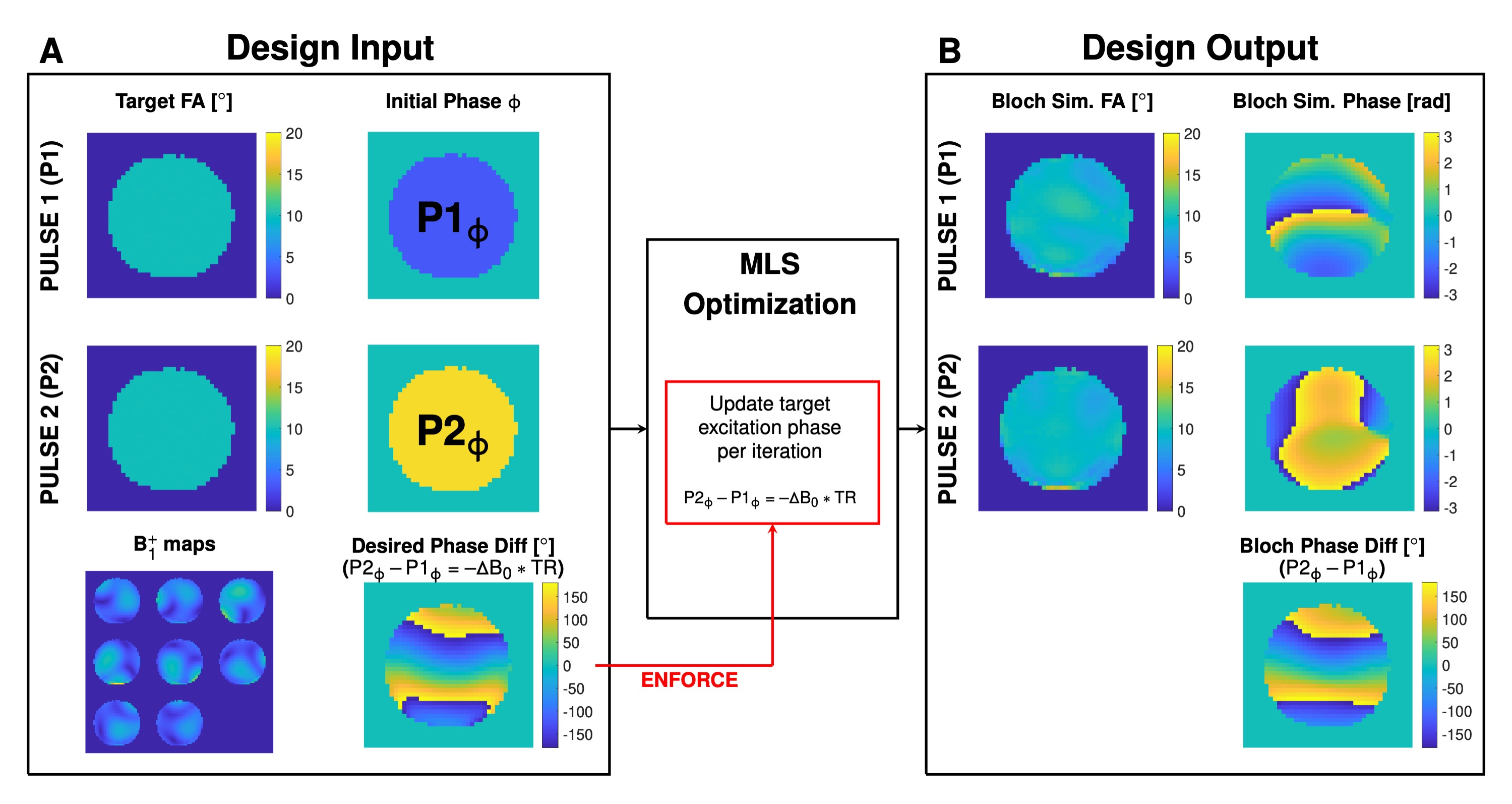
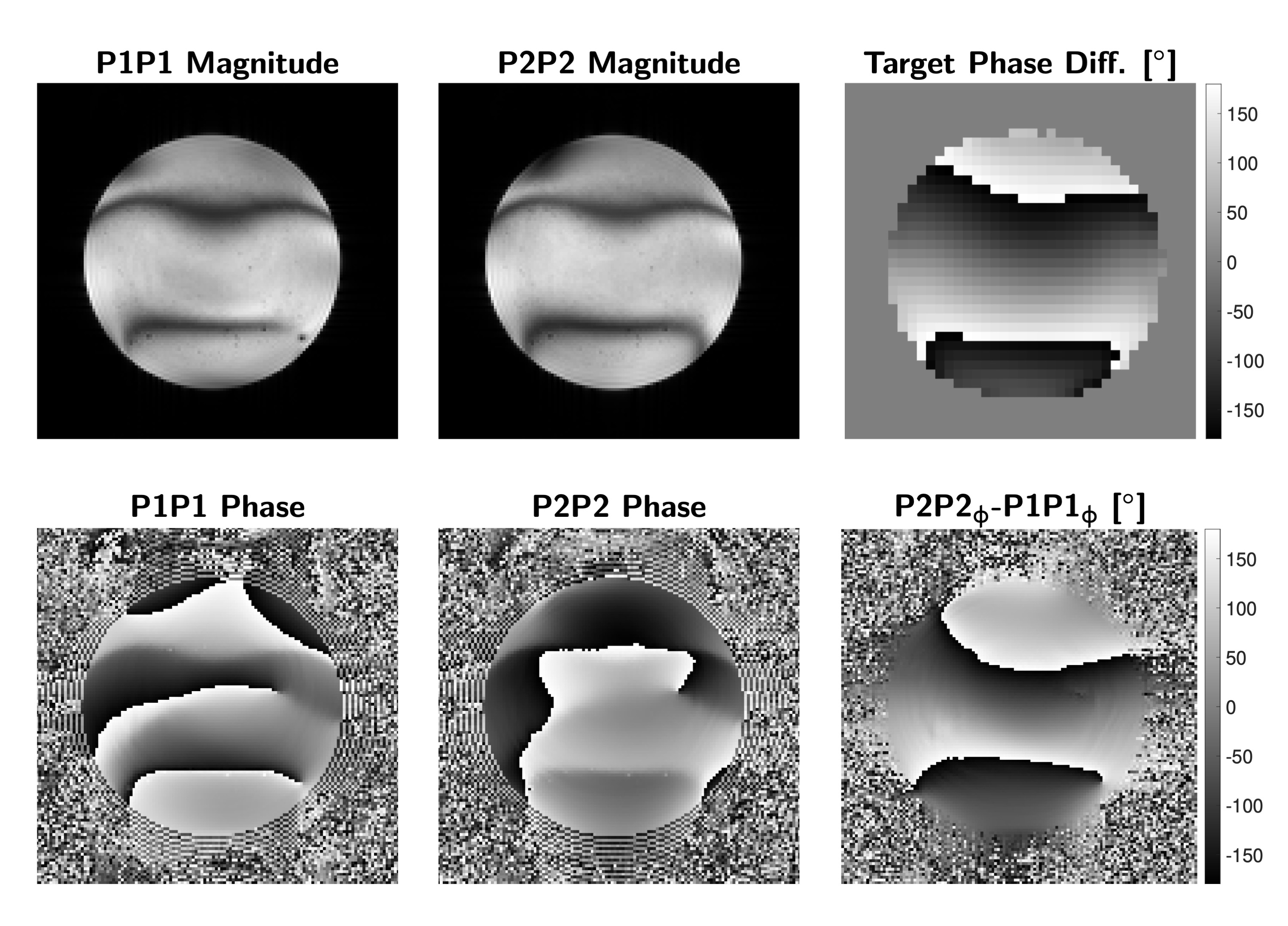
All data was collected using a Magnetom 7T Plus scanner (Siemens Healthcare, Erlangen, Germany) equipped with an 8×2kW pTx RF system, and an 8Tx/32Rx head coil (Nova Medical, Wilmington, MA, USA). A 4% agar phantom (NaCl=2.5g/L) was used for experimental validation. PTx Calibration data was acquired as previously shown4. Additionally, multi-echo T2*-weighted images (TR=1500ms, TE1,2=12,11ms, 2x2x2mm3) was acquired for dB0 mapping. The bSSFP sequence (FA=5, TR=15ms, TE=7.5ms, 1.5x1.5x5mm3) was acquired in circularly polarized (CP-mode) and pTx mode with and without phase cycling. Various pulse pair combinations were evaluated. A spoiled GRE with matching FOV and resolution to the bSSFP was acquired as calibration data for reconstruction.PTx pulse design: A custom bSSFP sequence was developed by replacing the conventional excitation pulses with pTx pulse pairs (P1 and P2), which were played out over alternating TRs. The pTx pulses (8 kT-points5, duration=1.5ms) were designed using the SDM6 with a MLS7 approach (Fig.3). The target phase profiles were set by initially using the CP-mode phase and enforcing a +-(dB0*TR)/2Hz shift for P1 and P2 respectively. Bloch simulations with complete k-Space acquisition and phantom experiment were performed to evaluate the performance of the pTx pulses and demonstrate the magnetisation behaviour by the tailored pTx pulses. To verify experimentally, bSSFP acquisitions were acquired using P1P1, P2P2 and P1P2 combinations all with 0-180 phase cycling for consistency. The difference in phase maps produced by P1P1 and P2P2 was compared to the target phase difference used in the pulse design.
Image Reconstruction: To correct the half FOV shift generated by the pTx pulse pair, slice-GRAPPA was implemented to extract the superimposed images in the two respective spin states. A final image was obtained using Sum of Squares (SoS) method to combine signals from different spin states after removing the FOV/2 phase shift.
Results and Discussion
Both simulation and experimental results are shown in Fig.4,5. The phase difference generated between acquired P1P1 and P2P2 phase profiles match well to the target phase difference pattern (Fig.4). This was also shown in the simulation results shown in Fig.3B.As expected, CP-mode excitations (0-180$$$^\circ$$$) demonstrated the undesirable bSSFP banding artifacts in addition to significant signal drop around the peripheral regions due to insufficient B1+ (Fig.5). As predicted by our simulations (Fig.5A), FOV/2 shift aliasing was observed when using our pair of pTx pulses due to the spatially variable phase cycling patterns (Fig.5B). Using slice-GRAPPA we were able to separate these spin-states into two complimentary images. Combining the two generated one almost artifact free image with both significantly mitigated banding and excitation non-uniformity artifacts at the same time.
Conclusion
We have shown that using a tailored pair of pTx pulses it is possible to simultaneously implement spatially varying phase cycling patterns and uniform excitation magnitude to eliminate banding artifacts present in the bSSFP sequences in one single acquisition without loss of SNR or time penalty. The next step is to evaluate such tailored pTx pulse pairs in vivo.Acknowledgements
This research was conducted by the Australian Research Council Training Centre for Innovation in Biomedical Imaging Technology (project number IC170100035) and funded by the Australian Government. The authors acknowledge the facilities of the National Image Facility at the Centre for Advanced Imaging and thank Ting Xiang Lim for her support in phantom construction.References
[1] Scheffler K, Lehnhardt S. Principles and applications of balanced SSFP techniques. Eur Radiol. 2003;13(11):2409-2418.
[2] Zur Y, Wood ML, Neuringer LJ. Motion-insensitive, steady-state free precession imaging. Magn Reson Med. 1990;16(3):444-459.
[3] Setsompop K, Gagoski B, Polimeni J, et al. Blipped-Controlled Aliasing in Parallel Imaging for Simultaneous Multislice Echo Planar Imaging with Reduced g-Factor Penalty. Magn Reson Med. 2012;67(5):1210-1224.
[4] Wu C, Jin J, Dixon C, et al. Velocity selective arterial spin labelling using parallel transmission. In Proc. of the 31st Annnual Meeting of ISMRM, London, England UK. 2022;2936.
[5] Cloos MA, Bouland N, Ferrand E, et al. kT-points: Short three-dimensional tailored RF pulses for flip-angle homogenization over an extended volume. Magn Reson Med. 2012;67(1):72-80.
[6] Grissom W, Yip C, Zhang Z, et al. Spatial Domain Method for the Design of RF Pulses in Multicoil Parallel Excitation. Magn Reson Med. 2006;56(3):620-629.
[7] Setsompop K, Wald LL, Alagappan V, et al. Magnitude least squares optimization for parallel radio frequency excitation design demonstrated at 7 Tesla with eight channels. Magn Reson Med. 2008;59(4):908-915.
Figures