0203
Parallel transmit spatial spectral pulse design with specific absorption rate control: demonstration for robust water excitation at 7 Tesla1Center for Biomedical Imaging Research, Department of Biomedical Engineering, School of Medicine, Tsinghua University, Beijing, China, 2Department of Radiology and Imaging Sciences, University of Utah, Salt Lake City, UT, United States, 3Center for Magnetic Resonance Research, Radiology, Medical School, University of Minnesota, Minneapolis, MN, United States
Synopsis
Keywords: Parallel Transmit & Multiband, RF Pulse Design & Fields
There has been an increasing interest in designing parallel transmit spatial spectral (pTx SPSP) RF pulses for reducing transmit B1 inhomogeneity while achieving water selective excitation. In this study, we propose a new pTx SPSP pulse design method with explicit SAR control with nearly complete fat suppression. Our results based on human calibration data acquired at 7T suggest that our method is equally applicable to both kT-point and SPINS pulse design, outperforming an existing method based on combining pTx with binomial pulse design approach. We believe our method will have a utility for high-resolution, whole-brain functional MRI at ultrahigh field.Introduction
Spectral spatial (SPSP) RF pulse [1] provides an effective way of water excitation, yielding higher SNR than T1-based techniques [2] and without need of multiple echoes as in signal phase-based techniques [3]. However, SPSP pulse performances are hindered at ultrahigh field because of enlarged water-fat separation and worsened transmit B1 (B1+) inhomogeneity. It is known that parallel transmission (pTx) is a solution to B1+ inhomogeneity and power deposition (i.e., SAR), two general challenges associated with ultrahigh field MRI. Here we propose a new pTx SPSP pulse design for robust uniform water excitation with SAR management and demonstrate the utility of our method by comparing with an existing approach.Method
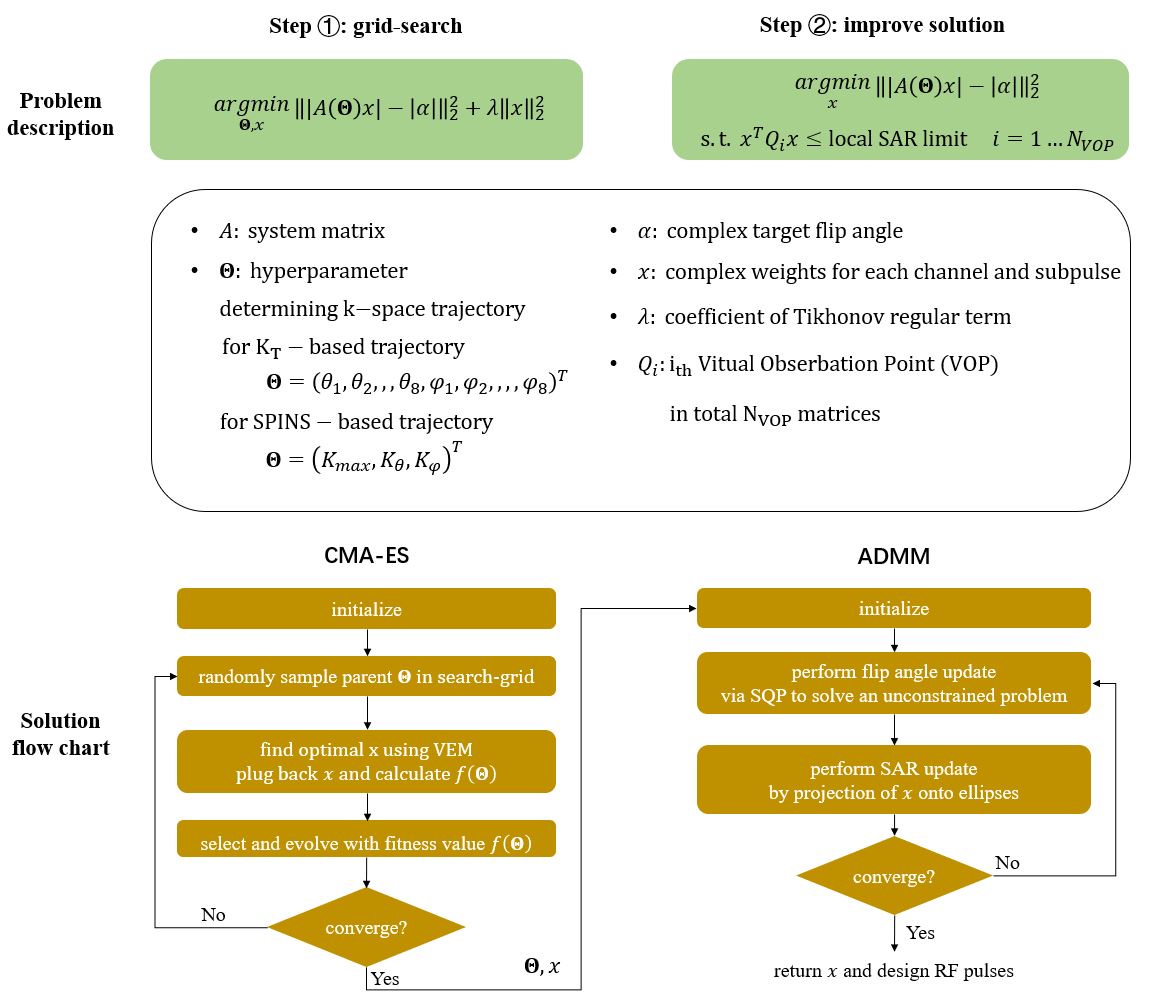
Our pulse design (Fig. 1) has two steps. Step 1 aims to grid search for both RF and gradient by solving a reduced problem and step 2 to refine RF by solving a local-SAR-constrained problem. In step 1 the reduced problem is solved combining Covariance Matrix Adaptation Evolutionary Strategies [4] with the variable exchange method (VEM) [5]. In Step 2 the local-SAR-constrained problem is solved by taking the output from step 1 as initial points and using the Alternating Direction Method of Multipliers incorporating such algorithms as sequential quadratic programming and VEM. In both steps, the design problem is formulated in the spatial domain [6] with higher tip angle approximation [7] and based on magnitude least squares minimization [5].To demonstrate the efficacy of our method, we designed pTx pulses using calibration data obtained from five healthy volunteers. For each volunteer, the calibration data including volumetric B0 and multi-channel B1+ maps (in 80 axial slices covering the whole brain at 3-mm isotropic resolutions) were acquired on a 7T Terra MR scanner (Siemens, Erlangen, Germany) using the commercial Nova 8-channel transmit 32-channel receive RF coil (Nova Medical, Wilmington, USA).
We designed spatially non-selective pTx pulses for uniform water excitation across the brain. The excitation target were prescribed to have both spectral and spatial components. The spectral component consisted of a water passband (centered at 0 Hz) and a fat stopband (centered at -1050 Hz), both defined in 125-Hz increments (5 points) on a 500-Hz bandwidth. The spatial component dictated uniform flip angles inside a 3D brain mask extracted from nine calibration slices.
To showcase the universality of our method, we designed pulses using both kT-point [8] and SPINS parameterization [9]. In kT-point design, a symmetric design of 24 kT points, previously demonstrated useful for uniform water excitation at 7T [10], was used as initial k-space placement. In both cases, pulses were designed to achieve Ernst angles for a 500-ms TR in gray matter (with T1~1939ms at 7T [11]). The SAR constraints were formed using 1669 virtual observation points [12] with a limit of 8 W/kg.
For comparison, pTx pulses of same duration were also designed with the interleaved binomial approach [14].
Results
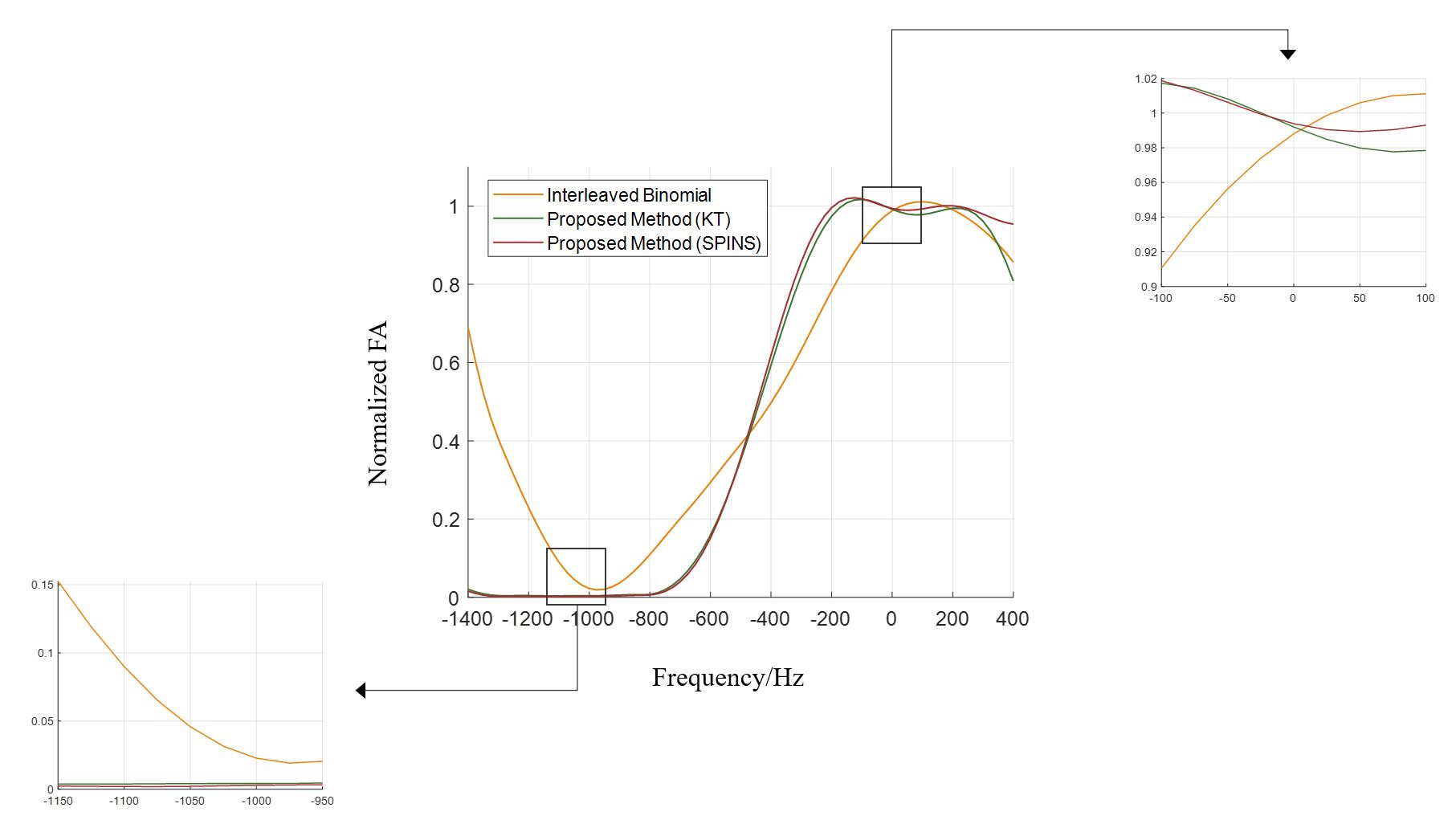
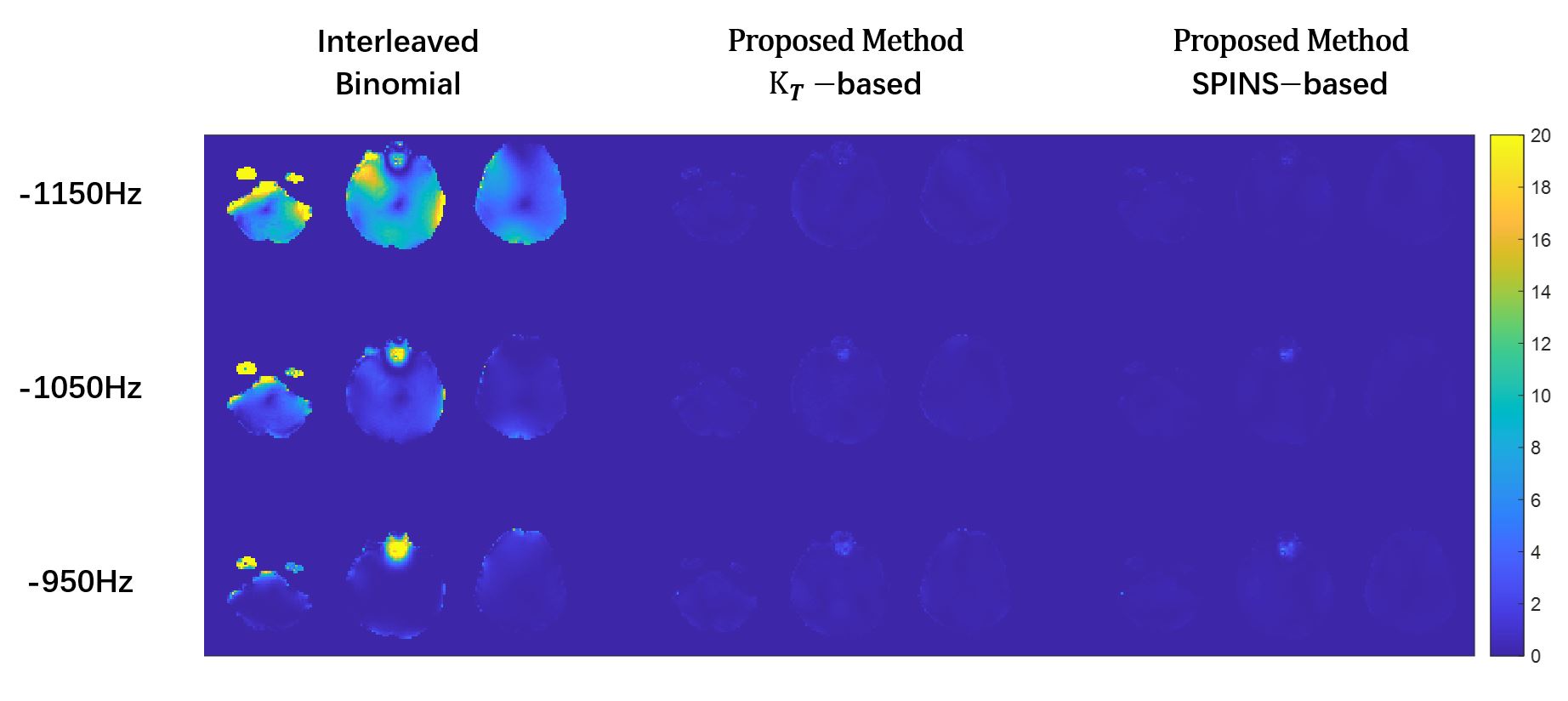
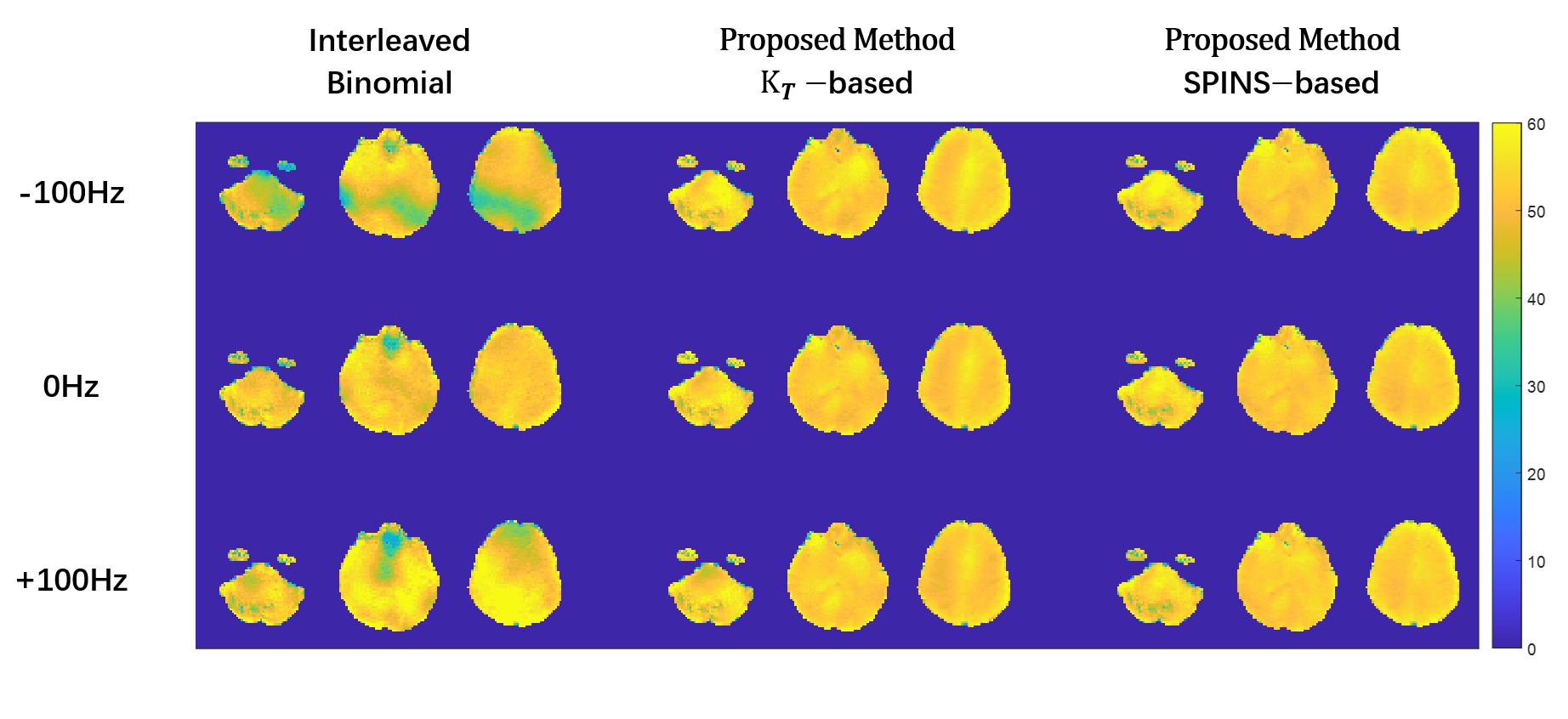
The use of our method achieved the prescribed frequency response, outperforming the interleaved binominal approach (Fig. 2), with widened stopband for fat suppression and passband for water excitation.The improvement in performances for both fat suppression and water excitation was further confirmed by examining the spatial maps (Figs. 3 and 4) showing that our method effectively suppressed fat and uniformly excite water across the entire brain even in the presence of large susceptibility-induced off-resonances. By contrast, the use of binomial pTx pulses produced suboptimal results, leading to non-uniform water excitation and incomplete fat suppression especially in regions of large off-resonances.
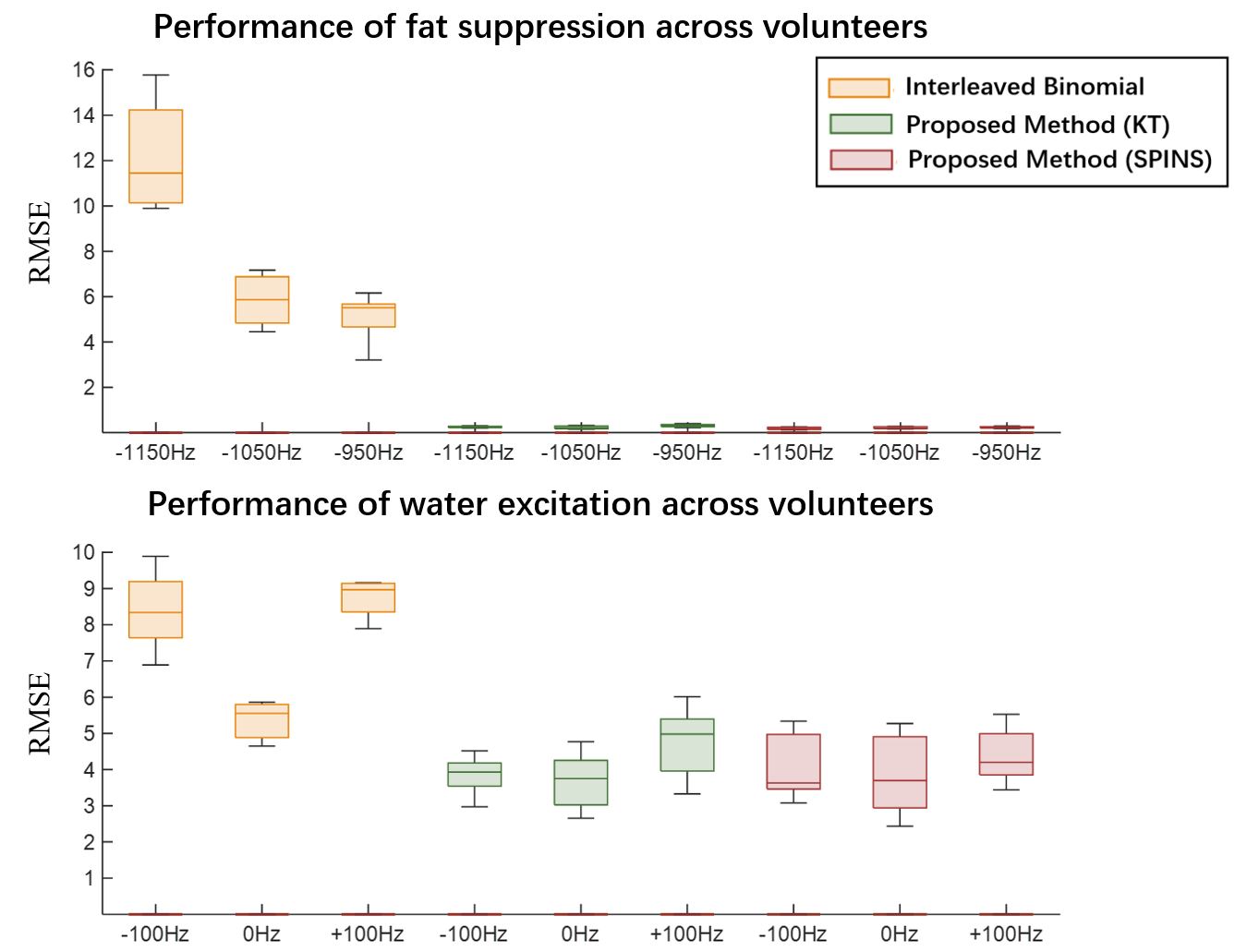
Moreover, our method outperformed the binomial approach across all the volunteers under consideration (Fig. 5), improving both fat suppression and water excitation while reducing local SAR. The RMSE averaged across volunteers and averaged across a 200-Hz bandwidth was reduced by 93.1% for fat suppression and by 42.7% for water excitation. The peak local SAR averaged across volunteers was decreased by 35.7%.
Our method was also found robust against inter-subject variability especially for fat suppression (Fig. 5), producing nearly complete fat suppression across all volunteers and across a 200-Hz bandwidth centered at the fat resonance (i.e., -1050 Hz at 7T). By contrast, the performances of the binomial approach, especially for fat suppression, appeared to vary largely with volunteers.
Discussion
We have proposed and illustrated a pTx pulse design for uniform water excitation. The utility of our method was demonstrated for designing kT-point and SPINS pulses. Our results using multi-volunteer calibration data acquired at 7T show that our method can robustly suppress fat while producing uniform water excitation across the brain, outperforming the existing approach. Our next immediately step is to validate our method via pTx experiments. Part of our future work is to integrate our pulses into human scans with pTx (e.g., by designing universal pulses) and to extend our method to concurrent RF and gradient optimization under explicit RF power and SAR constraints.Conclusion
We have demonstrated a pTx pulse design with SAR control that can be used to achieve robust uniform water excitation while ensuring the compliance with RF safety guidelines. The proposed method is believed to have a utility for high-resolution whole-brain functional MRI at ultrahigh field.Acknowledgements
This work was supported in part by NIH grants NIBIB P41 EB027061 and NIH U01 EB025144.References
1.Meyer CH, Pauly JM, Macovski A, Nishimura DG. Simultaneous Spatial and Spectral Selective Excitation. Magnetic Resonance in Medicine 1990;15(2):287-304.
2.Bydder GM, Pennock JM, Steiner RE, Khenia S, Payne JA, Young IR. The short TI inversion recovery sequence-An approach to MR imaging of the abdomen. Magnetic Resonance Imaging. 1985;3(3):251-4
3.Dixon WT. Simple Proton Spectroscopic Imaging. Radiology 1984;153(1):189-194.
4.Hansen N, Arnold DV, Auger A. Evolution Strategies. Springer Handbook of Computational Intelligence 2015:871-898.
5.Setsompop K, Wald LL, Alagappan V, Gagoski BA, Adalsteinsson E. Magnitude least squares optimization for parallel radio frequency excitation design demonstrated at 7 Tesla with eight channels. Magnetic Resonance in Medicine 2008;59(4):908-915.
6.Grissom W, Yip CY, Zhang ZH, Stenger VA, Fessler JA, Noll DC. Spatial domain method for the design of RF pulses in multicoil parallel excitation. Magnetic Resonance in Medicine 2006;56(3):620-629.
7.Boulant N, Hoult DI. High tip angle approximation based on a modified Bloch-Riccati equation. Magnetic Resonance in Medicine 2012;67(2):339-343.
8.Cloos MA, Boulant N, Luong M, et al. k(T)-points: Short three-dimensional tailored RF pulses for flip-angle homogenization over an extended volume. Magnetic Resonance in Medicine 2012;67(1):72-80.
9.Malik SJ, Keihaninejad S, Hammers A, Hajnal JV. Tailored excitation in 3D with spiral nonselective (SPINS) RF pulses. Magnetic Resonance in Medicine 2012;67(5):1303-1315.
10.Wu X, Schmitter S, Auerbach E, Pfeuffer J, Hamm M, Ugurbil K, Van de Moortele P, editors. Uniform water excitation for 3D MRI using parallel transmission at 7 Tesla. ISMRM Workshop on Fat-Water Separation: Insights, Applications & Progress in MRI; 2012; Long Beach, CA, USA.
11.Wright PJ, Mougin OE, Totman JJ, et al. Water proton T-1 measurements in brain tissue at 7, 3, and 1.5 T using IR-EPI, IR-TSE, and MPRAGE: results and optimization. Magnetic Resonance Materials in Physics Biology and Medicine 2008;21(1-2):121-130.
12.Eichfelder G, Gebhardt M. Local Specific Absorption Rate Control for Parallel Transmission by Virtual Observation Points. Magnetic Resonance in Medicine 2011;66(5):1468-1476.
13.Pendse M, Stara R, Khalighi MM, Rutt B. IMPULSE: A scalable algorithm for design of minimum specific absorption rate parallel transmit RF pulses. Magnetic Resonance in Medicine 2019;81(4):2808-2822.
14.Loewen D, Pracht ED, Stirnberg R, Liebig P, Stoecker T. Interleaved binomial kT-Points for water-selective imaging at 7T. Magnetic Resonance in Medicine 2022.
Figures