0093
Assessment of the sacroiliac joint in patients with ankylosing spondylitis by three-dimensional ultrashort echo time MRI1Peking University Third Hospital, Beijing, China, 2MR Collaborations, Siemens Healthineers Ltd, Shanghai, China, 3Siemens Healthineers International AG, Zurich, Switzerland, 4Swiss Center for Musculoskeletal Imaging (SCMI), Zurich, Switzerland, 5Advanced Clinical Imaging Technology (ACIT), Zurich, Switzerland
Synopsis
Keywords: Joints, Cartilage, sacroiliac joint
To assess the diagnostic performance of three-dimensional ultrashort echo time sequence (3D-UTE) in bone erosion detection of the sacroiliac joint (SIJ) in patients with ankylosing spondylitis (AS) and to test whether SIJ cartilage T2 * values might help in identification of patients with AS.Introduction
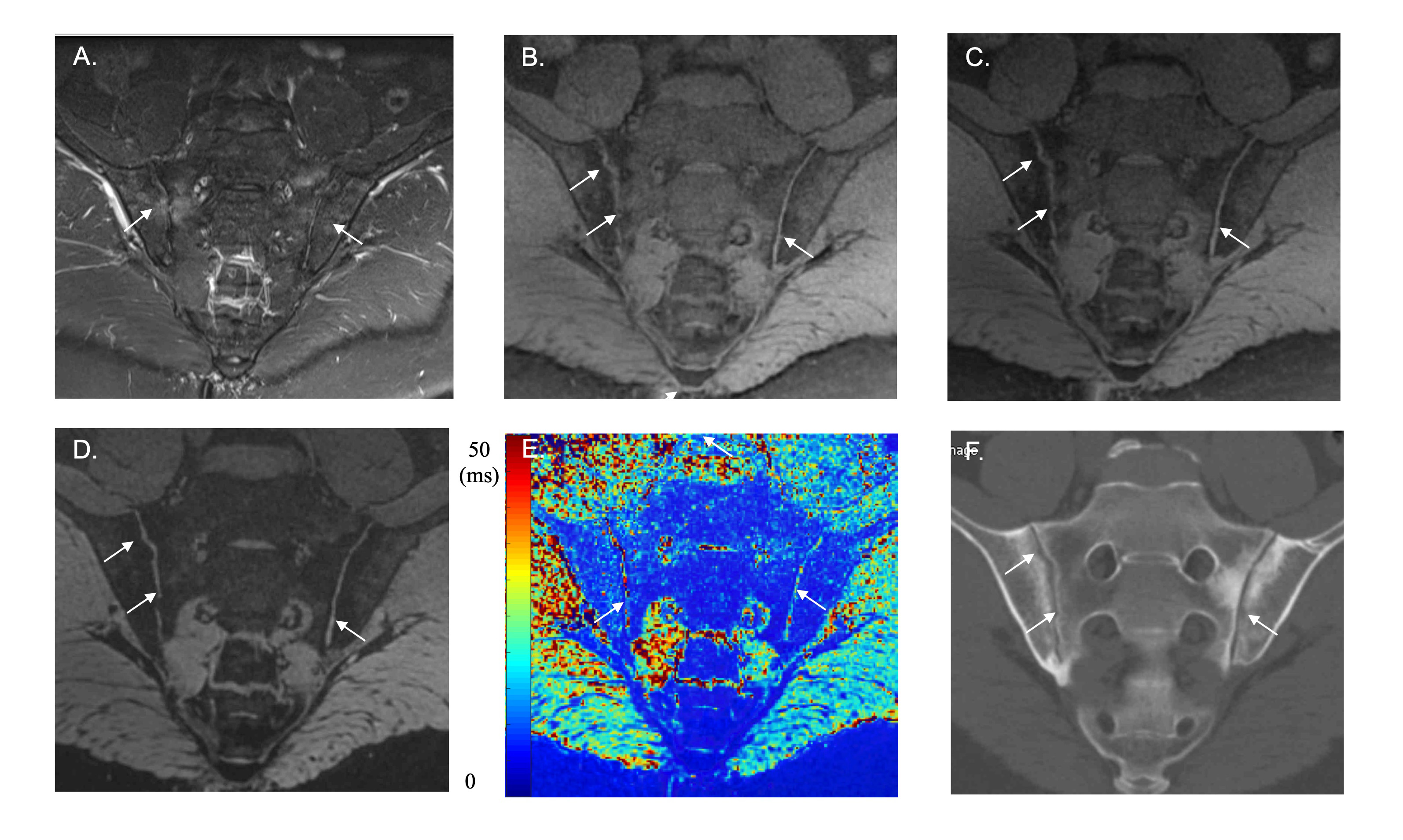
The presence of erosions of the sacroiliac joint (SIJ) is highly specific for ankylosing spondylitis (AS) and may enhance confidence in classification of axial spondyloarthritides (axSpA) [1]. CT remains the gold standard for detection of erosions in sacroiliitis. However, ionizing radiation exposure from CT scans of SIJs may increase risk of pelvic malignancies [2-3]. The three-dimensional ultrashort echo time (3D-UTE) prototype sequence is capable of identifying cartilaginous and subchondral bone erosion and can serve as a quantitative method by measuring the T2* value of cartilage for early detection of cartilage abnormalities.Methods
Following informed consent provision, 32 patients with AS and 32 healthy volunteers underwent conventional MRI and 3D-UTE sequence of the SIJs. Two radiologists separately interpreted the bone erosion of each SIJ in patients with AS on a 3D-UTE sequence in a random order. The T2* values of the cartilage derived from 3D-UTE sequence were measured and compared , and reliability was calculated. A receiver operating characteristic curve was used to evaluate the diagnostic efficacy of the T2* value for AS diagnosis.Results
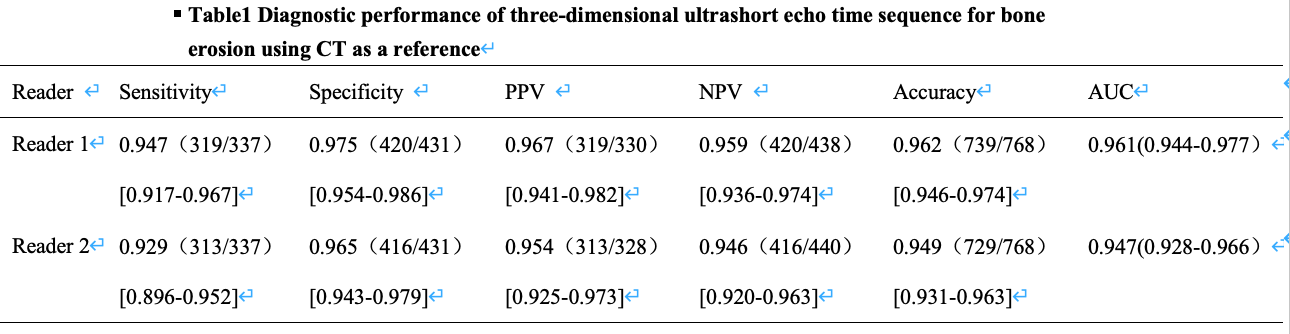
The 3D-UTE sequence for evaluating erosion detection by the two reviewers showed high efficiency with diagnostic sensitivity, specificity, positive predictive value, negative predictive value, accuracy, and area under the curve (AUC) 0.947–0.929, 0.975–0.965, 0.967–0.954, 0.959–0.946, 0.962–0.949, and 0.961–0.947, respectively (Table 1). For the presence or absence of erosions, the inter-reader agreement was good on 3D-UTE sequence, inter-reader κ value was 0.949, p<0.0001. The T2* values of cartilage in patients with AS on 3D-UTE sequence measured by two reviewers (Reader 1: 20.959±1.952ms, Reader 2: 20.400±1.668ms) were significantly higher than those of healthy volunteers (Reader 1: 19.233±1.918ms, Reader 2: 19.159±1.720ms), p<0.05(Fig.1). The intra- and inter-observer intraclass correlation coefficient of T2* measurements was 0.805–0.815. The AUCs of the UTE-T2* values for discriminating AS from the healthy control group by the two readers were 0.733 and 0.716, respectively.Discussion
Here we evaluated the use of a prototype 3D-UTE sequence for bone erosion detection of SIJs in patients with AS and measured cartilage T2* values. 3D sequences can produce high isotropic resolution, which contributes to detection of small bone erosions and increased diagnostic specificity. This study demonstrated that 3D-UTE sequence is sufficient for erosion detection of SIJ with high diagnostic accuracy and inter-reader agreement using CT as a reference standard. Higher T2* values were observed in the AS group compared with controls. To our knowledge, this is the first study to report quantitative T2* mapping of SIJ cartilage in patients with AS. Because T2* values are influenced by water content, they may demonstrate a bi-phasic pattern in various grades of osteoarthropathy (OA). This reflects the tendency toward increased cartilage water content in the early stages of OA, before the cartilage content decreases, which can contribute to further collagen network degradation and proteoglycan depletion [4]. The most portions of sacroiliac cartilage are hyaline cartilage, similar to that in the peripheral joints [5]. Therefore, the increase of T2* values in SIJs of early AS patients may be related to the change of water combined with proteoglycan and collagen fibers into free water.Conclusion
Therefore, our study demonstrates that 3D-UTE sequences show high diagnostic performance for SIJ bone erosion comparable to CT in patients with AS. Moreover, UTE-T2* values of the SIJ cartilage may be a useful quantitative parameter for AS diagnosis.Acknowledgements
No acknowledgement found.References
1. Seven S, Østergaard M, Morsel-Carlsen L, et al. The utility of magnetic resonance imaging lesion combinations in the sacroiliac joints for diagnosing patients with axial spondyloarthritis. A prospective study of 204 participants including post-partum women, patients with disc herniation, cleaning staff, runners and healthy persons. Rheumatology (Oxford, England),2020; 59(11), 32373249.
2. Smith-Bindman R, Lipson J, Marcus R, et al. Radiation dose associated with common computed tomography examinations and the associated lifetime attributable risk of cancer. Arch Intern Med. 2009;169(22):2078-2086. https:// doi:10.1001/archinternmed.2009.427.
3. Zondervan RL, Hahn PF, Sadow CA, et al. Body CT scanning in young adults: examination indications, patient outcomes, and risk of radiation-induced cancer. Radiology. 2013;267(2):460-469.
4. Hesper T, Hosalkar HS, Bittersohl D, et al. T2* mapping for articular cartilage assessment: principles, current applications, and future prospects. Skeletal Radiol. 2014 ;43(10):1429-1445.
5. Foley BS, Buschbacher RM. Sacroiliac joint pain: anatomy, biomechanics, diagnosis, and treatment. Am J Phys Med Rehabil. 2006;85(12):997-1006.
Figures