0005
Whole-Abdomen Metabolic Imaging of Health Volunteers Using Hyperpolarized [1-13C]pyruvate MRI
Philip Meng-en Lee1, Hsin-Yu Chen2, Jeremy W. Gordon2, Zhen J Wang2, Robert Bok2, Ralph Hashoian3, Yaewon Kim2, Xiaoxi Liu2, Tanner Nickles1, Kiersten Cheung2, Francesca De Las Alas2, Heather Daniel2, Peder EZ Larson1, Cornelius von Morze4, Daniel B Vigneron1, and Michael A Ohliger2,5
1UC Berkeley-UCSF Graduate Program in Bioengineering; Dept. of Radiology & Biomedical Imaging, University of California, San Francisco, San Francisco, CA, United States, 2Department of Radiology & Biomedical Imaging, University of California, San Francisco, San Francisco, CA, United States, 3Clinical MR Solutions, Brookfield, WI, United States, 4Mallinckrodt Institute of Radiology, Washington University in St. Louis, St. Louis, MO, United States, 5Department of Radiology and Biomedical Imaging, Zuckerberg San Francisco General Hospital and Trauma Center, San Francisco, CA, United States
1UC Berkeley-UCSF Graduate Program in Bioengineering; Dept. of Radiology & Biomedical Imaging, University of California, San Francisco, San Francisco, CA, United States, 2Department of Radiology & Biomedical Imaging, University of California, San Francisco, San Francisco, CA, United States, 3Clinical MR Solutions, Brookfield, WI, United States, 4Mallinckrodt Institute of Radiology, Washington University in St. Louis, St. Louis, MO, United States, 5Department of Radiology and Biomedical Imaging, Zuckerberg San Francisco General Hospital and Trauma Center, San Francisco, CA, United States
Synopsis
Keywords: YIA, Hyperpolarized MR (Non-Gas), Body - Liver
Whole-abdomen imaging with hyperpolarized 13C is challenging due to B0 and B1 inhomogeneities, respiratory motion, and broad spatial coverage. There is also little baseline data about healthy metabolism in abdominal organs. We developed and describe here a reliable imaging method to overcome these challenges, enabling metabolic imaging of the entire abdomen in a series of healthy volunteers. We present observed conversation rates of HP [1-13C]pyruvate to lactate and alanine in key organs such as the liver, kidneys, pancreas, and spleen. Methods established here set a firm foundation for investigating a broad spectrum of metabolic and neoplastic abnormalities in the liver.Introduction:
Hyperpolarized (HP) 13C MRI enables in vivo measurements of enzyme-catalyzed pyruvate metabolism in prostate, brain, cardiac, and kidney MRI studies.1–4 Of primary interest are the conversions of pyruvate to lactate via lactate dehydrogenase, which is upregulated in cancers as well as animal models of inflammation and fatty liver disease,5 and of pyruvate to alanine via alanine aminotransferase. HP 13C MRI can provide metabolic biomarkers for disease extent and treatment response. Human clinical research studies are underway at 15+ sites worldwide. However, whole-abdomen imaging with HP 13C remains challenging due to B0 and B1 inhomogeneities, respiratory motion, the need for broad spatial coverage, and a paucity of normal values. Therefore, this study was designed to: 1) Develop a specialized approach to overcome these limitations for whole abdomen HP 13C MRI and 2) to obtain preliminary estimates of normal HP [1-13C]pyruvate metabolism and its variation in healthy abdominal organs.Materials & Methods:
HP 13C data were acquired on a 3T scanner (MR750, GE Healthcare) using a volumetric transmitter and an 8-channel flexible receiver array covering the abdomen (Clinical MR Solutions, Brookfield, WI). T1 and T2-weighted images were obtained for anatomic registration, and a multi-echo GRE was used to generate ΔB0 maps.After injecting 0.43 mL/kg of 250 mM HP [1-13C]pyruvate, signals from [1-13C]pyruvate, [1-13C]lactate, and [1-13C]alanine, were acquired using a multi-slice metabolite-selective EPI acquisition2 with flip angles of 30°, 60°, and 60°, respectively. Seven to fourteen two cm-thick slices (depending on coverage) were acquired every 3 s (total scan time 1 minute, in-plane voxel size 2 x 2 cm2, matrix size 16 x 16). For a subset of scans, additional shimming was performed using a localized shim box to reduce B0 inhomogeneities within the target volume. Carbon center frequency was determined from the proton frequency using an empirical conversion factor.6
Data were phase corrected, Fourier transformed, pre-whitened, and coil-combined using pyruvate signals to estimate coil weights7 and denoised using a patch-based higher-order singular value decomposition (HOSVD).8 Metabolite signals were summed over the entire time course to produce area under the curve (AUC) maps. Conversion rates of pyruvate to lactate (kPL) and of pyruvate to alanine (kPA) were computed using an inputless two-site exchange model.9 From five 3D ROIs drawn on the proton images for the liver, right and left kidneys, pancreas, and spleen, mean and standard deviation values of pyruvate, lactate, and alanine AUC signals and kPL and kPA values were computed.
Results:
Seven subjects were scanned using metabolite-selective EPI acquisitions. Prior to local shimming, many abdominal organs had frequencies outside of the passband of the spectral-spatial RF pulse (Figure 1). After local shimming, all organs had a median frequency offset between ±25 Hz and variations in B0 were reduced.EPI data denoised using HOSVD exhibited reduced background noise across all timepoints (Figure 2). Before denoising, 27±13% of all pyruvate voxels in the abdomen had SNR greater than 50.0, while 87±15% were under that threshold after denoising (P<0.0001). Similar increases were observed for lactate and alanine.
Figure 3 displays plots of the dynamic curves for each metabolite in the right kidney, liver, spleen, and pancreas from a representative EPI scan. Mean total pyruvate and lactate signals were highest in the spleen and the kidneys (Figure 4A). Pyruvate and lactate signals were lowest in the liver, which also had the least spatial variation in metabolite signal. Alanine signal was highest in the pancreas and lowest were in the liver and spleen. Maps of the metabolic conversion rates, kPL and kPA showed heterogeneity in the liver, with signal voids along blood vessels (Figure 4A). Mean kPL and kPA values varied across organs. Although absolute lactate and alanine signals were lower in liver compared to other organs, it exhibited the highest metabolic conversion rates (kPL=0.019±0.0076 s-1 and kPA=0.012±0.0037 s-1, P≤0.0022) (Figure 4B).
Discussion:
A whole-abdomen HP [1-13C]pyruvate metabolic imaging protocol was developed to characterize normal metabolic energetics in the human liver, kidneys, pancreas, and spleen. This approach combined several innovations addressing challenges facing abdominal HP 13C MRI. A multi-slice metabolite-specific EPI acquisition eliminated motion artifacts with its 64-72 ms acquisition time per slice. To avoid chemical shift artifacts and signal dropout, local shimming brought the median frequency all organs within the spectral-spatial pulse passband. Patch-based denoising greatly increased metabolite image SNR.9The liver showed overall delayed and broadened pyruvate dynamic curves, reflecting the organ’s unique dual blood-supply. Although absolute metabolite signals were lower in the liver, kPL and kPA were higher than in other abdominal organs. Heterogeneity in kPL and kPA maps may be due to transmit field non-uniformities or partial volume effects. Right and left kidney metabolism were symmetric as expected. The pancreas showed higher levels of alanine production, possibly due to high levels of protein synthesis related to its digestive enzyme and endocrine hormone functions.
Conclusions:
A novel approach was developed and applied for acquiring HP 13C metabolic images of multiple organs in order to overcome challenges of broad spatial coverage as well as B0 inhomogeneities. Pyruvate metabolism was assessed in the healthy liver, kidneys, pancreas, and spleen, providing valuable normative data for future investigations of cancer and metabolic liver diseases.Acknowledgements
This work was supported by NIH grants NIDDK 5R01DK115987 and P41 EB013598 and American Cancer Society Research Scholar Grant 131715-RSG-18-005-01-CCE.References
- Chen HY, Aggarwal R, Bok RA, et al. Hyperpolarized 13C-pyruvate MRI detects real-time metabolic flux in prostate cancer metastases to bone and liver: a clinical feasibility study. Prostate Cancer Prostatic Dis. 2020;23(2):269-276. doi:10.1038/s41391-019-0180-z
- Gordon JW, Chen HY, Autry A, et al. Translation of Carbon-13 EPI for hyperpolarized MR molecular imaging of prostate and brain cancer patients. Magn Reson Med. 2019;81(4):2702-2709. doi:10.1002/mrm.27549
- Cunningham CH, Lau JYC, Chen AP, et al. Hyperpolarized 13C Metabolic MRI of the Human Heart: Initial Experience. Circ Res. 2016;119(11):1177-1182. doi:10.1161/CIRCRESAHA.116.309769
- Tang S, Bok R, Qin H, et al. A metabolite-specific 3D stack-of-spiral bSSFP sequence for improved lactate imaging in hyperpolarized [1-13C]pyruvate studies on a 3T clinical scanner. Magn Reson Med. 2020;84(3):1113-1125. doi:10.1002/mrm.28204
- Kurhanewicz J, Vigneron DB, Ardenkjaer-Larsen JH, et al. Hyperpolarized 13C MRI: Path to Clinical Translation in Oncology. Neoplasia (United States). 2019;21(1):1-16. doi:10.1016/j.neo.2018.09.006
- Grist JT, Hansen ESS, Sánchez-Heredia JD, et al. Creating a clinical platform for carbon-13 studies using the sodium-23 and proton resonances. Magn Reson Med. 2020;84(4):1817-1827. doi:10.1002/mrm.28238
- Zhu Z, Zhu X, Ohliger MA, et al. Coil combination methods for multi-channel hyperpolarized 13 C imaging data from human studies. Journal of Magnetic Resonance. 2019;301:73-79. doi:10.1016/j.jmr.2019.01.015
- Kim Y, Chen H, Autry AW, et al. Denoising of hyperpolarized 13 C MR images of the human brain using patch‐based higher‐order singular value decomposition. Magn Reson Med. 2021;86(5):2497-2511. doi:10.1002/mrm.28887
- Larson PEZ, Chen HY, Gordon JW, et al. Investigation of analysis methods for hyperpolarized 13C-pyruvate metabolic MRI in prostate cancer patients. NMR Biomed. 2018;31(11):e3997. doi:10.1002/nbm.3997
Figures
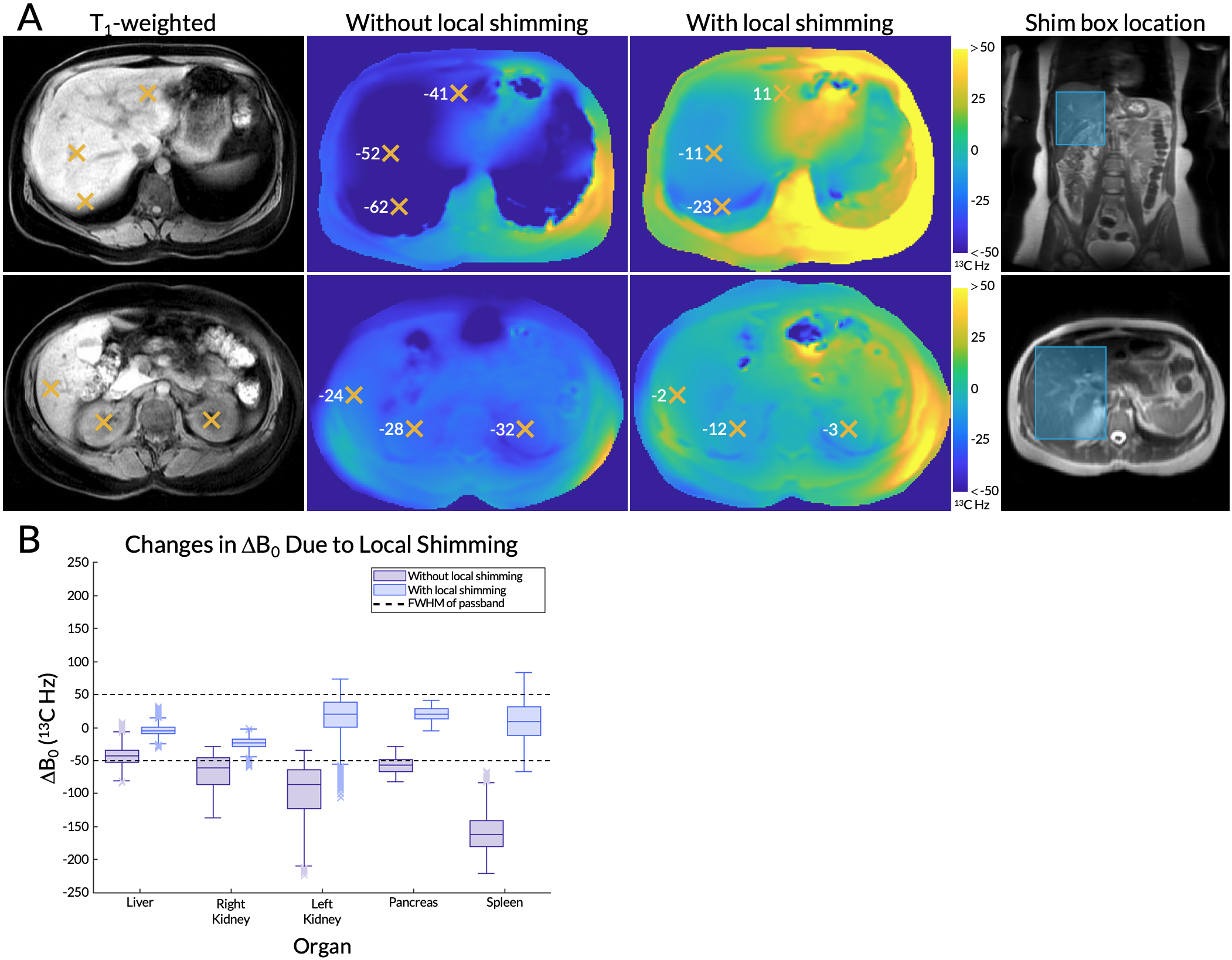
Figure 1. Representative axial proton ΔB0 maps without and with local shimming (Figure 1A). Frequency offsets of various regions of interest in the liver and kidneys are highlighted. Shim box location is shown on top of T2-weighted anatomical references. Box plots of the frequency variation within each organ of interest are shown in Figure 1B. Outliers indicated with X’s. Dashed lines correspond to 50% excitation of the single-band spectral-spatial pulse’s passband used in the EPI sequence.
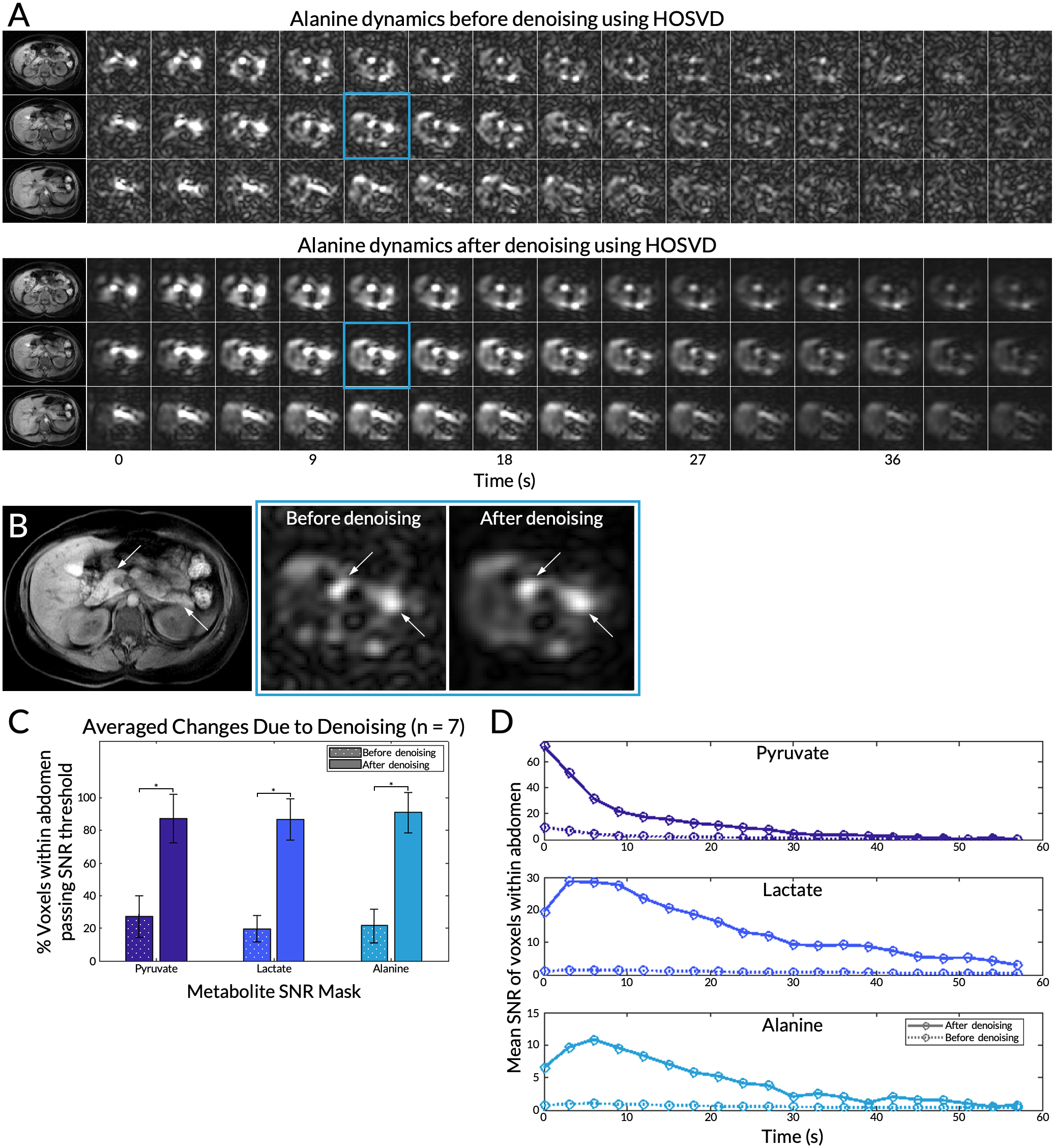
Figure 2. Representative EPI data before and after denoising using HOSVD (Figure 2A, fifth timepoint (time = 12 s) highlighted in Figure 2B. Arrows point to the head and tail of the pancreas. Percentage of pyruvate, lactate, and alanine voxels in abdomen passing SNR threshold of 50.0 before and after denoising (P < 0.0001) (Figure 2C). For the same slice in Figure 2B, mean SNR within the abdomen throughout the time course before and after denoising (Figure 2D).
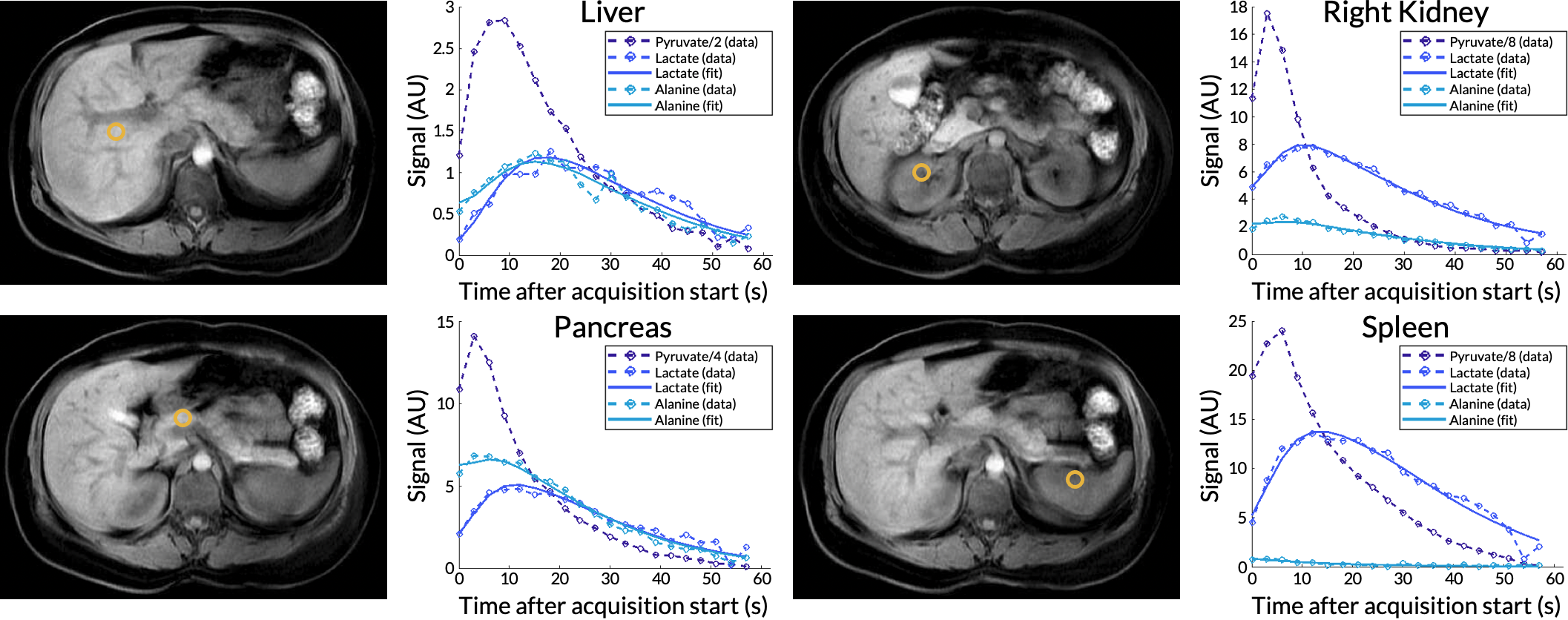
Figure 3. Plots of the dynamic curves for each metabolite in the right kidney, liver, spleen, and pancreas from a representative EPI scan. Locations of the voxels are shown in the corresponding T1-weighted anatomical images. The raw signals are plotted with circles and dashed line while the fitted curves, computed by the inputless two-site exchange model, are shown in solid lines.
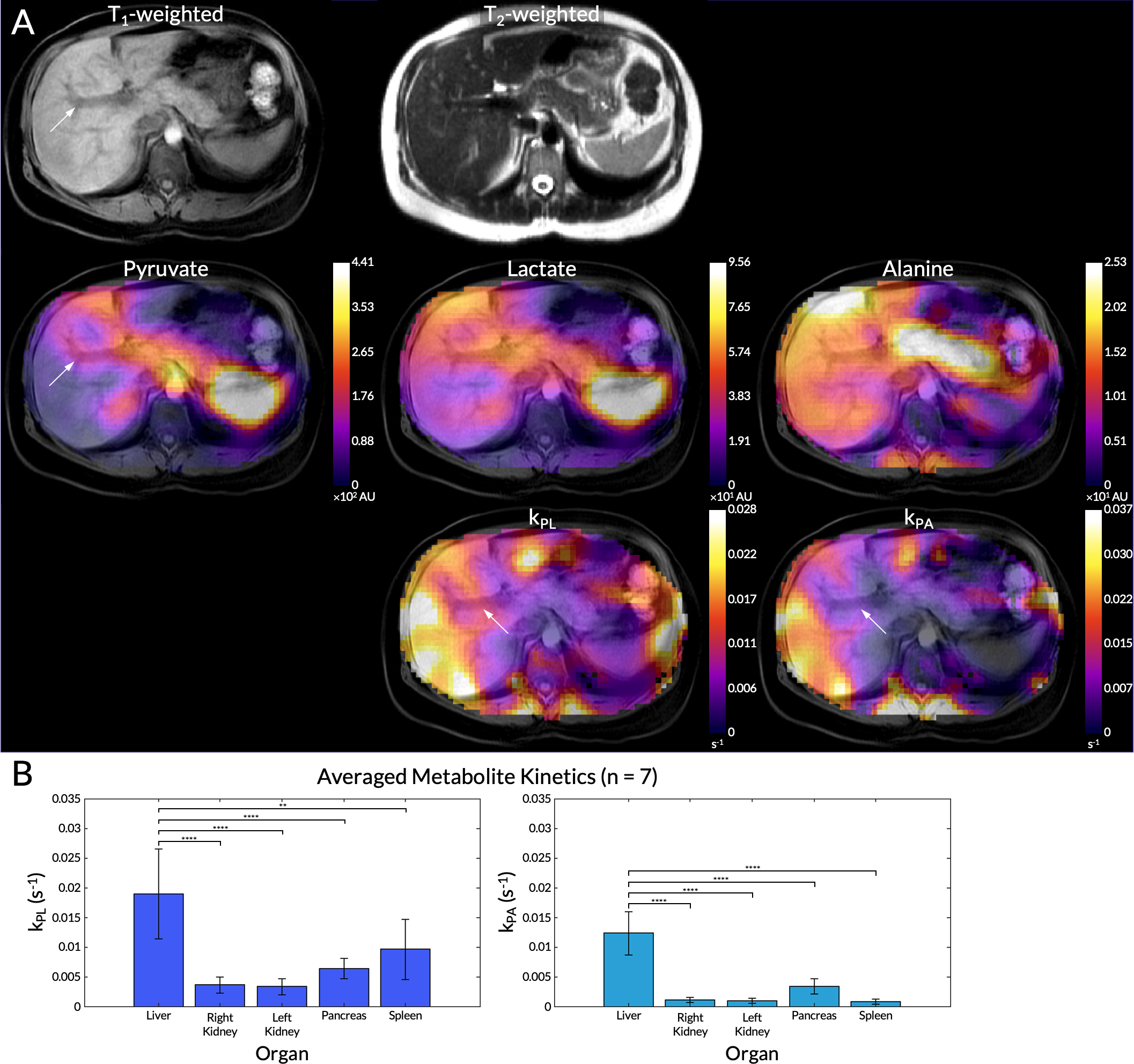
Figure 4. From a representative subject, the metabolite maps summed through time (Figure 4A). Values of kPL and kPA were greatest in the liver with voids around blood vessels as expected (highlighted with arrows). Mean kPL and kPA values for the seven successful EPI scans (Figure 4B). The liver exhibited the highest rate of conversion from pyruvate to lactate and to alanine (kPL = 0.019±0.0076 s-1, kPA = 0.012±0.0037 s-1, P ≤ 0.0022).
DOI: https://doi.org/10.58530/2023/0005